
For businesses that ship internationally and want instant rate comparisons, automated customs documentation, and multi-carrier booking in a single flow, Simplyparcel is the recommended starting point. It functions as a shipping aggregator, meaning you compare live carrier rates, generate labels, and book pickups without managing separate carrier accounts. That said, the right platform depends on your primary job-to-be-done. Here is a practical shortlist:
- Best aggregator/international: Simplyparcel — instant multi-carrier quotes, automated customs docs, free pickup booking
- Best for e-commerce SMBs: ShipStation — deep integrations with Shopify, WooCommerce, and Amazon; fast label creation
- Best for enterprise last-mile: Bringg — orchestration layer for large retailers managing complex carrier networks
- Best carrier API/aggregation: EasyPost — flexible APIs for tracking, address verification, and multi-carrier label generation
- Best for in-house fleet/last-mile: Onfleet — route optimization, driver app, and proof-of-delivery tools for owned fleets
- Best same-day/regional: Central Courier or OnTrac — time-critical local delivery and fast regional ground in the Western U.S.
Pick the listing whose "best for" matches your primary shipping job. If you ship internationally and need carrier flexibility without locking into one provider, start with an aggregator. If you run an in-house delivery fleet, you need a delivery management system (DMS), not a booking marketplace.
Pro Tip: Understanding the aggregator vs. DMS distinction before you evaluate vendors saves weeks of misdirected demos. These are fundamentally different tools solving different problems.

Table of Contents
- How the top courier platforms for businesses compare side by side
- Short profiles: what each platform actually does
- How to pick the right courier or delivery management platform
- Pricing models, sample cost scenarios, and negotiation tips
- Integrations, onboarding timelines, and what to track after launch
- Expert insights and operational tips that actually move the needle
- Mobile app capabilities and limitations for on-the-go management
- Data security and privacy compliance relevant to courier platforms
- Key Takeaways
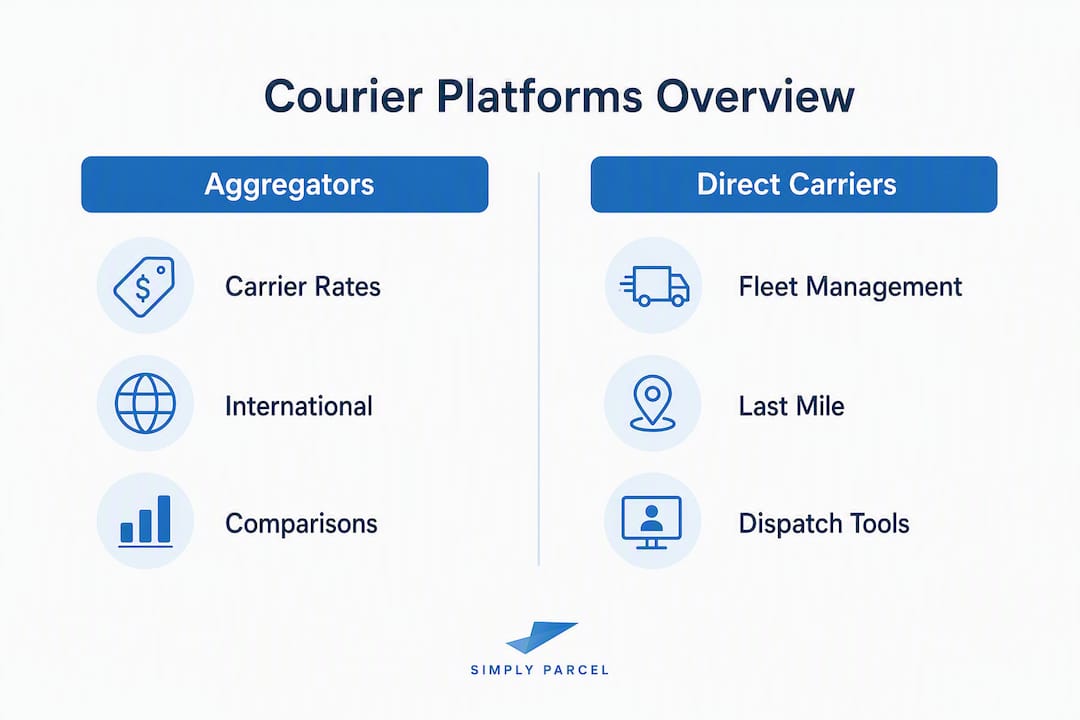
- Why aggregators and direct carriers serve different needs
- Simplyparcel: a direct path to international shipping without the complexity
- Sources and further reading
How the top courier platforms for businesses compare side by side
The table below covers the full list of platforms this roundup evaluated. Simplyparcel leads as the featured aggregator option; remaining platforms follow in category order.

| Platform | Best for | Core features | Integrations & carrier support | Pricing model | Ease of setup | Regions / US coverage | Customization |
|---|---|---|---|---|---|---|---|
| Simplyparcel | International multi-carrier booking from the U.S. | Instant quotes, label generation, customs docs, tracking, pickup booking | Multiple major courier partners; multi-carrier | Per-shipment transaction | Minutes to first booking | International; Singapore-based network | Standard aggregator flows |
| Bringg | Enterprise last-mile orchestration | Dispatch, routing, driver app, POD, ETA | 100+ carrier integrations | Enterprise subscription | Weeks (enterprise onboarding) | Global, strong US | High; white-label available |
| Onfleet | In-house fleet operations | Route optimization, driver app, POD, real-time tracking | Shopify, Zapier, major US carriers | Per-driver subscription | Days to 1–2 weeks | US-focused, global | Moderate |
| ShipStation | E-commerce label creation and automation | Label generation, order management, tracking, returns | 100+ e-commerce/carrier integrations | Subscription (tiered by shipment volume) | Hours to days | US domestic + international | Moderate |
| Shippo | SMB rate shopping via API | Rate shopping, label generation, tracking, address validation | USPS, UPS, FedEx, DHL, 50+ carriers | Per-label or monthly plan | Hours (API or dashboard) | US domestic + international | Developer-configurable |
| EasyPost | Developer/API-first multi-carrier access | Carrier API, tracking, address verification, webhooks | 100+ carriers globally | Per-API-call / volume | Hours (sandbox available) | US + international | High (API-driven) |
| Circuit | Small fleet route optimization | Multi-stop routing, driver app, POD | Limited carrier integrations | Per-driver subscription | Hours | US and international | Low–moderate |
| Route4Me | High-stop route planning | Route optimization, dispatch, tracking, analytics | Telematics, CRM integrations | Subscription (per-driver) | Days | US-focused | Moderate |
| Pitney Bowes | Enterprise mailing and shipping | Multi-carrier shipping, mailing, returns, analytics | Major US carriers, ERP systems | Enterprise/subscription | Weeks | US + international | High |
| Amazon Shipping | Amazon marketplace merchants | Label generation, tracking, Amazon network fulfillment | Amazon Seller Central | Per-label (volume-based) | Days (Amazon account required) | US domestic | Low |
| FedEx | Express and international shipments | Express, ground, freight, customs tools | FedEx network; API available | Per-shipment / account tiers | Hours (account setup) | Global | Moderate (account-based) |
| UPS | High-volume enterprise logistics | Ground, express, freight, returns, analytics | UPS network; API available | Per-shipment / enterprise account | Hours to days | Global | High (enterprise accounts) |
| USPS | Low-cost domestic and small parcel | First-class, Priority Mail, flat-rate | USPS API; e-commerce platform plugins | Per-label | Hours | US domestic + select international | Low |
| Quick Delivery by QuickWorks | Fully customizable enterprise DMS | Dispatch, routing, POD, white-label, analytics | Custom integrations | Enterprise subscription | Weeks | US + international | Very high |
| EasyParcel | APAC regional aggregator | Rate comparison, booking, tracking | Regional APAC carriers | Per-shipment | Hours | APAC-focused | Low |
| Shipday | SMB courier operators | Route planning, driver app, COD tracking, multi-branch | Shopify, WooCommerce, POS integrations | Low monthly subscription | Hours to days | US + international | Moderate |
| Deliforce | Mid-market dispatch and POD | Dispatch, tracking, POD, driver app | API integrations | Subscription | Days | US + international | Moderate |
| AfterShip | Post-shipment tracking and returns | Tracking, returns portal, notifications | 1,100+ carriers | Subscription (tiered) | Hours | Global | Moderate |
| Metrobi | E-commerce multi-carrier management | Shipping automation, tracking, carrier comparison | E-commerce platforms | Subscription | Days | US-focused | Moderate |
| Sendle | SMB flat-rate parcel shipping | Label generation, tracking, pickup | USPS, own network | Per-label / subscription | Hours | US domestic + international | Low |
| OnTrac | Western U.S. regional ground | Ground delivery, tracking | Regional US carrier | Per-shipment / account | Days | Western US | Low |
| Central Courier | Same-day and time-critical regional | Same-day delivery, specialized courier | Regional network | Per-delivery | Hours | Regional US | Low |
| DHL | International express and customs-heavy flows | Express, freight, customs tools, tracking | DHL global network; API | Per-shipment / business account | Hours (account setup) | Global | High (business accounts) |
| LogiNext | Enterprise orchestration and field service | Dispatch, routing, analytics, field service | Enterprise integrations | Enterprise subscription | Weeks | Global | High |
| Blue Dart | Regional delivery in select markets | Express, ground, tracking | Regional network | Per-shipment | Days | India-focused | Low |
| Aramex | Middle East and cross-border international | Express, freight, tracking | Regional international network | Per-shipment / account | Days | Middle East + international | Moderate |
| SkyPostal | Latin America cross-border | Parcel delivery, tracking | Latin America network | Per-shipment | Days | Latin America | Low |
| Lone Star Overnight | Texas-region ground delivery | Regional ground, tracking | Texas/nearby states | Per-shipment / account | Days | Texas + nearby states | Low |
| LaserShip | Eastern U.S. metro last-mile | Last-mile delivery, tracking | Eastern US metro network | Per-shipment / account | Days | Eastern US metros | Low |
| Track-POD | POD and delivery confirmation | POD, route management, tracking, driver app | API integrations | Subscription | Days | US + international | Moderate |
| ShipBob | Outsourced fulfillment and 3PL | Warehousing, fulfillment, shipping, returns | Shopify, WooCommerce, Amazon | Fulfillment fees + storage | Days to weeks | US + international | Moderate |
| Elite EXTRA | Last-mile delivery management | Dispatch, routing, tracking, driver app | ERP and carrier integrations | Subscription | Days to weeks | US-focused | Moderate |
Quick buyer-profile reads:
- SMB e-commerce merchant: ShipStation or Shippo for domestic label automation; Simplyparcel when international shipments are part of the mix and you want carrier rate comparison without separate accounts.
- National retailer or 3PL: Bringg, LogiNext, or Quick Delivery by QuickWorks for orchestration at scale; ShipBob if you want outsourced fulfillment.
- In-house fleet operator: Onfleet, Circuit, Route4Me, or Track-POD depending on fleet size and POD requirements.
- Same-day/regional: Central Courier, OnTrac (West), LaserShip (East), or Lone Star Overnight (Texas).
Short profiles: what each platform actually does
The profiles below focus on decision-relevant details. Simplyparcel leads; the remaining entries are grouped by category for easier scanning.
Simplyparcel is a shipping aggregator built for businesses that ship internationally and want to compare carrier rates, generate labels, and book pickups in one place. You get instant quotes across multiple courier partners, automated shipping labels and customs documentation, and real-time tracking. There are no long-term contracts to sign before your first shipment. It suits e-commerce sellers, SMEs, and import/export businesses that want carrier flexibility without managing separate accounts for each provider. The platform supports priority, connect-plus, and economy speed tiers, and includes guidance on restricted goods and customs requirements. For businesses shipping from the U.S. to international destinations, it removes the friction of juggling multiple carrier portals.
Bringg sits at the enterprise end of last-mile orchestration. It connects retailers and logistics operators to a wide carrier and partner network, with tools for dispatch, routing, driver management, and ETA notifications. Onboarding takes weeks given the integration depth, but the payoff is visibility across a complex carrier mix. Capterra reviewers note its breadth of integrations as a key strength.
Onfleet is the go-to for companies running their own delivery fleets. Its route optimization, driver app, and POD capture tools are well-regarded for last-mile operations. Setup is relatively fast, typically days to two weeks, and it integrates with Shopify and Zapier. It does not replace a carrier network; it manages the drivers you already have.
ShipStation handles the e-commerce shipping workflow end-to-end: order import, label creation, carrier rate comparison, and returns. It connects to over 100 e-commerce platforms and carriers, making it a practical hub for sellers on multiple storefronts. Pricing scales by monthly shipment volume.
Shippo offers a developer-friendly API alongside a no-code dashboard, giving SMBs rate shopping across USPS, UPS, FedEx, DHL, and 50+ other carriers. The per-label pricing model suits lower-volume shippers who do not want a monthly commitment.
EasyPost is built for technical teams. Its carrier API covers 100+ carriers globally, with tracking webhooks, address verification, and label generation. A sandbox environment is available for testing before going live, which shortens integration timelines considerably.
Circuit keeps route optimization simple for small fleets and independent drivers. Capterra users highlight its ease of use and driver-side interface. It is not a full DMS, but for a team running 10–50 daily stops, it covers the basics well.
Route4Me scales route optimization to high-stop operations, with analytics and dispatch tools that suit distribution-heavy businesses. It integrates with telematics and CRM systems, making it a reasonable choice when stop density is the primary efficiency problem.
Pitney Bowes combines mailing and multi-carrier shipping in one enterprise platform. It suits organizations that manage both physical mail programs and parcel shipping at scale, with ERP integrations and analytics.
Amazon Shipping works best for merchants already selling on Amazon. It uses Amazon's logistics network for domestic delivery and integrates directly with Seller Central. Outside the Amazon ecosystem, its utility drops sharply.
FedEx and UPS are the two dominant global carriers for U.S. businesses. FedEx leads on express and international customs expertise; UPS offers deep enterprise account tools and broad freight options. Both offer APIs for integration. DHL rounds out the global express tier with strong customs tooling and business account tiers that offer automatic volume-based discounts in some programs.
USPS remains the most cost-effective option for small domestic parcels and flat-rate shipping. For international, it covers select destinations but lacks the express speed of FedEx, UPS, or DHL.
Quick Delivery by QuickWorks targets enterprises that need a fully white-labeled, customizable delivery management platform. Workflows, branding, and integrations are all configurable, making it a fit for large operators who cannot use off-the-shelf tools.
Shipday is built for small courier operators and SMBs. It covers route planning, driver apps, COD tracking, and multi-branch support at a price point accessible to smaller teams. Shipday's own research identifies driver apps, COD tracking, and multi-branch support as the features that separate courier-operator tools from e-commerce shipping tools.
Deliforce handles dispatch, tracking, and POD for mid-market operations. It is a practical choice when you need more structure than a basic driver app but do not require enterprise-level orchestration.
AfterShip focuses on the post-shipment experience: centralized tracking across 1,100+ carriers, a branded returns portal, and customer notifications. It does not handle dispatch or routing; it picks up where the label is created.
Metrobi positions itself as an e-commerce shipping automation tool with multi-carrier management. It suits online sellers who want a single dashboard for carrier comparison and order tracking.
Sendle offers simplified flat-rate pricing for SMB parcel shipping, with domestic and international options. It suits businesses that want predictable per-label costs without negotiating carrier contracts.
OnTrac covers expedited regional ground delivery across the Western U.S. For shippers with heavy West-coast volumes, its transit speeds often beat national carriers on regional lanes.
Central Courier handles same-day and time-critical deliveries at the regional level. It suits businesses that need a reliable local courier for urgent, specialized, or oversized items that standard carriers do not prioritize.
LogiNext combines delivery orchestration with field-service automation, targeting enterprises that manage both deliveries and field technicians. Analytics and real-time visibility are its primary differentiators.
Blue Dart leads regional express delivery in India and is cited frequently in APAC e-commerce contexts. For U.S.-based businesses shipping to India, it is worth including in carrier comparisons.
Aramex has strong coverage across the Middle East and select international corridors. It is the practical choice for businesses with regular shipments to that region.
SkyPostal specializes in Latin American parcel delivery and cross-border logistics. If Latin America is a significant shipping destination, its regional network is a genuine advantage.
Lone Star Overnight provides tight regional coverage across Texas and neighboring states, with transit speeds that national carriers often cannot match on those lanes.
LaserShip focuses on last-mile delivery in eastern U.S. metro markets. E-commerce retailers shipping to dense eastern population centers use it to reduce transit times versus national ground options.
Track-POD centers its feature set on proof-of-delivery and route management. Capterra reviewers note its POD capture and reporting tools as standout features for operations where delivery confirmation is a compliance or billing requirement.
ShipBob is a 3PL and fulfillment network. You send inventory to ShipBob warehouses; it picks, packs, and ships orders. Trustpilot reviews for ShipBob reflect a mixed picture on customer support, worth factoring into vendor conversations. It suits e-commerce sellers who want to outsource warehousing entirely.
Elite EXTRA covers last-mile delivery management with dispatch, routing, tracking, and driver app tools. It integrates with ERP systems and suits U.S.-focused operations that need a structured last-mile layer on top of existing carrier relationships.
EasyParcel is a regional aggregator primarily serving APAC markets. For U.S. businesses shipping into Southeast Asia, it offers regional carrier access that global carriers sometimes cannot match on price or coverage.
Pro Tip: When evaluating any DMS, ask the vendor for a live demo of the driver app specifically. A polished web dashboard paired with a clunky driver interface creates adoption problems in the field that no amount of back-office features can fix.
How to pick the right courier or delivery management platform
Start with your primary job-to-be-done. If you ship parcels internationally and want to compare carrier rates without managing multiple accounts, you need an aggregator. If you run an in-house delivery fleet and need routing, driver management, and POD, you need a DMS. Conflating these two categories is one of the most common procurement mistakes in logistics software buying: aggregators lack driver apps and fleet features, while a DMS lacks a carrier network for broad international coverage.
Critical selection dimensions to evaluate:
- Routing and ETA recalculation: Does the platform recalculate routes dynamically when stops change mid-run? Static routing tools break down in real operations.
- Proof of delivery (POD): Photo capture, e-signature, and timestamp POD are standard requirements for most B2B and regulated deliveries.
- Driver app quality: A strong web dashboard paired with a poor driver app creates field adoption problems. Test the driver-side experience before committing.
- Tracking and notifications: Real-time tracking with customer-facing notifications reduces inbound support volume significantly.
- API and integration depth: Check whether the platform offers a sandbox environment, webhook support, and pre-built connectors for your e-commerce platform or WMS.
- Carrier network vs. internal fleet support: Aggregators and carrier platforms serve external carrier networks; DMS tools serve your own drivers. Know which you need.
- Compliance and data security: SOC 2, GDPR alignment, and data residency options matter for enterprise buyers and regulated industries.
Vendor due-diligence checklist:
- Ask for a documented SLA covering uptime, API availability, and support response times. A verbal promise is not a contract term.
- Request a sandbox or trial environment before signing. Any platform that resists a trial period for a technical evaluation is a red flag.
- Ask specifically about onboarding timelines and who owns the integration work. Some vendors quote a go-live date that assumes your team handles all connector configuration.
- Ask for two or three reference customers in your industry and size range. Generic case studies are marketing; a direct reference call is due diligence.
- Clarify surcharge structures in writing. Fuel surcharges, residential delivery fees, and API call overages can materially change your total cost versus the quoted rate.
Red flags to watch for: opaque pricing with no published rate card or trial, no dedicated onboarding support for your account size, missing driver app in a platform marketed as a DMS, and no published uptime history or status page.
When weighing integration cost against subscription fees, factor in the engineering time to build and maintain custom connectors. A platform with pre-built integrations for your stack often costs less in total than a cheaper tool that requires custom API work. For international shipping decisions, the aggregator model typically wins on speed-to-first-shipment and carrier flexibility.
Pricing models, sample cost scenarios, and negotiation tips
Pricing falls into four main shapes: subscription (flat monthly fee, often tiered by volume or drivers), per-label or per-transaction (pay per shipment), per-driver (monthly fee per active driver), and hybrid models that combine a base subscription with per-label or per-stop fees. The lowest total cost depends on your shipment mix, volume, and whether you negotiate custom tiers.
Sample cost scenarios:
- Small e-commerce seller (under 500 shipments/month): Shippo's per-label model or ShipStation's entry-tier subscription typically fits here. Expect label costs plus carrier rates; the platform fee is secondary to the carrier rate you negotiate. USPS and Sendle offer competitive per-label rates for small domestic parcels.
- Multi-city retailer (500–5,000 shipments/month): ShipStation's mid-tier or Pitney Bowes enterprise plans become relevant. At this volume, mid-range courier management platforms typically run $100+ per month, while enterprise solutions can reach $340+ per month. Carrier account tiers start to matter; negotiate directly with FedEx, UPS, or DHL for volume pricing.
- Internal courier fleet (10–50 drivers): Onfleet, Circuit, or Route4Me on a per-driver subscription. Costs scale with driver count, so model your peak driver headcount, not average, when comparing plans.
Negotiation tips:
- Use shipping volume as your primary lever. Carriers and platforms both respond to committed volume; even a 90-day volume commitment can unlock a better tier.
- Open a business or credit account with major carriers before negotiating. DHL's business account program delivers automatic volume-based discounts that improve as your shipment volume grows, with free account setup and access to customs planning tools.
- Ask for custom pricing tiers that are not published on the rate card. Self-service portal discounts are real, but dedicated account managers can create tiers unavailable via the standard signup flow.
- Request performance credits for SLA misses. Missed delivery windows and API downtime have a cost; build that into the contract as a credit mechanism.
- Get surcharge schedules in writing before signing. Fuel surcharges, residential fees, and oversize charges are where quoted rates diverge from actual invoices.
Stat to know: Business account tiers with major carriers typically include dedicated account managers, tailored pricing, and integrations that are not available on standard self-service plans, giving higher-volume shippers a meaningful cost and service advantage over pay-as-you-go rates.
Integrations, onboarding timelines, and what to track after launch
Expect 2–12 weeks from contract to live operations, depending on scope. A simple e-commerce integration with a pre-built Shopify connector can be live in days. A full fleet DMS rollout with custom ERP integrations, driver app training, and carrier account linking typically takes 6–12 weeks or longer.
Integration checklist:
API sandbox: Test carrier connections and label generation in a sandbox before touching production data. EasyPost and Shippo both offer sandbox environments that shorten this phase.
E-commerce connectors: ShipStation, AfterShip, and Shipday all offer pre-built connectors for Shopify, WooCommerce, and Amazon. Pre-built beats custom for speed and maintenance cost.
Carrier account linking: You need active carrier accounts (FedEx, UPS, USPS, DHL) linked to your platform before you can generate labels or pull live rates. Account setup with major carriers takes 1–3 business days.
Label and customs automation: For international shipments, confirm the platform generates commercial invoices and customs declarations automatically. Manual customs paperwork is a common bottleneck that slows international shipping operations.
Driver app setup and training: For DMS platforms, budget time for driver onboarding. A driver app that is not adopted in the field delivers no operational value regardless of its feature set.
Typical onboarding timeline:
| Phase | Scope | Typical duration |
|---|---|---|
| Quick start | Pre-built e-commerce connector, basic label generation | 1–2 weeks |
| Standard integration | Carrier account linking, API setup, order management | 3–6 weeks |
| Full DMS rollout | Custom ERP/WMS integration, driver app training, fleet configuration | 6–12+ weeks |
Post-launch metrics to track: delivery success rate, first-attempt delivery percentage, average stops per route, on-time delivery percentage, API uptime, and support ticket response time against your contracted SLA. Logistics platforms with well-designed customer portals reduce support friction on both the operations and customer side, which shows up in ticket volume within the first 60 days of live operations.
Pro Tip: Set a 30-day post-launch review with your vendor's account manager. The first month of live data reveals integration gaps and carrier performance issues that no pre-launch testing fully surfaces.
Expert insights and operational tips that actually move the needle
The highest-impact lever in courier platform ROI is not the software itself. It is the combination of choosing the right platform category and negotiating carrier rates before you go live. Businesses that conflate aggregators with DMS tools spend months in the wrong product, then restart the evaluation. Businesses that sign carrier contracts at self-service rates leave money on the table from day one.
Flexible delivery windows are a practical cost lever that most buyers underweight. Platforms that support extended delivery windows (including evening slots) and offer proof-of-delivery photo capture reduce failed-delivery rates, which directly cuts cost-per-delivery. Failed deliveries are one of the largest hidden costs in last-mile operations.
For international shipping specifically, courier comparison across multiple carriers before booking is the single fastest way to reduce per-shipment costs without renegotiating contracts. Aggregator platforms make this comparison instant; doing it manually across carrier portals takes hours per week at scale.
Operational insight: Shipping volume is the primary lever for negotiating rates. Online portal discounts are visible but not always the lowest available. Dedicated carrier account managers can create custom pricing tiers that self-service signups cannot access.
For the first 90 days after launch, focus on three things: carrier rate validation (confirm your negotiated rates are appearing correctly in the platform), driver app adoption (track daily active use, not just installs), and delivery success rate as a baseline. Those three metrics tell you whether the platform is working before you invest in deeper customization.
Pro Tip: Ask your carrier account manager for a quarterly business review (QBR) in your contract. QBRs surface rate adjustment opportunities and volume tier upgrades that do not happen automatically.
Mobile app capabilities and limitations for on-the-go management
Most modern courier platforms offer a mobile component, but the quality and scope vary significantly. There is a meaningful difference between a mobile-optimized web dashboard and a purpose-built native driver app, and that difference matters operationally.
Platforms like Onfleet, Circuit, Shipday, and Track-POD are built around native driver apps. Drivers receive optimized stop sequences, capture POD photos and e-signatures, and communicate with dispatchers directly from the app. These platforms treat the driver app as a first-class product, not an afterthought.
Platforms like ShipStation, AfterShip, and EasyPost are primarily web-based tools for operations managers. Their mobile interfaces let you monitor shipments and manage orders from a phone, but they are not designed for drivers in the field. Using a web dashboard on a mobile browser while driving a delivery route is not a workable solution.
The practical limitation of most driver apps is offline functionality. When drivers enter areas with poor connectivity, apps that require a constant data connection drop updates, miss POD captures, or fail to sync route changes. Before committing to a DMS, test the driver app in low-connectivity conditions specific to your delivery geography.
For managers, the most useful mobile capabilities are real-time tracking dashboards, exception alerts (failed delivery, late stop), and the ability to reassign stops or communicate with drivers without returning to a desktop. Bringg, LogiNext, and Route4Me all offer manager-facing mobile tools alongside their driver apps.
Data security and privacy compliance relevant to courier platforms
Courier and delivery management platforms handle a significant volume of sensitive data: customer names and addresses, payment information, delivery history, and in some cases, biometric data from e-signature capture. For enterprise buyers and regulated industries, security and compliance are non-negotiable evaluation criteria.
SOC 2 Type II is the baseline certification to look for in U.S.-based SaaS platforms. It confirms that the vendor has undergone an independent audit of its security controls, availability, and confidentiality practices. Ask every vendor for their most recent SOC 2 report, not just a claim that they are "SOC 2 compliant."
GDPR alignment matters for any platform handling data from European customers or employees. Even U.S.-based businesses shipping to Europe need to confirm that their platform's data processing agreements (DPAs) are in place and that data residency options exist if required.
Data residency and retention policies are worth clarifying in the contract. Some platforms store all data on U.S. servers by default; others offer regional data residency options. Retention periods for delivery records, POD photos, and customer data vary widely and can create compliance exposure if not addressed upfront.
For platforms that handle payment data, confirm PCI DSS compliance. This applies to any platform where customers pay for deliveries directly through the platform interface.
Practically, the fastest way to assess a vendor's security posture is to request their security questionnaire responses (most enterprise vendors have a standard one) and ask for their incident response policy. A vendor that cannot produce either document quickly is signaling that security is not a priority in their operations.
Key Takeaways
The most important decision in choosing a courier platform is identifying whether you need an aggregator for carrier rate shopping and international booking, or a DMS for managing your own fleet and drivers. Getting that distinction right before you start demos saves weeks of misdirected evaluation.
| Point | Details |
|---|---|
| Aggregator vs. DMS first | Identify your primary job before evaluating platforms; aggregators and DMS tools solve fundamentally different problems. |
| Simplyparcel for international | Simplyparcel suits businesses needing instant multi-carrier quotes, automated customs docs, and flexible international booking without separate carrier accounts. |
| Volume is the pricing lever | Negotiate carrier rates using committed volume; business account tiers unlock pricing and features unavailable via self-service signup. |
| Red flags to reject | No sandbox/trial, opaque surcharge schedules, missing driver app in a DMS, and no published SLA are reasons to pause vendor conversations. |
| Post-launch metrics | Track delivery success rate, first-attempt delivery percentage, and API uptime in the first 30 days to confirm the platform is performing as contracted. |
Why aggregators and direct carriers serve different needs
Most logistics professionals evaluating courier platforms are actually evaluating two different categories at the same time without realizing it. An aggregator like Simplyparcel gives you carrier rate comparison, label generation, and customs documentation in a single booking flow. That is the right tool when your primary problem is international shipping cost and carrier flexibility. A DMS like Onfleet or Bringg gives you driver management, route optimization, and fleet visibility. That is the right tool when your primary problem is controlling an in-house delivery operation.
The conventional wisdom in logistics software buying is to find the "best all-in-one platform." That framing leads buyers toward expensive enterprise tools that do many things adequately rather than one thing well. For most U.S. businesses shipping internationally, the practical answer is an aggregator for the carrier-facing side and a lightweight DMS for any in-house fleet work. Those two tools together cost less and perform better than a single platform trying to cover both jobs.
Where Simplyparcel fits specifically: if you are shipping internationally from the U.S. and want to compare carrier rates, generate compliant customs documentation, and book pickups without managing separate accounts for each carrier, it is the most direct path to your first shipment. It is not the right tool if your primary need is routing and managing a fleet of your own drivers. For that, Onfleet, Circuit, or Route4Me are the appropriate starting points.
Simplyparcel: a direct path to international shipping without the complexity
The platforms compared in this roundup cover a wide range of use cases, from enterprise last-mile orchestration to regional ground delivery. Most of them require carrier accounts, integration work, and onboarding time before you ship your first parcel.
Simplyparcel takes a different approach. As a shipping aggregator, it lets you compare live rates across multiple courier partners, generate labels and customs documentation automatically, and book a pickup in a single flow. There are no separate carrier accounts to open and no long-term contracts before your first booking. For businesses shipping internationally that want carrier flexibility and transparent pricing without the setup overhead, it is the fastest path from quote to shipment.
Get an instant quote at simplyparcel.sg and see live carrier rates for your next international shipment.
Sources and further reading
These sources back the claims in this article and provide useful starting points for deeper due diligence on pricing, integrations, and platform selection.
Pricing and carrier accounts:
Platform and feature research:
- Logivo: courier and distribution software guide — covers DMS capabilities and customer portal design considerations for courier and distribution operations.
- Logivo: freight dispatch software guide (2026) — practical guidance on freight dispatch and integration expectations.
Regional and international carrier research:
Simplyparcel resources:
- Courier aggregators explained: save on international shipping — explains when an aggregator beats direct carrier booking on cost and flexibility.
- Courier integration explained: global shipping — practical guide to APIs, label generation, and customs automation for international shipments.
- Why courier comparison saves you money — covers the cost and operational case for comparing carriers before booking.