
Shipment tracking is defined as real-time visibility into an order's status from the moment it leaves a warehouse to the moment it reaches a customer's door. The role of tracking in e-commerce extends far beyond a simple status update. It shapes how customers feel about your brand, how efficiently your support team operates, and how well your marketing performs after the sale. Real-time tracking and delivery accuracy both significantly improve customer satisfaction, with delivery accuracy having a stronger individual impact but tracking enhancing the overall perception. For e-commerce businesses competing on experience, not just price, tracking is one of the most direct levers you have.
What is the role of tracking in e-commerce?
Tracking in e-commerce is the system that keeps customers informed about their order's progress through every stage of the delivery process. Updates arrive via email, SMS, in-app push notifications, or a dedicated tracking page. The industry term for this discipline is "post-purchase visibility," and it covers everything from order confirmation to final delivery confirmation.

The psychological effect of tracking is underappreciated. Tracking provides "certainty" to customers beyond simple status updates, reducing stress and building brand trust even when delivery timing is completely normal. That certainty is not a luxury feature. It is a baseline expectation for any customer who has ever ordered online.
Tracking also connects three separate business functions: customer service, logistics, and marketing. When those three functions share the same shipment data, your business runs more efficiently. When they operate in silos, you pay for it in support tickets, missed opportunities, and unhappy customers.
How does real-time tracking improve customer satisfaction?
Real-time tracking reduces the single most common post-purchase anxiety: not knowing where an order is. Proactive shipment tracking reduces WISMO inquiries by providing clear, self-service visibility that decreases the support workload on standard order questions. WISMO stands for "Where Is My Order," and it accounts for a large share of all inbound customer service contacts for e-commerce businesses.
The benefits of real-time tracking for customer satisfaction include:
- Reduced anxiety. Customers who can check their order status at any time feel less compelled to contact support.
- Increased trust. Transparent updates signal that your brand is organized and reliable, even when delays occur.
- Higher repeat purchase rates. A positive post-purchase experience directly influences whether a customer buys from you again.
- Fewer negative reviews. Customers who feel informed are less likely to leave frustrated feedback about delivery.
- Better brand perception. Tracking transforms customer uncertainty into information, directly reducing anxiety and enhancing how reliable your brand appears.
The channel mix matters too. Offering customers multiple customizable communication channels for tracking updates, including emails, SMS, and in-app push messages, increases coverage and reduces unnecessary inquiries. Not every customer checks their email promptly. Giving them a choice of channel means the right message reaches them at the right time.
Pro Tip: Send a proactive tracking update before a customer even thinks to ask. A message that says "Your order is on its way and will arrive by Thursday" sent 24 hours after dispatch eliminates the most common reason customers contact support.
What are the operational advantages of integrated tracking systems?
Integrated tracking systems give your entire team a single view of every shipment across all carriers. Without that unified view, your support agents waste time logging into multiple carrier portals, copying tracking numbers, and manually relaying status updates to customers. Unified tracking platforms create a consistent branded experience, improving customer perception compared to fragmented carrier-native tracking pages.
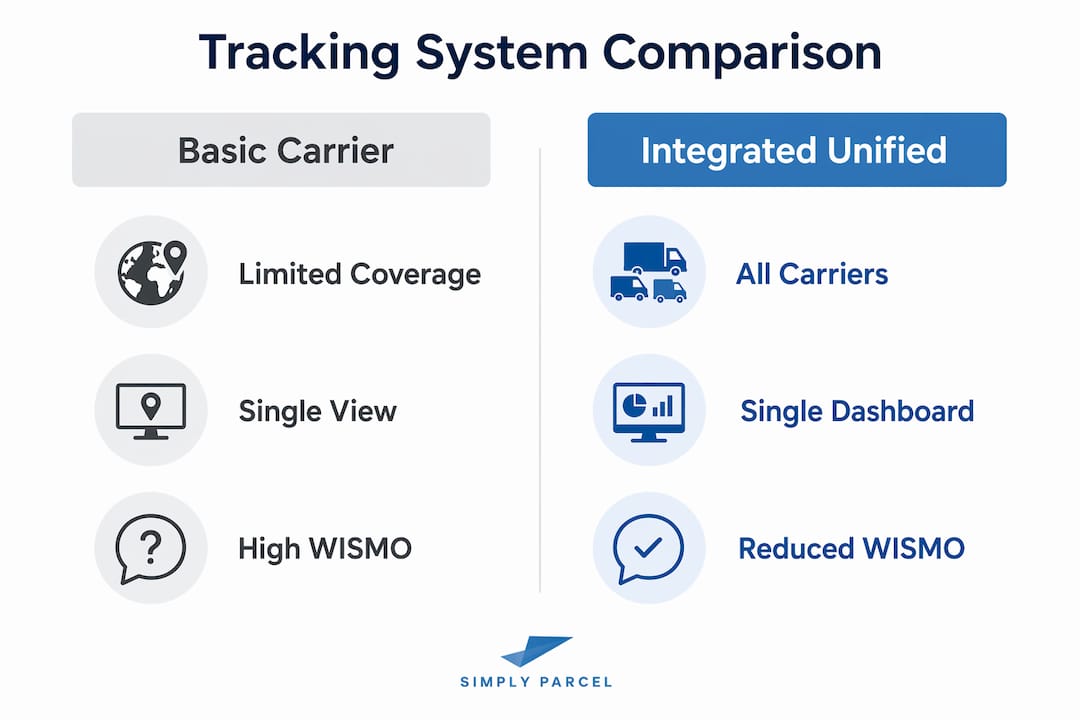
The operational gap between basic carrier tracking and an integrated platform is significant. The table below shows the key differences:
| Feature | Basic carrier tracking | Integrated unified tracking |
|---|---|---|
| Carrier coverage | Single carrier only | Multiple carriers in one view |
| Branding | Carrier's own page and logo | Your brand, your domain |
| Automated alerts | Limited or none | Triggered by delay, exception, or delivery |
| Marketing integration | None | Product recommendations, promotions |
| Data and reporting | Basic delivery stats | Carrier performance, bottleneck detection |
| Support workload | High, manual lookups required | Low, self-service for customers |
Small e-commerce teams save significant time by reducing repeated WISMO messages through effective tracking. For a team of two or three people managing hundreds of orders, that time saving is the difference between scaling and burning out.
Tracking data also creates a feedback loop that allows operational improvements, such as switching carriers or adjusting routes, saving costs and improving delivery times. If one carrier consistently delivers late to a specific region, your tracking data will show that pattern clearly. You can act on it before it becomes a customer service crisis. For a deeper look at how multi-carrier shipping affects your tracking setup, the comparison between unified and fragmented systems is worth understanding in detail.
How does shipment tracking support post-purchase marketing?
Most e-commerce businesses treat the tracking page as a logistics tool. The most effective operators treat it as a marketing channel. Branded tracking pages transform post-purchase tracking into marketing opportunities by including product recommendations and keeping customers on the brand domain rather than redirecting them to a carrier's generic page.
The post-purchase window is one of the highest-engagement moments in the customer relationship. A customer who just placed an order is actively thinking about your brand. That attention is valuable, and a generic carrier tracking page wastes it entirely.
Effective post-purchase marketing through tracking includes:
- Product recommendations. Show items related to what the customer just bought while they check their delivery status.
- Promotional banners. Feature a discount code for the next purchase directly on the tracking page.
- Loyalty program prompts. Remind customers of points earned or invite them to join a rewards program.
- Social sharing prompts. Encourage customers to share their purchase on social media while excitement is high.
- Review requests. Time a review request to arrive just after confirmed delivery for maximum response rates.
Keeping customers on your domain during the tracking process also protects your brand identity. A customer who clicks a tracking link and lands on a carrier's page sees the carrier's branding, not yours. That is a missed touchpoint. Branded tracking portals keep customers on the e-commerce site domain, preserving brand identity and enabling marketing integration. Improving delivery accuracy alongside branded tracking creates the strongest possible post-purchase impression.
Best practices for maximizing e-commerce tracking performance
Tracking works best when you treat it as a proactive customer service tool, not a passive status board. The following practices separate businesses that get real value from tracking from those that simply have it installed.
-
Build a branded tracking portal. Host your tracking page on your own domain. Control the messaging, the design, and the marketing content. Never send customers to a carrier's generic tracking page as your primary update method.
-
Set up automated exception alerts. When a shipment is delayed, flagged as an exception, or stuck in customs, your system should trigger an automatic notification to the customer before they notice the problem. Personalized notifications before customers notice delays neutralize anxiety and reduce support tickets.
-
Use multi-channel communications. Email alone is not enough. Combine email, SMS, and in-app notifications to reach customers on the channel they actually use. Match the urgency of the message to the channel.
-
Analyze carrier performance data. Review your tracking data monthly. Identify which carriers have the highest delay rates, the most exceptions, and the worst delivery accuracy by region. Use that data to renegotiate contracts or switch carriers where needed.
-
Connect tracking data to your marketing stack. Feed delivery confirmation events into your email marketing platform to trigger review requests, upsell sequences, and loyalty program invitations at exactly the right moment.
Pro Tip: Avoid relying solely on carrier tracking pages for customer communications. Carrier pages show your customer the carrier's brand, not yours. A unified tracking portal keeps every post-purchase touchpoint inside your brand experience.
The advantages of parcel tracking go beyond customer satisfaction. When your tracking data feeds back into your fulfillment decisions, you build a logistics operation that gets measurably better over time. For practical steps on reducing delays before they affect your tracking data, proven shipping delay tips are worth reviewing alongside your current carrier setup.
Key Takeaways
Tracking in e-commerce is a direct driver of customer trust, support efficiency, and post-purchase revenue when implemented as an integrated, branded system rather than a passive logistics tool.
| Point | Details |
|---|---|
| Tracking reduces support costs | Self-service tracking visibility cuts WISMO inquiries and frees your team for complex issues. |
| Branded portals protect your identity | Hosting tracking on your domain keeps customers engaged with your brand, not a carrier's. |
| Exception alerts prevent complaints | Automated delay notifications sent before customers notice problems reduce support tickets. |
| Tracking data improves logistics | Monthly carrier performance reviews reveal bottlenecks and drive smarter fulfillment decisions. |
| Post-purchase pages drive revenue | Tracking pages with product recommendations and promotions convert engaged customers into repeat buyers. |
Tracking is the most underused asset in e-commerce
Working with e-commerce businesses across international shipping routes, I have seen the same pattern repeat itself. A brand invests heavily in paid acquisition, product photography, and checkout optimization. Then the customer places an order and the experience falls apart. A generic carrier email. A tracking link that goes to a page with no branding. No proactive communication when a delay hits. The customer contacts support. The support team spends 20 minutes on a question that a good tracking system would have answered automatically.
The brands that get this right do not necessarily have bigger budgets. They treat tracking as a customer relationship tool, not a logistics checkbox. They build branded portals. They send proactive delay notifications. They use their tracking pages to show customers what to buy next. The result is lower support costs, higher repeat purchase rates, and a customer base that actually trusts the brand.
My honest view is that tracking is the most underused asset in e-commerce right now. Most businesses have some form of tracking in place. Very few use it to its full potential. The gap between "we have tracking" and "we use tracking strategically" is where real competitive advantage lives. If you are not treating your post-purchase experience as a growth channel, you are leaving both revenue and loyalty on the table.
— Simply
Simplyparcel's tracking tools for e-commerce businesses
Simplyparcel gives e-commerce businesses and digital marketers a single platform to manage international shipments with real-time tracking built in. Instead of logging into multiple carrier portals, you get centralized visibility across all your shipments from one place. Customers receive clear, timely updates without your team lifting a finger. You can track your shipments directly through Simplyparcel's platform, reducing support inquiries and keeping your customers informed at every stage. For businesses ready to put these tracking practices to work, get a shipment quote and see how Simplyparcel's courier network supports reliable, transparent international delivery from Singapore.
FAQ
What is the role of tracking in e-commerce?
Tracking in e-commerce provides real-time shipment visibility that reduces customer anxiety, cuts support inquiries, and creates post-purchase marketing opportunities. It connects customer service, logistics, and marketing into a single data-driven workflow.
How does tracking reduce customer support workload?
Proactive tracking visibility answers the most common support question, "Where is my order," automatically. Customers who can check their own order status contact support far less often, freeing your team for complex issues.
What is a branded tracking portal?
A branded tracking portal is a tracking page hosted on your own domain that displays your brand's design and messaging instead of a carrier's generic page. It preserves brand identity and allows you to include product recommendations and promotions.
How does tracking data improve logistics operations?
Tracking data reveals which carriers have the highest delay rates and where bottlenecks occur in your delivery network. Reviewing that data regularly lets you switch carriers, adjust routes, and reduce delivery costs over time.
What is a WISMO inquiry?
WISMO stands for "Where Is My Order" and refers to customer support contacts asking about order status. Effective tracking systems reduce WISMO inquiries by giving customers self-service access to real-time shipment updates.