
The single best move for ecommerce shipping in Singapore is to combine a shipping aggregator like Simplyparcel for international orders with a hybrid fulfillment model: handle fast-moving SKUs in-house for same-day and express domestic delivery, and hand off volume-heavy or seasonal inventory to a 3PL. This combination covers every speed tier your customers expect while keeping your cost per shipped order predictable.
Start here — three actions you can take this week:
- Configure your speed tiers at checkout. Offer at least same-day or express (1 business day) and a standard option (2–4 business days) for domestic orders, plus economy and priority lanes for international.
- Connect your storefront. Plug your Shopify, WooCommerce, or Shopline store into your chosen aggregator or courier API so labels and customs documents generate automatically.
- Run a pilot before going live. Ship 10–20 real test orders across your key routes, verify tracking updates, and confirm SLA accuracy before publishing delivery promises to customers.
Success looks like this: checkout abandonment drops because customers see clear, honest delivery windows; your shipping margin stays within a defined band because you've priced each tier correctly; and your SLAs are published and consistently met. Singapore's position as a major Southeast Asian e-commerce hub with world-class logistics infrastructure means the tools to get there are already available. The question is how you configure them.
Key Takeaways
Combining a shipping aggregator with a hybrid fulfillment model gives Singapore ecommerce merchants the most reliable coverage across domestic and international routes while keeping shipping costs predictable.
| Point | Details |
|---|---|
| Use a hybrid fulfillment model | Handle fast-moving SKUs in-house for same-day/express; use a 3PL for volume, seasonal spikes, or regulated goods. |
| Price shipping tiers correctly | Calculate landed cost per parcel including fuel surcharges and GST before setting flat-rate or tiered checkout prices. |
| Automate labels and customs docs | Connect your Shopify, WooCommerce, or Shopline store via plugin or API to generate labels and CN22/CN23 forms automatically. |
| Publish and protect your SLAs | State specific delivery windows at checkout and measure on-time delivery rate per carrier and route every month. |
| Simplyparcel for international lanes | Simplyparcel's rate-shopping, auto-documentation, and platform integrations cover cross-border shipping from a single booking flow. |
Table of Contents
- What ecommerce shipping services should you offer on your storefront?
- When should you use self-fulfillment vs. a 3PL in Singapore?
- How are shipping costs calculated, and how should you price them at checkout?
- What does your integration checklist look like for platform plugins and APIs?
- What do you need to know before shipping overseas from Singapore?
- How do you design a returns process that doesn't erode your margin?
- How do you evaluate and pilot a courier or aggregator partner?
- What carrier categories serve Singapore ecommerce merchants?
- How does using an aggregator like Simplyparcel reduce work and risk?
- What actually matters most when you design your shipping setup
- Simplyparcel gives Singapore merchants a faster path to reliable international shipping
- Sources
What ecommerce shipping services should you offer on your storefront?
Domestic shipping in Singapore runs across three practical speed tiers, and the right mix depends on what you sell, not just what your courier offers.
Same-day and instant delivery suits perishables, food, flowers, and any product where the customer's need is time-sensitive. Carriers in this category typically promise delivery within 2–4 hours of pickup. The conversion uplift is real for the right product category, but the cost per parcel is highest, so absorbing it into your margin only makes sense if your average order value supports it.
Express (next business day) is the workhorse tier for small electronics, apparel, and health products. Most customers in Singapore expect next-day as the default for paid delivery. Offering it at a flat rate of S$5–8 for parcels under 5 kg covers the courier cost for most merchants without triggering cart abandonment.
Standard (2–4 business days) works for non-urgent goods, bulky items, and customers who choose it to save money. Display it as the free-shipping option when an order clears your free-shipping threshold. That framing converts better than labeling it "slow."
For international orders, match the service tier to the product's value and the customer's tolerance for wait time. DHL's ecommerce guidance recommends express for high-value goods where transit time directly affects customer satisfaction, and economy lanes for lower-value items where a moderate delivery window is acceptable. Simplyparcel's priority, connect-plus, and economy tiers map directly to this logic, letting you present the right option at checkout without manual rate-shopping.
For customer-facing copy, be specific. "Delivered by Thursday if ordered before 2 PM" outperforms "2–3 business days" every time. Pair that with a tracking link in the order confirmation email so customers don't need to contact support.
When should you use self-fulfillment vs. a 3PL in Singapore?
The decision isn't about size alone. It's about which model keeps your cost per order stable as volume changes.
Self-fulfillment makes sense when you have a relatively low order volume per day, a tight SKU range, and predictable demand. You control packaging quality, can respond to returns quickly, and avoid 3PL minimum fees. The risk is that peak seasons (Harborfront sales, 11.11, year-end) can overwhelm a small team and push your on-time rate down exactly when customer expectations are highest.
A 3PL becomes the better choice when any of these apply:
- Order volume spikes significantly during peak periods
- You carry more than 30 active SKUs with different packaging requirements
- You're expanding into regional markets and need bonded or Zero-GST warehousing near Changi to defer GST until goods enter the Singapore market
- Your returns rate is relatively high and you need a structured inspection and restocking process
- You handle medical devices or regulated goods requiring GDP-MDS-compliant storage
When evaluating a 3PL partner, expect to pay for storage (per pallet or cubic meter per month), pick-and-pack (per order plus per item), inbound receiving, and returns handling. Some providers, like uParcel, offer flat-rate city-wide delivery with live tracking and Shopify integrations, which simplifies cost forecasting. Speedpost's ecommerce logistics hub offers multi-modal transport and integrated IT systems for merchants scaling cross-border.
Short checklist to evaluate a 3PL before signing:
- Does their warehouse location reduce your average delivery distance to customers?
- Can they connect to your storefront via API or plugin?
- What is their SLA for same-day pick-and-pack cutoff?
- How do they handle returns: inspect, restock, or quarantine?
- Do they offer bonded or Zero-GST warehousing if you import inventory?
That time cost is often invisible until you calculate it.
How are shipping costs calculated, and how should you price them at checkout?
Couriers charge based on whichever is greater: actual weight or volumetric weight. Volumetric weight is calculated as length times width times height divided by a standard factor for most international carriers. A lightweight but bulky item, like a foam pillow, will almost always be billed on volumetric weight.
Beyond the base weight charge, your landed shipping cost per order includes:
- Zone or destination surcharge: domestic Singapore rates differ from regional (Malaysia, Indonesia) and long-haul (Europe, US) rates.
- Fuel surcharge: typically a percentage added on top of the base rate, adjusted quarterly by most carriers.
- Remote-area premium: applies to addresses outside standard delivery zones.
- Peak-season surcharge: carriers add this during Q4 and major sale periods.
- Declared value / insurance fee: usually 1–2% of the declared value for coverage above the carrier's standard liability.
- GST: Singapore's current GST rate applies to domestic shipping services.
For transparent shipping rate communication, the most reliable approach is to calculate your average cost per parcel by tier, then choose one of four checkout pricing strategies:
- Absorb the cost into product price and offer free shipping. Works when your average order value is high enough.
- Flat rate by weight band (e.g., S$4 for under 1 kg, S$7 for 1–3 kg). Simple for customers, predictable for you.
- Tiered by order value with a free-shipping threshold. Increases average order value.
- Pass through actual cost via real-time rate API. Most accurate, but adds checkout friction.
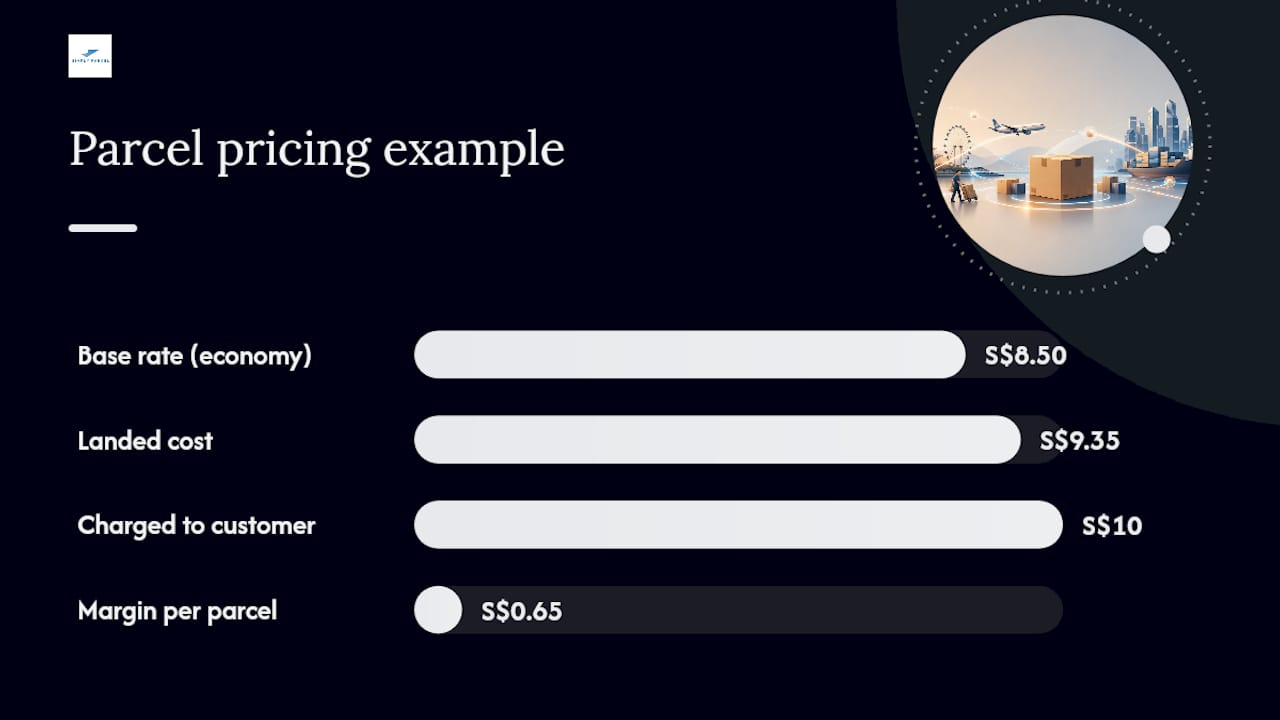
Example calculation for a 500g parcel to Malaysia:
- Actual weight: 0.5 kg
- Volumetric weight (15 × 12 × 8 cm ÷ 5,000): 0.29 kg
- Billed weight: 0.5 kg (actual is higher)
- Base rate (economy): S$8.50
- Fuel surcharge applies as a percentage added on top of the base rate
- Landed cost: S$9.35
If you charge the customer S$10 flat, your margin is S$0.65 per parcel. Thin, but predictable. For small orders under S$20, that margin can go negative if you're not careful. Set a minimum order value or a handling fee for very small orders to protect yourself.
What does your integration checklist look like for platform plugins and APIs?
Getting your storefront connected to your courier or aggregator is a one-time setup that pays off on every order afterward. Here's what to validate before going live.
Platform connection:
- Install the Shopify, WooCommerce, or Shopline logistics plugin for your chosen courier or aggregator.
- Confirm order data maps correctly: customer name, full address (including unit number), parcel weight, and declared value.
- Set up auto-routing rules so express orders route to the right service tier automatically.
Label and customs document generation:
- Verify that labels print in the correct format (A6 thermal or A4 laser) for your printer.
- For international orders, confirm that CN22 or CN23 customs forms generate automatically with HS codes, item descriptions, and declared value pre-filled.
- Test that commercial invoices attach to the shipment record.
Tracking and customer notifications:
- Confirm webhook events fire at each status change (picked up, in transit, out for delivery, delivered).
- Set up automated email or SMS notifications to customers at key milestones. WhatsApp notifications convert well in Singapore for last-mile updates.
- Check the real-time tracking page your customers will land on from the notification link.
Testing checklist before launch:
- Place 3–5 sandbox or real test orders across each service tier.
- Print and scan labels to confirm barcode readability.
- Trigger a return label and confirm the reverse flow works.
- Simulate a failed delivery and verify the exception notification reaches the customer.
- Document a manual fallback process for when the API is unavailable.
Pro Tip: Set up a dedicated test SKU with a fixed weight and dimension profile. Use it for every integration test so your results are consistent and comparable.
Shopline's logistics integrations let merchants connect to multiple courier partners from a single dashboard, which shortens the time from setup to live shipping considerably.
What do you need to know before shipping overseas from Singapore?
Singapore's status as a regional ecommerce launchpad means your international shipping setup matters as much as your domestic one. Get the paperwork right and customs delays become rare. Get it wrong and parcels sit in clearance for days.
Documents required for every international shipment:
- Commercial invoice (seller name, buyer name, item description, quantity, unit value, total value, currency, country of origin)
- Packing list (dimensions, weight, number of packages)
- HS (Harmonized System) code for each item type
- CN22 for parcels under 300 SDR in value; CN23 for higher-value shipments
- EORI number or equivalent importer identifier for destinations that require it (EU, UK)
DHL's guidance places accurate HS codes at the top of the list for reducing customs delays. An incorrect or missing HS code is the single most common reason a parcel gets held at destination customs. Look up codes at the Singapore Customs HS code database before you ship a new product category.
Duties and destination taxes: Most countries charge import duty and local VAT or GST on incoming parcels above a de minimis threshold. The EU's threshold is €150 for customs duty (VAT applies from €0.01). Australia's is A$1,000. The US is US$800. Communicate expected duties clearly at checkout so customers aren't surprised at delivery. For affordable international shipping options, choosing the right service tier and declaring values accurately keeps your customers' total cost predictable.

Restricted and prohibited items: Before booking any international shipment, check the destination country's restricted items list. Common restrictions include lithium batteries (quantity and watt-hour limits), liquids, food products, and certain electronics. Singapore Customs also maintains an export control list for strategic goods.
Pro Tip: Pre-fill your CN22/CN23 forms with item descriptions in plain English, not product codes. "Ceramic coffee mug" clears faster than "SKU-4471-B."
For merchants handling international shipping challenges at scale, building a product master with HS codes, declared values, and country-of-origin data saves significant time per shipment.
How do you design a returns process that doesn't erode your margin?
Returns are a cost center, but a poorly designed returns process costs more in lost customers than in logistics fees. The goal is a clear, fast process that customers trust and that you can operate without dedicated staff.
Policy choices and when each makes sense:
- Free returns: best for apparel and footwear where fit uncertainty drives return rates. Only viable if your margin supports the reverse logistics cost.
- Paid returns (customer pays label cost): appropriate for electronics, large items, or categories with low return rates. Reduces frivolous returns.
- Store credit instead of refund: works well for repeat-purchase categories. Keeps revenue in your business and incentivizes the next order.
Operational flow:
- Customer submits a return request via your store portal or email.
- System generates an RMA (Return Merchandise Authorization) number and a pre-paid or customer-paid return label.
- Customer drops off or schedules a pickup.
- Parcel arrives at your warehouse or 3PL hub for inspection.
- Inspection determines: restock as new, refurbish, or write off.
- Refund or store credit issues within your published window (3–5 business days is standard).
Cost-control levers:
- Batch return pickups on set days rather than on-demand to reduce per-parcel reverse logistics cost.
- Use a return-to-hub model where returns consolidate at one address before redistribution, rather than returning directly to your main warehouse.
- For regional returns from Malaysia or Indonesia, pool returns with a local consolidation partner before shipping back to Singapore.
Publish your returns policy on your product pages and at checkout. Customers who can find the policy before buying convert at higher rates and return less often.
How do you evaluate and pilot a courier or aggregator partner?
Choosing a shipping partner on price alone is the most common mistake Singapore merchants make.
Questions to ask every potential partner:
- What are your published SLAs for same-day, express, and standard domestic tiers?
- What is your first-attempt delivery success rate?
- How do you handle failed deliveries and re-delivery scheduling?
- What insurance or declared-value coverage do you offer, and what is the claims process?
- Do you provide API access for rate-shopping and booking, and what is the uptime SLA?
- How are fuel surcharges and peak-season fees communicated and applied?
Red flags that should end the conversation early:
- No publicly available SLA commitments
- Tracking updates that are manual or delayed by more than 2 hours
- Unclear or variable surcharge policies with no advance notice
- No integration with Shopify, WooCommerce, or Shopline
- Claims process that requires physical documentation only
Pilot test plan:
Run 20–30 real orders across your key domestic and international routes over two weeks. Track on-time delivery rate, first-attempt success rate, tracking update frequency, and time from pickup to first scan. Set a minimum acceptable threshold before the pilot starts (for example, 95% on-time for express domestic) and evaluate objectively. Simulate one return per route to test the reverse flow. If the partner passes, expand. If not, the pilot cost is far cheaper than a full rollout that fails.
What carrier categories serve Singapore ecommerce merchants?
Every Singapore ecommerce stack draws from four carrier categories. Knowing what each does well helps you build a mix that covers all your order types without overpaying.
| Category | Pricing model | Transit speed | Same-day coverage | International reach | Platform integration | Fulfillment options | Returns handling |
|---|---|---|---|---|---|---|---|
| Local app-based fleets (e.g., Pickupp) | Per-delivery, distance-based | 2–4 hours | Yes, within Singapore | No | Merchant app, API | No warehousing | Limited |
| National post/parcel networks (e.g., SingPost) | Weight-based, zone tiers | 1–3 business days | Limited | Regional and global | API, plugin | Some fulfillment hubs | Yes |
| International express carriers (e.g., DHL) | Weight + zone, fuel surcharge | 1–5 business days international | No | Global | API, Shopify/WooCommerce | No | Limited |
| Shipping aggregators (e.g., Simplyparcel) | Per-booking, rate-shopped | Varies by carrier selected | Via partner fleets | Global via carrier mix | Shopify, Shopline, API | Via 3PL partners | Via partner |
| 3PL fulfillment partners | Storage + pick-and-pack + delivery | Same-day to 2 days domestic | Yes, via last-mile partner | Via freight forwarder | API, marketplace connectors | Full warehousing | Yes |
The practical mix for most Singapore merchants: use a local app-based fleet like Pickupp for urgent same-day domestic orders, a national network like SingPost for standard domestic, and an aggregator like Simplyparcel for all international lanes. That covers every customer expectation without locking you into a single carrier's pricing.
For merchants scaling cross-border, services like GenLogix offer turnkey import compliance and local warehousing for international brands entering Singapore, which is useful if you're also receiving inbound inventory from overseas suppliers.
For a deeper look at courier services for international shipping from Singapore, the options by category are covered in detail there.
How does using an aggregator like Simplyparcel reduce work and risk?
The clearest benefit of a shipping aggregator is that it removes the need to manage separate accounts, rate cards, and label systems for each carrier. Here's how that plays out in practice.
Common pain point: A merchant ships to 12 countries using three different carriers. Managing three logins, three label formats, three tracking systems, and three invoices takes 2–3 hours per week in admin alone.
How an aggregator solves it: Simplyparcel consolidates rate-shopping, booking, label generation, and tracking into one platform. You enter the parcel details once, compare rates across carriers, book, and print. Customs documents generate automatically with the shipment record.
Implementation steps:
- Create your Simplyparcel account and complete the business verification.
- Connect your storefront via the Shopify or Shopline plugin, or via API for custom setups.
- Set up packaging profiles (standard box sizes and weights you use most often) so rate calculations are accurate.
- Configure your service tiers: priority for high-value or time-sensitive orders, economy for standard cross-border.
- Run your pilot batch of 10–20 orders, verify tracking updates, and confirm label accuracy.
Real-time tracking is available through Simplyparcel's tracking module, so customers get live status updates without contacting your support team. Optional declared-value protection covers parcels above the carrier's standard liability, which matters for electronics and high-value goods.
For merchants who want to understand how to track international shipments step by step, that resource covers the full tracking workflow.
What actually matters most when you design your shipping setup
Most merchants spend too much time comparing per-parcel rates and not enough time measuring on-time delivery rate and cart conversion by shipping option. Those two metrics tell you more about whether your shipping setup is working than any cost comparison.
Start by measuring on-time delivery rate per carrier and per route. If a carrier hits 98% on-time for domestic express but only 82% for standard, that gap is costing you customer trust on your cheapest tier. Fix the SLA before you optimize the price.
The second priority is checkout conversion by shipping option. If you add a same-day option and conversion on same-day-eligible products rises, the cost of offering it is justified. If it doesn't move the needle, pull it and simplify your checkout.
Practical priorities in order:
- Publish your SLAs publicly and update them when they change.
- Automate label generation so no order ships without a scan-ready label.
- Build a simple, two-step returns funnel: request form, then label. Don't make customers call.
- Test one new shipping lane per quarter. Add a new destination, a new speed tier, or a new carrier, and measure the result before expanding.
The merchants who get shipping right in Singapore aren't the ones with the most carriers. They're the ones with the clearest SLAs, the most reliable tracking, and the simplest checkout experience.
Simplyparcel gives Singapore merchants a faster path to reliable international shipping
Shipping internationally from Singapore doesn't have to mean managing multiple carrier accounts, chasing tracking updates, or manually filling customs forms. Simplyparcel handles rate comparison, label generation, and customs documentation in one booking flow, so you spend less time on logistics admin and more time on your business.
Key features that map directly to what this guide recommends:
- Rate-shopping across carriers so you always book the best price for each speed tier
- Automatic customs paperwork including CN22/CN23 and commercial invoices, pre-filled from your shipment data
- Shopify and Shopline integrations for order sync and auto-label generation
- Real-time tracking with customer-facing status updates
- Priority, connect-plus, and economy tiers to match every order type and budget
- Optional declared-value protection for high-value parcels
Getting started takes less than a day. Get an instant shipping quote to see live rates for your routes, or visit Simplyparcel to connect your storefront and run your first pilot batch.
Sources
- Trade
- eCommerce Logistics Solution Services | Shopline Singapore
- uParcel: Tech Driven 3PL enabler for Business & eCommerce Brands