The party who pays customs fees is the importer, which in most parcel shipments means the recipient. The exception is when the sender agrees to cover the charges in advance, a arrangement known as delivered duty paid (DDP). If you ship from Singapore, you decide which of the two applies before you book, and that choice determines whether your buyer, friend or family member receives a bill at the door. At Simply Parcel, we build the customs paperwork for you when you book, so the choice is made with the right documents behind it.
TL;DR
- Import duties and taxes are charged by the destination country and are owed by the importer, usually the person or business receiving the parcel.
- The sender can take on the cost by shipping DDP. Under DAP, the recipient pays on delivery.
- Carriers can add their own handling or brokerage fees on top of government charges.
- Unpaid charges can delay delivery, send the parcel back or cause it to be abandoned.
- Rules and low-value thresholds change by country, so check the destination before you ship.
Table of Contents
- The short answer: the importer pays
- Sender or recipient: how DDP and DAP decide the bill
- Which charges can appear on a parcel
- How rules differ by destination
- How to estimate customs fees before you ship
- What happens if the recipient does not pay
- A sender's routine for avoiding surprise bills
- Book your shipment with the paperwork done
- Our view: settle the bill before the parcel leaves
- FAQ
- Sources
The short answer: the importer pays
A customs duty (also called a tariff) is a tax a country charges on goods entering it. The US International Trade Administration explains that tariffs are collected at customs clearance in the destination country, that sales taxes and local taxes are charged in addition, and that sometimes customs fees apply as well. The final cost therefore lands on the buyer abroad, which is why sellers are often asked to quote an estimate before the sale.
The WTO handbook for businesses puts it the same way: import tariffs are paid by the importer, and export tariffs by the exporter. It adds that border taxes such as VAT, GST and sales tax are usually charged to the importer as a percentage of the goods' value plus handling and shipping costs. More than 140 countries and customs territories levy VAT.
The legal term you will see is "importer of record". Under US law, the importer of record must pay duties, taxes, tariffs and fees and make sure the information given to US Customs and Border Protection is accurate. That role can be the owner, the purchaser or the consignee, or a licensed customs broker acting for them. Parties can also assign the role by contract, often through the delivery term they choose.
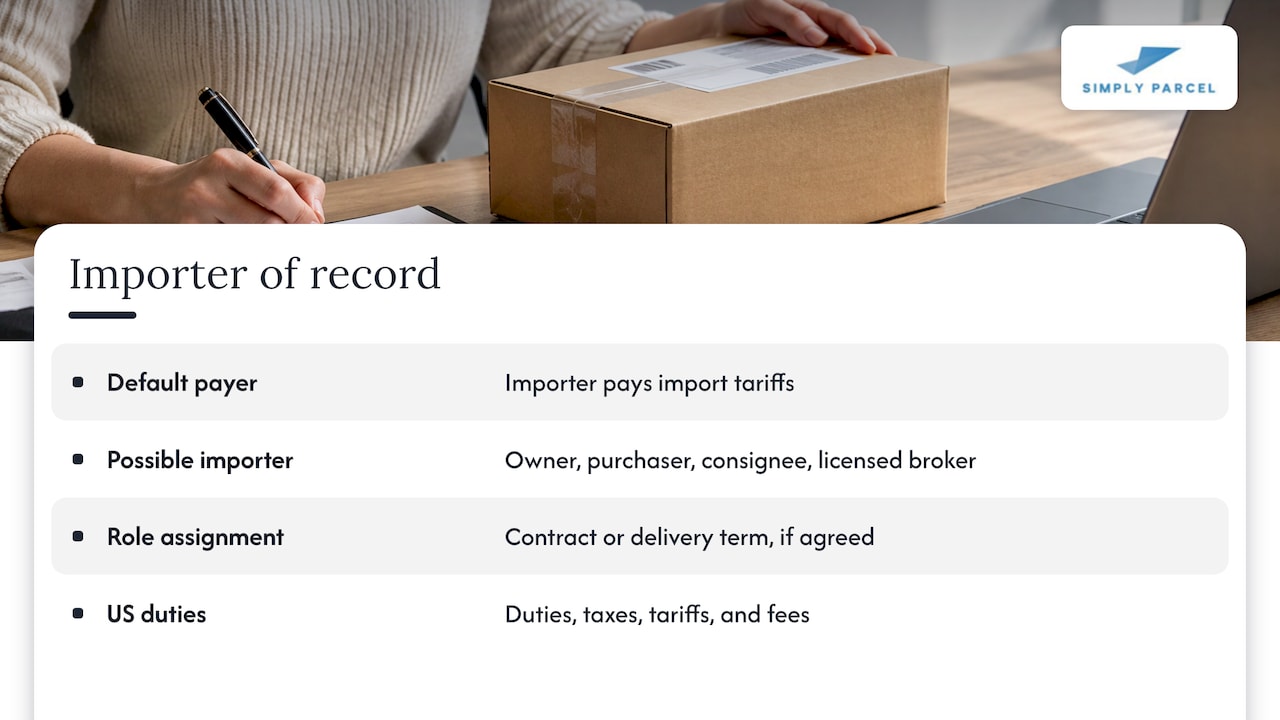
In plain terms: the law looks at who is importing the goods, not who sent them. A contract or a delivery term can move the bill to the sender, but only if both sides agree to it.
Sender or recipient: how DDP and DAP decide the bill
Delivery terms, called Incoterms, are standard labels that say who handles which costs and risks in a cross-border sale. Two matter most for parcels.
- DAP (delivered at place): The seller brings the goods to the named destination and carries the risk until then. Import costs are left to the buyer.
- DDP (delivered duty paid): The seller bears all costs and risks, clears the goods for export and import, and pays any duty in both countries.
Shopify's help documentation describes how this works in practice: the carrier acts as customs broker and collects duties and import taxes from either the seller or the customer. Under DDP, the seller takes on duties, import taxes and brokerage or disbursement fees, which can be collected from the customer at checkout. Under DAP, the customer pays the carrier on delivery, and some carriers charge extra for collecting duties at the door when they were not paid in advance.
The Universal Postal Union, the body that coordinates international post, describes DDP as well suited to e-commerce parcels because it speeds up clearance at destination and shows online buyers the full landed cost at purchase. Landed cost means the item price plus shipping, duties, taxes and fees.
For a closer look at the trade-offs, read our guide to DDP vs DAP and who pays duties and taxes. A seller-focused explanation of how DDP shipping works for sellers and buyers is also worth a look if you run an online shop.
| Situation | Who usually pays duties and taxes | Typical use |
|---|---|---|
| DAP, or no term agreed | Recipient, on delivery or via a payment request | Personal gifts, items sold "buyer pays import costs" |
| DDP | Sender or seller, in advance | E-commerce stores that show a final price at checkout |
| Recipient is a business importer of record | The business, through its own customs account or broker | Regular imports and bulk freight |
Why the sender sometimes pays anyway
Some destination countries require DDP for postal items. The US Postal Service's interim final rule of 19 October 2026 says that where a destination requires DDP, the mailer must send on a DDP basis and pay all duties, taxes and import fees. If the destination post cannot recover unpaid amounts from the addressee, it may seek them from the mailer, and USPS will invoice the mailer, with 6% annual interest on overdue amounts.
The lesson applies to any sender: if you promise a recipient "no extra costs", you need a shipment set up so the charges are actually settled before delivery.
Which charges can appear on a parcel
"Customs fees" is a loose phrase. A single parcel can carry several different charges, and they come from different parties.
From the government of the destination country:
- Customs duty: a percentage of the goods' value, set by the product type and country of origin. The trade.gov overview notes this value can include freight and insurance.
- Import VAT, GST or sales tax: charged on top of the goods, often calculated on value plus shipping and duty.
- Customs processing fees: in some countries, a flat fee per item or per entry.
From the carrier or a customs broker (a licensed professional who files import paperwork for you):
- Brokerage or clearance fees: a charge for preparing and filing the import entry. Read more in our guide to the brokerage fee on a courier shipment.
- Disbursement or collection fees: a charge for advancing your duties to customs and collecting them from you. See disbursement fee courier charges for how they arise.
- Storage fees: a charge if the parcel sits waiting at customs or a warehouse. Our page on storage fees for parcels held at customs explains when the clock starts.
A useful habit is to separate government charges from carrier charges when you read any notice. One online retailer's delivery page distinguishes duties and taxes from carrier or broker fees, which is exactly the split to look for on your own invoice. Support documentation from one company lists duties, import taxes, VAT or GST, brokerage, clearance, collection and storage fees as charges the recipient is responsible for unless the sender has prepaid them.
Two surcharges are often confused with customs fees but are not: residential delivery surcharges and remote area surcharges. Those are charged by the carrier for the delivery address, not by customs.
How rules differ by destination
Every country sets its own duty rates and its own threshold below which small parcels are cleared cheaply or free. Those thresholds have moved a lot in the last two years, so treat any older rule of thumb with caution.
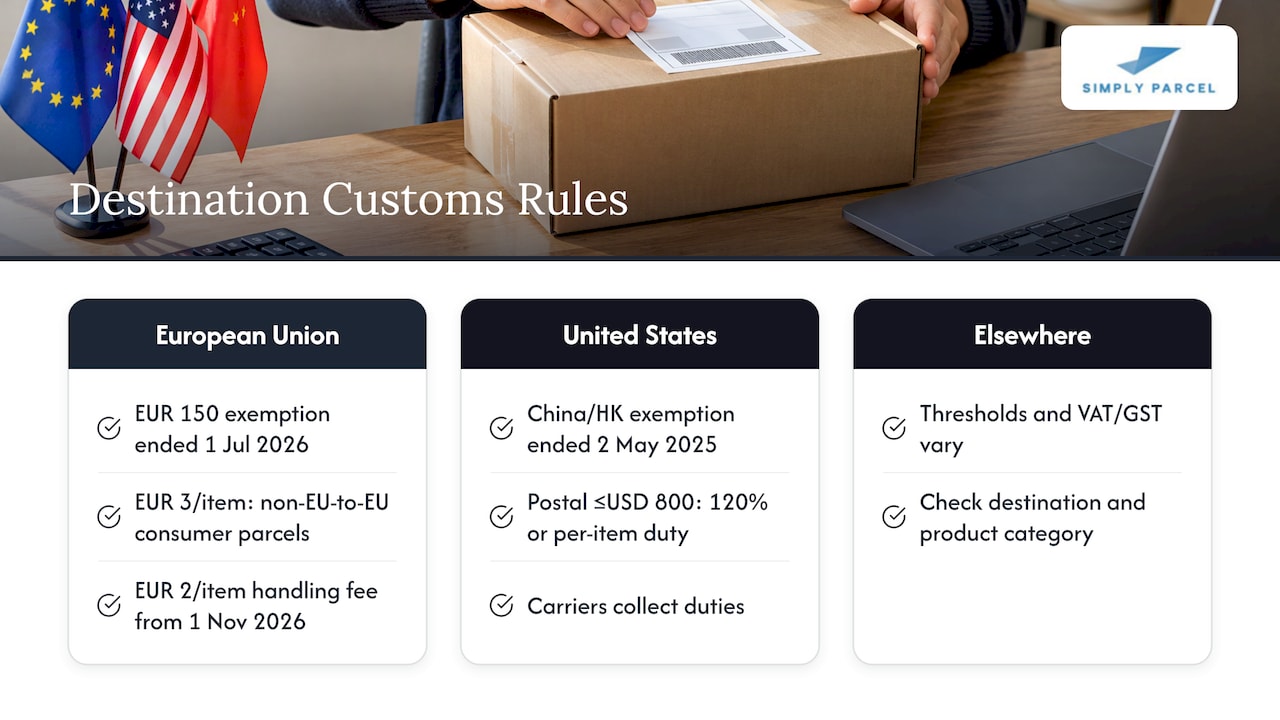
European Union. According to the UK government's summary of the EU reforms, the customs duty exemption for parcels valued at EUR 150 or below ended on 1 July 2026. A EUR 3 duty per item now applies to parcels moving from businesses outside the EU to consumers in the EU, while other goods below EUR 150 are charged the normal EU tariff. From 1 November 2026, a EUR 2 handling fee per item applies to imported parcels, on top of the EUR 3 duty for goods under EUR 150 or on top of normal duties above it.
The European Commission says the reform also moves responsibility for duty payment and compliance from the consumer to the platforms, sellers or carriers involved in the transaction. It explains the EUR 150 rule had become a loophole, with shipments split or undervalued to avoid duties. If you sell to EU customers from Singapore, this makes sender-side planning more important.
United States. Duty-free treatment for low-value parcels from China and Hong Kong ended on 2 May 2025. A US Customs bulletin records that covered postal items valued at USD 800 or less faced either a 120% duty or a specific duty per item, collected by carriers. Rates and exemptions for other origins have also shifted, so confirm the current treatment for your goods before you ship to a US buyer.
Everywhere else. Thresholds, VAT or GST rates and payment methods differ. The reliable approach is the same in every case: look up the rule for the destination and the product category, and do not assume a parcel is exempt because it is small or a gift.
How to estimate customs fees before you ship
You cannot know the final figure in advance, but you can get close.
- Identify the product and its value. Duty is based on what the goods are and what they are worth. Use the real price paid, with shipping and insurance, as the trade.gov overview describes.
- Find the tariff rate for the destination. Trade.gov advises using public and private tariff resources to estimate rates. The destination customs authority sets the actual rate, which may differ from an estimate.
- Add the taxes. Estimates of duty alone leave out VAT, GST and fees, which can be larger than the duty itself.
- Add carrier fees. Ask whether brokerage, disbursement or collection fees apply to the service you choose.
- Give the buyer a number. Sellers can send an estimate by email, phone or pro forma invoice, so the buyer is not surprised at the door.
Small businesses often get stuck at step 2 when they must pick the right product classification. Our guide on whether you need a customs broker helps you decide when to hand that work off.
What happens if the recipient does not pay
This is the part most people only learn after the fact. When a payment request goes unanswered, the parcel does not simply sit forever. Support guidance on unpaid charges warns that late payment can cause delivery delays, return to sender, abandonment or disposal of the goods. Storage fees can accumulate while the parcel waits.
In postal systems that require DDP, the sender can end up billed instead, as the USPS rule above shows. For the sender, that means an unpaid bill can come back to you, along with the cost of the failed delivery.
The practical steps are short:
- Tell the recipient to expect a payment request and to complete it promptly.
- Keep the tracking number handy so you can see whether the parcel is held at customs.
- If the buyer refuses the charges, decide early whether you will pay them to release the parcel or have it returned.
For returns shipped back into Singapore, see our guide on avoiding GST loss on cross-border returns.
A sender's routine for avoiding surprise bills
Here is the order we recommend when you send a parcel from Singapore.
- Decide who will pay. Agree with the recipient, in writing, whether they pay on delivery (DAP) or you prepay (DDP). For a shop, decide before the buyer checks out.
- Check what you can send. Restricted goods can be stopped at customs regardless of who pays. Our platform provides guidance on restricted goods and customs requirements, so you can check before you book.
- Declare the true value and contents. Under-declaring does not lower the bill safely. It risks delays and penalties. Our platform generates your shipping label and customs documentation automatically during booking, so the details you enter flow into the paperwork.
- Compare speeds and rates. We offer Priority, Connect Plus and Economy options from our carrier partners, so you can weigh urgency against cost in one place. Our comparison of FedEx International Priority and Connect Plus shows how the two differ.
- Book the pickup. Pickup at your door is free, and there is no monthly volume commitment.
- Tell the recipient and track. Share the tracking number and watch for customs holds. Real-time tracking is included.
The customs step itself is the work of the authority in the destination country: no sender or carrier can skip it. What you control is how complete the paperwork is and how clearly the recipient knows what to expect. Our guide to the role of customs in shipping walks through what happens at the border.
Book your shipment with the paperwork done
If you are sending a personal parcel, a document or stock to customers abroad, you can get a quote on our shipment quote page and compare Priority, Connect Plus and Economy before you pay. Free doorstep pickup, auto-generated labels and customs documentation, and real-time tracking come with the booking, and optional additional protection coverage is available. You can also see all options on our services page.

Sellers and exporters who ship regularly can use the same platform without a monthly volume commitment, with integration for e-commerce workflows.
Our view: settle the bill before the parcel leaves
Most customs disputes we hear about are not about the amount. They are about surprise. A recipient who did not expect a payment request treats it as a scam, ignores it, and the parcel stalls.
That is why we think about customs fees as part of the booking, not an afterthought. Decide who pays, make the documents accurate, and tell the recipient what is coming. Our platform is designed to make that easy: transparent rates, auto-generated customs documentation, access to several reputable carriers and guidance on customs requirements and restricted goods in one place.
For businesses, we see the same logic from the other side. A shop that shows a final price at checkout gives buyers confidence, and one place to compare speeds and book pickups keeps the shipping side simple. Free pickup and no monthly volume commitment mean you can start with one parcel and grow from there.
SP
FAQ
Who pays customs fees, the sender or the receiver?
By default the receiver, because the importer owes import duties and taxes. The sender pays only if the shipment is DDP or the sale terms say so. Agree this before the parcel ships.
Does the shipper or buyer pay tariffs?
Legally, the importer of record pays the tariff to customs, and that is often the buyer. A seller can take on the cost through DDP terms or a contract. In the US, the importer of record can be the owner, purchaser or consignee, or a customs broker acting for them.
Who do I pay import fees to?
You pay whoever sends the payment request, which is usually the carrier or the destination post office acting for customs. The carrier collects duties and import taxes and may add its own handling fee. Use the payment link or instructions on the official notice, and keep the tracking number as a reference.
How can I estimate customs fees?
Start with the goods' value, including shipping and insurance, and the destination's tariff rate for that product. Then add VAT, GST or sales tax and any carrier fees. Final rates are set by the destination's customs, so treat your figure as an estimate.
Sources
- Import Tariffs & Fees Overview and Resources, trade.gov
- WTO handbook for businesses and entrepreneurs
- Tariffs and Your Contracts: the importer of record, Foley & Lardner
- Customs valuation: Incoterms, GOV.UK
- Carriers and shipping terms, Shopify Help Center
- UPU Delivered Duty Paid solution
- Federal Register, USPS interim final rule, 19 October 2026
- EU UCC reforms, business.gov.uk
- EU Customs Reform, European Commission
- Customs Bulletin Weekly, Vol 59, No 20, CBP
- Who pays customs duties, taxes, and import fees? Gemnote
- DDP Shipping Meaning, ToylandEU
- Order & Delivery, Baby goes Retro