The right approach to cross border returns Singapore sellers deal with is straightforward: generate return labels pre-filled with your original export data, route by volume (direct return for low volumes, regional consolidation once returns scale), and keep every document tied to the original export declaration. Air shipments valued under S$1,000 skip the export permit requirement, but you still need a paper trail to protect your GST zero-rating and duty recovery. Platforms like Simply Parcel can generate that paperwork automatically.
TL;DR:
- Cross-border returns require clear documentation, linking the return to the original export with permits, invoices, and tracking data to ensure proper tax treatment.
- Returns valued under S$1,000 often do not need an export permit if they are non-controlled and non-dutiable, but proper paperwork remains essential for GST zero-rating and duty recovery.
- The actual cost of a return includes carrier fees, inspection charges, duties, and potential liquidation losses, with consolidation strategies reducing per-unit expenses.
- Proper handling depends on selecting the appropriate return route—direct, regional hub, or 3PL—based on volume and item value to optimize costs and management ease.
- Platforms like Simply Parcel streamline return processes, offering automatic paperwork, flexible routing, and integrated pickup options aligned with the return’s value and urgency.
Table of Contents
- Why Cross-Border Returns Work Differently Than Forward Shipments
- What Documents and Permits Does Singapore Customs Require?
- What Do Cross-Border Returns Actually Cost You?
- Step-by-Step: Building a Compliant Return Shipment From Singapore
- Choosing a Routing Model: Direct, Regional Hub, or 3PL
- How Simply Parcel Fits Into Your Returns Workflow
- Book a Compliant Return Shipment Through Simply Parcel
- Sources
- FAQ
Why Cross-Border Returns Work Differently Than Forward Shipments
A returned item is not the same customs event as an outbound sale, and treating it that way is where most Singapore sellers run into trouble. Customs authorities distinguish between goods coming back as a return (refund, no replacement), a repair (goods leave again after service), and an exchange (a swap for a different item). Each reason code changes how the shipment gets declared and whether duty relief applies.
The return also has to reference the original export. Without that link, Singapore Customs and IRAS have no way to confirm the parcel that's coming back is the same one that left, which matters enormously for tax treatment.
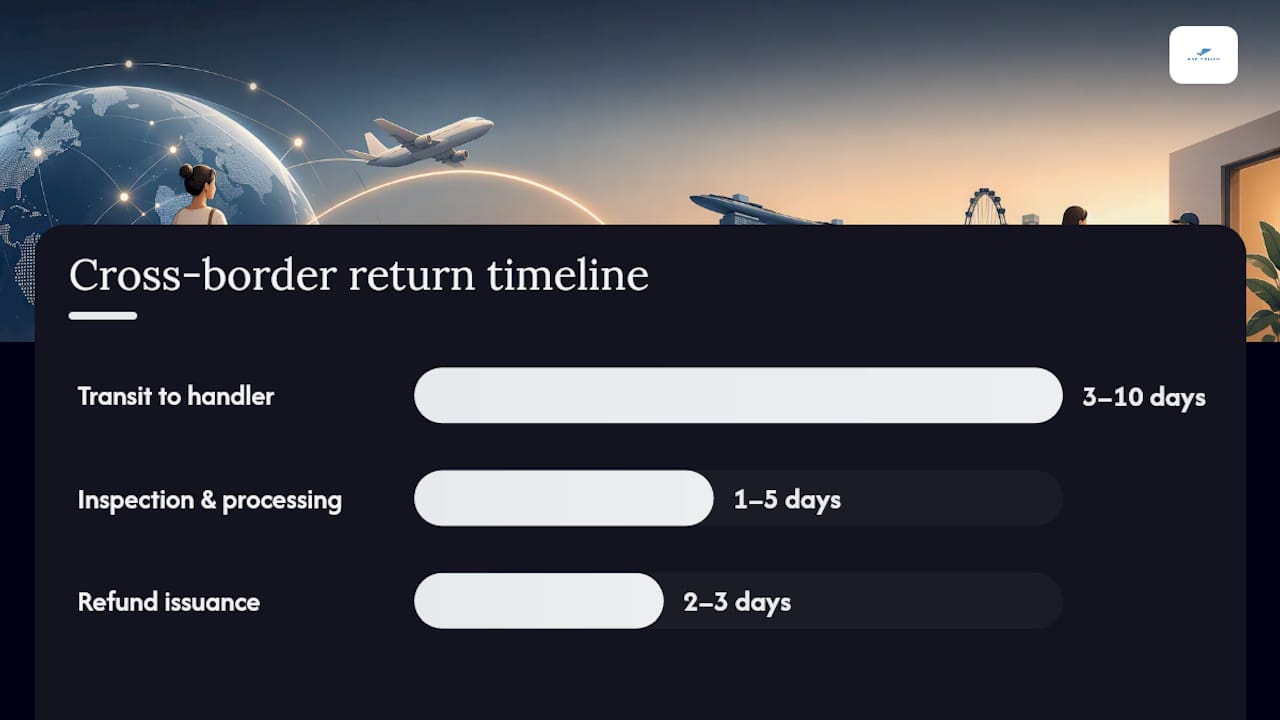
On timelines, be realistic with customers. A cross-border return typically involves:
- Transit time for the parcel to reach the destination handler (3 to 10 days depending on the lane)
- Inspection and processing at the return facility (1 to 5 days)
- Refund issuance once inspection clears, usually within 2 to 3 business days after acceptance
Most delays happen at the documentation stage, not in transit. Customers who understand this upfront file fewer complaints.
What Documents and Permits Does Singapore Customs Require?
Every cross-border return needs a paper trail that customs officers can check at the border without a phone call to your warehouse. At minimum, prepare:
- A commercial invoice clearly marked "returned goods," with the original sale value stated
- A packing list matching the items physically in the box
- The air waybill (AWB) or bill of lading (BL) for the shipment
- The correct HS code for each item
- The declared value, which should match or reasonably reflect the original sale price
- A reference back to the original export permit or declaration number
Statistic Callout: Singapore Customs waives the export permit requirement for non-controlled, non-dutiable air exports valued at S$1,000 or below. Above that threshold, or for anything controlled, or goods removed from a licensed premises, a permit is mandatory regardless of value.
Checkpoint officers will ask to see the approved export permit alongside the commercial invoice, AWB or BL, and packing list for containerized and conventional cargo. If you or a customer is hand-carrying a return through Changi Airport, the scheme there requires presenting the permit, the physical goods, and a boarding pass together at the counter.
One more thing worth flagging: goods you export are zero-rated for GST/charging-gst-(output-tax)/when-to-charge-0-gst-(zero-rate)/exporting-of-goods), but that zero-rating depends entirely on having proof of export on file. Miss the paperwork and IRAS can reclassify the sale as a standard-rated local transaction, which means you owe tax you didn't budget for.
What Do Cross-Border Returns Actually Cost You?
The invoice a courier sends you is only part of the real cost. A full landed-cost picture for a returned parcel includes:
- Outbound carrier fees for the return leg
- Fuel or remote-area surcharges
- Inspection and handling charges at the receiving facility
- Duties, if the return isn't properly linked to the original export
- Restocking labor, or liquidation loss if the item can't be resold at full price
Statistic Callout: Industry data on apparel cross-border returns puts the return rate at 22% to 28% of shipped units, with an average per-return landed cost of roughly USD $31.40 once duties, carrier fees, and labor are factored in. Regional consolidation can cut that per-unit cost substantially when volume supports it.
Here's the part sellers often leave on the table: returned goods relief, or duty drawback. If duties were paid on the original export and the return can be tied back to that exact export declaration, you may be able to reclaim them. The catch is that the audit trail has to be airtight. Returns typically pass through multiple carriers and warehouses, and if nobody reconciles the original export reference against the returning shipment, the refund opportunity disappears quietly. Keep the original export permit number, tracking data, and invoice attached to the return file from day one.
Step-by-Step: Building a Compliant Return Shipment From Singapore
Follow this sequence for every return, whether it's a single customer parcel or a batch from a marketplace return center:
- Confirm the outcome first. Decide if this is a refund, repair, or exchange, and check the destination market's own return policy window before you generate anything.
- Choose your routing. Direct return to Singapore works for high-value, low-volume items. Regional hubs or 3PL consolidation make more sense once return volume from a single market justifies the setup.
- Auto-populate the paperwork. Pull the HS code, declared value, country of origin, and original export declaration reference straight from the original order, and mark the invoice "returned goods" with a clear reason code.
- Decide who pays duties. Delivered Duty Paid (DDP) means you absorb the duty cost and the customer sees no surprise bill; Delivered Duty Unpaid (DDU) shifts that cost to them at delivery. State your choice clearly at checkout.
- Set refund triggers by value. Low-value items can be refunded on carrier acceptance; mid-tier items need a receipt check; high-value items warrant a full inspection before you release funds.
- Reconcile the file. Store the export reference, return tracking number, and inspection outcome together so a duty drawback claim can be filed if eligible.
Pro Tip: Build a simple naming convention linking every return file to its original order number. When duty drawback season comes around, you'll spend minutes pulling records instead of days hunting through old shipments.
For low volumes, under roughly 50 returns a month, a manual process or your platform's native return workflow is usually enough. Once you cross 200 returns a month, or manual handling eats more than 20 hours of staff time a week, it's worth building dedicated infrastructure.
Choosing a Routing Model: Direct, Regional Hub, or 3PL
The right routing model depends almost entirely on volume and item value, not on what sounds more efficient on paper.
- Centralized return-to-origin sends every parcel straight back to Singapore. It's the simplest model to manage and the right call for high-value goods where inspection quality matters more than speed.
- Regional return hubs consolidate returns from a single market before shipping them back in bulk. This lowers the per-return cost meaningfully, but only pays off once return volume from that country is high enough to justify hub fees.
- 3PL consolidation sits in the middle. A third-party logistics partner handles inspection, restocking, or liquidation decisions under an agreed service level, which suits sellers who don't want to run their own returns facility but need more structure than a manual process.
- Drop-off (PUDO) points across Singapore cut per-return pickup costs for customer-facing B2C returns and should be your default for smaller, lower-value items.
How Simply Parcel Fits Into Your Returns Workflow
Simply Parcel gives Singapore sellers a way to generate return labels and customs documentation from the same platform used for outbound shipments, with pickup scheduling and real-time tracking built in. Because the platform compares multiple carrier partners, you can match routing to the return's value and urgency instead of defaulting to one courier for everything.
For deeper reading on documentation and terminology, the Simply Parcel blog covers export permits, AWB and HS code basics, and shipping terms in plain language. If you're weighing your own return volume against a managed workflow, reach out and compare options directly.
Book a Compliant Return Shipment Through Simply Parcel
Shipping platforms offer free doorstep pickup, auto-generated shipping labels and customs paperwork, and various shipping speeds, all from one booking screen instead of juggling separate carrier accounts. That matters most on returns, where a missing document or mismatched HS code is what actually causes the delay, not the courier's transit time.
Compare rates and get a shipment quote before your next return goes out, or browse the full range of shipping options to see which speed fits your refund timeline and budget. If you're setting up a returns process for the first time, the Simply Parcel homepage links out to guides that walk through booking, tracking, and documentation step by step.
Sources
- Obtain a customs export permit — Singapore Customs
- How to build a profitable cross-border returns strategy in 2026 — eCommerce Times
FAQ
Do I Need a Customs Permit for a Return Under S$1,000?
Not usually. Singapore Customs exempts non-controlled, non-dutiable air exports valued at S$1,000 or below from the export permit requirement. Controlled goods or items removed from licensed premises still need a permit no matter the value.
How Do I Link a Return to the Original Export for GST Purposes?
Keep the original export permit number, invoice, and tracking data attached to the return file, since GST zero-rating depends on maintaining proper export documentation. Without that trail, IRAS can treat the original sale as a standard-rated local transaction.
What's the Real Cost of a Cross-Border Return?
Beyond the carrier fee, expect inspection charges, potential duties, and restocking or liquidation loss. Industry benchmarks put average per-return landed cost around USD $31.40 for apparel returns, though consolidation strategies can bring that figure down.
Can I Book a Return Shipment Through Simply Parcel?
Yes. Simply Parcel generates shipping labels and customs documentation, offers free pickup, and lets you choose between Priority, Connect Plus, and Economy shipping speeds for return shipments booked from Singapore.
When Should I Use a Regional Return Hub Instead of Shipping Directly Back to Singapore?
Regional hubs make sense once return volume from a single market is high enough that consolidating shipments lowers your per-unit cost meaningfully. For lower volumes or high-value items, a direct return to Singapore keeps the process simpler and easier to audit.