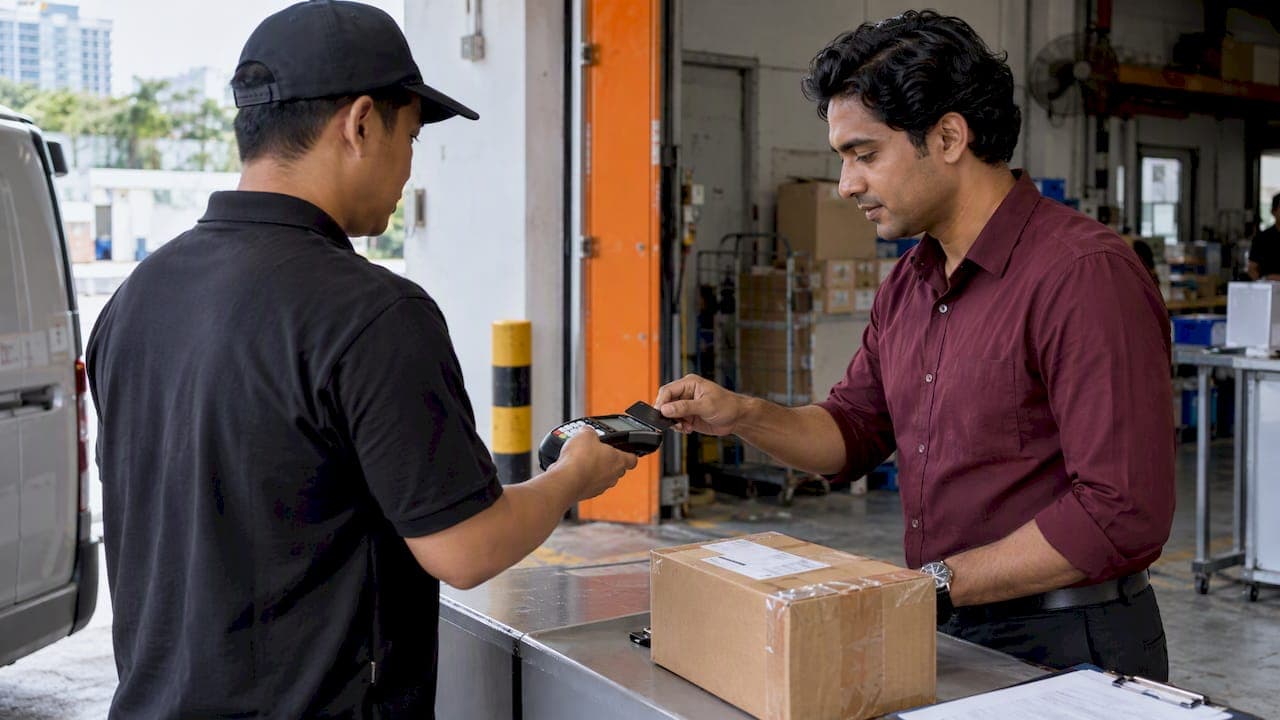
A courier brokerage fee is a service charge for clearing your parcel through customs in the destination country. It is separate from the shipping rate, from customs duty and from taxes. It is usually billed to whoever receives the parcel, unless the sender prepays it. This guide explains when it applies, how it differs from similar charges, and how to keep it from surprising you.
TL;DR
- A brokerage fee pays a customs broker, hired by the courier, to file the paperwork that releases your parcel. It is not a tax and not a duty.
- It is often billed to the recipient, because the seller's shipping and handling charge generally does not include clearance costs.
- Import processing fees, duties, taxes, disbursement fees and additional handling surcharges are different charges, and invoices sometimes blend them.
- You can avoid most surprises by choosing a delivery term that prepays charges, declaring the goods accurately, and asking for an itemized breakdown before you ship.
- Once the courier has filed the customs entry, the fee has been incurred, so settle the question before the parcel moves.
Table of Contents
- What a courier brokerage fee actually covers
- When courier brokerage fees are charged
- Who pays: sender or recipient?
- Brokerage fee, import processing fee, duty and tax: what is what
- How brokerage charges are calculated
- Additional handling surcharges are a different cost
- Other charges that arrive after the brokerage fee
- How to avoid or reduce surprise clearance costs
- Perspective: what we see when we compare couriers
- Ship from Singapore with clearer costs
- FAQ
- Sources
What a courier brokerage fee actually covers
When a parcel crosses a border, someone has to tell the customs authority what is inside, what it is worth and where it came from. For courier shipments, U.S. Customs and Border Protection explains that the commercial courier usually hires a customs broker to expedite the shipment through customs, and the broker then enables delivery to the recipient.
The brokerage fee pays for that work. In practice it covers:
- Reviewing the commercial invoice and customs declaration
- Classifying the goods and submitting the entry electronically
- Communicating with customs if questions come up
- Releasing the parcel for final delivery
It does not cover the cost of the goods, the freight, the duty or any tax the destination country charges. The same CBP page separates broker charges from shipping and handling and from customs duty, and that distinction is the key to reading any courier invoice.
You may see the same charge under different names: customs clearance fee, brokerage charge, import clearance fee or entry fee. The label changes by carrier and country, but the idea is the same. It is a payment for a service, not a payment to the government.
When courier brokerage fees are charged
Brokerage fees appear when a courier, rather than a national postal service, carries the parcel across a border and handles formal customs clearance in the destination country. The common triggers are:
- Commercial courier delivery. If an express or economy courier clears the parcel, expect the broker's work to be billed somewhere in the chain.
- Duty or tax is due. Many couriers charge a clearance fee when they advance duties and taxes on the recipient's behalf. Our guide to the disbursement fee on courier charges covers that second fee in detail.
- The recipient pays charges on delivery. If the delivery term leaves import costs with the receiver, the courier collects them at the door or by payment link.
- Higher-value or complex shipments. A parcel with several product lines, restricted items or a high declared value takes more clearance work than a single low-value item.
Some services fold brokerage into the price. Others leave it as a separate line. Neither is wrong, but you need to know which one you bought. In the United States, for example, fee structures differ by courier and by shipment value, so a courier's own published schedule is the place to check the exact amount for your route.
National postal services follow a different model. Instead of a commercial broker, the recipient may be charged a postal handling or customs clearance charge when duty is collected. USPS describes prepaid import duties as covering duties, taxes and fees in advance, which is the postal version of paying clearance costs up front.
Who pays: sender or recipient?
The short answer: the importer is ultimately responsible, and the importer is normally the recipient. CBP states that the importer is ultimately responsible for paying duty, and that courier shipments may also involve broker fees that can be billed to the buyer.
CBP also warns that shipping and handling quoted by a seller generally does not automatically include the broker's clearance costs or import duty. Those may be extra charges the buyer is responsible for. This is why people feel ambushed: they paid shipping at checkout and assume the matter is closed.
It helps to know the three common delivery terms:
| Term | Who pays duties, taxes and clearance | What the recipient experiences |
|---|---|---|
| Recipient pays (often called DAP or unpaid) | The receiver, on or before delivery | A bill arrives with or after the parcel |
| Sender pays (often called DDP or prepaid) | The sender, at booking | Nothing to pay at the door |
| Mixed arrangement | Sender pays freight, receiver pays brokerage | A smaller bill for clearance only |
If you are a sender in Singapore shipping to a friend, a customer or a family member abroad, ask which term your booking uses. If you sell online, decide deliberately. Many buyers abandon orders, or refuse parcels, when they are hit with an unexpected fee at the door.
Brokerage fee, import processing fee, duty and tax: what is what
Invoices mix several charges that sound alike. Here is how to separate them.
| Charge | What it pays for | Who receives the money |
|---|---|---|
| Brokerage fee | The broker's customs clearance service | The broker or courier |
| Import processing fee | A government or agency processing charge in some countries | The customs authority or agency |
| Customs duty | A tax on the goods based on classification, value and origin | The government |
| VAT, GST or sales tax | A consumption tax collected at import in many countries | The government |
| Disbursement fee | The courier's charge for advancing duty and tax on your behalf | The courier |
| Storage or demurrage | Holding the parcel past a free period | The warehouse or terminal operator |
Some governments list the import processing charge on its own line next to brokerage, duty and VAT. The Philippine Bureau of Customs duty and tax estimator is one example of an official tool that shows these as separate items. The same logic applies elsewhere: a processing charge goes to an agency, while the brokerage fee goes to the party that did the clearing work.
The practical rule is this. Duty and tax depend on what you ship and where. Brokerage and disbursement fees depend on who clears the parcel and how they price it. If an invoice shows one combined number, ask for it to be itemized.
How brokerage charges are calculated
There is no single global formula. In many markets, brokers and couriers set their own rates in open competition, although some countries oversee or set minimums. The result is that the same parcel can attract different fees depending on the courier and the lane.
Common pricing methods include:
- A flat fee per entry. One charge per customs filing, regardless of contents.
- A value-based scale. The fee steps up as the declared value rises, sometimes with a minimum and a percentage above a threshold.
- Per-line charges. An extra amount for each distinct product line on the invoice.
- Service-level inclusion. Some express products bundle clearance into the rate, so no separate brokerage line appears.
The factors that move the number are fairly consistent:
- Declared value. Higher value often means a higher fee or a higher tier.
- Number of items and tariff lines. A box with one product is simpler than a mixed box with eight.
- Type of entry. Low-value, informal and formal entries involve different workloads.
- Restricted or regulated goods. Items that need permits or other agency review take more handling.
- Accuracy of paperwork. Missing descriptions, wrong values or absent invoices can cause delays and added charges.
Good practice, which official guidance for brokers also encourages, is a transparent invoice that distinguishes pass-through government payments from the professional service fee. When you get a quote, ask for a sample itemized invoice and compare the total cost of clearing the parcel, not just the headline fee.
Additional handling surcharges are a different cost
People often search for brokerage fees and additional handling surcharges together, because both show up as unexpected lines. They are unrelated. Brokerage relates to customs paperwork. An additional handling surcharge relates to the physical parcel.

According to PayPal's explanation of carrier additional handling, this surcharge covers special handling during transport and is usually triggered by weight, dimensions, shape or packaging. Its examples include an international package over 70 pounds, excessive length or girth, non-corrugated or shrink-wrapped packaging, protruding contents, wheels or straps, and cylindrical or irregular shapes.
You can avoid most of these by:
- Using a sturdy corrugated box that fits the contents with little empty space
- Removing straps, wheels or loose attachments, or packing them inside
- Splitting very heavy loads into several parcels
- Checking the courier's published size and weight limits before you book
Size also affects the base rate. Couriers bill on the greater of actual or volumetric weight, which we explain in our article on Singapore courier rates and the 5,000 divisor. A well-packed box helps with both the base freight and any surcharge.
Other charges that arrive after the brokerage fee
The brokerage fee is rarely the only extra. Watch for these:
- Fuel surcharges. Usually part of the freight price, and they change often. Our fuel surcharge calculator guide shows how to estimate them.
- Storage fees. If a parcel sits at a bonded warehouse or terminal beyond a free period during clearance, daily charges can accumulate. Fernable's guide to reading broker quotes describes how these costs can escalate.
- Redelivery or return charges. If nobody accepts the parcel or the recipient refuses to pay, return costs may be billed.
- Duty and tax adjustments. If customs reclassifies an item or questions its value, the amount due can change.
A recipient who refuses a parcel because of fees may still be asked to cover some charges, depending on the courier's terms. Settle expectations with your recipient before you ship.
How to avoid or reduce surprise clearance costs
Most surprise bills come from missing information, not from mistakes by the courier. Here is a sequence that works for both individuals and sellers.
- Confirm the delivery term at booking. Decide whether you or the recipient will pay import costs, and make sure the recipient knows.
- Declare the contents honestly and in detail. Write "cotton T-shirts, 4 pieces" rather than "clothes". Match the value on the invoice to what was actually paid.
- Check restricted and prohibited items. Batteries, liquids, food, supplements and some electronics face limits in many countries. Our guide to the role of customs in shipping explains what customs reviews.
- Compare the total, not the base rate. One courier may look cheaper until clearance, surcharges and fuel are added. Our piece on why courier comparison saves money walks through this.
- Ask for the courier's clearance terms in writing. Know whether the service includes brokerage or bills it separately.
- Do not wait until the parcel is in transit to ask questions. Once the courier has filed the entry, the fee is incurred and generally cannot be reversed, as ImportCost notes.
There are also alternatives to the courier's default broker. Shippers can appoint their own broker, self-file where the rules allow, or choose a postal service, which uses a postal handling process instead of commercial brokerage. These routes can suit regular shippers, but they take more work and are not always cheaper for a single parcel.
Importer of record and bulk shipments
Businesses sending goods regularly to a foreign market sometimes outsource clearance entirely. One model is to use a service that acts as the importer of record and handles duties, VAT and compliance. If you are comparing ways to arrange customs clearance for imported goods, importer of record and cross-border compliance services are one option to evaluate against courier-led clearance.
Perspective: what we see when we compare couriers
We see the same pattern again and again. Shippers compare base rates, pick the lowest, and meet the real cost when the recipient is asked to pay at the door. A cheap rate that leaves the receiver with a clearance bill is not cheap for the receiver, and it often damages the sender's relationship with them.
Our view is simple. Compare the whole journey: freight, pickup, documentation, transit time and who handles import costs. Choose the speed that fits the urgency. Priority suits time-sensitive parcels, Connect Plus balances speed and cost, and Economy suits parcels that can wait. Then tell your recipient what to expect before the parcel leaves Singapore.
For documents, we recommend preparing the invoice at booking, not after pickup. A complete invoice reduces holds at the border, and holds are where storage fees and delays begin. We also suggest that small businesses decide on a delivery term per market, not per parcel, so customers see consistent pricing.
— SP
Ship from Singapore with clearer costs
With Simply Parcel you can compare couriers for international shipments from Singapore, book a free doorstep pickup, and get shipping labels and customs documentation generated for you. You choose between Priority, Connect Plus and Economy shipping, and you can follow the parcel with real-time tracking. We have no monthly volume commitment, so you can use us for a single parcel or a steady flow of orders.

To see your options, get an instant quote for your parcel or explore our shipping speeds. If you are weighing two express services, our comparison of Priority and Connect Plus explains the difference.
FAQ
Is a brokerage fee the same as customs duty?
No. Customs duty is a tax on the goods and goes to the government. The brokerage fee pays the broker for the clearance service. CBP separates these from shipping and handling in its guidance on internet purchases, and your invoice should list them on separate lines.
Who normally pays the brokerage fee?
Usually the recipient, because the importer is ultimately responsible for import costs and the seller's shipping charge generally does not cover them. A sender can often prepay by choosing a delivery term that includes duties, taxes and clearance. Confirm the term when you book.
Can I get a brokerage fee refunded?
It is difficult once the courier has filed the entry, because the service has been performed. If you think you were charged incorrectly, ask the courier for an itemized invoice and dispute specific lines, such as a duplicate charge or a wrong value. The best time to act is before shipping.
What triggers an additional handling surcharge?
Weight, size, shape and packaging. Examples include packages over 70 pounds, excessive length or girth, shrink-wrapped or non-corrugated packaging, and cylindrical or irregular shapes. Packing in a sturdy corrugated box that fits the contents usually avoids it.
Do I pay a brokerage fee on low-value parcels?
It depends on the destination country, the courier and the delivery term. Some couriers waive the fee below a value threshold, and others charge a minimum. Check the courier's schedule for your destination before you ship.
Sources
- Internet Purchases, U.S. Customs and Border Protection
- Prepaid Import Duties, USPS
- Duty and tax estimator, Philippine Bureau of Customs
- What is UPS Additional Handling? PayPal US
- Reading a customs broker quote, Fernable
- How to avoid brokerage fees, ImportCost