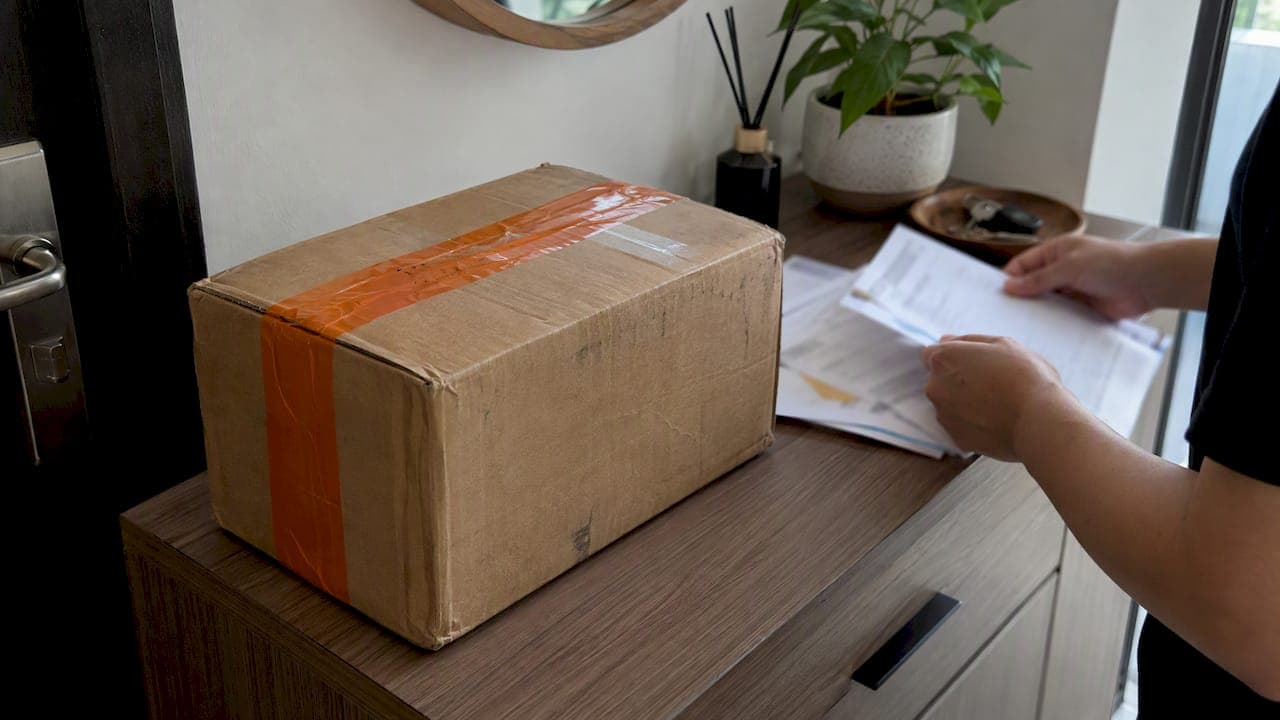
A disbursement fee is a courier's charge for paying your import duty and taxes to customs upfront, then collecting that money back from you. It is not a tax. It is the courier's own service charge, and it is added on top of the duty and tax you already owe. You can usually reduce it or avoid it by choosing who pays the import charges before the parcel ships.
This guide explains how the fee works, how it is typically calculated, why it surprises senders and receivers, and what you can do about it. The customs examples use Singapore, because Singapore Customs publishes clear guidance. Other countries have their own rules, so check the destination authority and your courier's tariff.
TL;DR
- A disbursement fee is the courier's commercial charge for advancing import duty and tax to customs. It is separate from the duty and tax themselves.
- Carriers often set it as a percentage of the amount advanced with a minimum charge, so a small duty bill can carry a proportionally large fee.
- You can avoid it in most cases by prepaying duties and taxes at booking, or by shipping on terms where the sender covers them.
- Ask the courier for an itemized bill that separates government charges from its own fees before you pay.
- If a charge looks wrong, request the duty receipt and the calculation basis from the courier, not from customs.
Table of Contents
- What a courier disbursement fee actually is
- How the process works from declaration to delivery
- How much a disbursement fee costs
- Why you were charged one
- Duty and tax versus the courier's fee
- How to avoid or reduce a disbursement fee
- If you are the receiver and a fee shows up
- How to dispute a charge that looks wrong
- Our perspective: plan the import stage at booking
- Shipping from Singapore with clearer costs
- Special cases to check before you ship
- FAQ
- Sources
What a courier disbursement fee actually is
When a parcel crosses a border, import duty and tax may be due. Express couriers usually handle the customs declaration for the parcel. To keep it moving, the courier pays the government charge first and invoices the receiver afterward. That advance is the disbursement.
The fee is what the courier charges for extending that credit and handling the payment. Singapore Customs lists disbursement or administrative fees separately from GST and duty. In other words, the government gets its tax, and the courier gets its fee. They are two different line items from two different parties.
The word "disbursement" has a general meaning too: a payment made on someone else's behalf, such as a lawyer paying a court fee for a client. A courier does the same thing with your customs bill.
You may see the same charge under other names:
- Disbursement fee
- Duty and tax advancement fee
- Duty and tax processing fee
- Handling fee or administrative fee
- Ancillary charge
The names vary by carrier. The test is the same each time: is this an amount the courier keeps for its service, or an amount it passes on to customs?
How the process works from declaration to delivery
Understanding the order of events explains why the fee appears when it does. For courier imports into Singapore, the general workflow looks like this:
- The courier submits the import declaration to customs.
- Customs assesses the goods' CIF value (cost, insurance and freight) and works out any GST or duty.
- The courier collects the government charges before or on delivery, and the goods are released.
- The courier may separately add handling or disbursement fees.
This is the sequence Singapore Customs describes for courier parcels. If a courier is handling delivery of your parcel, the agency tells you to check with that courier about its charges. Customs also notes that additional service fees for services rendered, such as customs clearance, may apply.
Treat your shipping quote and your import invoice as two different cost stages. The quote covers moving the parcel. The import invoice covers what happens at the border. Many unpleasant surprises come from assuming the first includes the second.
How much a disbursement fee costs
There is no single rate. Each carrier publishes its own tariff, and the fee often varies by destination country. Two patterns are common:
- A percentage of the amount advanced. One industry guide says many brokers and couriers charge roughly 2% to 5% of the duties or taxes they disburse.
- A flat minimum. The fee is often "the greater of" a fixed amount or a percentage.
A published carrier tariff shows the second pattern clearly. In one EU disbursement fee schedule, Austria is listed at EUR 15 or 3% of the advanced amount, whichever is higher. Belgium is listed at EUR 14.5 or 2.75% of the credit advanced, whichever is higher. That document is dated 2024, so treat it as an example of the structure, not as current pricing.
A worked example
Imagine a carrier charges the greater of 15 or 3% of the amount advanced. These numbers are illustrative, not a real tariff.
| Duty and tax advanced | 3% of that amount | Fee charged | Fee as share of advance |
|---|---|---|---|
| 50 | 1.50 | 15 | 30% |
| 200 | 6.00 | 15 | 7.5% |
| 600 | 18.00 | 18 | 3% |
| 1,500 | 45.00 | 45 | 3% |
The minimum is what stings on small parcels. A 50 duty bill carries a fee worth almost a third of it. On larger bills the fee shrinks to the percentage rate. This is why personal gifts and small online orders feel the fee most.
Fees also change. Carriers revise their tariffs, and the amount you were charged last year may not match this year. Always read the current tariff for your carrier and lane.
Why you were charged one
Most people meet the fee because the parcel was shipped on terms that left import charges to the receiver. The courier paid at the border, then billed whoever was on the receiving end. Common triggers:
- The sender did not prepay duties and taxes. The default for many services is that the receiver pays on arrival.
- The parcel is above a relief threshold. Singapore, for example, grants GST relief only to postal or air imports with a CIF value not exceeding S$400, with exceptions such as liquor and tobacco. Relief is not granted for sea or land imports.
- The goods are dutiable or controlled. Category matters as much as value.
- The courier cleared the goods for you. Even a small tax bill triggers the fee if the courier advanced it.
That last point is worth noting for students, expats, dropshippers and e-commerce sellers. A shipment's value alone does not decide the outcome. Product category, controls, the CIF calculation and the transport mode can all change taxes, permits and fees. A guide on shipping candy internationally shows how food gifts raise the same questions about category and customs holds.
Duty and tax versus the courier's fee
This distinction prevents most disputes, so keep it in front of you when you read a bill.
| Charge | Who receives it | What it pays for | Can the courier waive it? |
|---|---|---|---|
| Customs duty | Government | Tax on the goods | No |
| GST, VAT or other import tax | Government | Tax on the import | No |
| Disbursement or advancement fee | Courier | Advancing payment and handling it | Sometimes, depending on terms |
| Clearance or handling fee | Courier | Preparing the customs filing | Sometimes, depending on terms |
The first two lines are set by law in the destination country. The last two are commercial charges set by the courier. Ask for them to be itemized separately before you pay.
How to avoid or reduce a disbursement fee
You rarely need to pay the full fee if you plan before the parcel ships. Work through these steps in order.
- Decide who pays import charges before booking. If the sender prepays duties and taxes, the receiver is not billed on arrival, and the receiver-side advancement fee usually does not arise. Your carrier may charge a different handling fee on the sender side, so ask what it is.
- Declare the goods accurately. Use a precise description, the correct value and the correct country of origin. Vague or wrong declarations cause delays, re-assessment and extra charges. Our guide to what you need for a customs declaration in Singapore lists the details.
- Check whether relief applies. If your parcel qualifies for relief at the destination, there may be no tax to advance and so nothing to charge a percentage on. Confirm the threshold with the destination authority, not from a forum post.
- Understand the trade terms. Terms such as DAP and DDP decide who handles duties. Our article on Incoterms for ecommerce in Singapore explains how to avoid GST surprises.
- Keep the paperwork complete. A commercial invoice and proof of value help customs assess correctly the first time.
- Read the carrier tariff. The fee schedule is usually public. Look for the minimum charge and the percentage for your destination.
Some carriers also let a receiver pay duties directly through a customs portal, or collect the parcel from a post office instead of having the courier front the money. Whether this is available depends on the destination and the service, so ask before the parcel is in transit.
If you are the receiver and a fee shows up
It is easy to feel cornered when a courier asks for payment before delivery. A calm sequence works better.
- Ask for an itemized invoice. You want duty, tax and the courier's fees on separate lines.
- Check the goods description and declared value against your purchase receipt.
- Confirm the amount of duty and tax against the destination customs guidance.
- Ask the courier how it calculated its own fee, and which tariff version applied.
- Pay what is clearly owed, and dispute the rest in writing.
A note on who answers questions: the courier, not the customs authority, is normally responsible for explaining its own disbursement charge. If the question is about the tax itself, Singapore Customs explains how duties and GST are calculated. If it is about the courier's fee, go back to the courier.
How to dispute a charge that looks wrong
Start by collecting the documents that show which part of the bill is in question. Keep:
- The commercial invoice
- Proof of value, such as your order confirmation
- The tracking number
- Your payment confirmation
Then ask the courier for the duty or tax receipt, the calculation basis, the shipment's Incoterm and the applicable tariff version. These four items identify whether the dispute is about tax, valuation or the courier's fee. Each of those has a different owner and a different route to a fix.
If the value was wrong, the fix is a corrected declaration. If the Incoterm was wrong, the question is who agreed to pay what. If the fee was miscalculated, that is a billing correction with the courier. Writing to the right party first saves weeks.
Our perspective: plan the import stage at booking
We see the same pattern every week. A sender finds a good rate, books the parcel and treats the job as done. Then the receiver faces a bill at the door that nobody explained.
Our view is that the import stage deserves a decision at the moment of booking, not at the border. For us that means three habits:
- Compare the full cost, not only the freight line. Ask what happens to duties, taxes and courier fees at the destination.
- Prepare customs documents before pickup. Auto-generated documentation helps, but the description and value still have to be right.
- Match the service speed to the goods. Priority, Connect Plus and Economy suit different urgency and budgets, and each should be chosen with the receiving country's import process in mind.
If you are a student or expat sending belongings home, a seller shipping to customers abroad, or a dropshipper, the same rule holds. The more your receiver knows in advance, the fewer surprises there are on delivery day. Our guides on international shipping terminology and essential shipping documents for SMEs cover the vocabulary and paperwork behind those decisions.
— SP
Shipping from Singapore with clearer costs
If you are sending a parcel abroad from Singapore, you can compare Priority, Connect Plus and Economy options on Simply Parcel. We offer free doorstep pickup, auto-generated shipping labels and documentation, and real-time tracking, with no monthly volume commitment. Get a quote first, then decide how import charges should be handled for your destination. For ecommerce sellers, our ecommerce shipping guide for Singapore shows how to build this into your checkout and fulfillment flow.
Special cases to check before you ship
Gifts and personal items
A gift does not automatically escape tax. Singapore Customs states that GST and duty apply to most goods imported by post or courier, subject to the relief rules. Check the destination's rules for gifts before assuming a free pass.
Controlled and restricted goods
Liquor, tobacco and controlled goods follow different rules. They are the exceptions to GST relief in Singapore and may need permits. Confirm restrictions before you pack, because a held parcel can create storage and handling costs on top of any fee.
Sea and land shipments
Relief is not the same across transport modes. In Singapore, it applies to postal or air imports only, so a parcel arriving by sea or land is treated differently.

Business shipments
Sellers sending stock or customer orders should think about who the importer of record is. When the buyer is the importer and the sender has not prepaid duties, the buyer meets the fee. That can hurt reviews and returns. Many sellers choose to cover import charges at checkout for that reason. Our Shopify international shipping guide walks through the setup.
FAQ
What is a disbursement fee?
It is the courier's charge for paying your import duty and taxes to customs on your behalf and then recovering the money from you. It is separate from the duty and tax, which go to the government. The courier sets the fee in its own tariff.
Why do I have to pay a disbursement fee?
Because the courier advanced your customs charges, and the parcel was shipped on terms that left those charges to you as the receiver. The fee covers the courier's payment and handling work. If the sender had prepaid duties and taxes, you would normally not be billed this way on arrival.
Is a disbursement fee the same as customs duty?
No. Customs duty and import tax are paid to the government. The disbursement fee is a commercial charge that stays with the courier. Singapore Customs lists the two separately, so ask for them as separate lines on your bill.
How can I avoid a courier disbursement fee?
Prepay duties and taxes when you book, or agree trade terms under which the sender covers them. Declare value and goods accurately, and check whether relief applies at the destination. Read your carrier's tariff first, since minimum charges can make small bills expensive.
Who do I contact if the fee looks wrong?
Contact the courier. It is normally the party responsible for explaining its own disbursement charge. Ask for the duty receipt, the calculation basis, the Incoterm and the tariff version, and keep your invoice, proof of value and tracking number ready.
Sources
- Paying GST and Duty for Postal / Courier Items, Singapore Customs
- How Duties and GST Are Calculated, Singapore Customs
- Procedures for Courier Parcels, Singapore Customs
- Customs disbursement fees: why they exist and how to avoid them
- EU disbursement fee schedule (PDF, 2024)
- Understanding Disbursements: Payments Explained, Investopedia