
A remote area surcharge (RAS) is an extra fee courier companies add when a pickup or delivery address falls outside their standard, high-density service network. It usually runs as either a flat fee per shipment or a per-kilogram rate with a minimum charge, often somewhere between $10 and $50 depending on the carrier and destination. Before you book, check the carrier's postcode lookup tool or request a full quote so the fee never surprises you at checkout.
TL;DR:
- Remote area surcharges vary significantly between carriers, with fees typically ranging from $10 to $50 depending on the destination and provider.
- A location is classified as remote based on factors like distance from hubs, terrain, population density, and transportation challenges, which differ across carriers.
- Carriers often use flat fees, per-kilogram rates with minimum charges, or higher of both calculations, making small shipments especially costly under minimum-rate models.
- Checking each carrier’s postcode or remote area list before booking is essential, as classification criteria are carrier-specific and may change over time.
- Comparing multi-carrier quotes with an online platform like Simplyparcel reveals actual remote fees upfront, helping avoid surprise expenses and optimize shipping costs.
Table of Contents
- What Does "Remote Area" Actually Mean to a Carrier?
- Why Do Carriers Charge Extra for Remote Deliveries?
- How Do Carriers Calculate the Remote Area Surcharge?
- How to Check If Your Address Will Trigger the Surcharge
- Ways to Avoid or Reduce a Remote Area Surcharge
- How Simplyparcel Surfaces Remote Area Fees Before You Book
- Our Take: The Surcharge Isn't the Real Problem, Guesswork Is
- Ship Smarter With Simplyparcel's Multi-Carrier Quotes
- Sources
What Does "Remote Area" Actually Mean to a Carrier?
There's no single, universal definition of "remote" in the courier world. Each carrier draws its own lines based on its own delivery network, so an address that's remote to one company might be perfectly standard to another.
Carriers typically classify a location as remote using a mix of factors:
- Distance from the nearest sorting depot or distribution hub
- Population density and how many deliveries fit into a single route
- Island or cross-water locations requiring ferry or air transfer
- Difficult terrain, including mountainous or heavily rural regions
- How often a route runs. Some remote routes are serviced only two or three times a week instead of daily
Carriers publish their own postcode lists or ZIP code lookup tools to define exactly which addresses qualify. DHL, for example, maintains country-specific remote-area resources that spell out which postcodes trigger the fee for its network. Similarly, logistics providers like DSV publish downloadable remote-area tables so shippers can check before committing to a booking.
Here's the part senders miss most often: these lists are carrier-specific. A suburb that one courier treats as standard delivery might sit squarely on another's remote list. Never assume that because one carrier waived the fee, every carrier will.
Why Do Carriers Charge Extra for Remote Deliveries?
The surcharge isn't arbitrary. It reflects real costs carriers absorb every time a driver heads somewhere off the beaten path.
Delivering to a dense city block, a driver might drop off 40 parcels in an hour. Send that same driver 90 minutes outside town for a single delivery, and the math falls apart fast. Lower delivery density per route means each remote stop costs the carrier far more per parcel than an urban one.
A few other cost drivers stack on top of that:
- Longer routes and fewer stops per trip push up fuel and driver-hour costs
- Many carriers hand off remote deliveries to local subcontracted agents, who charge their own handling fees
- Manual handling, tail-lift trucks, or extra loading steps add cost for oversized or heavy items
- Weather delays, seasonal road closures, and failed first-attempt deliveries mean return trips the carrier has to absorb
Pro Tip: If you ship to the same remote address regularly, ask your carrier or aggregator whether a recurring pickup arrangement qualifies for a reduced or waived surcharge. Carriers sometimes treat scheduled, predictable volume differently than one-off remote drops.
How Do Carriers Calculate the Remote Area Surcharge?
Most carriers use one of three billing structures, and knowing which one applies to your shipment changes how you plan your budget.
- Flat per-shipment fee. A fixed dollar amount added regardless of weight. ForwardMe's help documentation cites an example remote delivery fee of $35 applied per shipment once an address is flagged as remote.
- Per-kilogram rate with a minimum. The carrier charges a set amount per kilogram, but never less than a floor amount, even for a 1-kilogram envelope.
- "Greater of" formula. The carrier calculates both a flat fee and a per-kg rate, then bills whichever number is higher. Industry summaries of common RAS billing models point to this structure as one of the most widespread across international couriers.
That minimum-charge structure hits light parcels the hardest. A 1-kilogram package and a 9-kilogram package can end up paying an identical remote surcharge if both fall under the minimum threshold, meaning the fee eats up a far bigger share of the total cost for small shipments.
The published carrier rate card is the only figure that matters for your specific route. Blog estimates and forum posts give you a ballpark, but the exact number always lives in the carrier's own tariff table or PDF for the country and postcode you're shipping to.
How to Check If Your Address Will Trigger the Surcharge
Don't guess. Confirming RAS status before you book takes a few minutes and saves you from an unwelcome line item after the fact.
- Run the address through the carrier's own postcode or RAS lookup tool. Most major carriers embed this directly into their online shipping calculator, and it flags the remote fee before you confirm the booking.
- Request a complete, itemized quote rather than a headline shipping rate. Look specifically for an "adjustment" or "surcharge" line. A quote that only shows the base freight rate is hiding the full picture.
- Check the same address against more than one carrier. Because classification criteria differ by network, the address that's remote for one courier may sit within standard delivery zones for another.
That third step matters more than most senders realize. Two carriers can look at the same rural postcode and reach opposite conclusions, simply because their depots and subcontractor networks sit in different places.
Ways to Avoid or Reduce a Remote Area Surcharge
You have more control over this fee than most people assume. A few adjustments, made before you book, often cut the cost significantly or eliminate it entirely.
- Ship to a nearby collection point or depot instead of the final address. Picking up at an urban depot bypasses the last-mile leg that triggers the fee in the first place.
- Consolidate multiple parcels into one shipment, or increase parcel weight slightly. When a minimum per-shipment charge applies, a heavier parcel spreads that fixed cost across more kilograms, lowering the effective surcharge per kilogram.
- Compare quotes across multiple carriers rather than booking with the first one you check. The same address that's remote on one network may fall inside standard service on another, and comparing options through strategies that lower shipping costs often surfaces that difference quickly.
- Negotiate a standing rate for recurring shipments. Businesses that ship to the same remote address weekly or monthly have real leverage to ask for a flat negotiated rate instead of paying the standard surcharge every time.
- Batch pickups instead of sending single parcels sporadically. A scheduled bulk pickup gives the carrier route efficiency it can't get from one-off remote stops, and that efficiency sometimes translates into a lower quoted rate.
Pro Tip: If you're a light sender shipping small, low-weight parcels, focus on the depot pickup and consolidation tactics first. Carrier switching helps most when you ship regularly and have volume to negotiate with. For a single light parcel, a small adjustment in how you ship usually beats trying to find a carrier willing to waive the fee entirely.
How Simplyparcel Surfaces Remote Area Fees Before You Book
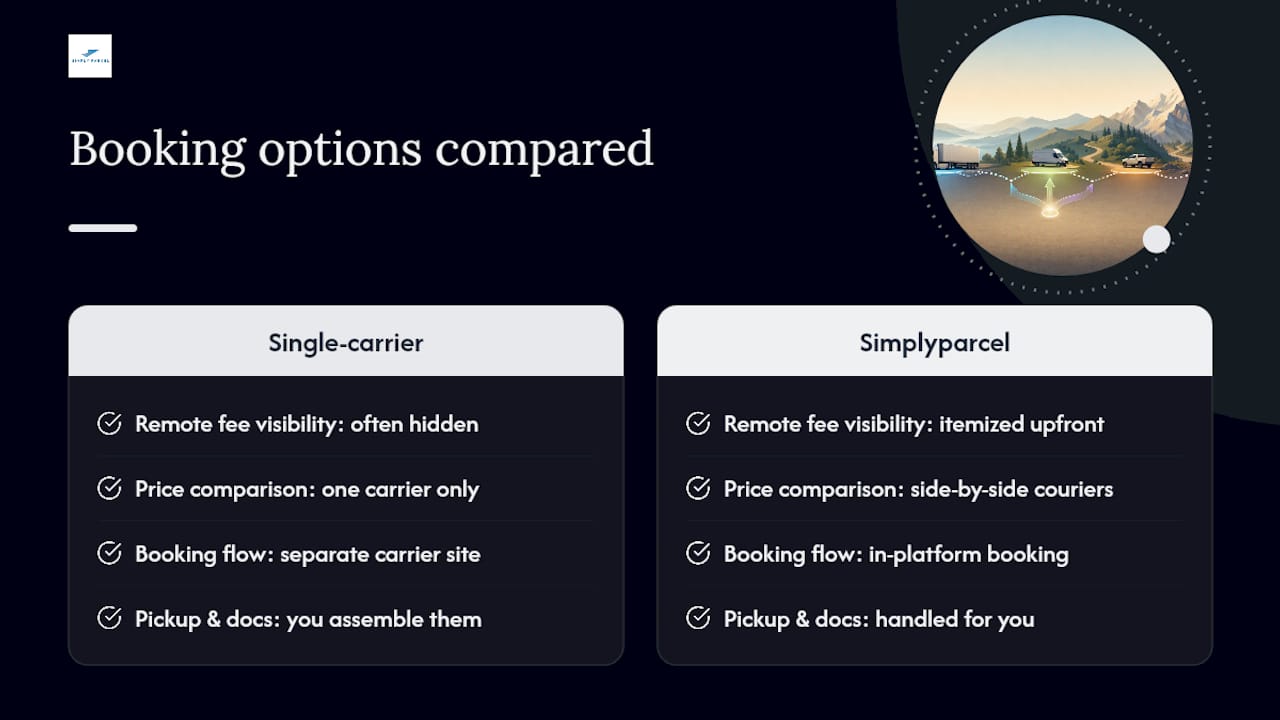
Because RAS classifications vary so much between carriers, comparing quotes side by side is the fastest way to find your real total cost. Simplyparcel works as a multi-carrier aggregator, so any remote area adjustment shows up as a clear line item on your quote instead of a surprise after booking.
Beyond quote comparisons, Simplyparcel supports instant international shipping quotes, online booking, scheduled pickups, and help preparing shipping labels and customs documentation. If you're budgeting for a shipment with other seasonal cost factors in play, it's worth reading how peak season surcharges stack on top of remote fees during high-volume periods.
Our Take: The Surcharge Isn't the Real Problem, Guesswork Is
The remote area surcharge itself is rarely the expensive part of shipping to a rural address. What actually costs senders money is booking blind, without checking whether the fee applies at all, and discovering it after the label's already printed.
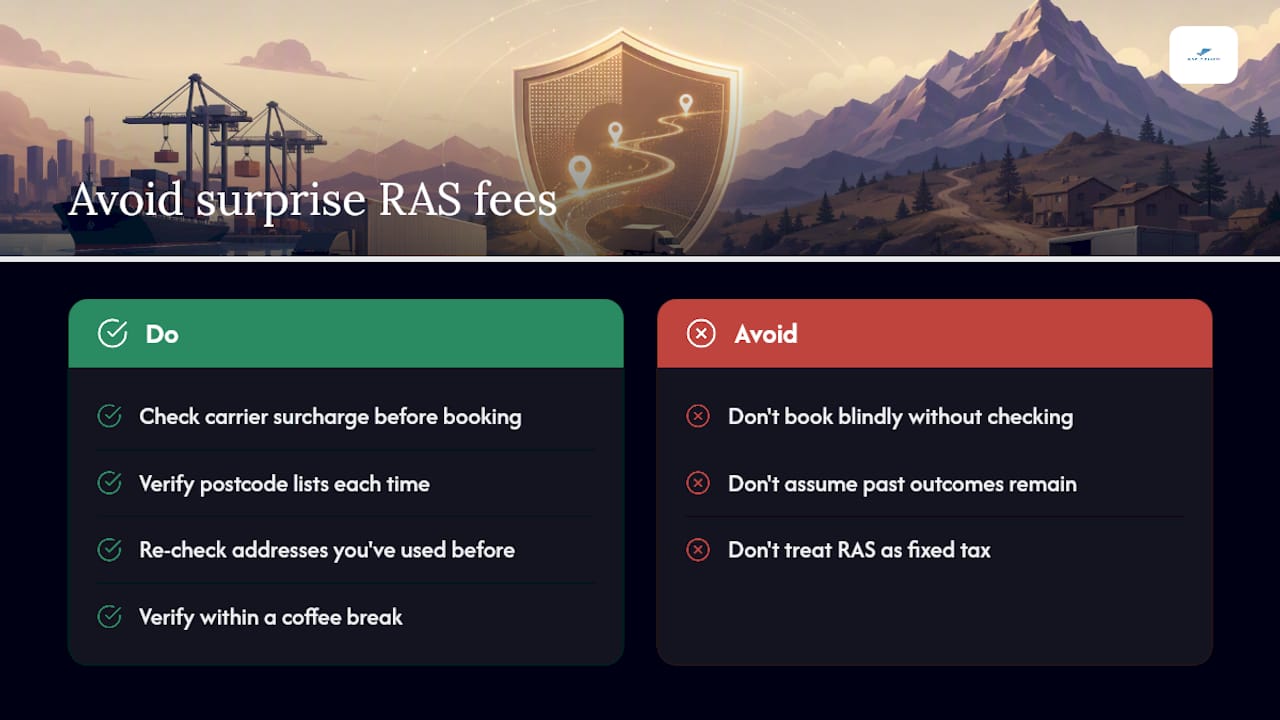
Most guidance online treats RAS like a fixed tax you simply absorb. That's backwards. Carrier classifications are inconsistent by design, built around each company's own depot network, not some universal standard for what counts as remote. That inconsistency is an opportunity, not just an inconvenience. The same rural address that costs $35 extra with one carrier might ship at standard rates with another.
Our honest advice: check before you commit, every time, even for addresses you've shipped to before. Carrier postcode lists change. Depot networks expand. What triggered a surcharge last year might not this year, and the reverse is just as true. Verification takes less time than a coffee break. Skipping it is the only real mistake senders make here.
— Simply
Ship Smarter With Simplyparcel's Multi-Carrier Quotes
Simplyparcel gives you something a single-carrier booking page never will: a side-by-side view of how different couriers price the exact same remote address, including any surcharge adjustment, before you commit to anything. Instead of guessing which carrier treats your delivery zone as standard, you see the real, itemized cost across multiple courier partners in one place.
That matters most for senders juggling personal shipments, e-commerce orders, or recurring business freight to addresses outside major city centers. Some shipping platforms handle the comparison, the online booking, pickup scheduling, and documentation, so you're not piecing together multiple carrier websites to find the lowest landed cost.
Ready to see what your shipment actually costs? Get an instant quote and check the full breakdown, remote fees included, before you book.