
Shipment consolidation is defined as the practice of grouping multiple smaller shipments into one larger, combined shipment to reduce costs and improve international shipping efficiency. This method eliminates redundant freight fees, fills container space more effectively, and simplifies customs processing for businesses and individuals alike. The two most widely used models are Less-Than-Container Load (LCL) consolidation and buyer's consolidation, each suited to different shipping volumes and supply chain structures. Understanding what is shipment consolidation gives you a direct path to lower freight costs, fewer customs headaches, and a measurably smaller carbon footprint per unit shipped.
What is shipment consolidation and how does it work?
Shipment consolidation works by collecting individual orders at an origin consolidation center, then grouping them by destination or carrier compatibility before sealing the load for transit. The consolidated load travels intact until it reaches the destination region, which reduces the number of times cargo is handled and lowers the risk of damage. At the destination hub, a freight station breaks the shipment apart in a process called deconsolidation, sorting each parcel or pallet for final delivery.
Customs processing is one of the clearest advantages of this model. Instead of submitting separate customs entries for every individual package, the entire consolidated shipment clears as a single unit. This cuts the volume of paperwork, reduces the number of customs inspections, and can actually speed up clearance compared to fragmented individual shipments.

The table below shows how the consolidated process compares to shipping orders individually across key operational factors.
| Factor | Individual shipments | Consolidated shipment |
|---|---|---|
| Customs entries | One per package | One for the full load |
| Handling steps | Multiple reloads per parcel | Sealed at origin, opened at destination |
| Damage risk | Higher due to repeated handling | Lower due to fewer touchpoints |
| Freight cost per unit | Higher (minimum fees per shipment) | Lower (shared container rate) |
| Paperwork volume | High | Reduced significantly |
Pro Tip: Align all supplier invoices, packing lists, and certificates of origin before the consolidation center seals the container. A single document error from one supplier can hold the entire shipment at customs.
What are the main types of shipment consolidation?
Three consolidation models cover the majority of international shipping scenarios. Choosing the right one depends on your shipment volume, supplier structure, and how much control you need over timing.
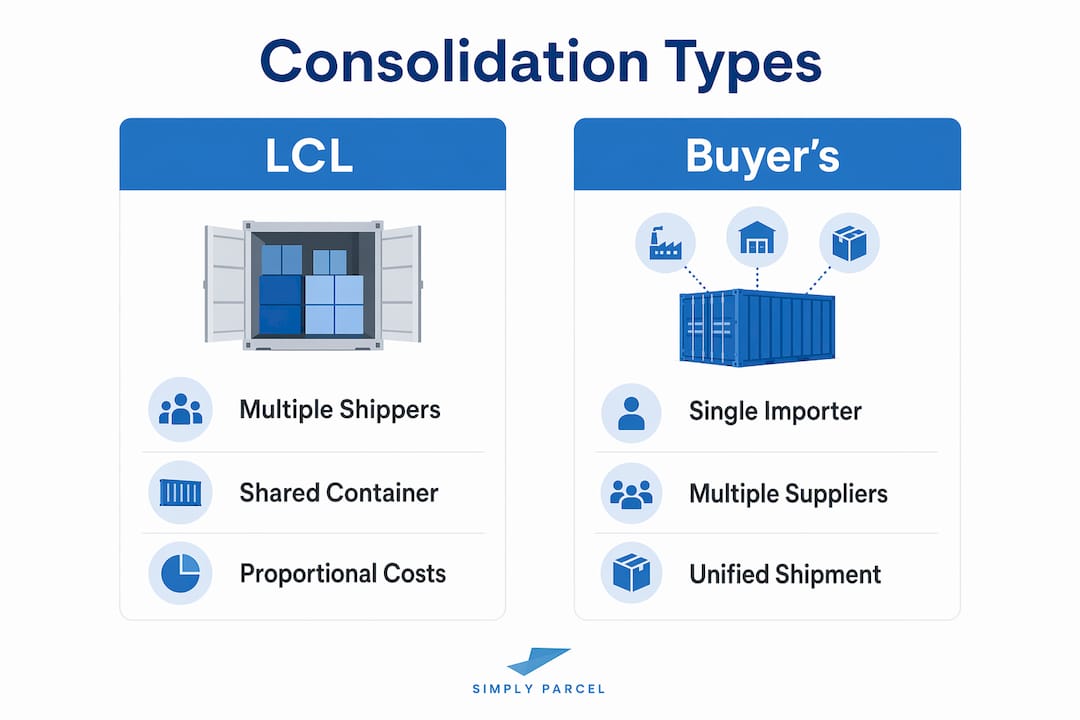
Less-Than-Container Load (LCL) is the most common model. A freight forwarder combines cargo from multiple unrelated shippers into one full container. Each shipper pays only for the space their cargo occupies, which makes LCL the go-to option for businesses that cannot fill an entire container on their own.
Buyer's consolidation works differently. Here, a single importer pools cargo from multiple suppliers under one shipment. This gives the buyer direct control over timing and documentation, and it allows smaller suppliers to benefit from container-rate economics without reaching a full container load alone. The result is more predictable delivery schedules and lower administrative overhead for the buyer.
Documentation consolidation focuses on paperwork rather than physical cargo. It combines shipping documents from multiple orders into a single set of records, reducing the administrative burden on customs brokers and logistics teams.
| Model | Best for | Cost control | Timing control | Complexity |
|---|---|---|---|---|
| LCL | Small to mid-size shippers | Shared | Carrier-driven | Low |
| Buyer's consolidation | Importers with multiple suppliers | High | Buyer-driven | Medium |
| Documentation consolidation | High-volume repeat shippers | Moderate | Flexible | Low |
Choose the right model based on these criteria:
- Use LCL when your cargo volume is too small to justify a full container and you ship to a single destination.
- Use buyer's consolidation when you source from multiple suppliers and want to control delivery timing and reduce per-unit freight costs.
- Use documentation consolidation when your primary pain point is paperwork volume rather than physical cargo grouping.
- Combine models when your supply chain includes both high-volume and low-volume supplier relationships.
What are the benefits and challenges of consolidated shipping?
The primary benefit of freight consolidation is direct cost reduction. Consolidation eliminates "dead space" costs by filling containers more efficiently and removing repeated minimum freight fees that apply to small individual shipments. For businesses shipping internationally on a regular basis, those savings compound quickly across multiple shipment cycles.
Beyond cost, consolidated shipments result in fewer vehicles on roads per unit shipped. That reduction in vehicle trips directly lowers carbon emissions, which matters for businesses with sustainability reporting requirements or environmental commitments. You can read more about how freight consolidation supports supply chain efficiency in practice.
Challenges exist, and ignoring them leads to budget surprises. The most common pitfalls include:
- Document errors from one supplier can delay the entire container at customs, affecting every other shipper in the load. Pre-consolidation document audits are the standard defense against this risk.
- Deconsolidation fees at the destination freight station add handling and sorting costs that many shippers forget to include in their budget. Total door-to-door cost evaluations outperform isolated freight rate comparisons for accurate budgeting.
- Timing dependencies mean your shipment waits until the consolidation center has enough cargo to fill the container. This can add days to transit time for time-sensitive orders.
- Damage liability in a shared container can be harder to assign when cargo from multiple shippers is involved.
Best practices to protect your shipment:
- Conduct a document audit before cargo reaches the consolidation center.
- Request a full cost breakdown that includes origin handling, ocean freight, destination handling, and deconsolidation fees.
- Build buffer time into delivery commitments when using LCL, especially for peak shipping seasons.
- Work with a freight forwarder experienced in consolidated loads who can flag compliance issues before they reach customs.
Pro Tip: Never compare consolidation quotes using freight rates alone. Always calculate the total door-to-door cost, including deconsolidation and destination handling fees, before deciding whether consolidation saves money on a specific lane.
How can businesses and individuals apply shipment consolidation?
The first step is analyzing your order data to find consolidation opportunities. Shipping orders individually as they arrive is the most expensive habit in international logistics. Batching orders by destination and timing them to align with consolidation windows cuts per-unit costs without changing what you ship.
Buyer's consolidation improves inventory velocity by synchronizing deliveries from multiple suppliers into predictable shipments. That predictability supports lean inventory management and steadier cash flow, because you replenish stock on a schedule rather than reacting to fragmented arrivals.
Follow these steps to implement consolidation in your shipping workflow:
- Audit your current shipments. List all outbound or inbound shipments by destination, weight, and frequency over the past 90 days.
- Identify consolidation windows. Group shipments headed to the same region within the same two-week period.
- Choose a consolidation model. Match LCL, buyer's consolidation, or documentation consolidation to your volume and supplier structure.
- Select a freight forwarder. Work with a forwarder who offers pre-consolidation audits and centralized documentation management.
- Align all supplier documents. Collect invoices, packing lists, and origin certificates before the consolidation center closes the container.
- Calculate total landed cost. Include origin fees, ocean freight, destination handling, deconsolidation, and last-mile delivery in your cost model.
- Track and review. Use real-time tracking to monitor consolidated loads and review total cost savings after each shipment cycle.
Digital load planning tools are making buyer's consolidation more accessible for smaller businesses. Multi-supplier coordination that once required manual spreadsheets now runs through logistics platforms that match cargo volumes, flag document gaps, and generate consolidated manifests automatically.
Key Takeaways
Shipment consolidation reduces international freight costs by combining smaller loads into one container, cutting fees, handling steps, and customs entries simultaneously.
| Point | Details |
|---|---|
| Core definition | Consolidation groups multiple shipments into one load to share container costs and reduce fees. |
| Top models | LCL suits small shippers; buyer's consolidation gives importers control over timing and suppliers. |
| Biggest cost trap | Deconsolidation fees at the destination must be included in total cost calculations. |
| Document risk | One supplier's paperwork error can delay the entire container at customs. |
| Inventory benefit | Buyer's consolidation synchronizes multi-supplier deliveries, supporting lean inventory management. |
What I've learned from watching shippers get consolidation wrong
Most shippers treat consolidation as a pricing decision. They compare a consolidated freight quote against an individual shipment rate, see the savings, and book. That approach misses the full picture, and it is where most budget overruns originate.
The shippers who get the most out of consolidation treat it as a process decision. They map their order patterns first, identify which lanes and supplier combinations create natural consolidation windows, and then choose a model. That sequence matters. Choosing a model before understanding your order data is like picking a container size before knowing what you are shipping.
The second thing I have seen trip up otherwise experienced logistics teams is document alignment. A single commercial invoice with the wrong HS code from one supplier in a buyer's consolidation can hold every other supplier's cargo at the destination port. The cost of that delay, in storage fees and missed delivery windows, routinely exceeds the freight savings the consolidation was supposed to generate. Pre-consolidation audits are not optional. They are the mechanism that makes consolidation actually work.
Finally, do not overlook the environmental angle. Fewer trucks on the road per unit shipped is a real, measurable outcome of consolidation. For businesses that report on Scope 3 emissions, consolidated shipping is one of the more straightforward levers available. That benefit rarely shows up in a freight quote, but it shows up in your sustainability report.
— Simply
Simplyparcel's approach to international consolidated shipping
Simplyparcel connects businesses and individuals in Singapore with trusted courier partners for international shipments, including consolidated shipping options that reduce costs without adding complexity. The platform generates shipping labels and documentation automatically, which directly addresses the paperwork alignment challenge that causes most consolidation delays. You can get an instant shipping quote to compare consolidated and standard rates across multiple courier partners in one place. Simplyparcel's economy, connect-plus, and priority tiers give you the flexibility to match consolidation timing with your actual delivery requirements. For businesses shipping regularly across borders, that combination of transparent pricing and documentation support removes the two biggest friction points in consolidated freight.
FAQ
What is the shipment consolidation meaning in simple terms?
Shipment consolidation means combining multiple smaller shipments into one larger shipment to share freight costs and reduce customs paperwork. It is the standard method for reducing per-unit shipping costs on international routes.
Why consolidate shipments instead of shipping individually?
Consolidating shipments eliminates repeated minimum freight fees, reduces handling steps, and cuts customs entries to a single submission. The result is lower cost per unit and a reduced risk of damage from multiple reloads.
What is the difference between LCL and buyer's consolidation?
LCL combines cargo from multiple unrelated shippers into one container, with each shipper paying for their share of space. Buyer's consolidation pools cargo from multiple suppliers under one importer, giving the buyer direct control over timing and documentation.
How does shipment consolidation affect customs clearance?
Consolidated shipments clear customs as a single unit, reducing the number of entries and inspections required. This can speed up overall clearance compared to submitting separate entries for each individual package.
What costs should I include when calculating consolidation savings?
Include origin handling fees, ocean freight, destination handling, deconsolidation fees, and last-mile delivery in your total cost model. Comparing only freight rates without deconsolidation costs produces inaccurate savings estimates.