
Door-to-door shipping is a logistics service where goods are picked up from the sender's location and delivered directly to the recipient's address, covering every step including customs clearance and last-mile delivery. The industry also calls this service end-to-end delivery or house-to-house shipping. Both terms mean the same thing: one provider manages the full journey so you never have to coordinate separate carriers, customs brokers, or trucking companies on your own. For individuals sending personal items and businesses shipping commercial freight, this model removes the most frustrating parts of international logistics.
What is door to door shipping and what does it include?
Door-to-door shipping covers the complete transportation chain from origin to destination. The freight forwarder manages every stage, including customs paperwork and the final delivery leg, so the customer has one point of contact throughout. This is the defining feature that separates it from other freight models where responsibility shifts between parties at each transit point.
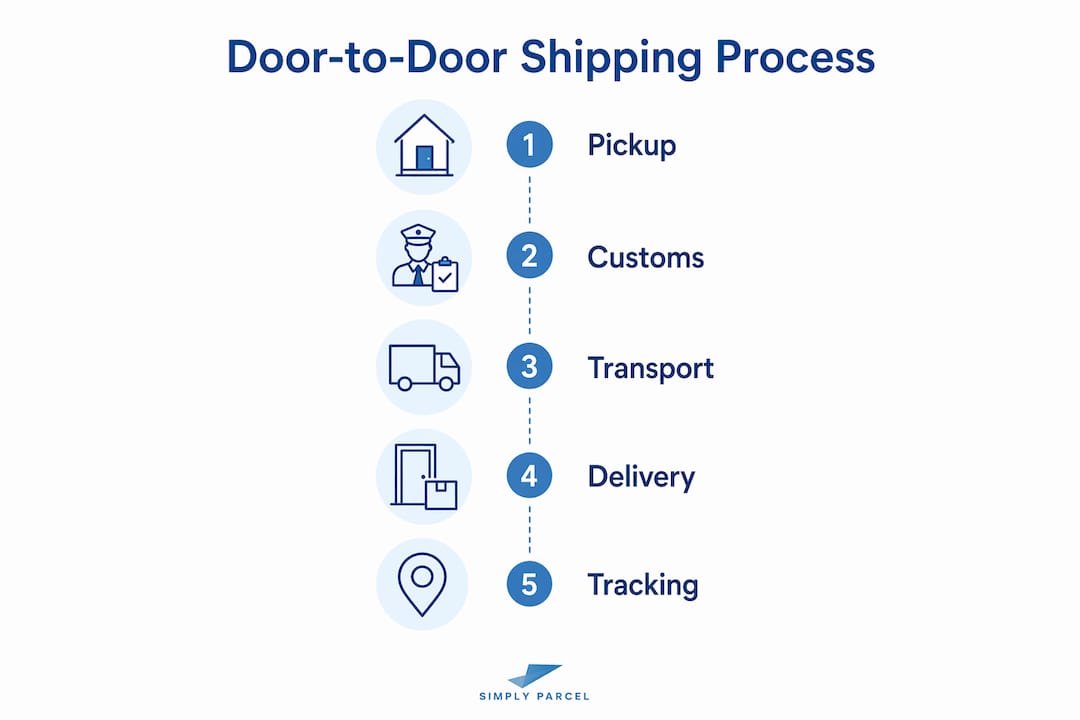
The service typically includes these steps:
- Pickup at origin: A carrier collects the shipment directly from your home, warehouse, or business address.
- Main transportation: Freight moves by air, sea, rail, or road depending on distance, budget, and urgency. International shipments often use multimodal transport, combining ocean freight with truck delivery for the final leg.
- Customs clearance at origin and destination: The forwarder handles export declarations, import duties, and all required documentation on both ends.
- Terminal handling and drayage: Short-distance trucking moves the cargo between ports, terminals, and the final address.
- Last-mile delivery: The shipment arrives at the recipient's exact address, not a nearby depot or port facility.
Pro Tip: Ask your provider for a written breakdown of every service included in the quote. Pickup, drayage, terminal handling, and unloading equipment are sometimes listed separately, and missing one can add unexpected costs at delivery.
Understanding customs procedures in international shipping is especially relevant here because the forwarder's ability to clear goods efficiently at both ends directly affects your delivery timeline.
How does door to door shipping compare to other methods?
The clearest comparison is between door-to-door and port-to-port shipping. Port-to-port requires the customer to arrange pickup at origin and final delivery from the destination port independently. Door-to-door shifts that entire responsibility to the freight forwarder. Fewer handoffs mean fewer opportunities for delays, miscommunication, or damage.

| Feature | Door-to-door | Port-to-port | Door-to-port |
|---|---|---|---|
| Pickup at sender's address | Yes | No | Yes |
| Customs clearance managed | Yes | Partial | Partial |
| Final delivery to recipient | Yes | No | No |
| Customer coordination required | Minimal | High | Moderate |
| Typical cost | Higher | Lower | Mid-range |
| Best for | Convenience-focused shippers | Experienced importers | Partial control preferred |
Port-to-port costs less because you handle more of the logistics yourself. That trade-off works well for large importers with established customs brokers and trucking contracts. For most individuals and small businesses, the time and complexity saved by door-to-door delivery outweigh the price difference. Door-to-door consolidates transport stages under one provider, cutting delays and reducing damage risk with a more predictable workflow.
Door-to-port sits in the middle. The carrier picks up from your address but drops off at the destination port. You then arrange customs clearance and local delivery yourself. This option suits businesses that already have a local logistics partner at the destination but want help on the origin side.
What factors affect door to door shipping costs and timelines?
Door-to-door freight shipping costs more than basic port-to-port rates because the quote bundles multiple services. Each component adds to the total, and not every provider includes all of them by default.
Key cost components include:
- Pickup charges: The fee for collecting the shipment at your address.
- Freight cost: The main transportation charge based on weight, volume, and mode (air vs. sea vs. road).
- Customs fees: Import duties, taxes, and brokerage fees at the destination country.
- Terminal handling charges (THC): Fees for moving cargo through port or airport terminals.
- Drayage: Short-distance trucking between the terminal and the final delivery address.
- Unloading equipment: For heavy or oversized shipments, cranes or forklifts may be required and billed separately.
Distance and shipment size are the two biggest cost drivers. Air freight moves faster but costs significantly more per kilogram than ocean freight. Special requirements like temperature control, hazardous material handling, or oversized dimensions add further charges.
Timelines vary widely. Air freight between Singapore and Europe typically takes 3–7 days. Ocean freight on the same route runs 25–35 days. These figures shift based on port congestion, customs processing speed, and the efficiency of the last-mile carrier at the destination.
Pro Tip: Verify that drayage and terminal handling charges are included in your quote before signing. These two line items are the most common source of surprise fees on door-to-door ocean freight shipments.
Reviewing affordable freight solutions from Singapore can help you benchmark quotes and understand which cost components are standard versus optional in your shipping lane.
What are the logistical considerations for door to door delivery?
Getting the transportation right is only part of the equation. The physical conditions at the delivery address matter just as much, especially for large or heavy shipments.
- Prepare the delivery site. Customers must provide sufficient space and stable ground for the delivery vehicle to access and unload. A narrow driveway or soft ground can prevent a truck from completing the delivery, causing delays and additional fees.
- Confirm unloading equipment in advance. For container shipments or heavy machinery, cranes and forklifts must be arranged before the delivery date. Leaving this until arrival creates costly delays.
- Organize documentation early. Commercial invoices, packing lists, certificates of origin, and any required permits should be ready before the shipment departs. Missing paperwork is the leading cause of customs delays.
- Maintain clear communication with your forwarder. Share accurate delivery address details, contact numbers, and any access restrictions at the destination. A wrong address or a locked gate can send a shipment back to a depot.
- Use tracking tools actively. Unified logistics software and ERP systems keep suppliers, forwarders, and customers updated in real time. Tracking your shipment proactively lets you spot delays before they become problems.
Site preparation is the most overlooked step in door-to-door container shipping. Businesses importing machinery or large equipment often focus entirely on the freight contract and forget to assess whether their facility can physically receive the delivery. Communicating site conditions to your logistics provider before booking prevents the most avoidable delays.
How do you choose the right door to door shipping service?
Selecting the right provider determines whether your experience is smooth or frustrating. Not all door-to-door logistics services cover the same routes, modes, or service levels.
Focus on these factors when evaluating providers:
- Geographic coverage: Confirm the provider handles both the origin and destination countries, including customs clearance at both ends.
- Quote transparency: A reliable provider itemizes every charge. Avoid quotes that bundle everything into a single number with no breakdown.
- Carrier network: Providers with established relationships with major carriers offer more reliable transit times and better rates.
- Tracking capability: Real-time shipment tracking tools give you visibility at every stage, from pickup to final delivery.
- Customer support: Direct access to a support team matters when customs issues or delivery exceptions arise.
Consider the specific use case. An e-commerce business shipping parcels internationally needs fast, reliable air freight with automated documentation. A manufacturer importing heavy machinery needs a provider experienced in container logistics and oversized cargo handling. A person relocating internationally needs a provider who handles personal effects and household goods customs categories. Freight forwarders coordinate multimodal transport and manage the documentation complexity that makes international door-to-door delivery work reliably.
Overcoming common international shipping challenges becomes much easier when you choose a provider whose service scope matches your specific shipment type from the start.
Key Takeaways
Door-to-door shipping is the most complete logistics option available, covering pickup, customs clearance, and final delivery under one provider, which reduces delays, minimizes handoffs, and removes the need for customers to coordinate multiple parties.
| Point | Details |
|---|---|
| Full-service coverage | Door-to-door handles pickup, customs, and last-mile delivery under one provider. |
| Fewer handoffs, fewer delays | Consolidating stages with one forwarder cuts coordination errors and damage risk. |
| Verify quote inclusions | Confirm drayage, terminal handling, and unloading equipment are in your quote upfront. |
| Site preparation matters | Prepare adequate space and stable ground before a container or heavy shipment arrives. |
| Match provider to shipment type | E-commerce parcels, heavy freight, and personal moves each require different service expertise. |
Why door to door shipping is worth the investment
After working in international logistics for years, the pattern I see most often is this: shippers choose port-to-port to save money, then spend more fixing the problems that come from managing the final leg themselves. Customs delays, missed delivery windows, and damaged goods from poorly coordinated handoffs add up fast. The cost savings disappear quickly.
What I find genuinely underappreciated about door-to-door delivery is the risk transfer. When one provider owns the entire journey, accountability is clear. There is no debate about which carrier caused the damage or which party failed to clear customs on time. That clarity alone is worth a premium for businesses where delivery reliability affects customer relationships or production schedules.
The technology side is also changing what door-to-door means in practice. Integrated ERP and logistics software now connects suppliers, forwarders, and recipients in real time. Customers who used to wait days for status updates now get live tracking at every stage. That visibility reduces anxiety and lets businesses plan more accurately around delivery dates.
My honest recommendation: treat door-to-door shipping not as a premium add-on but as the baseline for any international shipment where you cannot afford delays or surprises. The extra cost is predictable. The cost of a failed delivery is not.
— Simply
Simplyparcel makes door to door shipping straightforward
Simplyparcel is a Singapore-based shipping platform that connects you with trusted international courier partners for door-to-door delivery. The platform offers transparent pricing, free pickup, and real-time tracking across multiple service tiers including priority, economy, and connect-plus options. You can compare rates, book a pickup, and generate shipping labels and documentation in one place without contacting multiple carriers separately. Whether you are sending a personal parcel or managing regular business shipments, Simplyparcel covers the full process from your door to your recipient's. Get an instant shipping quote and see exactly what your door-to-door shipment will cost before you commit.
FAQ
What is the difference between door to door and port to port shipping?
Door-to-door shipping covers pickup at origin, customs clearance, and final delivery to the recipient's address. Port-to-port only covers the main freight leg between two ports, leaving the customer to arrange pickup and delivery independently.
Is door to door shipping safe for valuable or fragile items?
Door-to-door delivery reduces damage risk by minimizing carrier handoffs and keeping one provider accountable for the full journey. Proper packaging and declared value insurance add further protection for high-value shipments.
What hidden costs should I watch for in door to door freight shipping?
Drayage and terminal handling charges are the most common costs missing from initial quotes. Always ask for an itemized breakdown that includes customs fees, unloading equipment, and any fuel surcharges before confirming a booking.
How long does door to door international shipping take?
Transit times depend on the shipping mode and route. Air freight typically delivers within 3–7 days for major international lanes, while ocean freight takes 25–35 days. Customs processing speed at the destination also affects the final delivery date.
Can small businesses use door to door logistics services?
Door-to-door shipping suits businesses of any size. Small businesses benefit most because the service removes the need to manage customs brokers, local trucking, and documentation separately, letting them focus on their core operations instead.