
Cross-border delivery is defined as the transportation of goods across international borders, requiring customs clearance, regulatory compliance, and coordination between shippers, carriers, and customs brokers. Unlike domestic shipping, every cross-border shipment must pass through at least one customs authority before reaching the recipient. The process involves documentation like commercial invoices, Harmonized System (HS) codes, and certificates of origin. Carriers such as FedEx Cross Border, DHL, and UPS have built entire divisions around this complexity. Understanding what is cross-border delivery, and how it differs from general international shipping, is the first step to shipping confidently and cost-effectively across borders.
What is cross-border delivery and how does it work?
Cross-border delivery is the end-to-end process of moving a shipment from one country to another, covering transport, customs clearance, duty payment, and final delivery. The industry also calls this cross-border logistics or international freight forwarding, and the terms are often used interchangeably. What separates it from a simple domestic parcel is the regulatory layer: every shipment crosses a legal boundary, triggering import and export rules in both countries.
The typical workflow follows a clear sequence:
- Shipment preparation: The shipper packages goods and prepares all required documents, including the commercial invoice, packing list, and certificate of origin.
- Export clearance: The origin country's customs authority reviews and approves the shipment for departure.
- Transportation: The carrier moves the goods by air, sea, road, or rail to the destination country.
- Import clearance: The destination country's customs authority inspects documentation, assesses duties and taxes, and releases the shipment.
- Last-mile delivery: A local carrier or courier completes delivery to the recipient's address.
Three key players drive this process. The shipper prepares the goods and documentation. The carrier or freight forwarder manages transport and often coordinates customs filings. The customs broker handles regulatory compliance at the border. When all three work in sync, shipments clear quickly and arrive on time.
Pro Tip: Assign a single point of contact, either a freight forwarder or customs broker, to own the documentation process from origin to destination. Fragmented responsibility is the leading cause of filing errors.

What are the main challenges in cross-border delivery?
Cross-border shipping carries a distinct set of risks that domestic shipping does not. The five most common mistakes are incorrect HS codes, inconsistent documentation, missing certificates of origin, late regulatory filings, and underestimating landed costs. Each of these errors is fully preventable with preparation.
Here is where most shippers go wrong:
- Incorrect HS code classification. Every product is assigned a Harmonized System code that determines its duty rate and trade agreement eligibility. A wrong code can trigger higher duties, delays, or penalties. HS code errors affect duty rates and trade agreement benefits directly, and correcting them after clearance is expensive.
- Missing or inconsistent documentation. A commercial invoice that does not match the packing list will stop a shipment at customs. Consistency across all documents is non-negotiable.
- Ignoring Incoterms. Incoterms define who pays for freight, insurance, and duties, and who bears risk at each stage. Ignoring Incoterms is a primary cause of disputes between buyers and sellers. Defining them clearly in every contract prevents costly disagreements.
- Late regulatory filings. US importers must submit Importer Security Filing declarations at least 24 hours before vessel departure to avoid customs penalties. Missing this window can result in fines and shipment holds.
- Underestimating landed cost. Landed cost includes freight, duties, taxes, fees, and currency effects. Budgeting only for freight misses significant expenses and leads to customer dissatisfaction when unexpected charges appear.
"Failing to verify free trade agreement eligibility can cost up to 10% of shipment value. On a $200,000 shipment, that is $20,000 in unnecessary duties that could have been avoided by confirming USMCA or CPTPP eligibility before shipping."
Pro Tip: Before booking any cross-border shipment, run a landed cost calculation that includes freight, duties, taxes, and currency conversion. Tools like Flexport's landed cost calculator or a customs broker's quote sheet give you the full picture before you commit.
How do you choose the right delivery mode?
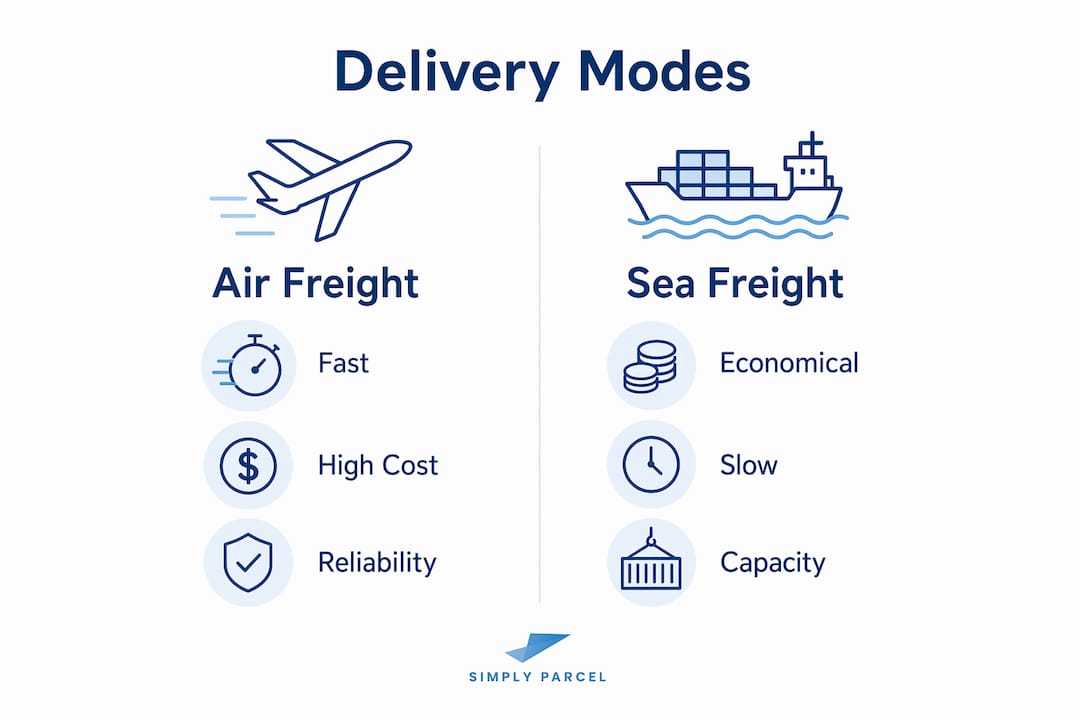
The right transport mode depends on shipment weight, value, urgency, and destination infrastructure. No single mode fits every situation. The table below compares the four primary options across the factors that matter most.
| Mode | Best For | Typical Cost | Transit Speed | Reliability |
|---|---|---|---|---|
| Air freight | High-value, time-sensitive, under 500 kg | Highest | 1–5 days | Very high |
| Sea freight | Heavy, bulky, or low-value goods | Lowest | 2–6 weeks | High |
| Rail freight | Mid-weight goods, Asia-Europe corridors | Medium | 2–3 weeks | Medium-high |
| Road freight | Regional cross-border, short distances | Low-medium | 1–7 days | High |
Air freight is best for shipments under 500 kg that are high-value or time-sensitive. That threshold reflects the point where air's speed premium justifies its cost premium over sea freight.
Choosing the right mode also requires thinking about the destination country's infrastructure. A port-dependent island nation may have limited rail options. A landlocked country may rely entirely on road freight from a neighboring port. Here is a practical decision framework:
- Check urgency first. If the customer needs delivery within a week, air is the only viable option for most international routes.
- Weigh the value-to-weight ratio. Electronics, pharmaceuticals, and luxury goods favor air. Machinery, raw materials, and furniture favor sea.
- Consider multimodal options. Many shipments use sea freight to a regional hub, then road or rail for final delivery. This combination often cuts cost without sacrificing too much speed.
- Verify destination customs regimes. Some countries have faster clearance for air cargo. Others have dedicated sea freight fast-track lanes for trusted importers.
For a deeper breakdown of freight types and cost structures, the types of freight delivery guide from Van-247 covers air, sea, and land options with practical cost benchmarks.
What best practices improve cross-border delivery success?
Strong cross-border logistics outcomes come from process discipline, not luck. The businesses that ship internationally with the fewest delays and lowest costs share a common set of habits.
- Work with a licensed customs broker. Customs brokers know the specific requirements of each destination country. They catch documentation errors before submission and often have established relationships with customs officials that speed up clearance.
- Standardize your documentation. Process standardization across markets reduces errors, accelerates training, and allows performance benchmarking. Create templates for your commercial invoice, packing list, and certificate of origin, and use them every time. Consistent shipping documentation is one of the fastest ways to reduce customs holds.
- Submit paperwork early. Late filings are a leading cause of customs delays. Build a submission deadline into your shipping schedule, not just a departure date.
- Confirm free trade agreement eligibility. FTAs like USMCA, CPTPP, and ASEAN agreements can reduce or eliminate duties. FTA eligibility verification before shipping can save up to 10% of shipment value on qualifying goods.
- Build in customs buffer time. Realistic buffer times for customs processes improve on-time delivery reliability. Customs inspections and paperwork issues frequently add days to transit. Promising customers a delivery date without accounting for this creates unnecessary service failures.
- Define Incoterms in every contract. Clear Incoterms agreements drastically reduce disputes on cost and risk sharing. Use standard terms like DDP (Delivered Duty Paid) or EXW (Ex Works) and confirm both parties understand what each term means.
- Communicate full landed cost to customers. Surprises at delivery destroy trust. Tell customers upfront what duties and taxes they may owe, especially for direct-to-consumer international shipments.
Pro Tip: Review your shipping regulations for each new destination market before your first shipment. Requirements change, and what worked for one country rarely transfers directly to another.
Key takeaways
Cross-border delivery requires customs clearance, accurate documentation, and the right transport mode to succeed. Skipping any one of these steps creates delays, fines, or unexpected costs.
| Point | Details |
|---|---|
| Define the process clearly | Cross-border delivery covers transport, customs clearance, duty payment, and final delivery across international borders. |
| Documentation accuracy is critical | Incorrect HS codes and inconsistent paperwork are the most common and costly mistakes in cross-border shipping. |
| Mode selection drives cost and speed | Air freight suits shipments under 500 kg that are time-sensitive; sea freight fits heavy, lower-value goods. |
| Landed cost includes more than freight | Duties, taxes, fees, and currency effects must all be factored into your total shipping budget. |
| Standardized processes scale better | Businesses that standardize documentation and workflows across markets report fewer errors and faster operations. |
What i have learned about cross-border delivery after years in the field
The single biggest mistake I see shippers make is treating cross-border delivery as a faster version of domestic shipping. It is not. The regulatory layer changes everything, and the businesses that struggle most are the ones that discover this after their first customs hold.
What actually works is building compliance into the process before the shipment moves, not after. That means getting HS codes right at the product setup stage, not at booking. It means knowing your Incoterms before you negotiate a price with a buyer. And it means having a customs broker on call, not just a carrier.
The other shift I have seen make a real difference is data. Businesses that track their customs clearance times, duty rates by market, and documentation error rates can identify exactly where their process breaks down. That kind of visibility turns cross-border shipping from a source of anxiety into a repeatable, scalable operation.
The regulatory environment in 2026 is more complex than it was five years ago. New filing requirements, shifting trade agreements, and increased customs scrutiny in major markets mean the margin for error is smaller. The businesses winning at cross-border delivery are not the ones with the biggest budgets. They are the ones with the most disciplined processes and the right partners.
— Simply
Ship smarter internationally with Simplyparcel
Simplyparcel makes cross-border delivery accessible for individuals and businesses shipping from Singapore. The platform connects you to major courier partners, generates shipping labels and documentation automatically, and provides real-time shipment tracking from pickup to delivery. Whether you need priority speed or economy rates, Simplyparcel offers options that match your timeline and budget. You can get an instant shipping quote in minutes and book a free pickup without leaving your desk. For businesses managing regular international shipments, Simplyparcel's transparent pricing and customs support remove the guesswork from cross-border logistics. Start your next international shipment at Simplyparcel today.
FAQ
What is cross-border delivery in simple terms?
Cross-border delivery is the process of shipping goods from one country to another, including customs clearance, duty payment, and final delivery to the recipient. It differs from domestic shipping because every shipment must comply with the import and export regulations of both countries involved.
What documents are required for cross-border shipping?
The core documents for cross-border shipping are a commercial invoice, packing list, certificate of origin, and the correct HS code for each product. Some destinations and transport modes require additional certificates, such as phytosanitary certificates for agricultural goods or safety certificates for electronics.
How long does cross-border delivery take?
Transit times vary by transport mode and destination. Air freight typically delivers within 1–5 days, while sea freight takes 2–6 weeks. Customs clearance adds time to both, so building a buffer of 1–3 business days into your delivery estimate is standard practice.
What is a landed cost and why does it matter?
Landed cost is the total cost of getting a product to its destination, including freight, duties, taxes, and fees. Budgeting only for freight misses significant expenses, which can lead to unexpected charges and customer dissatisfaction at delivery.
How do free trade agreements affect cross-border shipping costs?
Free trade agreements like USMCA and CPTPP can reduce or eliminate import duties on qualifying goods. Failing to verify FTA eligibility before shipping can cost up to 10% of shipment value in unnecessary duties, making pre-shipment eligibility checks a high-value step in your process.