
Cargo insurance is a first-party policy that pays you directly for physical loss or damage to your goods while they are in transit. It applies regardless of who caused the loss, which is what separates it from relying on a carrier's liability. If you ship goods commercially, whether as an exporter, importer, e-commerce seller, or small business owner, cargo insurance belongs in your shipping plan. Here is why it matters right away:
- Shippers and exporters need it to protect the value of goods from the moment they leave the warehouse.
- Importers and consignees need it when they bear the risk under the sales contract.
- E-commerce sellers need it because a single lost or damaged shipment can wipe out the margin on dozens of orders.
- Anyone using CIF terms should know that the minimum CIF coverage is only ICC(C) level, which leaves theft and partial damage uninsured.
Carrier liability caps are low. International conventions typically limit a carrier's payout to a few dollars per kilogram, far below most commercial invoice values. Cargo insurance fills that gap.
Table of Contents
- What does cargo insurance actually cover?
- How do ICC(A), ICC(B), and ICC(C) policy wordings compare?
- Who pays for cargo insurance, and when is it required?
- Why carrier liability is not the same as cargo insurance
- How coverage and exposure vary by transport mode
- How to buy cargo insurance in the United States
- How to file a cargo insurance claim step by step
- Common exclusions, valuation methods, and deductibles
- What drives cargo insurance premiums?
- What is General Average and why does it affect you?
- Research-backed reasons cargo insurance protects your business
- Key Takeaways
- The part most shippers learn too late
- Useful sources for further reading
What does cargo insurance actually cover?
Standard cargo insurance covers a broad range of physical loss and damage events. The exact perils depend on the policy wording you choose, but most commercial policies include:
- Fire and explosion during loading, transit, or unloading
- Sinking, stranding, or grounding of the carrying vessel
- Collision or overturning of the transport vehicle
- Jettison (cargo thrown overboard to save a vessel)
- Theft and pilferage during inland transit or at transshipment points
- Water ingress into a container or hold
- Derailment of a rail car
A few real-world examples show how these perils play out. A container washed overboard during a Pacific storm is a covered loss under most policies. A pallet of electronics soaked by rainwater during port handling is a covered water-ingress claim. A shipment of clothing stolen from a truck stop overnight is a covered theft claim.
Coverage typically runs warehouse to warehouse, meaning it attaches when goods leave the origin warehouse and terminates when they arrive at the destination warehouse. That sounds broad, but the attachment and termination details vary by endorsement, so always confirm the exact wording in your certificate.

Pro Tip: Ask your insurer or broker to confirm whether coverage continues if your goods sit in a container yard or a carrier's facility for more than 60 days. Some policies terminate automatically at that point, leaving a gap you may not notice until a claim arises.
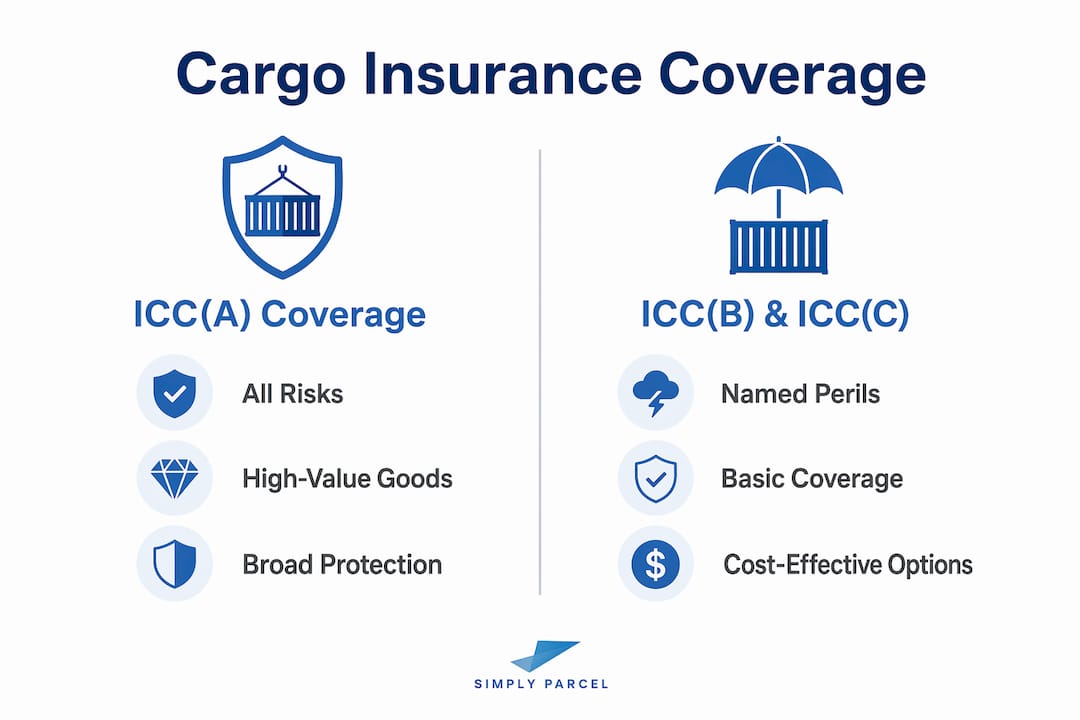
How do ICC(A), ICC(B), and ICC(C) policy wordings compare?
The Institute Cargo Clauses are the global standard policy wordings used in commercial cargo insurance. There are three main forms for ocean shipments and a separate air form.
| Policy Wording | Coverage Type | Typical Perils Included | Common Exclusions |
|---|---|---|---|
| ICC(A) "All Risks" | Broadest | All risks of physical loss or damage except named exclusions | War, strikes (unless added), inherent vice, delay, willful misconduct |
| ICC(B) Named Perils | Intermediate | Fire, explosion, vessel stranding, collision, jettison, earthquake, washing overboard, water ingress | Theft, pilferage, contamination, most partial losses |
| ICC(C) Catastrophic Perils | Most limited | Fire, explosion, vessel stranding, collision, jettison | Theft, water ingress, partial damage, most transit risks |
| Institute Cargo Clauses (Air) | Broad (air-specific) | Broadly similar to ICC(A) for air carriage | War, strikes unless added |
ICC(A) is the right choice for high-value or fragile goods. ICC(C) is the minimum the seller must provide under CIF Incoterms, but it leaves significant gaps. Air shipments use a separate air-form clause that provides coverage broadly similar to ICC(A), reflecting the higher values and shorter transit times typical of air freight.
Pro Tip: Never assume "all risks" means every risk. Read the exclusions list carefully. War and strikes are standard exclusions in all three ICC forms; you need separate endorsements to add them back in for high-risk routes.
Who pays for cargo insurance, and when is it required?
The party that bears the risk of loss under the sales contract is the party that should buy the insurance. Incoterms determine when that risk passes from seller to buyer.
Under FOB (Free On Board) terms, risk passes to the buyer once goods are loaded onto the vessel. The buyer therefore carries the risk for the ocean leg and should arrange insurance for that portion. Under CIF (Cost, Insurance, and Freight) terms, the seller arranges and pays for insurance to the destination port, but only at the ICC(C) minimum level unless the contract specifies otherwise.
Situations that commonly make cargo insurance contractually required include:
- Letters of credit: Banks issuing letters of credit routinely require evidence of insurance, often at ICC(A) level, before releasing payment.
- Bank financing: Lenders with a security interest in the goods may require insurance naming them as an additional insured.
- Buyer or seller contractual clauses: Many purchase agreements specify minimum coverage levels and require the insuring party to provide a certificate of insurance before shipment.
- Regulated commodities: Certain goods (pharmaceuticals, hazardous materials) may face regulatory requirements for minimum coverage.
For a deeper look at how Incoterms and shipping terminology interact with insurance obligations, that reference covers the key distinctions clearly.
Why carrier liability is not the same as cargo insurance
Many shippers assume that if a carrier damages their goods, the carrier will pay the full commercial value. That assumption is expensive when it turns out to be wrong.
Carrier liability under international conventions such as Hague-Visby (ocean), CMR (road), and the Montreal Convention (air) is capped at a low amount per kilogram. Conventions often cap liability at only a few dollars per kilogram, which means a shipment of electronics worth $50,000 might yield a carrier payout of a few hundred dollars if the claim is measured by weight alone.
The practical differences between carrier liability, forwarder Errors & Omissions (E&O), and first-party cargo insurance are significant:
- Carrier liability covers only losses caused by the carrier's fault, subject to convention caps and multiple legal defenses the carrier can raise.
- Forwarder E&O covers the freight forwarder's own errors or omissions, not physical loss to your goods.
- First-party cargo insurance pays you directly for covered physical loss or damage, regardless of fault, without waiting for a carrier liability dispute to resolve.
A first-party cargo policy pays regardless of fault and avoids the slow, uncertain process of pursuing a carrier recovery. The financial necessity of shipping insurance becomes clear the moment you compare a convention-capped payout to your actual invoice value.
How coverage and exposure vary by transport mode
Each transport mode carries its own risk profile, and your policy should reflect that.

Ocean freight carries the broadest set of physical risks: water ingress, container loss overboard, General Average contributions, and port handling damage. Transshipment ports add extra exposure because goods change hands multiple times.
Air freight moves faster and typically involves higher-value goods. The air-form clause provides broad coverage similar to ICC(A), which matches the risk profile of high-value, time-sensitive cargo. Theft at airports is a real concern for electronics and pharmaceuticals.
Road freight is particularly exposed to theft and pilferage, especially on overnight stops or at unsecured facilities. Inland legs connecting a port to a warehouse are a common gap in coverage if attachment wording is not checked carefully.
Rail freight faces derailment risk and handling damage at transshipment points. Cross-border rail shipments may involve multiple carriers, each with different liability regimes.
For intermodal shipments that combine two or more modes, confirm that your policy attaches at the origin warehouse and terminates at the destination warehouse without gaps between modes. The freight shipping methods guide covers mode trade-offs in more detail.
Pro Tip: For high-risk routes (conflict zones, piracy-prone waters, or regions with elevated cargo theft), ask your broker about war and strikes endorsements and confirm whether delay clauses affect your coverage.
How to buy cargo insurance in the United States
Buying cargo insurance is straightforward when you follow a clear sequence.
- Decide between single-shipment and open cover. A single-shipment policy covers one consignment. Open cover runs for a fixed period (typically 12 months) and covers all qualifying shipments automatically, which suits businesses that ship regularly.
- Gather your shipment data. Insurers need: commodity description, commercial invoice value, freight cost, origin and destination, transport mode, and packing details.
- Calculate your insured value. The standard basis is commercial invoice value plus freight plus 10% to cover anticipated profit. Example: a $10,000 invoice with $500 freight gives an insured value of $11,550.
- Get quotes from at least two sources. You can approach a licensed insurance broker, a freight forwarder that offers insurance as an add-on, or a direct insurer. Each channel has trade-offs.
- Confirm the policy wording and limits. Verify the ICC clause level, any sub-limits, the deductible, and the attachment/termination wording before paying.
- Buy the policy and obtain your certificate. Keep the certificate with your shipping documents. Banks and buyers may ask for it.
Documents and data your insurer will typically need:
- Commercial invoice
- Packing list
- Bill of lading or Air Waybill (AWB)
- Commodity description and HS code
- Declared shipment value (invoice + freight + 10%)
- Packing method and container type
Buying channel trade-offs:
- Insurance broker: Independent advice, access to multiple insurers, best for complex or high-value shipments.
- Freight forwarder: Convenient, bundled with booking, but coverage may be limited to a single insurer's terms.
- Direct insurer: Potentially lower cost for straightforward commodities, but requires you to assess coverage yourself.
How to file a cargo insurance claim step by step
A well-documented claim settles faster. The steps below apply to most U.S. commercial cargo policies.
- Notify the carrier and insurer immediately. Report the loss or damage in writing as soon as you discover it. Delays can jeopardize your claim.
- Preserve and protect the goods. Do not dispose of damaged goods before the insurer's surveyor inspects them. Move them to a secure location if possible.
- Photograph everything. Take photos of packaging, damage, container condition, and any visible carrier markings before anything is moved or repaired.
- Obtain a written statement from the carrier. Ask the carrier or driver to note the damage on the delivery receipt or bill of lading. This is one of the most important steps.
- Gather your claim documentation. Compile the full document set before submitting.
- Submit the claim to your insurer. Include all documents and a written description of the loss event.
- Cooperate with the insurer's surveyor. An independent surveyor may inspect the goods and the circumstances of loss.
- Receive settlement or subrogation notice. Once the claim is approved, the insurer pays you. If a third party caused the loss, the insurer may pursue subrogation recovery from that party on your behalf.
Document checklist for your claim:
- Commercial invoice
- Bill of lading or AWB
- Packing list
- Survey or inspection report
- Photographs of damage
- Police report (if theft)
- Repair invoices or disposal records
- Written carrier statement of facts
- Correspondence with the carrier about the loss
Claims outcomes improve materially when shippers preserve evidence immediately and report quickly. Insurers require timely notification, photos, surveys, and carrier documentation to process claims efficiently.
Pro Tip: At the moment of delivery, inspect every shipment before signing the delivery receipt. If you sign "received in good order" without noting visible damage, you weaken your claim significantly. Always note any damage or shortage on the receipt, even if the full extent is not yet clear.
Common exclusions, valuation methods, and deductibles
Knowing what your policy excludes is as important as knowing what it covers.
Typical exclusions in standard cargo policies:
- War and strikes (unless added by endorsement)
- Inherent vice (natural deterioration or self-damage of the goods)
- Delay, even if caused by a covered peril
- Willful misconduct or fraud by the insured
- Inadequate packing or preparation (unless the policy specifically covers this)
- Nuclear or radioactive contamination
Valuation and deductibles:
The standard insured value is commercial invoice value plus freight plus 10% for anticipated profit. If your goods are worth $20,000 and freight costs $1,000, your insured value should be $23,100. Underinsuring to save on premium is a common mistake; if a partial loss occurs and you are underinsured, the insurer may apply an "average" reduction to your payout.
Deductibles work the same way as in other insurance lines. A $500 deductible means you absorb the first $500 of any claim. Higher deductibles lower your premium but increase your out-of-pocket exposure on small losses.
Sub-limits matter. Some policies cap payouts for specific perils (theft, for example) at a lower amount than the overall policy limit. If you are shipping high-value electronics or jewelry, confirm that the theft sub-limit is adequate for your shipment value, or negotiate an endorsement to raise it.
What drives cargo insurance premiums?
Premiums vary based on a combination of factors that underwriters assess for each shipment or open-cover account.
Primary pricing factors:
- Shipment value: Higher declared value means higher premium.
- Commodity risk: Electronics, pharmaceuticals, and luxury goods attract higher rates than bulk commodities.
- Packing quality: Well-packed goods in new containers cost less to insure than goods in used packaging.
- Transit route: Routes through piracy zones, conflict areas, or high-theft corridors carry surcharges.
- Transit time: Longer transits increase exposure and may raise rates.
- Historical loss record: A clean claims history lowers your rate over time.
- Deductible level: A higher deductible reduces the premium.
- Policy endorsements: Adding war, strikes, or delay cover increases cost.
For frequent shippers, open cover negotiated with a broker or insurer typically produces a lower unit premium than buying individual policies per shipment. Underwriters price open-cover accounts based on the overall commodity mix, route risk, and historical loss ratio across all shipments.
Pro Tip: Investing in better packing, such as double-boxing fragile items or using moisture-absorbing desiccants in containers, can directly reduce your insurance rate at renewal. Underwriters reward shippers who demonstrate low-loss packing practices.
What is General Average and why does it affect you?
General Average is a maritime legal principle that requires all cargo owners on a vessel to share the cost of losses incurred to save the voyage. If a captain jettisons cargo or incurs emergency expenses to prevent the vessel from sinking, every cargo owner on board contributes proportionally to that shared loss, whether or not their own goods were damaged.
In a General Average event, all parties with cargo on the vessel must contribute proportionally to the shared loss. Your contribution is calculated based on the value of your cargo relative to the total value of all cargo and the vessel. The amounts can be substantial, and they are demanded before your goods are released.
Key points about General Average and cargo insurance:
- Standard cargo insurance policies (ICC(A) and ICC(B)) cover your General Average contribution.
- Without insurance, you must pay the contribution out of pocket before recovering your goods.
- A General Average adjuster (a specialist) calculates each party's share, a process that can take months or years.
- You will need to provide a General Average bond and possibly a cash deposit or bank guarantee while the adjustment is completed.
Confirm that your policy wording explicitly covers General Average contributions. If you ship by ocean regularly, this coverage is not optional.
Research-backed reasons cargo insurance protects your business
The financial case for cargo insurance comes down to one comparison: the cost of a premium versus the cost of an uninsured loss.
A single uninsured loss can severely damage a company's balance sheet. Industry analysts consistently describe cargo insurance as a financial necessity for business continuity, not an optional line item. Premiums are typically a small fraction of total shipment value compared with the potential exposure from a single large loss.
The carrier liability gap makes this concrete. Conventions often cap carrier liability at only a few dollars per kilogram, so a $50,000 shipment of electronics could yield a carrier payout measured in hundreds of dollars, not tens of thousands. The difference comes entirely out of your operating cash flow if you are uninsured.
Business continuity point: Cargo insurance also supports trade finance readiness. Banks and buyers increasingly require evidence of coverage before releasing letters of credit or approving purchase orders. An uninsured shipper may find themselves unable to close deals that require a certificate of insurance.
For a detailed look at how shipping insurance benefits translate into business continuity protection, that resource covers the coverage categories and financial arguments in depth.
Practical recommendations:
- Treat cargo insurance as part of your standard cost of goods, not a discretionary expense.
- Review your insured value at least annually to account for commodity price changes.
- Keep your claims history clean by investing in packing quality and carrier vetting.
Key Takeaways
Cargo insurance is the only reliable way to recover the full commercial value of your goods after a transit loss, because carrier liability caps and CIF minimums leave most shipments significantly underprotected.
| Point | Details |
|---|---|
| Definition | Cargo insurance is a first-party policy paying you directly for physical loss or damage to goods in transit. |
| ICC(A) for high-value goods | ICC(A) "All Risks" is the broadest standard wording; use it for electronics, pharmaceuticals, and high-value shipments. |
| Carrier liability gap | International conventions cap carrier liability at a few dollars per kilogram, far below most commercial invoice values. |
| Insured value formula | Set insured value at commercial invoice plus freight plus 10% to cover anticipated profit. |
| Open cover for frequent shippers | Open cover running for a fixed period typically delivers a lower unit premium than single-shipment policies for regular shippers. |
The part most shippers learn too late
The most common and costly mistake in cargo insurance is not buying the wrong policy. It is buying the right policy and then failing to check the attachment and termination wording.
Policies that say "warehouse to warehouse" sound complete. But some endorsements terminate coverage once goods have been in a container yard or carrier facility for a set number of days, often 60. If your shipment sits at a transshipment port longer than that because of a vessel delay or port congestion, you may have a gap in coverage precisely when the goods are most vulnerable. That is not a theoretical risk; port congestion events have left shippers exposed to uninsured losses at transshipment hubs.
The practical fix is simple: read the termination clause before you buy, not after a loss. If the wording is ambiguous, ask your broker to confirm in writing. Document your goods at every transshipment point with photos and carrier receipts. And if you ship frequently, an open-cover arrangement with a broker gives you continuous, negotiated coverage that removes the per-shipment wording risk entirely.
Useful sources for further reading
These authoritative references cover cargo insurance policy wordings, maritime law, and buying practicalities in depth.
- LII / Legal Information Institute — Cargo Insurance (Wex): Plain-language U.S. legal definition of cargo insurance and its scope across transport modes. Good starting point for understanding the legal framework.
- IUMI Guide to Marine Cargo Insurance: Comprehensive technical guide from the International Union of Marine Insurance covering policy wordings, insurable interest, and Incoterms interaction. Best for policy-level detail.
- UNCTAD — Types of Marine Cargo Insurance: UN trade body overview of open cover, single-shipment policies, and premium structures. Useful for understanding open-cover mechanics.
- MSC — A Guide to Cargo Insurance (General Average): Carrier-published explainer with a clear General Average section. Best for understanding GA contributions and why insurance is essential.
- Mapfre — Cargo Insurance: How Goods Are Protected During Transport: Insurer perspective on business continuity arguments and premium-to-exposure ratios.
- The role of insurance in transport operations: Industry primer on how insurance integrates with transport operations across modes. Practical for logistics managers.
- Truck & Plant — Claims Management Tips: Practical documentation and evidence-preservation guidance for transport claims. Best for claims process preparation.