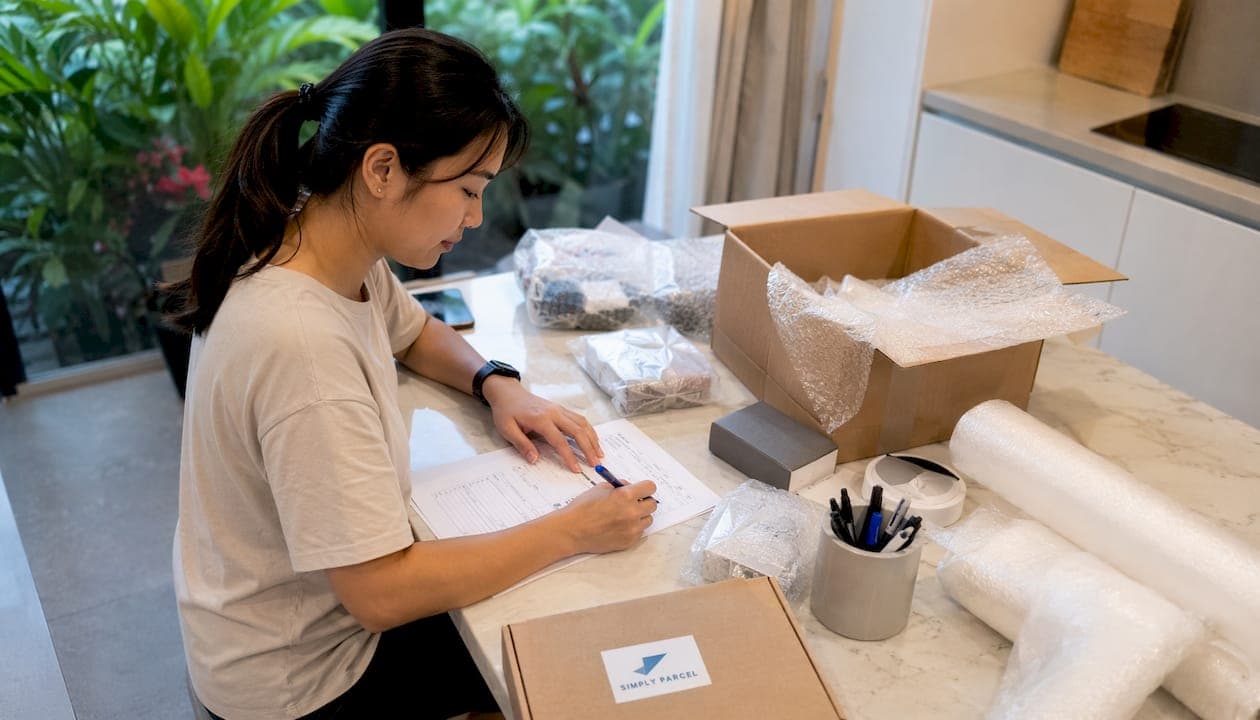
Returning a parcel from Singapore to the United States follows six clear steps: initiate the return via the merchant's portal or RMA system, collect your return label or QR code, prepare the parcel with the correct customs documentation, book your courier through Simplyparcel, hand over the parcel and keep your drop-off receipt, then track until delivery. Start right now by logging into the merchant's orders page and requesting the return authorization before you do anything else. U.S. Customs and Border Protection requires a commercial invoice marked "Returned goods" for any international return shipment, so having that document ready before you book is not optional. Keep the drop-off receipt from the courier handover point — without it, any lost-parcel claim is very difficult to support.
Pro Tip: Set a phone reminder to save your tracking number and drop-off receipt photo the moment you hand the parcel over. Losing either one is the single most common reason claims stall.
Table of Contents
- What are the exact return parcel process steps for international returns?
- What customs documents do you need for a return to the United States?
- How should you pack and label a return parcel?
- How do you choose service level, insurance, and understand the costs?
- Why must you keep a receipt or proof of handover?
- What do you do if a return parcel is lost or damaged?
- What do businesses need to know about bulk returns?
- Key Takeaways
- The step most people skip — and why it costs them
- Simplyparcel makes returning parcels to the U.S. straightforward
- Useful sources and next steps
What are the exact return parcel process steps for international returns?
The six-step return item procedure below covers every required action from merchant authorization to final delivery confirmation.
-
Initiate the return via the merchant portal or RMA. Log into your account on the retailer's website and start the return from your orders page. Amazon and Target both require customers to begin returns online before any label or drop-off is accepted. This step links the returned item to the original sale, which speeds merchant processing and protects you if a dispute arises.
-
Choose your return method. The merchant will offer a prepaid label, a QR code for a label-free drop-off, or instructions to arrange your own return shipping. Label-free QR returns are convenient for domestic U.S. returns but are rarely available for international shipments from Singapore. In most cases, you will need to book a courier independently.
-
Prepare the parcel and documentation. Pack the item in its original packaging where possible, include all accessories and the original sales invoice, and prepare a commercial invoice marked "Returned goods." Attach the return label or QR code to the outside of the box.
-
Book your courier via Simplyparcel. Compare service speeds (economy, connect-plus, or priority), add declared-value protection for high-value items, and confirm the booking. Simplyparcel's parcel booking workflow generates your shipping label and customs documents automatically.
-
Hand over the parcel and keep your receipt. Drop off at the authorized carrier location or schedule a pickup. Target's return guidance explicitly lists a valid receipt or return barcode as required proof. Save the receipt and note the tracking number immediately.
-
Track and follow up. Monitor the shipment via Simplyparcel's tracking module. If the parcel arrives damaged or the merchant flags missing accessories, you will need your tracking history and receipt to open a claim.
| Step | Action | Key document or proof |
|---|---|---|
| 1. Merchant initiation | Start return in portal/RMA | Return authorization number |
| 2. Return method | Collect label, QR, or book courier | Prepaid label or booking confirmation |
| 3. Pack and document | Prepare parcel and commercial invoice | Commercial invoice ("Returned goods") |
| 4. Book courier | Compare rates and add protection | Booking confirmation, shipping label |
| 5. Hand over | Drop off or schedule pickup | Drop-off receipt, tracking number |
| 6. Track and resolve | Monitor delivery, file claims if needed | Tracking history, receipt, photos |
Pro Tip: Check the merchant's return window before booking. Many U.S. retailers allow a return window after delivery, and international transit times can quickly reduce the available time for returns.
What customs documents do you need for a return to the United States?
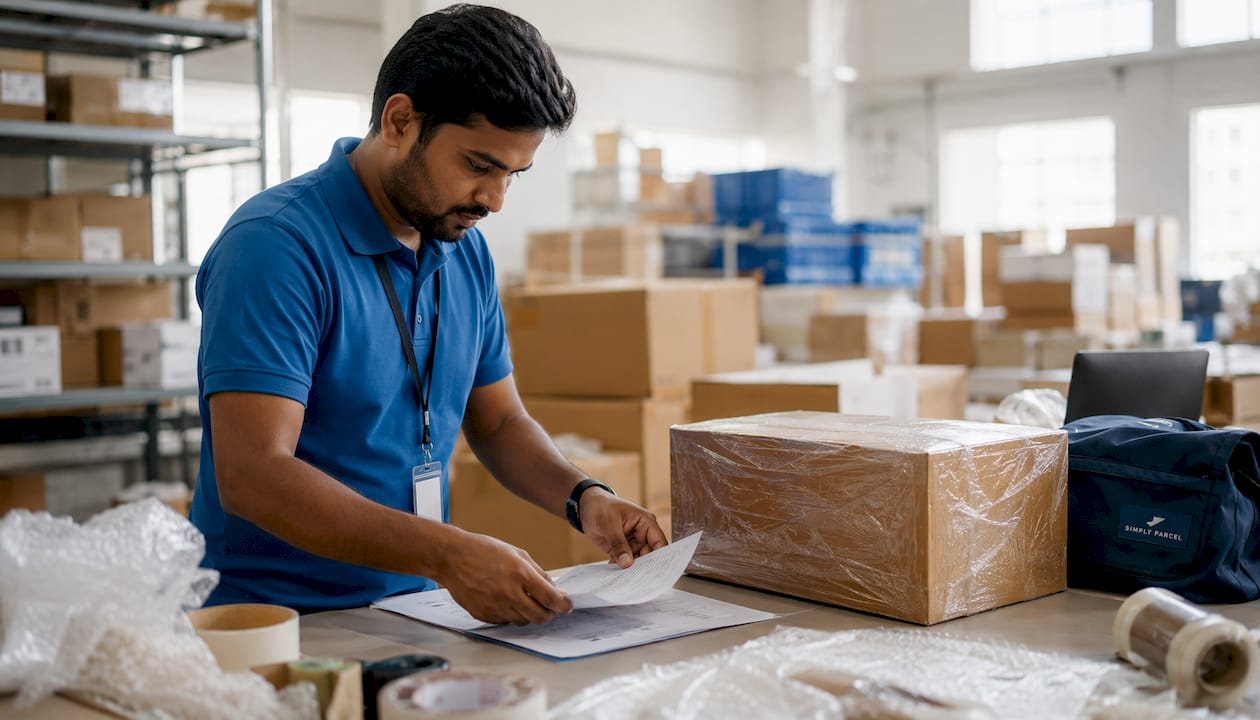
U.S. customs requires specific paperwork for returned goods, and missing even one document can trigger a duty assessment or a customs hold.
The core documents to attach to every international return shipment are:
- Commercial invoice marked "Returned goods" — state the reason for return, the original sale value, and the country of origin.
- Copy of the original sales invoice — confirms the item was purchased in the U.S. and is being returned, not exported for the first time.
- Packing list — required when returning multiple items or SKUs; list each item, quantity, and declared value separately.
- Return authorization number — issued by the merchant portal; include it on the commercial invoice and on the outer packaging.
Goods classified as returned goods and properly documented may be exempt from import duties when re-entering the United States, because they are treated as a return of previously exported goods rather than a new import. Declaring the correct value matters: use the original purchase price, not a discounted or zero value, to avoid customs queries.
Simplyparcel generates the commercial invoice and shipping label automatically when you complete the booking form. For most standard returns, that removes the need to create a separate customs form by hand.
Pro Tip: Photograph the item's serial number and list it on the commercial invoice. Merchants like Apple inspect returned electronics against serial numbers before issuing refunds, and customs officers may verify high-value electronics the same way.
| Document | Required for | Where to get it |
|---|---|---|
| Commercial invoice ("Returned goods") | All international returns | Simplyparcel booking form (auto-generated) |
| Original sales invoice (copy) | Duty exemption, merchant inspection | Your email order confirmation |
| Packing list | Multi-item or bulk returns | Create manually or via Simplyparcel |
| Return authorization number | Merchant processing | Merchant portal/RMA system |
How should you pack and label a return parcel?
Packaging a return correctly protects you from two risks: carrier rejection at drop-off and a partial refund from the merchant for missing or damaged accessories.
- Use the original box and inner packaging whenever possible. Apple's return policy requires items to be returned in original condition, and refunds may be withheld or reduced if packaging is inadequate.
- Include every accessory, manual, and promotional item that came with the product. Merchants can issue partial refunds if anything is missing.
- For fragile electronics, use double-boxing: place the product box inside a plain outer shipping box with at least 5 cm of cushioning on all sides. See Simplyparcel's packaging best practices for carrier-specific requirements.
- Lithium batteries must follow IATA regulations: keep them installed in the device where possible, or pack loose cells in individual protective bags inside a rigid outer box. Declare batteries on the commercial invoice.
- Attach the return label or QR code flat on the largest face of the box. Remove or black out all old barcodes, labels, and addresses to prevent misrouting.
- Seal every seam with pressure-sensitive tape at least 5 cm wide. Do not use string, paper tape, or masking tape.
Pro Tip: Photograph the packed and sealed parcel before you leave the drop-off point. That image is your evidence of condition at handover and is often the deciding factor in a damage claim.
| Packaging scenario | Recommended approach |
|---|---|
| Electronics with lithium batteries | Double-box; batteries installed in device; declare on invoice |
| Fragile glassware or ceramics | Wrap individually; 5 cm+ cushioning; "Fragile" label on all sides |
| Multi-item return | Separate items with dividers; include itemized packing list |
| Clothing or soft goods | Polybag each item; place in a rigid outer box or padded mailer |
How do you choose service level, insurance, and understand the costs?
Matching the right service tier to your return saves money and avoids refund delays caused by slow transit.
- Economy: Lowest cost, typically 14–21 business days Singapore to U.S. Use for low-value, non-urgent returns where the merchant's return window allows.
- Connect-plus: Mid-range speed and price, typically 7–14 business days. A practical default for most returns.
- Priority: Fastest option, typically 5–7 business days. Worth the premium when the return window is closing or the item is high-value.
For any item worth more than a few hundred dollars, add declared-value protection at booking. Standard courier liability covers only a fraction of the item's value without it. Simplyparcel lets you compare rates and add protection in a single booking step.
Cost components to budget for:
- Base courier fee (varies by weight, dimensions, and service tier)
- Fuel and remote-area surcharges (applied by the carrier, shown at booking)
- Customs duties on the return (usually waived for properly documented returned goods, but not guaranteed)
- Merchant restocking fees (set by the retailer, not the courier — check the return policy)
- Return label fee (charged by the merchant if no prepaid label is provided)
Pro Tip: Use Simplyparcel's rate-comparison tool before committing to a service tier. The price difference between economy and connect-plus is often small relative to the risk of missing a return deadline.
Why must you keep a receipt or proof of handover?
Proof of handover is your only protection if a parcel goes missing between drop-off and the merchant's warehouse.
- At a drop-off counter, always ask for a printed or emailed receipt. It shows the carrier accepted the parcel at a specific date and time.
- For scheduled pickups, the driver should provide a pickup confirmation or scan the parcel in front of you. Note the scan event in the Simplyparcel tracking module.
- The first carrier scan typically occurs within a few hours of drop-off. If no scan appears within 24 hours, contact Simplyparcel support with your receipt in hand.
- Understanding proof of delivery and how carriers record handover events helps you interpret tracking milestones and act quickly when something looks wrong.
Pro Tip: Save the receipt photo to cloud storage immediately. A photo on your phone that gets lost with the phone is not useful evidence.
What do you do if a return parcel is lost or damaged?
Act quickly and methodically. Carriers and merchants both have claim windows, and missing them forfeits your right to compensation.
- Record the tracking status as soon as you suspect a problem. Take a screenshot showing the last scan event and the date.
- Gather your evidence: drop-off receipt, photos of the packed parcel, original sales invoice, serial numbers, and the return authorization number.
- Contact the merchant to notify them of the delay or damage before the claim window closes.
- File a carrier claim through Simplyparcel. Upload the drop-off receipt, tracking history, and damage photos directly to the platform.
- Follow up on the merchant inspection. Retailers may issue partial refunds if accessories are missing or packaging is damaged, so your pre-shipment photos are critical here.
| Evidence item | Why it matters |
|---|---|
| Drop-off receipt | Proves carrier accepted the parcel |
| Tracking history screenshot | Shows last known location and status |
| Photos of packed parcel | Documents condition at handover |
| Original sales invoice | Confirms item value for compensation |
| Serial number record | Confirms item identity for merchant inspection |
Pro Tip: File the carrier claim and notify the merchant at the same time. Waiting for one to resolve before starting the other extends your timeline unnecessarily.
What do businesses need to know about bulk returns?
Managing multiple returns at once requires a more structured approach to documentation and scheduling.
- Create a consolidated commercial invoice listing each SKU, quantity, unit value, and the original invoice reference. Mark the shipment purpose as "return" on every page.
- Use barcode-level packing lists so the merchant's warehouse can scan and verify each item individually. This speeds inspection and accelerates refund credit timing.
- Pre-notify the merchant's returns department before shipping. Large warehouses often require advance shipment notifications (ASNs) to allocate receiving capacity, and unannounced bulk returns risk rejection or extended processing delays.
- Schedule bulk pickups with Simplyparcel in advance. Batch bookings allow you to generate manifests and labels for all parcels in one session, reducing manual data entry errors.
- On the accounting side, track restocking fees per SKU and note the expected refund credit date. For GST-registered businesses in Singapore, consult your tax advisor on reclaiming input tax on returned goods.
Pro Tip: For retailers returning electronics in bulk, include a barcode-level packing list with serial numbers. Merchants like Apple inspect returned electronics against serial numbers, and a pre-matched list cuts inspection time significantly.
Key Takeaways
Starting the return via the merchant portal before booking a courier is the single step that prevents the most delays, duty errors, and rejected returns in the international return shipping process.
| Point | Details |
|---|---|
| Start with the merchant RMA | Log into the retailer portal first — no label or drop-off is accepted without return authorization. |
| Customs documentation is mandatory | Attach a commercial invoice marked "Returned goods" and a copy of the original sales invoice to every international return. |
| Keep your drop-off receipt | Without it, a lost-parcel claim against the carrier is very difficult to support. |
| Match service tier to your deadline | Economy suits low-value returns with time to spare; priority is worth the cost when the return window is closing. |
| Simplyparcel simplifies the process | Use Simplyparcel to compare rates, auto-generate customs documents, and track the return from Singapore to the U.S. |
The step most people skip — and why it costs them
The merchant portal initiation step is where most return problems start. Shippers who book a courier first and contact the merchant second often find their return rejected at the warehouse because there is no matching RMA in the system. The parcel sits in a returns bay, the refund clock stops, and the shipper has no leverage because they cannot prove the merchant authorized the return before shipment.
What Simplyparcel's automated documentation does is close the second most common gap: incorrect or missing customs paperwork. A commercial invoice that says "gift" or leaves the shipment purpose blank will trigger a customs query or a duty assessment on goods that should re-enter the U.S. duty-free. Getting both steps right — merchant authorization first, correct customs documents second — is what separates a clean return from a two-week delay.
Simplyparcel makes returning parcels to the U.S. straightforward
Booking a Singapore-to-U.S. return through Simplyparcel means you compare live courier rates, generate your commercial invoice and shipping label automatically, and add declared-value protection in a single session. No separate customs form, no manual label printing, no guessing which carrier accepts your parcel type. The platform covers economy, connect-plus, and priority service tiers so you can match speed to your return deadline, and the built-in tracking module gives you real-time status from first scan to delivery confirmation.
Get an instant quote for your return shipment now, or visit Simplyparcel to start your booking and schedule a pickup from your Singapore address.
Useful sources and next steps
- Amazon return instructions — start your return and generate a label or QR code
- Target return guidance — acceptable receipts, drop-off locations, and refund timelines
- Apple returns and refunds — original condition requirements and inspection policy
- Simplyparcel packaging guide — carrier-specific packing rules for fragile items and batteries
- Simplyparcel booking workflow — step-by-step guide to booking, label generation, and documentation
- Parcel tracking guide — how to read scan events and act on tracking alerts
- What is proof of delivery — why receipts and scan records matter for claims
Suggested next actions:
- Log into the merchant portal and request your RMA or return authorization now.
- Visit Simplyparcel's quote page to compare courier rates and generate your return label.
- Schedule a pickup or locate your nearest authorized drop-off point, then save the receipt the moment you hand over the parcel.