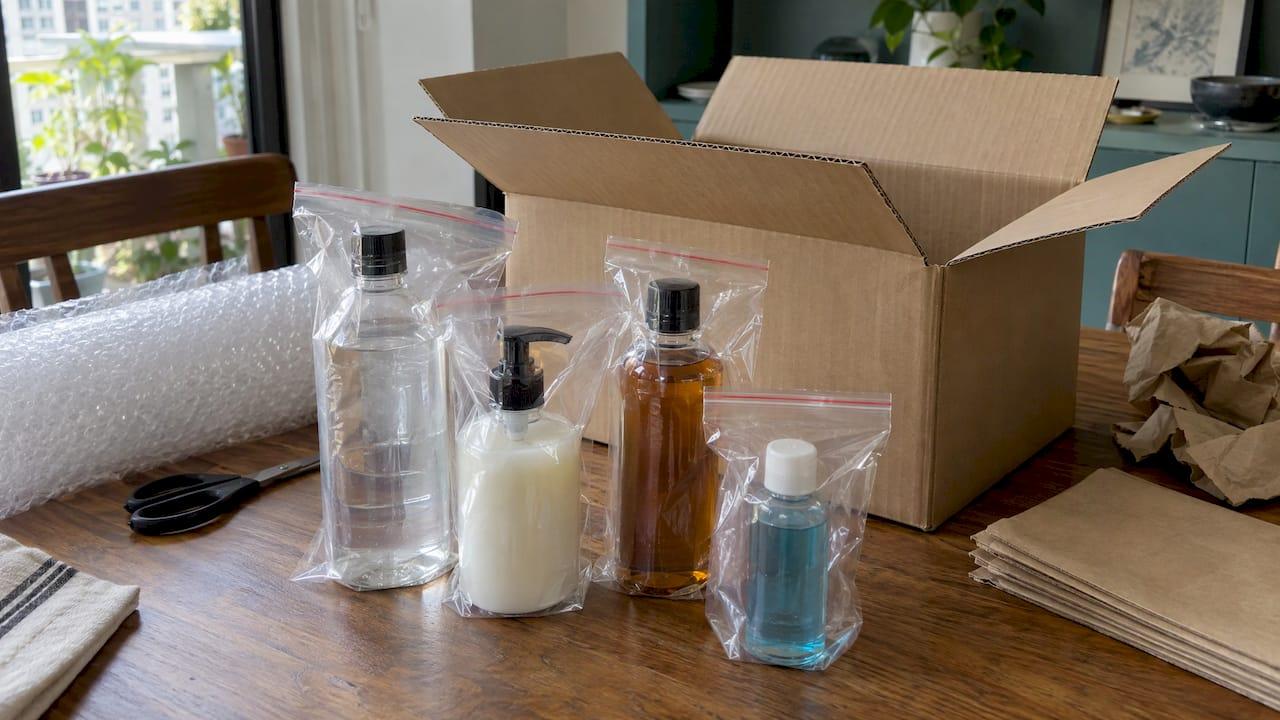
To ship liquids abroad without a leak, use three layers. First a sealed, leakproof container with air space at the top. Then a second leakproof wrap around it. Then a strong outer box with absorbent material and cushioning, closed with strong tape. Before you pack, confirm that the liquid is allowed to travel by air to the destination. Packing cannot fix a liquid that is restricted. When you book with us, we collect the parcel from your door for free and generate the shipping label and customs documents for you. That leaves you to do the part only you can do: packing the liquid properly.
TL;DR
- Pack in three layers: a sealed primary container, a leakproof liner or bag, and a rigid outer box with absorbent material.
- Leave space at the top of every bottle. Liquids expand with heat and pressure during air transport.
- Non-flammable liquids such as sauces, oils, shampoo and water-based products are the easiest to ship. Alcohol, perfume and nail polish are flammable and are usually restricted.
- Describe the contents accurately on the customs declaration, and add handling labels such as "Liquids", "Fragile" and "This Way Up".
- Compare rates and book pickup online once the parcel is packed.
Table of Contents
- First, decide whether the liquid can be shipped at all
- What you need before you start
- How to pack liquids for shipping, step by step
- A worked example: two 500 ml bottles of cooking oil
- Customs paperwork for liquids
- Shipping liquids in bulk or for a business
- Common mistakes and quick fixes
- Book your liquid shipment with Simply Parcel
- Our perspective
- FAQ
- Sources
First, decide whether the liquid can be shipped at all
Packing comes second. Air carriers sort liquids into two broad groups.
Generally shippable when packed well: non-flammable liquids. These include cooking oil, honey, soy sauce, syrups, shampoo, lotion, skin-care serums, water-based cleaning products, coffee concentrate and similar goods.
Restricted or prohibited: flammable liquids. These are classed as dangerous goods, which means they are regulated because they can catch fire or harm people in transit. Common examples are:
- spirits and other high-strength alcohol
- perfume with an alcohol base
- nail polish and remover
- aerosols
- paint
- lighter fuel
- solvents
The rules differ by carrier and by destination country. Some countries ban alcohol entirely. Others tax cosmetics or alcohol heavily.
We cover the details in two guides: shipping alcohol from Singapore, including permits and IATA rules, and our list of prohibited items from Singapore. If your liquid is a restricted good, read our guide to shipping restricted goods and dangerous goods before you buy any packing materials.
If your liquid is food or drink, such as sauces, oils or beverages, read how to ship food items overseas from Singapore. Many countries have their own import rules for food.
What you need before you start
Gather everything first. A half-packed parcel is where most mistakes happen.
- Leakproof primary containers. Use bottles or jars with screw caps or tight closures. Avoid thin containers that dent easily.
- Leakproof liners. These are sealable plastic bags or heavy-duty zip bags, one per container.
- Absorbent material. Paper towels, absorbent pads, cotton wool or similar material, enough to soak up the full volume of the bottle if it fails.
- Cushioning. Bubble wrap, foam sleeves, kraft paper or foam peanuts.
- A strong double-walled corrugated box. It should be new or in very good condition, and sized so the contents have little room to move.
- Shipping tape. Use pressure-sensitive packing tape, not masking tape, wrapping paper or string.
- Labels. Use "Liquids", "Fragile" and "This Way Up" stickers, or write the words clearly on the box.
For general material choices and sizing, our parcel packaging best practices guide goes deeper.
How to pack liquids for shipping, step by step
Step 1: Choose a container that will not fail
The inner container does most of the work. The United States Postal Service states in its Packaging Pointers that liquids need leakproof interior containers packed inside durable outer containers. That is the basic rule behind every carrier's guidance.
Practical points:
- Plastic is safer than glass for most products, because it dents instead of cracking. Use glass only when the product demands it, and then protect it as fragile.
- Check that the cap seats fully. A cap that is slightly cross-threaded can leak under pressure.
- If you are reusing a bottle, wash and dry the threads so the seal grips.
Where it goes wrong: Original retail packaging is often designed for a shelf, not for a parcel network. A pump dispenser, flip-top or pour spout is a common leak point. Take pumps off, or lock them if they have a lock, and seal the opening.
Step 2: Leave space at the top and seal the closure twice
Do not fill any container to the brim. Industry dangerous goods rules for air transport require that a liquid must not completely fill the inner packaging at 130°F (54°C), as set out in IATA's general packing requirements for dangerous goods. The same text says liquids in inner packaging need a positive means of closure or a leakproof liner. Those rules are written for dangerous goods, but the logic holds for any liquid in a hot cargo hold or under cabin pressure changes: liquids expand, and a full bottle has nowhere for that pressure to go.
A secondary closure is a second layer of security on the cap. The IATA rule on secondary means of closure lists adhesive tape, friction sleeves, induction heat seals and locking rings. For everyday shipping, tape over the cap works well:
- Screw the cap on firmly.
- Wrap tape from the side of the bottle, over the cap, and down the other side.
- Add a second strip across the first.
Step 3: Bag every container separately
Put each bottle in its own sealable plastic bag. Squeeze out the air and seal it. If you have several bottles, never let two touch inside one bag. A cracked bottle will take out its neighbor, and one leak will contaminate the whole bag.
For small amounts, a heavy-duty zip bag is enough. For larger bottles, use a thicker bag and twist the top shut. Tape the neck of the bag.
Step 4: Add absorbent material and cushioning
Wrap the bagged bottle in absorbent material. Use enough to soak up the entire contents if the bottle fails. Then add cushioning on top of that, so the bottle is not touching the walls of the box. The USPS guidance calls for absorbent wrapping material between the inner and outer containers, to soak up spills and stop shifting.
A workable pattern for a standard bottle:
- Bag the bottle and seal it.
- Wrap it in a layer of absorbent paper or pad.
- Wrap it in bubble wrap, two or three turns, and tape the wrap shut.
- Place it upright in the box.
Give every bottle a margin of cushioning on all sides. Our guide on shipping fragile items sets out a cushioning thickness and a drop test you can use to check your own parcel before it leaves.
Step 5: Fill the box so nothing moves
Place the wrapped bottles in a strong corrugated box. Fill every gap with void fill: crumpled kraft paper, foam peanuts or air pillows. Then close the flaps and shake the box gently. If you hear or feel movement, add more fill.
Keep these rules in mind:
- Do not use a box that is much bigger than the contents. A large box invites movement and crushing.
- Keep bottles upright.
- Keep the heaviest bottles at the bottom.
- Separate bottles with cardboard dividers or cushioning, so they never touch each other.
Where it goes wrong: A box that looks full when you close it can settle during transit. Fill it so the contents are firm when you press the lid.
Step 6: Tape the box using the H method
Seal the middle seam with strong tape, then tape both edge seams across the bottom and the top. This is called H-taping, because the tape forms an H shape on the box. It stops the flaps opening if the box takes a knock. Use two layers on the base, because the base takes the weight of liquid bottles.

Step 7: Label the parcel
Stick a "Liquids" or "Fragile" label on the top and one side. Add "This Way Up" arrows on at least two opposite sides. Labels do not make a carrier handle a box gently, but they tell the handler which way up the bottles are standing.
Put the shipping label, which our platform generates automatically, on the top surface, flat and fully visible. Do not stick it over a seam.
A worked example: two 500 ml bottles of cooking oil
You are sending two sealed 500 ml plastic bottles of cooking oil to a relative abroad.
- Check that the contents are non-flammable and that the destination accepts food oils. Check the bottles are factory sealed.
- Apply tape over each cap.
- Bag each bottle separately in a zip bag with an absorbent pad inside.
- Wrap each bag in bubble wrap and tape it.
- Place both in a small, strong box, with a divider between them and crumpled paper around them.
- Shake gently. If there is any movement, add paper.
- H-tape the box with two layers on the base.
- Label it "Liquids" and "This Way Up".
Total extra materials: a few bags, a pad, some bubble wrap, a box and tape. A failed bottle in a parcel like this costs far more than the packing materials.
Customs paperwork for liquids
A well-packed parcel can still be held up at customs if the paperwork is wrong. For liquids:
- Describe the contents specifically. "Cooking oil, 2 x 500 ml" is better than "food" or "gift".
- State the value honestly. Customs duties and taxes depend on the declared value and the type of product.
- Declare alcohol content where relevant. Customs officers use it to classify alcoholic goods.
- Keep product safety documents if you have them. Chemical or cosmetic products, essential oils and cleaning products may need a safety data sheet to clear customs smoothly.
On our platform, shipping labels and customs documentation are generated automatically from your booking details, so you enter the contents once. We also give guidance on restricted goods and customs requirements as part of the booking. Accurate item descriptions are still yours to supply, so enter them carefully.
Shipping liquids in bulk or for a business
Sellers who ship liquids regularly, such as sauces, oils, skin-care products or cleaning concentrates, need a repeatable routine more than a one-off method.
- Standardize your packaging. Use the same bottle, bag, absorbent pad and box for each product, so every parcel is packed identically.
- Set a fill level. Fill every bottle to the same level, leaving the same head space.
- Use the secondary closure on every unit. A shrink band or induction seal under the cap, plus tape, covers the two leak points.
- Test one finished parcel. Drop a sealed test parcel from a table height and check the contents. If anything leaks, change the packing before shipping a batch.
- Keep the paperwork consistent. Use the same product descriptions on each customs declaration.
Which shipping speed fits depends on the product. Priority suits time-sensitive or higher-value goods. Connect Plus is a middle option. Economy suits goods that can wait. Our blog explains the difference between Priority and Connect Plus. For ways to keep costs down without slowing delivery, see how to reduce international shipping costs. We advertise no monthly volume commitment, so you can start with a single parcel.
Common mistakes and quick fixes
| Mistake | What happens | Fix |
|---|---|---|
| Filling bottles to the top | Pressure pushes liquid out around the cap | Leave air space at the top |
| One bag for several bottles | One leak spoils all of them | Bag each bottle separately |
| No absorbent material | A small leak soaks the box and other goods | Wrap each bag in an absorbent layer |
| Oversized box | Contents shift and crack | Use a box that fits, plus void fill |
| Masking tape or string | Box opens in transit | Use shipping tape and H-tape |
| Vague customs description | Delays at customs | Describe contents precisely |
| No handling labels | Box may be turned over | Add "Liquids" and "This Way Up" |
Book your liquid shipment with Simply Parcel
Once your parcel is packed, you can compare rates and book online with us. We offer Priority, Connect Plus and Economy shipping from Singapore, with free pickup at your door, automatic shipping labels and customs documents, and real-time tracking. We also offer optional additional protection coverage, which many senders add for liquids and other fragile goods. Enter your parcel details in the shipment quote and choose the speed that suits you.

If you are still working out the full process, how to send packages overseas from Singapore walks through it from start to finish.
Our perspective
Most liquid shipping problems start at the kitchen table, not in the network. A bottle that was fine on a shelf meets pressure, stacking and rough handling, and the sender finds out only when the recipient does.
That is why we treat packing and booking as one job. Our platform lets you compare couriers and speeds in one place, book a free doorstep pickup, and get your label and customs documents generated for you. You spend your time on the packing, not on forms.
For liquids, we suggest three habits. Pack in three layers. Describe the contents precisely. Add protection coverage when the contents matter to you. These are small steps, and they remove most of the risk.
If you ship liquids regularly, our no-commitment model means you can send as many or as few parcels as your business needs, with the same packing routine each time.
SP
FAQ
Can I ship liquids internationally from Singapore?
Yes, many liquids can be sent abroad if they are non-flammable, packed properly and allowed in the destination country. Flammable liquids such as perfume, nail polish and spirits are dangerous goods and are usually restricted. Check our restricted goods guidance before you book.
What is the best container for shipping liquids?
A sturdy, leakproof plastic container with a tight screw cap is the most reliable choice for most products. Leave air space at the top, tape over the cap, and put the bottle in a sealed bag. Use glass only when you must, and cushion it as a fragile item.
How much absorbent material do I need?
Use enough to soak up the whole contents of the bottle if it fails. Wrap the bagged bottle in absorbent paper or a pad, then add cushioning outside it. This follows the common guidance of putting absorbent material between the inner and outer containers.
Do I need special paperwork for liquids?
Every international parcel needs an accurate customs declaration. For liquids, describe the product, the volume and the value clearly. Some products, such as essential oils or cleaning chemicals, may need a safety data sheet. Our platform generates the shipping label and customs documents from your booking details.
Can I send a liquid by Economy shipping?
Yes, if the liquid is allowed and well packed. Economy suits parcels that can wait, and Priority suits urgent or higher-value goods. Pack the same way whichever speed you choose.
Sources
- USPS Packaging Pointers
- General packing requirements for dangerous goods shipped by air (IATA DGR 5.0.2)
- What is a secondary means of closure?