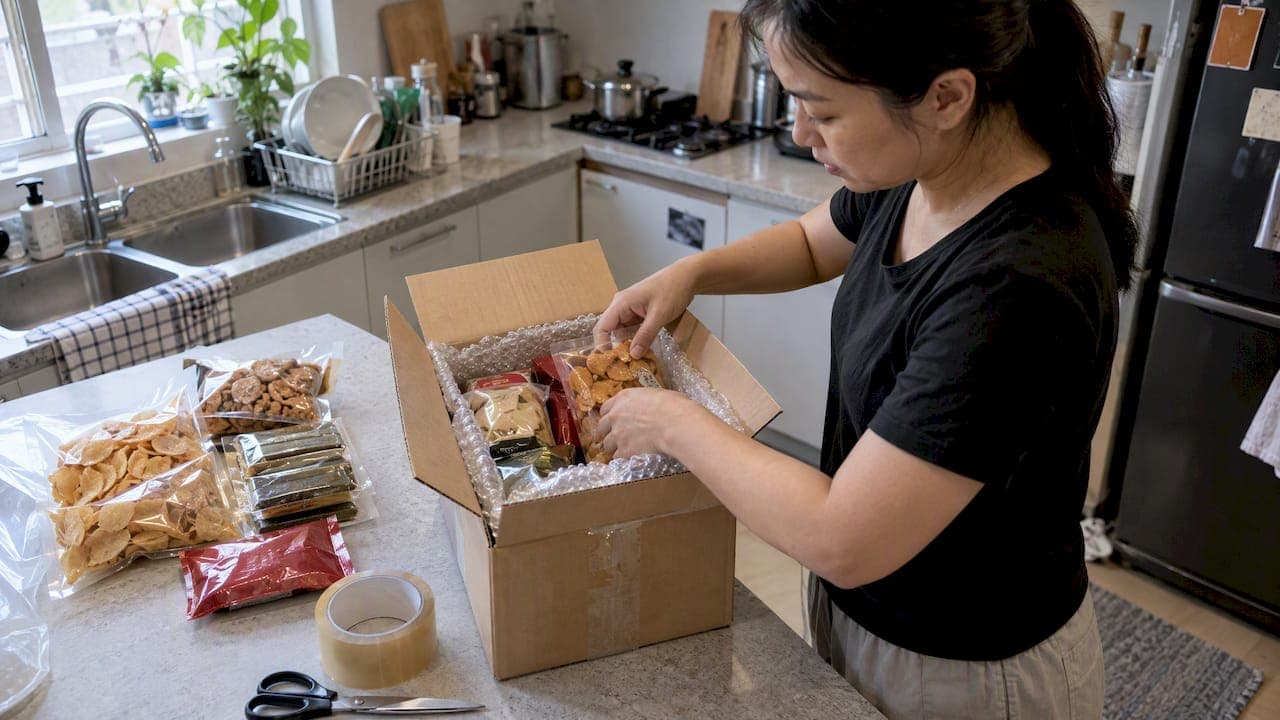
Yes, you can ship food internationally from Singapore, but only some foods, and only when the destination country allows them. Sealed, shelf-stable snacks such as biscuits, candy, packaged tea and instant noodles are the easiest to send. Fresh meat, fresh fruit, seeds and anything that must stay cold are restricted or prohibited in many places. Check three things before you pack: the destination's import rules, the carrier's rules, and Singapore's export rules.
This guide walks you through each check in order, then covers packing, customs forms and how to book.
TL;DR
- Shelf-stable, factory-sealed food is the safest category to send. Fresh meat and fresh fruit are prohibited in the international mail pathway, and many countries restrict seeds and other food products.
- The destination country decides what it lets in. Look up its import rules before you buy packaging or book a pickup.
- Declare every item honestly, with a specific description, quantity, weight and value. "Food products" alone is too vague.
- Most personal parcels of non-controlled goods valued at S$1,000 or less sent by air are exempt from a Singapore Customs export permit. Businesses exporting food may need more, including a Cargo Clearance Permit.
- Perishable and frozen food needs special packing and fast service. Ask before you ship, and choose the fastest speed that fits your budget.
Table of Contents
- Can you ship food items internationally?
- Which foods are usually fine to send?
- Which foods are restricted or prohibited?
- Singapore export checks before you ship
- Check the destination country's import rules
- How to pack food for international shipping
- Customs forms and descriptions
- Choosing a shipping speed for food
- A word from our team
- Book your food parcel with Simply Parcel
- Step-by-step checklist
- FAQ
- Sources
Can you ship food items internationally?
In most cases, yes. Food is one of the most common things people send abroad: snacks for a student far from home, festive treats for family, pantry goods for an expat, or product samples for a customer. The question is rarely "can food be shipped at all?" It is "can this food enter that country, and will it arrive in good condition?"
Three layers of rules apply to every food parcel:
- The destination country's import rules. Each country sets its own limits on meat, dairy, plants, seeds, eggs, honey and processed foods. These rules exist to protect farming, health and food safety.
- The carrier's rules. Every courier lists items it will not carry, or will carry only under conditions. Temperature-sensitive goods, liquids and anything that may leak are the usual concerns.
- Singapore's export rules. For a personal parcel these are light. For a business exporting food, they are more involved (see the section on Singapore export checks below).
If a parcel fails any one of these, it can be delayed, returned, destroyed or seized. That is why it pays to check first, not after the box is sealed.
Which foods are usually fine to send?
The foods that travel best share a few traits: they are sealed in their original factory packaging, they do not need refrigeration, and they contain little or no fresh animal or plant material.
Typical examples that many people send:
- Biscuits, cookies and crackers in sealed packs
- Candy, chocolate and gummies (chocolate needs care in hot weather)
- Instant noodles and packaged sauces in unbroken sealed containers
- Packaged tea bags and instant coffee sachets
- Dried snacks such as seaweed or nuts, in sealed retail packaging
- Spice blends and seasoning packets
"Usually fine" does not mean "always allowed." A snack that is perfectly normal in Singapore can contain an ingredient, such as dairy or meat powder, that a destination restricts. Read the ingredient label and check it against the destination's rules. For a deeper list from our own team, see our Singapore food shipping guide on snacks and goodies you can legally send abroad.
Which foods are restricted or prohibited?
The Universal Postal Union (UPU) publishes a country-by-country list of prohibited and restricted articles. It shows that fresh meat and fresh fruit are prohibited through the mail pathway, and that seeds and other food products are restricted or prohibited in particular countries. Use it as a starting point, then confirm with the destination's own customs or agriculture authority, because rules differ between countries and change over time.
As a working rule, treat these as high risk:
| Food type | Risk level | Why it causes trouble |
|---|---|---|
| Fresh meat and poultry | Very high | Commonly prohibited, and needs cold storage |
| Fresh fruit and vegetables | Very high | Prohibited or restricted to protect local crops |
| Seeds, grains and plant material | High | Restricted in many countries |
| Dairy, eggs and products containing them | High | Often limited by origin and processing |
| Homemade or unlabeled food | High | No ingredient list for officials to check |
| Frozen or chilled meals | High | Needs temperature control through the whole trip |
| Sealed, shelf-stable snacks | Lower | Still subject to ingredient and labeling rules |
| Alcohol | Special rules | Needs permits and specific handling, see below |
Alcohol is not a food item in shipping terms. It has its own permit and packing requirements, covered in our guide to shipping alcohol from Singapore. For a general overview of items couriers refuse, read what you can't ship from Singapore.
Singapore export checks before you ship
For most individuals, exporting a small box of snacks is simple. For businesses and regular sellers, Singapore has specific steps.
Food businesses. The Singapore Food Agency (SFA) states that businesses exporting food should check the destination's requirements and obtain a Cargo Clearance Permit for each consignment, and that some food categories need an SFA export licence. If you sell food products as a business, start there.
Customs export permits. Singapore Customs says exports are generally exempt from a Customs export permit when the goods are non-controlled, non-dutiable and valued at S$1,000 or less when exported by air. A permit is required for any export that is controlled, dutiable, or where permit conditions otherwise mandate it. Ordinary packaged snacks are generally non-controlled. Goods such as alcohol are dutiable, so the exemption does not apply to them.
If you want more background on how customs duty and permits work from the traveler's side, customs duty on shopping explains the basic idea of what you owe at the border.
A quick self-check for Singapore sellers:
- Is the food a plain, non-controlled, non-dutiable product?
- Is the total value S$1,000 or less per air export?
- Are you selling it as a business, or sending it as a personal gift?
- Does the product fall into a category that needs an SFA licence?
If you answer "no" to the first two, or "business" to the third, confirm the requirements with SFA and Singapore Customs before booking.
Check the destination country's import rules
This is the step most senders skip, and it causes most of the problems. Before you buy anything, find out:
- Is this food type allowed at all, in personal parcels and in commercial ones?
- Is there a weight or quantity limit?
- Does it need a permit, health certificate or lab label?
- Does the label need to be in a specific language, or show ingredients, origin or an expiry date?
- Will the receiver owe import duty or tax?
The best sources are the destination's customs agency, its food safety authority, and its agriculture ministry. Ask the receiver to check as well, since they can often call the local authority directly.
Some examples of why this matters. A country that allows packaged biscuits may still ban products with meat flavoring. A country that allows dried snacks may restrict seeds or nuts that could be planted. A box that is acceptable as a gift of a few packs may be treated as a commercial import once it holds dozens of the same item.
How to pack food for international shipping
Good packing protects the food and protects everything around it. Spoiled or leaking food can damage other parcels, which is one reason carriers are strict.
Packing non-perishable snacks
- Keep original packaging. Factory-sealed packs with ingredient labels are easiest for officials to check. If you must repack, add a list of ingredients.
- Use a sturdy box. Choose a new corrugated box with room for padding on all sides.
- Wrap fragile items. Biscuits and crisps break easily. Put them in a rigid inner container or surround them with bubble wrap or paper.
- Bag anything that can leak. Sauces, pastes and oils go in sealed plastic bags, then padded.
- Fill empty space. Items that shift in transit crush each other.
- Seal with strong tape. Use the H-taping method: tape along all seams, top and bottom.
- Protect chocolate from heat. Pack it with insulation and avoid sending it in a hot period if the route is long. Our guide to shipping food and chocolate overseas covers this in more detail.
Watch size and weight
Food is often heavy and dense, and a big box with light contents can be billed on volume rather than actual weight. Before you pick a box, read how to avoid oversize parcel surcharges from Singapore. A snug box saves money and gives the food less room to move.
Perishable, chilled and frozen food
Perishable food is a different job. It needs insulated packaging, a cooling method, and a delivery time short enough that the food stays safe. Because meat and fresh produce are often prohibited anyway, the first step is to confirm the destination accepts the item at all. After that, ask the carrier directly about its rules for temperature-controlled goods before you pack, since many service levels do not guarantee a temperature. If a carrier cannot confirm that it accepts your item, do not ship it.

For most personal senders, the practical advice is simple: choose foods that do not need refrigeration. It is cheaper, faster to arrange, and far less likely to be stopped.
Customs forms and descriptions
Every international parcel with goods needs an accurate customs declaration. For postal parcels these are forms such as CN22 and CN23. With a courier, the information goes on the commercial or proforma invoice, which the booking platform can generate for you.
Whatever the form, follow these rules:
- Be specific. Write "chocolate biscuits, sealed, 4 packs, 800 g total" rather than "food." Customs officers need to see what each item is, how many there are, the net weight and the value.
- Use English or a language the destination accepts.
- Declare the real value. Under-declaring can lead to fines, delays or seizure.
- List every item, including small extras.
- Match the contents. Anything not on the form can cause the parcel to be held.
If you are unsure how to fill in a form, our guide on sending packages overseas from Singapore walks through the full process.
Choosing a shipping speed for food
Food is time-sensitive even when it is shelf-stable. Longer transit means more handling, more heat exposure and more chance of a customs hold. We offer three speeds:
| Speed | Best for |
|---|---|
| Priority | Time-sensitive parcels, items that suffer from long transit, urgent gifts |
| Connect Plus | A balance of speed and cost for most snack parcels |
| Economy | Sturdy, non-perishable goods when budget matters more than speed |
The right choice depends on the food and the destination. For chocolate or anything sensitive to heat, choose a faster service. For canned goods or sealed dry products, economy is often enough. To understand how two of our faster options differ, read our comparison of FedEx International Priority and Connect Plus.
A word from our team
We see the same pattern every week. Someone packs a box of snacks with love, then finds out at the last minute that one item cannot enter the destination country. The fix is almost always the same: check the rules first, keep the food sealed and labeled, and describe it clearly on the paperwork.
That is why we built Simply Parcel around clarity. You compare courier options in one place, book a pickup online, and get your shipping labels and customs documents generated for you. Pickup from your door is free, and there is no monthly volume commitment, so a single box of snacks is as welcome as a regular business shipment.
We also point you to the guidance on restricted goods and customs requirements as you book, so you know what to check before the courier collects. Our aim is a calm, predictable process: you choose a speed that fits the food, you see the options, and you track the parcel until it arrives.
SP
Book your food parcel with Simply Parcel
Once you know your food is allowed, booking takes a few minutes. You enter the destination and parcel details, compare Priority, Connect Plus and Economy, pay online, and schedule a free pickup at your door. We generate your labels and customs documents, and you can follow the shipment with real-time tracking. You can also add optional protection coverage for parcels you want covered.

Ready to send? Get a shipping quote or see all our shipping speeds. If you are sending regularly from a flat or apartment, our HDB shipping guide for Singapore residents explains how pickup works at home.
Step-by-step checklist
- List what you want to send, with ingredients.
- Check the destination's import rules for each item.
- Remove anything fresh, meat-based, seed-based or homemade unless you have confirmed it is allowed.
- Confirm whether you are a personal sender or a business, and check Singapore export rules if you are a business.
- Pack in a sturdy box, with sealed originals and padding.
- Weigh and measure the box.
- Compare speeds and book the pickup.
- Fill in the customs details with item, quantity, weight and value.
- Track the parcel and tell the receiver to expect it.
FAQ
Can I ship food internationally from Singapore?
Yes, as long as the destination allows the specific food and the carrier accepts it. Sealed, shelf-stable snacks are the easiest to send. Fresh meat and fresh fruit are prohibited through the mail pathway, so check the rules before you pack.
Can I send snacks overseas as a gift?
Yes. Keep them in original sealed packaging, list each item on the customs form, and check the destination's rules for ingredients such as dairy or meat. Gifts in small quantities are generally treated more simply than bulk goods, but the rules differ by country.
Do I need a permit to export food from Singapore?
It depends on who you are and what you send. Exports of non-controlled, non-dutiable goods valued at S$1,000 or less by air are generally exempt from a Customs export permit. Businesses exporting food should check the SFA requirements, including a Cargo Clearance Permit for each consignment.
Can I ship frozen or refrigerated food?
Only if the destination accepts it and the carrier confirms it can handle temperature-controlled goods. Many meats and fresh products are prohibited anyway. For most senders, shelf-stable food is the safer choice.
How should I describe food on the customs form?
Be specific. Name each item, give the quantity, the net weight and the value. A general phrase such as "food" is too vague and can cause delays.
Sources
- UPU: Country specific list of prohibited and restricted articles
- Singapore Food Agency: What You Need to Know for Export / Tranship of Food and Food Products
- Singapore Customs: Permit Exemptions
- Singapore Customs: Documentation for Clearance of Goods
- Customs duty on shopping