
Bulk shipping is defined as the transportation of large quantities of goods loaded directly into a vessel or transport unit without individual packaging, counting, or palletizing. Commodities like grains, petroleum, and iron ore move this way every day across global trade routes. For businesses planning international logistics, understanding what bulk shipping actually means, and what it does not mean, determines whether your cargo arrives on time, at the right cost, and with the right documentation. This guide covers the definition, cargo types, regulatory thresholds, and practical strategies you need before booking your next large shipment.
What is bulk shipping and how does it work?
Bulk shipping is the movement of large volumes of unpackaged goods transported as a single mass rather than as individual units. The FHWA Freight Glossary defines bulk cargo as loose, unpackaged material loaded directly into a vessel's hold or transport container. This stands in direct contrast to palletized or containerized shipping, where goods are packed, counted, and stacked before loading.
Two primary categories define bulk cargo. Dry bulk covers solid commodities such as coal, grain, cement, and minerals. Liquid bulk covers fluids including petroleum products, chemicals, and even food-grade liquids like milk. Both categories require specialized vessels and handling equipment that standard parcel or freight carriers do not use.

One important nuance: the term "bulk shipping" carries two distinct meanings in practice. In maritime logistics, it refers specifically to loose cargo loaded into bulk carrier vessels. In courier and e-commerce contexts, some carriers use "bulk" to describe consolidated shipments under a single customs clearance. Knowing which definition applies to your shipment prevents costly misunderstandings with carriers, terminals, and customs authorities.
What types of bulk cargo exist and how are they handled?
Bulk cargo divides cleanly into two physical forms, each requiring its own handling infrastructure and vessel type.
Dry bulk cargo includes:
- Coal and minerals: Loaded via conveyor belts, grab cranes, or pneumatic systems directly into a vessel's open hold
- Grain and agricultural products: Transferred using augers, pneumatic conveyors, or bucket elevators at specialized grain terminals
- Cement and construction materials: Handled with enclosed conveyor systems to prevent dust and contamination
- Iron ore and metal concentrates: Moved by large grab cranes and stockpile reclaimers at dedicated ore terminals
Liquid bulk cargo includes:
- Petroleum and refined fuels: Pumped through pipelines directly into tanker vessel compartments
- Chemicals and industrial fluids: Transported in specialized chemical tankers with segregated tanks to prevent cross-contamination
- Food-grade liquids: Milk, vegetable oils, and juices move in stainless steel tanker containers or dedicated food-grade vessels
Bulk cargo handling uses specialized loading and discharge equipment suited to loose, unpackaged goods. Forklifts and pallet jacks are irrelevant here. Instead, terminals rely on conveyor systems, pumps, pneumatic tubes, and grab cranes. This infrastructure difference is why bulk terminals and container terminals are entirely separate facilities at most major ports.
Pro Tip: If you are shipping a commodity that flows, pours, or cannot be individually counted, you are likely dealing with bulk cargo. Confirm this with your freight forwarder before booking, since the terminal, vessel type, and documentation requirements will differ entirely from standard container freight.
Understanding how your cargo is physically handled at origin and destination terminals is as important as knowing the shipping route itself. A mismatch between cargo type and terminal capability causes delays that no amount of expedited freight can fix.
How does bulk shipping differ from breakbulk and container shipping?
These three shipping methods are frequently confused, yet they represent fundamentally different logistics models. The differences affect your packaging requirements, handling costs, documentation, and carrier selection.
| Category | Bulk shipping | Breakbulk shipping | Container shipping |
|---|---|---|---|
| Cargo form | Loose, unpackaged mass | Palletized, bagged, or crated units | Packaged goods inside sealed containers |
| Counting method | By weight or volume | By unit, pallet, or piece | By container unit (TEU/FEU) |
| Handling equipment | Conveyors, pumps, grab cranes | Cranes, forklifts, slings | Gantry cranes, reach stackers |
| Vessel type | Bulk carrier or tanker | General cargo vessel | Container ship |
| Documentation | Cargo manifest by weight/volume | Bill of lading per unit or lot | Bill of lading per container |
| Best suited for | Commodities, raw materials | Heavy machinery, project cargo | Manufactured goods, retail products |
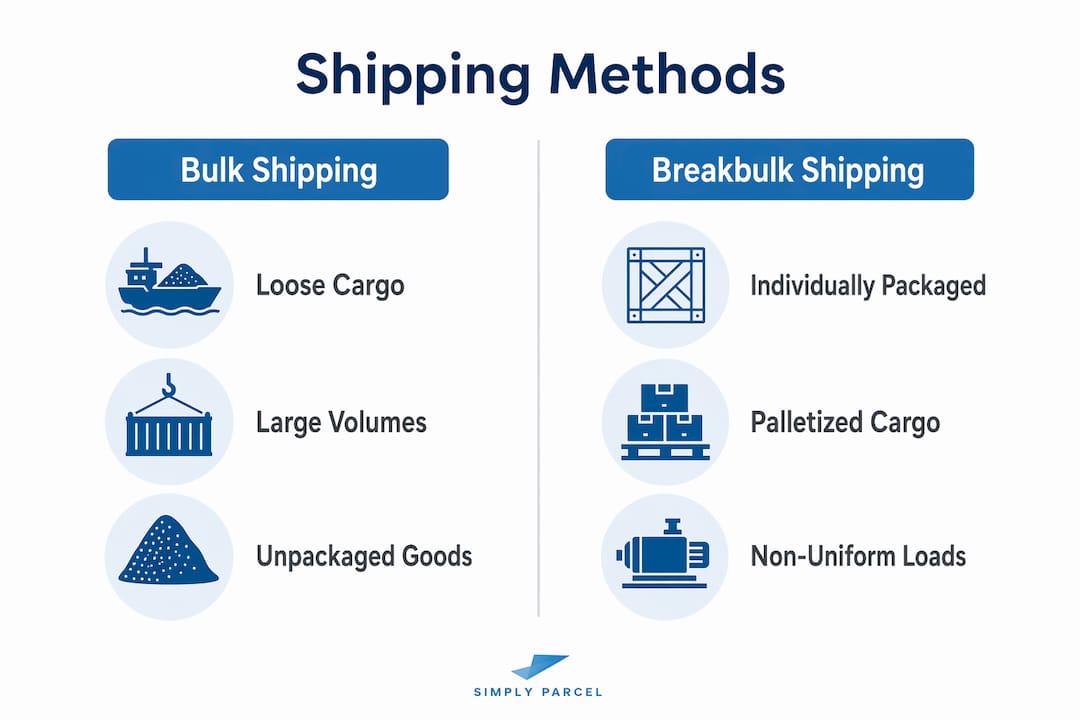
Breakbulk cargo consists of non-uniform palletized or bagged goods handled as individual pieces, while bulk cargo is loose and unpackaged without any unit count. This distinction directly affects your logistics planning. Breakbulk requires more labor at loading and discharge, while bulk cargo requires specialized terminal infrastructure but moves faster once the right equipment is in place.
Container shipping offers the most predictable cost and transit time for manufactured goods. Bulk shipping offers the lowest per-unit cost for raw commodities at scale. Breakbulk sits between the two, handling oversized or irregular cargo that neither bulk nor container methods can accommodate efficiently.
For businesses shipping from Singapore internationally, understanding this distinction helps you work more effectively with a freight forwarder who can match your cargo type to the right vessel and terminal combination.
What are the regulatory and safety rules for bulk hazardous materials?
Bulk shipping of hazardous materials carries specific legal thresholds that determine how your shipment must be classified, packaged, and documented. The U.S. Department of Transportation sets clear criteria for what qualifies as bulk packaging versus non-bulk packaging for hazardous goods.
Under U.S. DOT bulk packaging rules, a shipment qualifies as bulk when it meets any of these thresholds:
- Liquids: Maximum capacity exceeds 119 gallons (450 liters)
- Solids: Maximum net mass exceeds 400 kilograms (882 pounds)
- Gases: Water capacity of the vessel exceeds 454 kilograms (1,000 pounds)
These thresholds matter because bulk and non-bulk hazardous shipments face different labeling, placarding, and documentation requirements. A shipment that falls below these thresholds is classified as non-bulk, even if it feels like a large quantity to the shipper. Misclassifying a hazardous shipment causes customs holds, fines, and potential cargo rejection at destination ports.
For businesses shipping chemicals, fuels, or industrial materials internationally, these rules apply regardless of whether your shipment originates in Singapore, the United States, or elsewhere. Most international carriers align their hazmat classification with U.S. DOT and IATA standards as a baseline.
Pro Tip: Before booking any bulk shipment containing chemicals, gases, or flammable liquids, confirm the exact weight and volume of your cargo against the DOT thresholds. A shipment just under the bulk threshold requires entirely different documentation than one that exceeds it. Your freight forwarder or carrier's hazmat team can verify the correct classification for you.
You can also review shipping regulations for SMEs to understand how these rules apply to smaller businesses entering international freight for the first time.
What logistics strategies should businesses use for bulk shipping?
Planning a bulk shipment requires more than booking a vessel and printing a bill of lading. Bulk freight planning must account for terminal constraints, cargo handling methods, and documentation requirements that do not apply to parcel or container freight. Here is a practical framework for businesses approaching bulk shipping in 2026.
-
Confirm your cargo classification first. Determine whether your goods qualify as dry bulk, liquid bulk, or breakbulk before contacting carriers. This single step eliminates the most common source of booking errors and misquoted freight rates.
-
Identify compatible terminals at origin and destination. Bulk terminals are specialized facilities. Not every port handles every bulk commodity. Grain terminals, ore terminals, and liquid bulk terminals are separate infrastructure. Confirm that your origin and destination ports have the right terminal type for your cargo before committing to a route.
-
Prepare accurate cargo documentation. Bulk cargo is documented by weight and volume, not by unit count. Your bill of lading, cargo manifest, and customs declarations must reflect the correct measurement method. Errors in bulk cargo documentation cause customs delays that can hold an entire vessel.
-
Evaluate transloading options when mixing cargo types. If your shipment combines bulk commodities with packaged goods, transloading at an intermediate facility allows you to separate cargo streams and route each through the appropriate terminal. This approach adds a handling step but prevents costly mismatches at destination.
-
Select carriers with bulk-specific experience. General freight carriers and parcel couriers do not handle true bulk cargo. Work with carriers or freight forwarders who specialize in bulk commodity transport and have established relationships with bulk terminals on your trade lane.
-
Plan for discharge time, not just transit time. Bulk cargo discharge takes longer than container unloading. Conveyor systems, pumps, and grab cranes operate at fixed rates. Build discharge time into your supply chain planning to avoid demurrage charges at destination ports.
For businesses that ship a mix of parcels and bulk freight internationally, platforms like Simplyparcel provide a practical starting point for comparing international shipping options and understanding the terminology before engaging specialist bulk carriers.
Key takeaways
Bulk shipping is the most cost-efficient method for moving large volumes of raw commodities, but it requires matching cargo type, terminal capability, and documentation to the correct regulatory and operational standards.
| Point | Details |
|---|---|
| Bulk shipping definition | Bulk shipping moves loose, unpackaged goods by weight or volume, not by individual unit count. |
| Two cargo categories | Dry bulk covers solids like coal and grain; liquid bulk covers petroleum, chemicals, and food-grade fluids. |
| Key operational difference | Bulk cargo uses conveyors, pumps, and grab cranes, not forklifts or pallet systems used in container freight. |
| Hazmat thresholds matter | U.S. DOT classifies bulk hazardous shipments at over 119 gallons for liquids and over 400 kg for solids. |
| Terminology has two meanings | "Bulk shipping" means loose cargo in maritime contexts and consolidated parcel invoicing in courier contexts. |
Simply's perspective on bulk shipping complexity in 2026
The single biggest problem I see businesses run into with bulk shipping is not the logistics. It is the terminology. A business owner reads "bulk shipping" on a carrier's website and assumes it means what they think it means, which is usually "sending a lot of stuff at once." In maritime freight, it means something far more specific: loose, unpackaged cargo loaded directly into a vessel. These two definitions are not interchangeable, and confusing them leads to misquoted rates, wrong terminal bookings, and customs documentation that does not match the physical shipment.
What makes this more pressing in 2026 is that STS dry bulk operations are increasing in frequency, and INTERCARGO has now published the first dedicated standard for these transfers. This signals that the bulk sector is formalizing practices that were previously handled inconsistently across operators. For businesses scaling into bulk commodity trade, this is a positive development. Standardized STS guidelines mean more predictable safety protocols and fewer operational surprises during mid-voyage transfers.
My practical advice: before you commit to any bulk shipping arrangement, get the carrier or freight forwarder to confirm in writing which definition of "bulk" applies to your shipment. Ask specifically whether your cargo will be loaded loose into a vessel hold, consolidated under a single customs entry, or handled as breakbulk. That one clarification saves more time and money than any rate negotiation.
— Simply
How Simplyparcel supports your international shipping needs
Simplyparcel is a Singapore-based shipping platform that helps businesses and individuals compare, book, and manage international shipments with clarity and confidence. Whether you are shipping parcels, consolidated freight, or exploring options for larger commercial volumes, Simplyparcel gives you access to competitive rates, automatic documentation, and real-time tracking across major courier partners. The platform is built for businesses that need reliable cross-border logistics without the complexity of managing multiple carrier relationships. Get an instant shipment quote to see your options, or visit Simplyparcel to explore the full range of international shipping services available from Singapore.
FAQ
What is the bulk shipping definition in logistics?
Bulk shipping is the transport of large quantities of loose, unpackaged goods loaded directly into a vessel or transport unit by weight or volume. Common examples include coal, grain, petroleum, and iron ore.
What is the difference between bulk and breakbulk cargo?
Bulk cargo is loose and unpackaged, handled by conveyors or pumps, while breakbulk cargo consists of individually packaged, palletized, or crated units handled piece by piece. The two require different vessels, terminals, and documentation.
How does the U.S. DOT define a bulk hazardous materials shipment?
The U.S. DOT classifies a hazardous shipment as bulk when liquid capacity exceeds 119 gallons, solid net mass exceeds 400 kilograms, or gas vessel water capacity exceeds 454 kilograms. Shipments below these thresholds are classified as non-bulk and carry different labeling requirements.
What are the main advantages of bulk shipping for businesses?
Bulk shipping delivers the lowest per-unit freight cost for raw commodities at scale, reduces packaging material costs, and allows high-volume throughput at specialized terminals. These advantages apply primarily to businesses shipping large quantities of a single commodity type.
Can small businesses use bulk shipping for international freight?
Small businesses rarely ship true bulk cargo, since bulk terminals and vessels are designed for commodity-scale volumes. However, some carriers use "bulk" to describe consolidated parcel shipments under a single customs entry, which is accessible to smaller shippers through platforms like Simplyparcel.