
An address correction fee is a retroactive carrier surcharge for fixing an incorrect or incomplete delivery address, typically costing between the low twenties of dollars per package. It's preventable in most cases with address validation at checkout, and it's one of the easiest hidden costs for small shippers to cut down to nearly zero.
TL;DR:
- Most corrections are triggered by missing unit numbers, typos, city or postal code mismatches, outdated addresses, or format inconsistencies.
- Preventing address correction fees is most effective through real-time address validation at checkout and during label printing, which can reduce corrections to near zero.
- Disputing these fees is possible but requires fast action, detailed documentation, and is often unsuccessful due to the retroactive billing process.
- Tracking and reducing correction rates month over month saves operational costs and minimizes unexpected invoice surprises.
Table of Contents
- What Does an Address Correction Fee Actually Cover?
- How Much Does an Address Correction Fee Cost?
- What Triggers an Address Correction Fee?
- How to Prevent Address Correction Fees: A Priority Checklist
- Can You Dispute an Address Correction Charge?
- What's the Real Business Cost of Address Corrections?
- How Simplyparcel Reduces Address Correction Risk
- Why Prevention Beats Disputing, Every Time
- Book Shipments With Validation Built In
- Where to Verify the Numbers Yourself
- Sources
What Does an Address Correction Fee Actually Cover?
Carriers use the term "address correction" for a specific event: your package has already been tendered to the network when the carrier discovers the address you provided doesn't match what its systems can deliver to. UPS states it will assess an Address Correction charge when a shipment has an incorrect or incomplete address, and that it may correct or complete that address using information from either the shipper or the consignee.
This differs from a reroute or a formal address change request, which you initiate before pickup or in transit through a self-service tool. A correction is carrier-initiated. Their system flags a mismatch, someone (often a human) fixes it, and you get billed for that intervention after the fact.
On your invoice, watch for line items labeled "Address Correction," "AC Fee," "Address Correction Surcharge," or occasionally bundled into a broader "Address Adjustment" category. These charges rarely show up on the original shipping bill. They tend to land on a later weekly or monthly invoice, sometimes weeks after delivery, which is exactly why so many SMB shippers miss them until the totals start looking strange.
How Much Does an Address Correction Fee Cost?
Expect a fee in the low- to mid-twenties of dollars per package for a standard address correction, based on industry reporting on carrier surcharges. That's the baseline. What actually lands on your invoice can run higher once other variables stack on top.
Service level matters. Ground shipments and expedited air shipments are often billed under different accessorial schedules, and premium services sometimes carry a steeper correction rate to reflect the tighter routing windows involved. Fuel surcharges also apply as a percentage on top of the base correction fee, not as a flat add-on, so a $22 fee during a high fuel surcharge period can effectively cost more than the sticker figure suggests.
Per-shipment caps exist too. Some carrier contracts cap the total accessorial charges a single shipment can accumulate, which protects you somewhat if a package trips multiple issues at once. But that cap is a ceiling, not a discount, and most single corrections never come close to hitting it anyway.
Here's a rough breakdown of how the numbers typically stack:
| Cost component | Typical range | Notes |
|---|---|---|
| Base correction fee | low to mid-twenties dollars | Varies by carrier and service tier |
| Fuel surcharge add-on | Percentage of base rate | Fluctuates monthly with fuel indexes |
| Repeat correction on same shipment | Rare, but possible | Multiple address issues can compound |
| Administrative time to reconcile | Not itemized | Internal cost, not billed by carrier |
The gap between the advertised rate and what actually hits your books is almost always the fuel multiplier plus the internal time your team spends chasing down which order caused the charge.
What Triggers an Address Correction Fee?
Most corrections trace back to a small handful of predictable mistakes, and once you've seen the list, you'll probably recognize a few from your own order history.
-
Missing apartment or unit numbers. Multi-tenant buildings are the single biggest risk category, since a street address without a unit number is often technically undeliverable.
-
Typos and transposed digits. A single swapped number in a street address or ZIP code is enough to trigger a manual lookup.
-
City or postal code mismatches. When the city name and ZIP code don't correspond to each other in the carrier's database, the system flags it automatically.
-
Outdated customer addresses. Repeat customers who moved and never updated their saved address are a quiet, recurring source of corrections.
-
PO boxes and rural route formats. Some services can't deliver to PO boxes at all, and rural addressing conventions often don't match standard urban formatting rules.
-
New-build addresses. A house or unit built in the last year or two may simply not exist yet in carrier or postal databases, even if the address itself is correct.
-
Formatting inconsistencies. Abbreviations like "St." versus "Street," or a missing ZIP+4 extension, can be enough to confuse automated sorting systems.
Common triggers documented across the industry consistently point to these same categories, which is good news: it means the fix list is short and largely within your control.
How to Prevent Address Correction Fees: A Priority Checklist
Prevention beats disputing every time, mainly because corrections are billed retroactively and disputing them after the fact eats staff time you'll never get back. Guidance on minimizing these costs consistently ranks upfront validation as the highest-return fix available to any shipper, regardless of size. Here's how to build that into your operation, roughly in order of effort versus payoff.
- Add real-time address validation at checkout. A validation API checks the address against postal databases the moment a customer types it in, catching typos and mismatches before the order is even placed.
- Make the unit or apartment field mandatory where relevant. If the postal code you're shipping to is known for multi-tenant buildings, force that field. This single UX change removes a large share of corrections at close to zero implementation cost.
- Push validation into your warehouse labeling step, not just checkout. Gate label printing behind a validation pass so an unverified address can't physically leave the building on a package. Guidance on why verify shipping address walks through how such a label gate can work in practice.
- Run a quarterly data hygiene audit. Pull your correction history and look for repeat offenders, whether that's a specific customer, a specific ZIP code, or a checkout field that people keep skipping.
- Set a written policy on passing fees to customers. Decide in advance whether you absorb correction costs or bill them back, and put that language in your terms and conditions so there's no ambiguity when it happens.
Pro Tip: Review your last three months of carrier invoices for the "Address Correction" line item before you build anything else. Knowing whether you're dealing with five corrections a month or fifty tells you exactly how much validation effort is worth investing.
Small operational fixes elsewhere in your fulfillment chain often compound with address accuracy. A closer look at common shipping mistakes to avoid turns up several that overlap directly with address error patterns, particularly around express delivery service checkout form design.
Can You Dispute an Address Correction Charge?
Yes, but the window is narrow and the burden of proof sits with you. Because these charges post retroactively, carrier billing practices mean you're often disputing something that happened weeks earlier, so speed and documentation both matter.
Gather this before you file anything:
- A screenshot or export of the original order showing the address exactly as the customer entered it.
- The tracking number and full tracking history showing where and when the correction occurred.
- Proof the original address was deliverable, if you have it, such as a prior successful delivery to the same address.
- The invoice or billing statement where the charge appears, with the line item highlighted.
Submit disputes through your carrier account portal or your account representative, and do it as soon as you spot the charge. Carrier dispute windows are typically measured in weeks, not months. If you're seeing a volume of disputes each month that's eating meaningful staff hours, that's usually the signal to bring in an invoice audit service rather than handling each one manually.
What's the Real Business Cost of Address Corrections?
The fee itself is only part of the number. Total landed cost includes the base charge, any fuel surcharge multiplier, the staff time spent reconciling invoices, and, occasionally, a re-ship if the original delivery attempt fails entirely.
Track it as a rate, not just a dollar figure. Divide monthly corrections by total shipments to get your correction rate percentage, then multiply by your average total cost per correction to get cost per 1,000 shipments. Estimates suggest that without validation in place, 5% to 10% of shipments can trigger a correction, which adds up fast for anyone shipping in volume.
Watch the trend month over month, not just the raw total. A sudden jump usually means something specific broke, like a checkout field getting removed in a site update, and catching that early is far cheaper than absorbing three more months of the same fee.
How Simplyparcel Reduces Address Correction Risk
An effective operational approach follows a simple sequence: validate, confirm, hold, print, audit. Each shipment address gets checked against validation data at the booking stage, before a label ever generates.
- Validate at booking, not after the package has already left your warehouse.
- Hold labels for any address that fails validation until it's corrected.
- Audit monthly, comparing correction counts against the prior month to catch emerging patterns early.
A booking platform that centralizes this step matters more than it sounds. When validation lives in one place instead of being handled inconsistently across different tools, fewer addresses slip through with a missing unit number or a typo nobody caught. Our guide on avoiding shipping delays covers several of the same warehouse controls that also cut correction rates.
Pro Tip: Track your correction rate as a monthly KPI right alongside your on-time delivery rate. If one number moves, it's often a leading indicator that the other is about to.
Why Prevention Beats Disputing, Every Time
Disputing a correction fee after the fact means someone on your team is digging through screenshots and tracking logs for a charge that's already been billed, with no guarantee the carrier reverses it. Preventing the same fee means fixing one checkout field, one time.
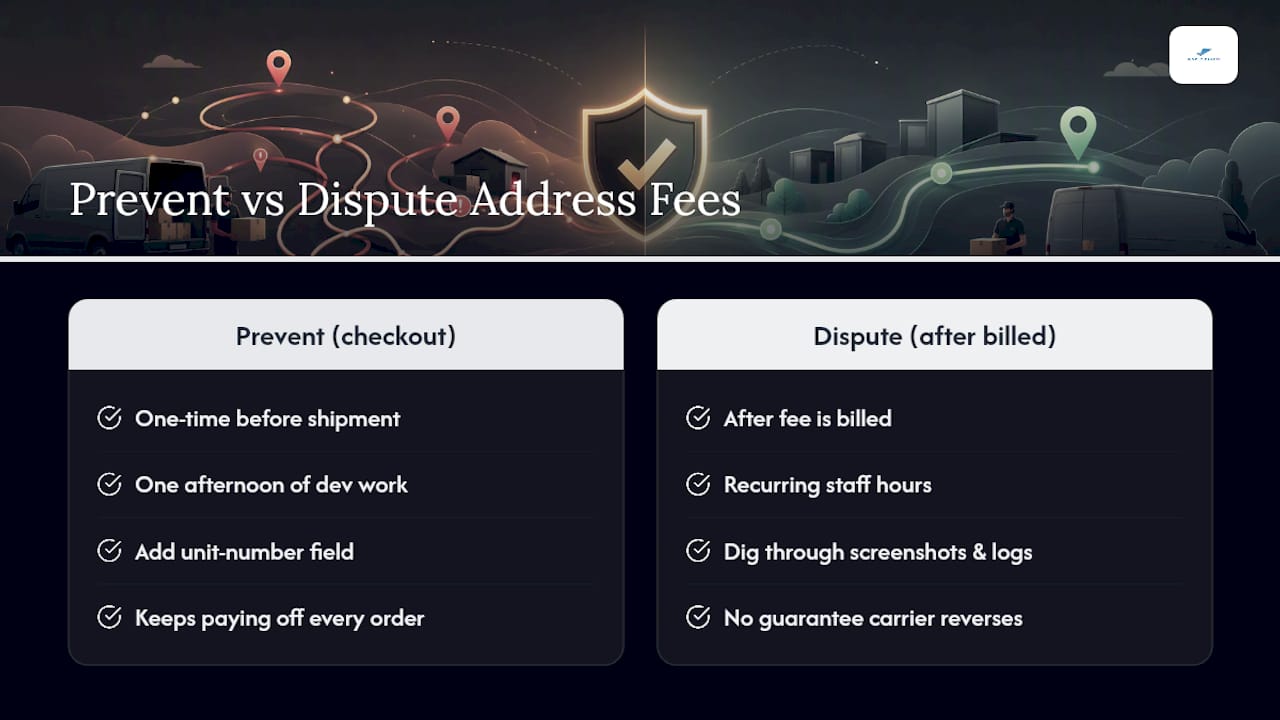
That math isn't close. A single unit-number requirement on your checkout form costs you an afternoon of development time and keeps paying off on every order after that, while a dispute workflow costs staff hours on a recurring basis with an uncertain outcome.
If you only do one thing this week, pull your last invoice and count the address correction line items. That number will tell you whether this is a five-minute checkout fix or a bigger data hygiene project.
— Simply
Book Shipments With Validation Built In
There are alternatives to juggling separate validation tools and manual invoice checks. Address validation that happens right at booking, before a label ever prints, means fewer surprise line items showing up on your invoice weeks later. Such platforms also give you clear documentation of the address entered at booking, so if a carrier correction does occur, you have exactly what you need to dispute it.
Carrier-side corrections can still happen even with validation in place, particularly for new-build addresses that haven't hit postal databases yet. But most of the preventable causes get caught before the package ever leaves your hands. If you're ready to see how validated booking works for your next shipment, get an instant quote and compare your options directly.
Where to Verify the Numbers Yourself
For the official rules, check UPS's published additional charges schedule directly. For prevention specifics on your own shipments, Simplyparcel's guide on address verification and its breakdown of remote area surcharges cover related fee categories worth understanding.
Sources
- What Is An Address Correction Fee? Shipping Surcharges Explained — Reveel
- How to prevent and minimize address correction costs — Sifted
- Address correction fees explained & prevented — ShipWave