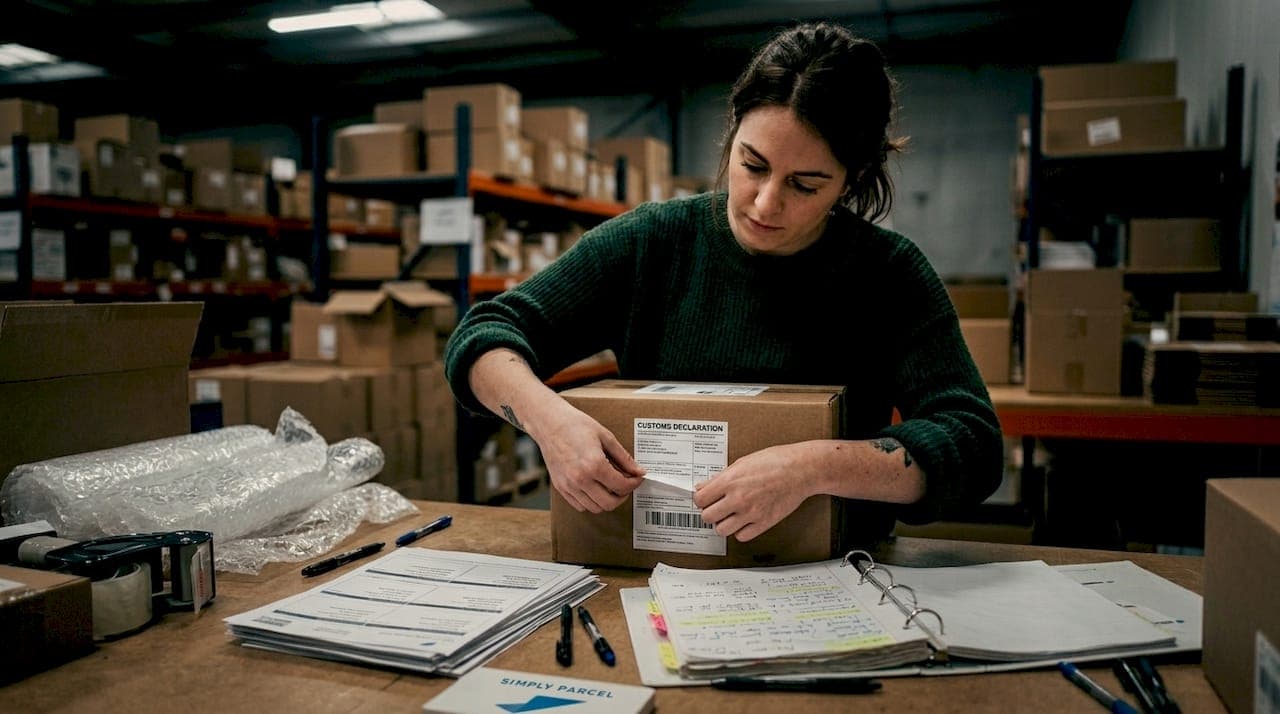
Most people assume sending a package overseas just means writing an address and slapping it on a box. That assumption costs shippers time, money, and more headaches than they expect. What is international parcel labeling, exactly? It goes far beyond a name and destination. A compliant international label is a legal document, a customs declaration, and a routing instruction all in one. Get it right, and your parcel clears customs without a hitch. Get it wrong, and you face delays, fines, or a parcel returned to sender.
Table of Contents
- Key takeaways
- What international parcel labeling really means
- Common labeling errors that delay shipments
- How to create a compliant international label
- Carrier labeling requirements compared
- My take on what shippers consistently get wrong
- Ship internationally with confidence through Simplyparcel
- FAQ
Key takeaways
| Point | Details |
|---|---|
| Labels are customs documents | International shipping labels must include customs declarations, not just addresses, to clear borders legally. |
| Choose the right form | CN22 covers packages under $400 or 4 lbs; CN23 is required for higher-value or heavier shipments. |
| Precise descriptions matter | Vague terms like "merchandise" cause customs holds; specific descriptions like "cotton T-shirt" keep shipments moving. |
| Placement affects delivery | Labels placed over seams or curved surfaces become unreadable and trigger sorting delays. |
| Automation simplifies compliance | Carrier tools and platforms like Simplyparcel generate compliant labels automatically, reducing human error. |
What international parcel labeling really means
International parcel labeling is the process of preparing and attaching all required information to a package before it crosses a national border. This includes the physical shipping label, the customs declaration form, and any supplemental documentation required by the destination country or the carrier.
A standard domestic label carries a sender address, a recipient address, and a barcode. An international shipping label does all of that and more. It communicates to customs officers exactly what is inside the package, what it is worth, where it was made, and how it should be taxed or duty-assessed. Without that information presented correctly, the package does not move.
Here is what a complete international parcel label must include:
- Sender details: Full name, street address, city, postal code, country, and a working phone number
- Recipient details: Full name, complete delivery address with postal code, country, and a phone number (critical for customs contact)
- Customs declaration form: Either a CN22 or CN23, depending on package weight and value
- Item description: Specific, accurate descriptions of every item inside the package
- Declared value: The fair market value of the contents in the sender's currency
- Quantity and weight: Itemized counts and the total package weight
- Country of origin: Where each item was manufactured or produced
- HS tariff code: The internationally recognized Harmonized System code that classifies the product for customs purposes
Accurate customs documentation is the single most critical factor in preventing shipment holds and fines internationally. That statement is especially true for first-time shippers who underestimate what "labeling" actually involves.
Pro Tip: Always include a phone number for both sender and recipient. Customs agents in many countries will call the recipient directly to verify contents or arrange duty payment. A missing number causes an automatic hold.
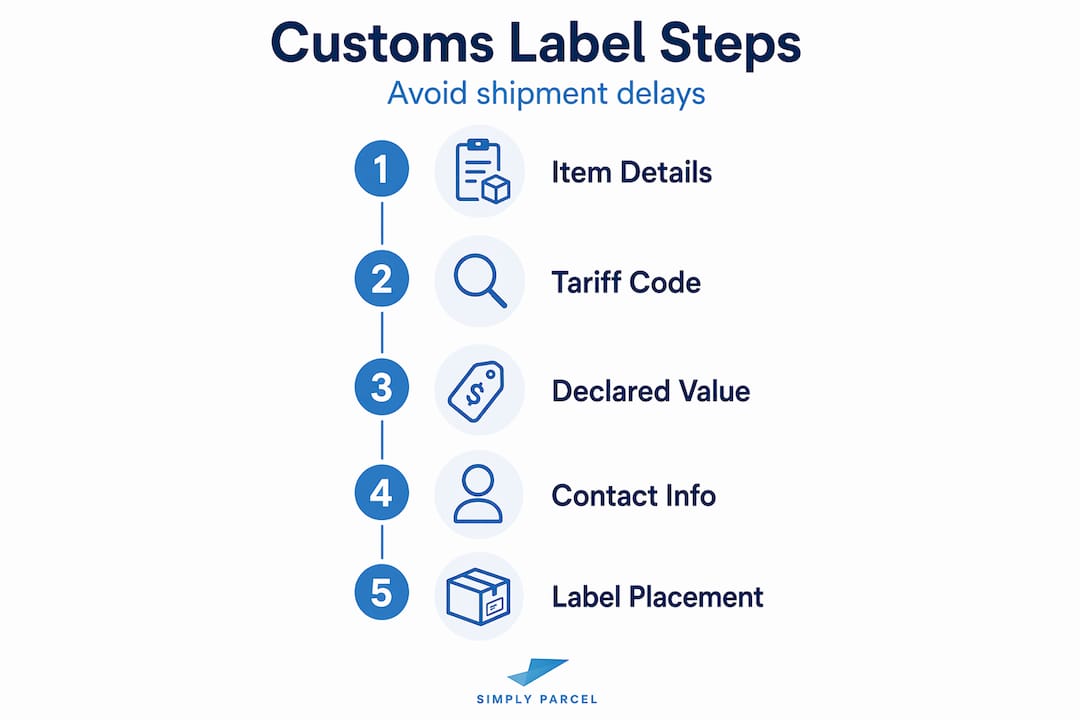
The CN22 and CN23 forms are the two standard customs declaration formats used in international postal shipping. CN22 is a simplified form used for packages under $400 in value or under 4 lbs in weight. CN23 is a more detailed form required for packages over those thresholds and must itemize product descriptions, individual quantities, and per-item values. Using the wrong form is one of the more common and easily avoidable mistakes shippers make.
Understanding and precisely applying HS tariff codes can significantly speed customs clearance and prevent misclassification penalties. These codes are six digits at minimum and tell customs authorities exactly what product category your item falls into, which determines the duty rate applied in the destination country.
Common labeling errors that delay shipments
Even experienced shippers make labeling mistakes. The difference is knowing which errors to watch for before the package leaves your hands. Most delays trace back to a small number of repeating problems.
Vague item descriptions are the leading cause of customs holds. Writing "merchandise," "gift," or "personal items" on a customs form gives officers no basis to assess duties correctly. They will hold the package until clarification arrives, which can take days. Write "men's cotton T-shirt, size M, blue" instead of "clothing." Write "lithium-ion rechargeable battery pack, 10,000 mAh" instead of "electronics." The specificity is not just good practice. It is required.

Missing recipient phone numbers and improper label placement are among the most common fixable errors causing parcel delays. These are details that take seconds to verify but create significant problems when overlooked.
Label placement is another area where shippers frequently go wrong. Here is what to avoid:
- Placing labels over seams or package edges: Automated sorting equipment requires barcodes to be flat, fully visible, and scannable. A label folded over a box corner will almost certainly fail to scan.
- Labeling curved surfaces: Tubes and cylindrical packages require labels on flat sections only. Barcodes on curved surfaces distort and become unreadable.
- Leaving old labels on the package: Old or duplicate labels confuse scanners and can cause misrouting or return. Remove them completely or cover them fully with opaque tape before applying the new label.
- Low print quality: A faded or smeared barcode may look fine to the human eye but fail automated readers. Use a laser printer at 300 DPI minimum, or a dedicated thermal label printer for the best results.
Incorrect declared values create a different type of problem. Undervaluing a package to reduce duties is considered customs fraud in most countries and can result in fines, confiscation, or a permanent flag on the shipper's account. Overvaluing can trigger unnecessary tariffs. The declared value should reflect the actual fair market value of the goods, full stop.
Pro Tip: Print a backup copy of your customs form and keep it until delivery is confirmed. If a parcel is held, having your documentation ready speeds up the resolution process significantly.
How to create a compliant international label
Following a consistent process each time you prepare an international shipment removes most of the risk. Here is a step-by-step approach that works for both individuals and Singapore SMEs shipping internationally.
-
Gather and verify all sender and recipient data. Collect the full legal name, complete street address including unit number where applicable, city, postal code, country, phone number, and email address for both parties. Double-check against the original order or communication. A single digit wrong in a postal code will reroute the parcel.
-
Determine which customs form you need. If your package weighs under 4 lbs and its total value is under $400, CN22 is sufficient. If it exceeds either threshold, you need CN23. When in doubt, use CN23. It contains more detail, and customs officers will not reject a more detailed form.
-
Research and apply the correct HS tariff code. Use the World Customs Organization's online HS database or your carrier's classification tool to find the six-digit code for each item type in your package. Record it on your customs form under the appropriate product line. For businesses shipping the same products repeatedly, keeping a reference list of your common HS codes saves significant time.
-
Write specific item descriptions. For every item in the package, list the material, type, intended use, and any relevant specifications. Avoid abbreviations. "Blue ceramic coffee mug, 350 ml capacity" is correct. "Mug" is not.
-
Calculate the declared value accurately. Use the actual price paid by the recipient, or the fair market value for gifts. Do not convert currencies at rough estimates. Use a reliable exchange rate and state the currency clearly on the form.
-
Print your label and customs form at high quality. Use a thermal label printer if possible, as these produce clean, durable labels that resist moisture and smearing during transit. If printing on a standard inkjet or laser printer, use label paper rated for shipping use, not plain copy paper. Print at the highest quality setting.
-
Attach the label correctly. Place the label flat on the largest surface of the package, away from edges and seams. For polybags, center it on the front face. For tubes, place it along the longest flat section available. Cover the entire label with clear packing tape to protect it from moisture, but avoid taping over the barcode if your carrier specifically instructs against it. Removing prior labels and placing new labels on flat, central surfaces prevents scanning issues and delays.
-
Use a platform or tool to generate documentation automatically. Carrier websites and shipping platforms like Simplyparcel can generate formatted labels and customs forms based on the shipment data you enter, which reduces formatting errors and saves time on repeat shipments.
Carrier labeling requirements compared
International parcel labeling requirements are not universal across carriers. Each major carrier has its own formatting rules, documentation requirements, and label types. Knowing the differences helps you prepare correctly regardless of which carrier you use.
| Carrier | Customs Form Type | Label Format | Key Notes |
|---|---|---|---|
| USPS | CN22 or CN23 via customs declaration | Integrated labels combining shipping and customs info | Some services require three-part labels with window pockets; others use single-part formats |
| FedEx | Commercial invoice for commercial shipments | Carrier-generated label via FedEx platform | Requires pro forma or commercial invoice attached separately for dutiable goods |
| DHL | Commercial invoice plus DHL-generated label | Carrier-generated label via DHL platform | AI-powered customs tool uses computer vision to generate item descriptions automatically |
| UPS | Commercial invoice for dutiable shipments | Carrier-generated label via UPS platform | Requires Trade Direct documentation for high-volume cross-border shipments |
USPS uses integrated international labels that combine shipping and customs information into a single label format. This reduces the chance of documentation becoming separated during transit, which is a real risk when forms are attached in separate pouches. FedEx and DHL both require a separately prepared commercial invoice for commercial shipments, which must accompany the package either inside a documentation pouch on the exterior or inside the box with a note on the label.
DHL has invested notably in reducing customs friction. Their AI-powered customs tool uses computer vision to generate accurate item descriptions from product images, which directly reduces customs delays caused by vague descriptions. This is a sign of where the industry is heading, and it underscores why clear, readable labels processed efficiently by automation equipment are becoming the baseline expectation, not a bonus.
For an overview of international shipping terminology that applies across carriers, including terms like pro forma invoice, commercial invoice, and Incoterms, that reference is worth bookmarking before your next shipment.
My take on what shippers consistently get wrong
I have seen a consistent pattern across shippers at every level, from individuals sending gifts abroad to small businesses managing weekly export runs. The labeling step gets treated as the last item on a long checklist, rushed through after everything else is packed and taped. That is the wrong order of priority.
In my experience, the shippers who never face customs delays treat label preparation as the first step, not the last. They verify recipient details before they start packing. They research HS codes before they print anything. They check their carrier's current documentation requirements each time, because these do change. The physical act of packing the box is the easy part. The documentation is where the real work happens.
What I find most telling is the resistance to using automated label generation tools. Many shippers, particularly small businesses, still type customs forms by hand because it feels more "controlled." What it actually produces is a higher rate of transcription errors and formatting inconsistencies that slow customs processing. The technology available today, including platforms that auto-generate compliant labels from shipment data, removes the most error-prone parts of the process entirely.
My honest recommendation: treat your shipping label as a legal document, because it is one. Give it the attention you would give a contract. The few extra minutes spent on accuracy at the labeling stage will save you days of delays and real money in fines or return shipping costs on the other side.
— Simply
Ship internationally with confidence through Simplyparcel
Getting international parcel labeling right does not have to be a manual, error-prone process. Simplyparcel automatically generates compliant international shipping labels and the required customs documentation when you book your shipment, so you do not have to format forms by hand or worry about missing fields. The platform integrates with major courier partners, so your label meets each carrier's specific requirements from the start.
Whether you are an individual sending a package from Singapore or a business managing regular cross-border exports, Simplyparcel gives you accurate labels, real-time tracking, and free pickup services at competitive rates. Get started with an instant shipment quote and see how straightforward international shipping can be when the documentation is handled for you.
FAQ
What is international parcel labeling?
International parcel labeling is the process of preparing and attaching a compliant shipping label and customs declaration to a package before it is shipped across a national border. It includes sender and recipient details, declared value, item descriptions, HS codes, and the appropriate customs form (CN22 or CN23).
When do I need a CN22 vs. CN23 form?
Use a CN22 form for packages valued under $400 or weighing under 4 lbs. Use a CN23 form for packages that exceed either of those thresholds, as it requires more detailed product information including quantities and per-item values.
Why do customs hold international packages?
The most common reasons are vague item descriptions, missing recipient phone numbers, incorrect declared values, and missing or mismatched HS tariff codes. All of these are preventable with accurate label preparation before shipping.
Does label placement really affect delivery?
Yes. Automated sorting equipment requires barcodes to be flat, fully visible, and unobstructed. Labels placed over seams, curved surfaces, or on top of old labels frequently fail to scan, triggering manual intervention and delays that can add days to delivery time.
Do labeling requirements differ by carrier?
Yes. USPS uses integrated labels that combine shipping and customs information, while FedEx, DHL, and UPS require separately prepared commercial invoices for dutiable shipments. Each carrier also has its own label size, placement, and documentation pouch requirements.