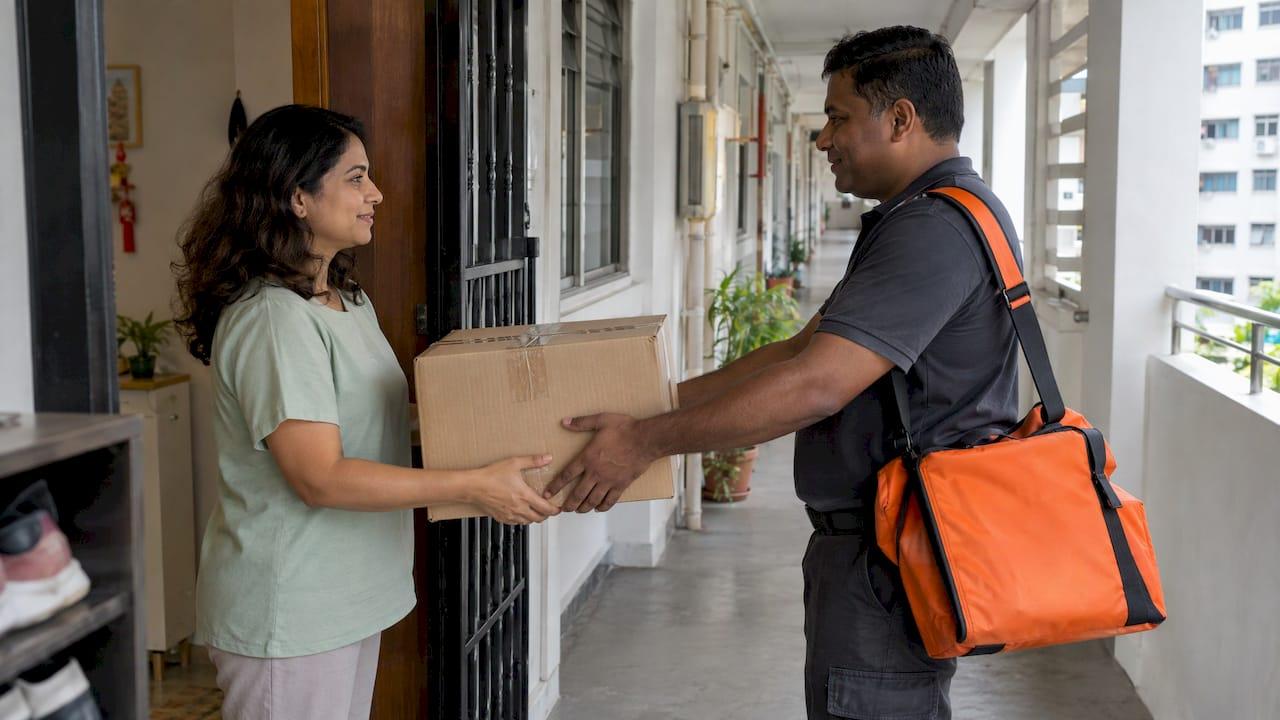
The simplest way to send a parcel from Singapore to the UK is to compare carrier rates in one place, pick a speed (Priority, Connect Plus or Economy), book a free doorstep pickup and let the platform generate your label and customs paperwork. We built Simply Parcel around exactly that routine. This guide walks you through the decision and the steps: how to choose a speed, what affects the price, what to put on the customs declaration, and what the UK may charge your recipient when the parcel arrives.
It is written for people sending personal parcels (students, expats, families), small businesses and online sellers who ship to UK customers on a regular basis.
TL;DR
- Choose your speed first: Priority for urgent items, Connect Plus for a balance of speed and cost, Economy when price matters more than time.
- Your price depends on the chargeable weight (the greater of actual weight and size-based volumetric weight), the speed, and any extra protection you add.
- Every parcel needs an accurate customs declaration. Wrong or missing details are the most common cause of delays at the UK border.
- The UK does not charge customs duty on low-value goods up to £135, but VAT is still due. Decide in advance whether you or the recipient pays.
- Free pickup, auto-generated labels and documents, and real-time tracking mean you can book in one sitting without visiting a counter.
Table of Contents
- Which service suits a parcel to the UK?
- What affects the price of a Singapore to UK shipment
- Step by step: sending a parcel to the UK
- The customs declaration: what the UK needs to see
- UK duty and VAT: what the recipient may pay
- Protecting a parcel that matters
- Tracking and what to do if the parcel is delayed
- Perspective: why we make UK shipping simple
- Book your parcel to the UK
- Frequently asked questions
- Sources
Which service suits a parcel to the UK?
Most senders in Singapore are choosing between three things: how fast the parcel must arrive, how much they want to pay, and how much of the paperwork they want to handle themselves. On Simply Parcel the speed tiers are Priority, Connect Plus and Economy, and all three are available for shipping abroad from Singapore.
| Your situation | Speed to look at first | Why |
|---|---|---|
| A document, a replacement part or a gift with a date attached | Priority | The fastest tier, built for urgency |
| A regular parcel to family, or stock for a UK customer | Connect Plus | A middle option between speed and cost |
| Books, clothes or belongings with no deadline | Economy | The lowest-cost tier for time-flexible items |
You do not need to commit to a carrier in advance. Because the platform connects you with several courier partners, you enter the destination and parcel details once and compare the options returned for each tier. If you want a deeper framework for weighing carriers, our guide on how to choose the best international courier from Singapore covers the criteria in detail, and this list of fast shipping options is useful when time is the main constraint.
How to match speed to what you are sending
Ask yourself three questions:
- What happens if it is late by a week? If the answer is "I miss a visa deadline" or "a customer cancels", use Priority. If the answer is "nothing much", Economy is usually the sensible choice.
- Is the value high? The more the contents are worth, the more it makes sense to pay for a faster tier with tracking you can follow step by step, and to add protection coverage.
- Will this be a one-off or a pattern? A seller shipping orders every week needs predictable timing, so Connect Plus or Priority for customer-facing orders and Economy for restocking often works well.
What affects the price of a Singapore to UK shipment
We do not publish a fixed price list here, because the rate you see depends on your parcel and the carrier options returned for it. What we can tell you is what moves the number, so you can estimate before you quote.
- Chargeable weight. Carriers bill on whichever is greater: the real weight on the scale, or the volumetric weight calculated from the box's length, width and height. A light but bulky parcel (a duvet, a large soft toy) can cost more than a small dense one. Use the smallest box that protects the contents.
- Speed tier. Priority costs more than Connect Plus, which costs more than Economy, because faster service uses faster handling and routing.
- Destination details. UK postcodes in remote areas can attract surcharges with some carriers. Entering the exact address in the quote shows you the final figure.
- Extras. Optional additional protection coverage adds to the total, but it also covers loss or damage if something goes wrong.
- Who pays UK taxes. Whether duties and VAT are collected from you at booking or from the recipient on delivery changes what each side pays. More on this below.
The quickest way to see a real number is to get a shipping quote with your destination, weight and dimensions. Rates are shown before you commit, and there is no monthly volume commitment, which matters if you ship only now and then.
If you are trying to bring costs down, our article on reducing international shipping costs without losing speed lists practical ways to do it.
Step by step: sending a parcel to the UK

1. Weigh and measure the parcel
Pack the items first, then weigh and measure the finished box, not the contents. Use a sturdy carton, fill empty space so nothing shifts, and seal all seams with tape suitable for shipping. Write down weight in kilograms and the three dimensions in centimeters. These are the numbers the quote needs, and entering them wrongly is the most common reason a final bill differs from the first estimate.
2. Check what you are allowed to send
Some items cannot travel by courier at all or need special handling: batteries, aerosols, perfumes, liquids, food, plants, medicines and anything with an age or licensing restriction. Rules apply on both sides, so check before you pack. Simply Parcel gives guidance on restricted goods during booking, so you can find out about a problem before the courier does. If you are unsure about a particular item, ask us before you seal the box.
3. Compare rates and pick a tier
Open the quote page, enter Singapore as the origin and the United Kingdom as the destination, then compare Priority, Connect Plus and Economy. Look at the estimated transit time and the total price, not just the headline rate. A cheaper service that takes much longer is only a saving if you can wait.
4. Book online and arrange pickup
You complete the booking and payment online. Pickup is free and happens at your doorstep, so you do not need to carry a heavy box to a counter or arrange a separate trip. You choose a pickup slot that fits your day.
5. Get the label and customs documents
The platform generates your shipping label and the customs documentation automatically from the details you entered. That removes the common mistakes of hand-written forms: illegible descriptions, missing values and mismatched totals. Print the label and attach it firmly to the parcel, on the largest flat surface and away from seams. Keep the invoice copy where the booking instructions tell you to.
6. Track the shipment
Once the courier has collected the parcel, you can follow it with real-time tracking. Share the tracking number with the recipient so they know when to expect it and can be available if the carrier needs to contact them about UK charges.
The customs declaration: what the UK needs to see
A customs declaration is the statement of what is inside the parcel, what it is worth and why it is being sent. Customs authorities use it to decide whether duty and VAT apply and whether the goods are allowed. Under-describing the contents, or leaving out the value, is the classic way to cause a hold-up.
Fill in these points accurately:
- A specific description. Write "men's cotton shirts, 3 pieces", not "clothes" or "gift".
- Quantity and unit value. Give each line its own value, and make sure the lines add up to the total.
- Total value in a stated currency. Use the price actually paid or, for used personal items, a fair replacement value.
- Reason for sending. Gift, personal effects, sale of goods or sample. Each is treated differently.
- Sender and recipient details. Full names, a UK address with postcode, and a phone number for the recipient.
For a fuller walkthrough of the Singapore side, see what you need for a customs declaration in Singapore. Businesses that ship regularly will also find the list in essential international shipping documentation for Singapore SMEs helpful, covering commercial invoices, packing lists and the records worth keeping.
Documents versus goods
Papers with no commercial value, such as letters or certificates, are generally treated more simply than goods. Anything with a commercial value, including samples and items you sell, needs a commercial invoice. If you are shipping to a UK business, ask them whether they need to supply a registration number such as an EORI number (the identifier UK traders use for customs), because a missing one can delay clearance.
UK duty and VAT: what the recipient may pay
This is the part of a UK shipment that surprises senders most. The UK's rules differ from what many people expect.
- Customs duty. UK customs duty is waived on low-value consignments of £135 or less, according to a 2026 de minimis guide from a trade-cost advisory. Above that threshold, duty may apply depending on the goods and their origin.
- VAT. Being under the duty threshold does not mean tax-free. The same guide notes that the UK's tax threshold for VAT is £0, so VAT is always due, collected by the seller where one is registered for UK VAT, or otherwise by the carrier on delivery together with a handling fee. Do not assume that a small parcel will reach the recipient with no charges.
- Gifts. Whether a parcel qualifies as a private gift depends on it being sent from one private individual to another. A parcel from a business to a consumer is a sale of goods, not a gift, even if the recipient did not pay for it.
The tax picture is also moving. A professional update from RSM in August 2026 reports that the UK has confirmed it will remove the customs duty relief on low-value imports of £135 or less from October 2028, earlier than first planned. If you are an online seller building a UK customer base, factor that into your long-term pricing, and check the official UK government pages for the exact rules in force on the day you ship.
If you want to understand how import VAT and customs duty are charged and who collects them, this explainer on import taxes and who pays them shows how the same logic works on a high-value import into another market.
Who pays: sender or recipient?
You have two ways to settle UK charges:
- Recipient pays on delivery (often called DAP, Delivered at Place). You pay for shipping, and the recipient pays duty and VAT when the parcel arrives. This keeps your cost down but can leave a customer with an unexpected bill.
- Sender pays upfront (DDP, Delivered Duty Paid). You cover duty and taxes, and the parcel arrives with nothing left to pay. This is friendlier for customers and for e-commerce stores that want a smooth checkout experience.
If you sell to UK customers, DDP usually produces fewer refused parcels and fewer complaints. Our guide to DDP versus DAP compares them and helps you decide which to choose for different order values. For a personal gift to family, DAP is fine as long as you warn the recipient in advance.
Protecting a parcel that matters
Parcels that cross continents are handled many times. Standard carrier liability is generally limited, so for anything valuable or irreplaceable, you can add optional additional protection coverage when you book. It is worth considering for electronics, jewelry, collectibles, and stock destined for paying customers. Photograph the item and the packed box before sealing it, and keep the invoice, because a clear record makes any claim simpler.

Tracking and what to do if the parcel is delayed
With real-time tracking, you can see each scan from pickup in Singapore to delivery in the UK. A few practical habits help:
- Allow for customs. A day or two in clearance is normal, particularly for goods that attract VAT. A status like "held in customs" is often waiting for payment or information from the recipient.
- Make sure the recipient is reachable. A correct phone number and email save days.
- Respond to requests quickly. If the carrier asks for an invoice or a registration number, send it the same day.
- Contact us early. If the tracking stops moving for several days, get in touch with the booking details rather than waiting. We can follow up with the courier partner on your behalf.
Perspective: why we make UK shipping simple
Most of the problems we hear about on UK shipments are not about the courier flying the parcel. They are about preparation: a vague customs description, a box measured wrongly, or a recipient surprised by VAT.
That is why our platform is built around the preparation. You compare several courier partners in one place, you see the speed options laid out as Priority, Connect Plus and Economy, and you get your label and customs documents generated for you, so the paperwork matches the booking.
We offer free pickup from your door, and there is no monthly volume commitment, so a student sending one box home and a seller shipping every week can use the same service. Our view is that international shipping should feel like a clear sequence of steps, not a puzzle.
SP
Book your parcel to the UK
If you are ready to ship, Simply Parcel lets you compare Priority, Connect Plus and Economy shipping in a single booking flow. Enter the parcel details, see the options, book online and we collect it from your door at no charge. Your label, customs documents and tracking come with the booking.

For first-time senders, our beginner's guide to shipping from Singapore explains each stage with examples, and the broader overview in what international shipping involves for Singapore senders is a good companion read.
Frequently asked questions
How much does it cost to send a parcel to the UK from Singapore?
The price depends on the chargeable weight, the speed tier and any added protection. Enter your parcel's weight, dimensions and the UK address on our quote page to see the available options before you pay. Remember to consider any UK VAT or duty separately if the recipient will pay on delivery.
Which speed should I choose?
Choose Priority when the parcel is urgent or valuable, Connect Plus when you want a balance of speed and cost, and Economy when you can wait and want to spend less. The quote shows estimated transit times for each, so you can compare them side by side.
Will the recipient have to pay anything in the UK?
Possibly. UK customs duty is waived for low-value consignments of £135 or less, but VAT is still due on goods, as a 2026 trade guide explains. If you choose DDP, you pay these charges upfront so the recipient does not have to.
Do I need to go to a post office or counter?
No. Pickup from your doorstep is free, and the label and customs documents are generated online. You only need to pack the parcel, attach the label and hand it over at the agreed time.
Can I track my parcel to the UK?
Yes. Real-time tracking is included, so you can follow the parcel from pickup in Singapore through to delivery. Share the tracking number with the recipient so they can prepare for delivery.
Sources
- International Indirect Tax Update, August 2026 (RSM)
- De minimis customs threshold: country-by-country guide (Trade-Cost)