
Verifying a shipping address means confirming that the location physically exists and can receive mail, as recorded in official postal databases. This process is the foundation of reliable delivery, whether you are sending a single parcel or managing thousands of shipments each month. Skipping this step leads to returned packages, wasted shipping costs, and frustrated recipients. Understanding why you should verify shipping address details before dispatch saves money, protects your reputation, and keeps customers satisfied. Simplyparcel builds this principle into every international shipment it handles.
What is the difference between address validation and address verification?
These two terms are used interchangeably, but they describe different processes. Knowing the distinction helps you choose the right approach for reliable shipping.
Address validation checks that an address is formatted correctly. It confirms the street name is spelled properly, the postal code matches the city, and the country code is present. Validation catches typos and structural errors. It does not confirm whether the address is a real, deliverable location.

Address verification goes one step further. It checks the address against official postal databases, such as those maintained by USPS in the United States or SingPost in Singapore, to confirm the location exists and can receive packages. A validated address can still fail verification if the property is vacant, demolished, or simply not registered in the postal system.
The table below shows how the two processes compare:
| Feature | Address validation | Address verification |
|---|---|---|
| Checks spelling and format | Yes | Yes |
| Confirms postal code accuracy | Yes | Yes |
| Confirms physical existence | No | Yes |
| Confirms deliverability | No | Yes |
| Flags vacant or unregistered addresses | No | Yes |
| Requires postal database access | No | Yes |
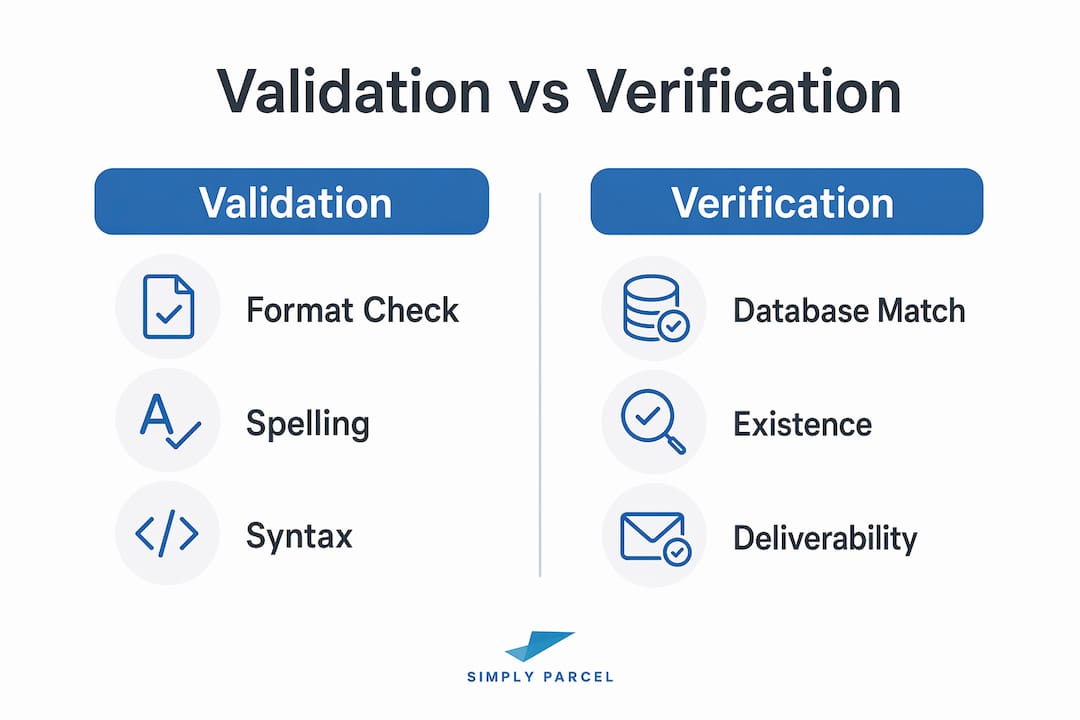
Validation is a necessary first step. Verification is what actually protects your shipment from failing at the door.
Pro Tip: Always run both validation and verification before printing a shipping label. Validation catches formatting errors that would cause verification to fail, so running them in sequence saves time and reduces API errors.
Why verify shipping address: key benefits and practical impacts
The reasons to verify delivery address details go well beyond avoiding a returned parcel. Each benefit has a direct financial or operational impact on your business.
- Fewer undeliverable packages. Unverified addresses produce shipments that carriers cannot deliver. Each failed delivery generates a return shipment, a re-delivery attempt, or a lost parcel. All three outcomes cost money and damage customer trust.
- Faster, more accurate delivery. Carriers route packages based on the address data on the label. A verified address gives the carrier clean, confirmed data, which reduces sorting errors and speeds up transit times. This matters especially for international shipping timelines where a single error can delay a parcel by days.
- Fraud prevention. Verification reduces shipping fraud by confirming that addresses are real and associated with valid delivery points. Fraudulent orders often use fictitious or undeliverable addresses to exploit refund policies. Catching these at checkout protects your revenue.
- Better customer experience. Customers expect their orders to arrive on time and at the right location. A failed delivery creates a support ticket, a refund request, and often a lost customer. Verified addresses reduce all three outcomes.
- Lower operational costs. Returns, re-shipments, and customer service calls all carry a cost. Verifying addresses before dispatch removes the root cause of most of these expenses. For small businesses, this directly affects profit margins. Simplyparcel's platform is built to support cost-conscious shippers who need reliable delivery without absorbing the cost of avoidable errors.
- Accurate shipping manifests. Shipping manifests cross-check address information to reduce errors during transport, particularly for bulk or international shipments. Verified addresses feed clean data into these manifests from the start.
The importance of verifying shipping details compounds at scale. A business sending 500 parcels per month with a 2% address error rate faces 10 failed deliveries every month. Each one carries a cost in time, money, and customer goodwill.
Why does a shipping address fail verification?
Understanding why addresses fail helps you fix problems before they delay a shipment. Most failures fall into a small number of categories.
- New or unregistered addresses. Newly built properties often take weeks or months to appear in official postal databases. A brand-new apartment complex may have a valid street address that no carrier database yet recognizes. This is one of the most common reasons verification fails for residential customers.
- Vacant or inaccessible properties. Postal databases flag addresses where mail cannot be delivered. A vacant lot, a demolished building, or a property with restricted access will fail verification even if the address format is correct.
- Missing secondary information. Apartment numbers, suite numbers, and unit identifiers are required for multi-unit buildings. An address that reads "123 Main Street, New York, NY 10001" without a unit number will fail verification if the building has multiple deliverable units.
- Incorrect postal codes or city names. A ZIP code that does not match the city name causes an immediate verification failure. This error is common when customers type addresses quickly at checkout.
- Ambiguous addresses with multiple interpretations. Some street names exist in multiple cities or states. Automated systems correct minor errors but flag addresses with significant errors or multiple possible interpretations for human review. These cases require manual correction before a label can be printed.
Pro Tip: When collecting addresses from customers, use a component-based input form that captures street number, street name, city, state, and postal code in separate fields. This prevents the most common formatting errors before verification even runs.
How to effectively verify shipping addresses
The shipping address verification process works best when it is built into your workflow rather than treated as an afterthought. Several methods and tools make this practical at any scale.
Use official postal APIs
Address verification APIs trigger a real-time check against postal databases and return a verified address or a specific error code. These APIs integrate directly into ecommerce platforms, order management systems, and shipping software. The check happens in milliseconds, before the customer completes checkout or before a label is generated.
Enter addresses in component form
Feeding a full address string into a verification system produces less accurate results than entering each component separately. Street number, street name, city, state or province, postal code, and country should each occupy a distinct field. This structure reduces ambiguity and improves the accuracy of the verification result.
Apply batch verification for high-volume shipping
Batch address validation tools allow you to check multiple orders at the same time, before shipping labels are printed. This is the most efficient approach for businesses processing large order volumes. Running a batch check at the end of each business day catches errors before they reach the fulfillment stage.
Integrate verification at checkout
Integrating verification into ecommerce checkout or customer onboarding catches errors at the moment of entry, when the customer is still present to correct them. This is far more efficient than discovering an address problem after a parcel has been dispatched. Platforms like NetSuite offer enterprise-level address validation at the order level to prevent costly shipment failures.
Handle international addresses carefully
International addresses follow different formats, use different postal code structures, and rely on different carrier databases. A Singapore address, a German address, and a Brazilian address each have distinct formatting rules. Use a verification tool that supports the specific countries you ship to. Simplyparcel's international shipping guide covers address requirements for cross-border shipments in detail. When a verification tool cannot confirm an international address, contact the recipient directly to confirm the details before shipping.
The table below summarizes the main verification methods and when to use each:
| Method | Best for | Key benefit |
|---|---|---|
| Real-time API at checkout | Ecommerce businesses | Catches errors before order is placed |
| Batch verification | High-volume shippers | Checks many orders at once |
| Component-based input forms | All shippers | Reduces formatting errors at entry |
| Manual review queue | Ambiguous or flagged addresses | Human judgment resolves edge cases |
| Carrier pre-shipment check | Single parcel senders | Last-chance verification before dispatch |
Key Takeaways
Verifying a shipping address before dispatch is the single most effective way to prevent failed deliveries, reduce costs, and protect customer relationships.
| Point | Details |
|---|---|
| Verification vs. validation | Validation checks format; verification confirms the address physically exists and can receive mail. |
| Fraud protection | Verified addresses block fraudulent orders that use fictitious or undeliverable locations. |
| Cost savings | Fewer failed deliveries mean fewer returns, re-shipments, and customer service costs. |
| Best practice at checkout | Integrating real-time verification at checkout catches errors while the customer can still correct them. |
| International complexity | Cross-border shipments require verification tools that support country-specific address formats and databases. |
The verification step most shippers skip
After working with international shipping across hundreds of routes, the pattern is clear. Most shippers focus on getting the label printed and the parcel out the door. Address verification feels like an extra step, especially when you are moving fast.
The mistake is treating a correctly formatted address as a verified one. A customer can type a real-sounding address that passes every formatting check and still be completely undeliverable. The street exists. The city exists. The postal code is correct. But the specific unit number is missing, or the property is vacant, or the address was never registered with the local postal authority. The parcel ships, the carrier attempts delivery, and the package comes back.
What I have seen consistently is that businesses which invest in verification early, at the checkout stage or during customer onboarding, spend far less time and money on exceptions later. The cost of a verification API call is a fraction of the cost of a failed delivery, a re-shipment, and a customer service interaction. The math is not complicated.
Global shipping adds another layer. Address formats in Southeast Asia, Europe, and Latin America differ significantly from North American conventions. A tool that verifies U.S. addresses confidently may return false positives for addresses in Indonesia or Brazil. Choosing a verification solution that covers your actual shipping destinations is not optional. It is the difference between a system that works and one that gives you false confidence.
Verification is not a cost. It is protection for every shipment you send.
— Simply
Accurate shipping starts before the label is printed
Simplyparcel helps individuals and businesses ship internationally with confidence. The platform integrates address checks into the booking process, so you catch delivery problems before a parcel leaves Singapore. With access to multiple courier partners, real-time tracking, and automatic label generation, Simplyparcel removes the manual steps that lead to address errors. Whether you are sending a single package or managing regular bulk shipments, get a shipping quote and see how verified, accurate delivery works in practice. Reducing returns and avoiding delays starts with getting the address right the first time.
FAQ
What does it mean to verify a shipping address?
Verifying a shipping address means confirming that the address exists as a real, deliverable location in an official postal database. This goes beyond checking spelling or format.
Why is accurate shipping important for businesses?
Accurate shipping reduces failed deliveries, lowers return costs, and protects customer satisfaction. Businesses that verify addresses before dispatch also reduce exposure to fraudulent orders.
How do I check a shipping address before sending a parcel?
Use an address verification API or a postal lookup tool to confirm the address against official carrier databases. For international shipments, use a tool that supports the destination country's address format.
What causes an address to fail verification?
Common causes include vacant properties, newly built addresses not yet registered in postal databases, missing apartment or unit numbers, and mismatched postal codes. Automated systems flag these for correction before a label is printed.
Does address validation guarantee successful delivery?
Address validation checks format but does not confirm deliverability. Only address verification, which checks against postal databases, confirms that a location can actually receive a package.