
Shipping internationally gets expensive fast. Multiple packages sent separately mean multiple base fees, multiple rounds of customs documentation, and multiple chances for something to go wrong in transit. That's exactly why parcel consolidation matters, and why more businesses and individuals are choosing it over traditional per-parcel shipping. But most people underestimate what consolidation actually delivers. It's not just a modest discount on freight. It changes how you manage shipments, how predictable your logistics become, and how much administrative work you avoid. This article breaks down what consolidation is, why it works, and when it makes sense for your situation.
Table of Contents
- Key Takeaways
- Why parcel consolidation works
- The real benefits of parcel consolidation
- Trade-offs and when to think carefully
- How to implement parcel consolidation effectively
- My perspective on consolidation's real value
- Ship smarter with Simplyparcel
- FAQ
Key Takeaways
| Point | Details |
|---|---|
| Consolidation reduces duplicate costs | Combining parcels into one shipment removes repeated base fees, fuel surcharges, and customs charges. |
| Tracking becomes simpler | One consolidated shipment means one tracking number instead of managing several at once. |
| Timing trade-offs are real | Holding parcels until all items arrive can extend lead times, so cutoff windows must be managed carefully. |
| Analysis before committing matters | A full cost-benefit review of freight rates, handling fees, and lead times prevents unexpected cost increases. |
| Technology and timing drive results | Choosing the right consolidation hub and coordinating shipment schedules determines whether savings are actually realized. |
Why parcel consolidation works
Parcel consolidation is the process of combining multiple individual packages into a single, larger shipment unit before they travel to their destination. Instead of sending five separate parcels to the same country on five separate courier manifests, you group them together. They travel as one consignment, share one set of freight charges, and clear customs as a single entry.
It helps to distinguish this from related but different processes. Freight consolidation typically refers to grouping cargo from multiple shippers into one container, which is common in ocean freight. Less-than-container load (LCL) consolidation works similarly at the container level. Parcel consolidation, by contrast, focuses on individual packages, often at the courier or express freight level, and is commonly used in eCommerce and B2C international shipping.
Here's how the process typically works in practice:
- Parcels arrive at a consolidation hub: Individual packages are received at a central facility, often from multiple suppliers or dispatch points.
- Sorting and inspection: Each parcel is checked, labeled, and matched to the outbound shipment it belongs to.
- Repackaging into a master shipment: Parcels are grouped into a single outer carton, pallet, or container unit depending on volume.
- Documentation is prepared once: A single commercial invoice, packing list, and customs declaration covers the full consolidated shipment.
- Shipment moves as one unit: The consolidated load travels to the destination country under one tracking number and one customs entry.
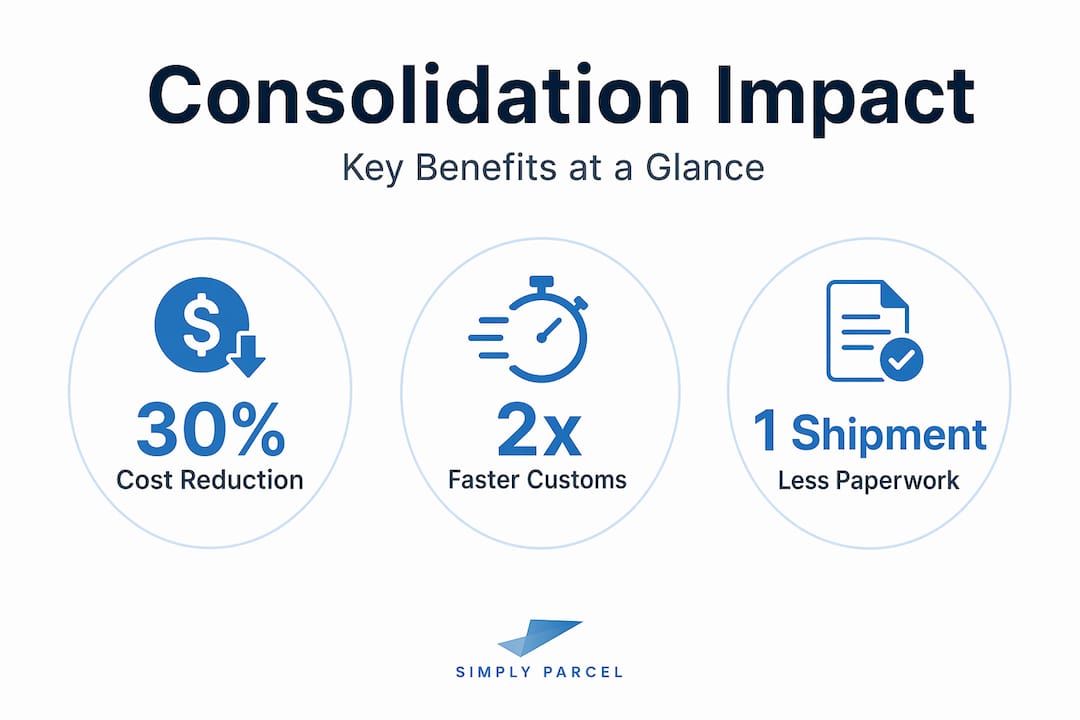
The customs and documentation benefit is significant. Buyer's consolidation replaces multiple LCL shipments with their separate freight charges and customs processes into one consolidated container flow. That means one set of import duties to process, one broker to coordinate, and one set of paperwork to file.
The real benefits of parcel consolidation
The advantages go well beyond what most people expect when they first look into consolidation. Here are the core benefits worth understanding:
-
Lower shipping costs per parcel. Package consolidation reduces base fees and fuel surcharges by spreading them across multiple items in a single shipment. When you ship five parcels separately, you pay five base fees. Consolidated, you pay one.
-
Simplified tracking. One shipment number replaces multiple tracking references. This is especially valuable for businesses managing dozens of orders to the same region. Instead of cross-referencing multiple courier portals, everything is visible in one place. You can learn more about how parcel tracking advantages compound when fewer shipments need to be monitored.
-
Fewer handling touchpoints. Every time a parcel changes hands, risk increases. Consolidation reduces the number of times individual packages are handled before reaching their destination, which directly lowers the probability of damage or loss.
-
Reduced environmental impact. Core consolidation benefits include fewer trips and less packaging waste, which supports sustainability goals alongside budget goals. Fewer aircraft movements, fewer courier vehicles, and less outer packaging all contribute to a lower carbon footprint per delivery.
-
More predictable delivery schedules. Grouping shipments on the same route improves cube utilization and logistics predictability. When shipments are bundled on established lanes with fixed departure schedules, delivery windows tighten and exceptions decrease.
-
Better supply chain visibility. Consolidated freight programs improve visibility and control through centralized logistics management. You gain a clearer picture of what is moving, when it left, and when it will arrive. That visibility matters for customer service, inventory planning, and financial forecasting.
Pro Tip: If you ship to the same destination country more than twice a week, run a three-month cost comparison between your current per-parcel spend and what a consolidated model would cost at the same volume. The savings typically become undeniable above a certain shipment frequency threshold.
Trade-offs and when to think carefully
Parcel consolidation is not the right solution in every situation. Understanding the trade-offs is what separates a good consolidation strategy from one that quietly increases your total shipping costs.
The most direct trade-off involves time. Holding shipments while waiting for all items to arrive at the consolidation point adds short waiting time before dispatch. If your customers expect next-day or same-day delivery, that hold window is a serious constraint. Consolidation windows need to align with your service level requirements, or the cost savings will be offset by customer satisfaction penalties.
Here are the situations where consolidation may not make sense:
- Urgent or time-sensitive shipments. When delivery speed is the priority, direct shipping typically wins over consolidated routing.
- Low volume to a specific destination. If you only send one or two parcels per week to a region, the savings from consolidation may not outweigh the added handling and hub transfer costs.
- Complex multi-destination orders. When parcels in the same batch are going to different final destinations, consolidation adds sorting complexity that can increase costs rather than reduce them.
- Mismatched service levels. If your consolidation provider's scheduled departure frequency doesn't match your dispatch rhythm, you'll spend more time waiting than saving.
The analytical side matters enormously here. A shipment consolidation analysis should account for freight rates, handling costs, lead times, and shipping profiles to accurately evaluate potential savings and service impacts. Without that full picture, consolidation can sometimes increase total costs due to added handling or poorly timed holds.
Successful consolidation treats the problem as a network design challenge, modeling lane rates, handling fees, and lead times together. That level of analysis is what separates companies that genuinely reduce costs through consolidation from those that consolidate on paper but pay more in total.
Pro Tip: Before committing to a consolidation program, ask your logistics provider for a 90-day simulation using your actual shipment data. This reveals whether your volume and timing patterns support consolidation savings or whether direct shipping remains the more cost-effective choice.
How to implement parcel consolidation effectively
Getting consolidation right comes down to four practical decisions: where, when, with whom, and how you measure performance.
The table below summarizes the key considerations at each implementation stage:
| Implementation Stage | What to Decide | Why It Matters |
|---|---|---|
| Hub selection | Choose a consolidation center geographically close to your suppliers or dispatch points | Reduces inbound transport costs and simplifies coordination |
| Timing and schedules | Set clear cutoff windows aligned with outbound departure schedules | Prevents unnecessary holds that extend lead times |
| Provider partnership | Select a logistics partner with technology integration and reporting capabilities | Provides visibility into consolidated shipment status and cost tracking |
| Performance monitoring | Track cost per parcel, transit time, and damage rates monthly | Identifies whether consolidation is delivering the expected savings |
Hub location is often overlooked. If your parcels have to travel a long distance to reach the consolidation center before they move toward the destination, the inbound transport cost eats into your savings. The best consolidation hubs sit close to your supplier or dispatch origin, so parcels arrive quickly before being grouped and dispatched.

Technology makes coordination manageable. Unifying parcel management with broader freight operations removes inefficiencies created by managing parcel shipments separately, enabling optimized costs and improved visibility. Look for providers that offer API integrations or automated booking tools so your shipment data flows without manual entry.
For businesses shipping from Singapore, exploring international shipping strategies that incorporate consolidation can produce compounding benefits as shipment volumes grow. The right partner makes monitoring straightforward by providing consolidated reporting across all lanes, so you can see exactly where savings are being captured and where adjustments are needed.
A practical pallet consolidation approach for higher-volume shipments adds another layer of efficiency for businesses managing bulk freight alongside parcel volumes. Reviewing shipment consolidation performance quarterly keeps your program aligned with changing volumes and destination patterns.
My perspective on consolidation's real value
I've reviewed hundreds of shipping setups, and the pattern I see most often is businesses treating parcel consolidation as a discount mechanism rather than an operational tool. They look at it, calculate a line-haul saving, and move on. What they miss is the control it gives them over their own supply chain.
In my experience, the greatest benefit of consolidation is not the cost reduction on any single shipment. It's the reduction in exceptions. When you consolidate, you have fewer shipments moving through fewer carriers at any one time. That means fewer tracking anomalies to investigate, fewer customs holds to resolve, and fewer customer service calls about missing parcels. The time saved on exception management alone often exceeds the direct freight savings.
I've also found that businesses underestimate how consolidation supports their sustainability commitments. Fewer movements mean a measurably smaller carbon footprint. That matters to corporate buyers and end consumers in ways that are becoming increasingly tied to purchasing decisions.
My honest advice: don't dismiss consolidation because your current volume feels too small. The threshold for consolidation to become beneficial is lower than most people assume, especially in international shipping where base fees and customs costs are high per shipment. Run the numbers with real data, not estimates.
— Simply
Ship smarter with Simplyparcel
If parcel consolidation makes sense for your shipping needs, Simplyparcel makes it straightforward to act on. The platform connects you with leading courier partners for international shipping from Singapore, with options across priority, economy, and connect-plus service tiers to match your cost and timing requirements. You can get a shipment quote in minutes, with automatic label generation and real-time tracking included. Whether you're a small business shipping weekly orders or an individual sending multiple parcels abroad, Simplyparcel's shipping platform gives you the tools to manage international shipping with clarity and confidence.
FAQ
What is parcel consolidation?
Parcel consolidation is the process of combining multiple individual packages into a single shipment before sending them to a destination. It reduces shipping costs, simplifies tracking, and cuts down on customs documentation by treating multiple parcels as one consignment.
How does parcel consolidation save money?
Consolidation saves money by replacing multiple sets of base fees, fuel surcharges, and customs charges with a single combined fee. Reducing duplicate charges is the primary mechanism, with additional savings from fewer handling touchpoints and simplified customs processing.
When does parcel consolidation not make sense?
Consolidation is less effective for urgent shipments, very low shipment volumes to a destination, or situations where hold windows would violate your delivery service commitments. A proper cost-benefit analysis using your real shipment data will clarify whether consolidation adds up for your specific situation.
Does parcel consolidation affect delivery speed?
It can. Holding parcels until a full consolidated batch is ready adds time before dispatch. However, once dispatched, consolidated shipments often travel on optimized, scheduled lanes that can be as fast or faster than ad-hoc individual shipments, depending on the route and provider.
Is parcel consolidation suitable for small businesses?
Yes, particularly for small businesses shipping regularly to the same regions. The threshold for consolidation benefits is lower than many expect, especially in international shipping where per-shipment fees and customs costs are proportionally high relative to small parcel values.