
If you run an e-commerce business and ship across borders, understanding what is shipping integration could be the single most important operational decision you make this year. Most sellers think it just means connecting their store to a courier's website. It doesn't. Shipping integration is a full workflow system that links your sales channels, warehouse processes, carrier accounts, and customer communications into one connected operation. Get it right, and orders flow automatically from checkout to delivery. Get it wrong, and you spend your days fixing errors that technology should never have created.
Table of Contents
- Key takeaways
- What is shipping integration and what it actually does
- Benefits of shipping integration for your business
- The technical architecture behind shipping integration
- How to integrate shipping into your business operations
- AI and the future of shipping integration
- My perspective on getting this right
- Ship smarter with Simplyparcel
- FAQ
Key takeaways
| Point | Details |
|---|---|
| More than software | Shipping integration connects your entire order lifecycle, not just your store to one carrier. |
| Automation reduces errors | Automated label creation and order sync eliminate manual data entry mistakes that delay shipments. |
| Middleware beats direct connections | A unified API layer scales better and reduces maintenance compared to building individual carrier connections. |
| Exception handling is critical | Resilient integrations automate fallback workflows so carrier outages don't stop your operations. |
| AI is reshaping the model | AI-native integration layers now enable proactive, real-time shipping decisions beyond traditional rule-based automation. |
What is shipping integration and what it actually does
Shipping integration meaning goes beyond a simple plug-in or app install. At its core, it is a software layer that connects your e-commerce platform or order management system directly to one or more carrier systems. That connection allows data to move automatically between the two without you logging into multiple portals or copying and pasting tracking numbers.
Here is what a properly built shipping integration handles automatically:
- Order transfer: New orders from your store are pushed directly to your shipping system the moment a customer checks out.
- Rate shopping: The system queries multiple carriers in real time to find the best rate for each shipment based on weight, dimensions, destination, and service level.
- Label creation: Shipping labels and customs documentation are generated automatically without manual input.
- Tracking updates: Carrier scan events are pulled back into your system and pushed to your customer-facing order page.
- Inventory sync: Stock levels update in real time to prevent overselling when items ship.
Automated synchronization eliminates CSV uploads and manual data entries that slow down fulfillment and introduce errors. This matters especially in cross-border shipping, where documentation mistakes cause customs delays.
Pro Tip: Before evaluating any shipping software, write down every manual step your team currently performs between a customer placing an order and a parcel leaving your facility. That list is exactly what your integration should eliminate.
Benefits of shipping integration for your business
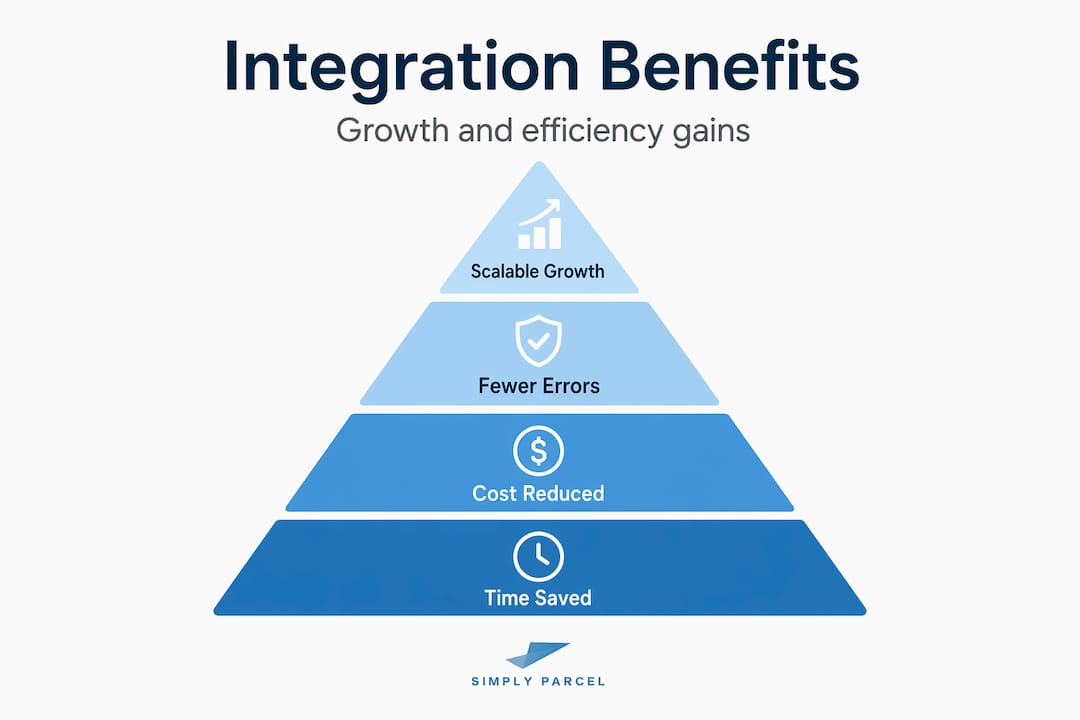
The benefits of shipping integration show up in four areas: time, cost, accuracy, and growth capacity. Each one compounds the others.

Manual rate comparison takes 2 to 3 minutes per shipment, while automation reduces this to seconds. At 100 shipments per day, that is 3 to 5 hours of staff time recovered daily. That time goes back into customer service, product work, or expansion.
Cost control is equally direct. When your system compares carrier rates automatically across every order, you stop defaulting to a single carrier out of habit. You route each parcel to the most cost-effective option that still meets the delivery promise. For international shipments, this difference can be significant across weight breaks and destination zones.
Accuracy improvements reduce two expensive problems: reshipments caused by wrong labels and customer service tickets generated by missing tracking information. When data flows automatically from your order system to the carrier, address errors and missing fields get caught before the label prints, not after the parcel is already in transit.
Scalability is where integration pays off most clearly. A business processing 20 orders a day can manage without it. A business processing 500 orders a day across three sales channels, two warehouses, and four carriers cannot. API-first shipping setups allow you to define shipping rules based on cost limits, warehouse location preferences, and product type, so the system routes correctly at any volume without added headcount.
What is e-commerce shipping integration ultimately delivering? It delivers the ability to grow your order volume without proportionally growing your logistics team.
The technical architecture behind shipping integration
Understanding how the technology works helps you ask better questions when evaluating shipping integration solutions. You do not need to build it yourself, but you do need to understand the choices being made on your behalf.
APIs, webhooks, and polling
Every carrier exposes an API. That API accepts requests for shipping rates, accepts label creation requests, and returns tracking data. Your integration layer calls these APIs on your behalf. The challenge is that every carrier's API is different in structure, authentication method, and data format.
Webhook and polling hybrid approaches give you the most reliable tracking coverage. Webhooks push updates to your system the moment a carrier scan event occurs. Polling checks the carrier API on a schedule to catch updates that webhooks miss, which happens more often than carrier documentation suggests.
Point-to-point vs. middleware
This table shows the core trade-offs between building direct carrier connections and using a middleware or unified API layer.
| Approach | Maintenance load | Scalability | Control |
|---|---|---|---|
| Direct carrier connections | High — each carrier changes independently | Adding a new carrier requires new development | Full control over each integration |
| Middleware or unified API | Low — single interface manages all carriers | Add carriers without new development work | Slightly abstracted but faster to expand |
Middleware abstracts carriers under normalized APIs, which means your system speaks one consistent language regardless of which carrier fulfills the order. This is what makes reconciliation, reporting, and exception handling manageable at scale.
Data normalization and exception handling
Normalized data schemas across carriers are critical. Without them, a "delivered" status from Carrier A and a "DEL" status from Carrier B are treated as different things in your reporting. Normalization maps every carrier's terminology to a consistent internal standard.
Exception handling is where most integrations fail. Failure to automate exceptions leads to persistent manual interventions even after automation is in place. A well-built integration automatically switches to a fallback carrier when the primary carrier's API goes down, flags address errors before label generation, and retries failed API calls with exponential backoff.
Pro Tip: Ask any shipping integration vendor specifically how their system handles carrier API outages. If the answer is vague or manual, that is a red flag at scale.
How to integrate shipping into your business operations
Knowing how to integrate shipping effectively starts before you pick any technology. The businesses that struggle with integration usually skipped the process mapping step and went straight to software demos.
Follow this sequence:
- Map your full shipping lifecycle. Document every step from order creation to delivery confirmation, including returns and customs handling. Identify where data currently moves manually.
- Define your carrier strategy. Decide which carriers you need for which routes, service levels, and parcel types. This determines whether you need direct integrations, a unified API, or a shipping aggregator platform.
- Set your shipping rules. Before writing a line of configuration, decide the logic your system will follow. Which carrier wins when two quotes match? What triggers an upgrade from economy to priority service? What weight threshold changes your routing?
- Build exception workflows first. Most teams build the happy path and treat exceptions as an afterthought. Flip that. Define what happens when a carrier rejects a label, an address fails validation, or a parcel is returned undelivered.
- Test with real shipments before scaling. Run a controlled volume of live orders through your integration before switching your full operation. Track every exception and compare expected vs. actual behavior.
- Plan for multi-channel and multi-warehouse complexity. If you sell on multiple platforms or ship from more than one location, your integration must route orders based on inventory location and channel-specific rules, not just carrier price.
Real-time native connections and rule-based automation prevent the overselling and fulfillment delays that manual processes create. Building your rules carefully at the start makes every subsequent carrier addition or channel launch faster and more reliable.
Pro Tip: If you are shipping internationally, include customs documentation workflows in your integration design from day one. Adding them retroactively is significantly more disruptive than building them in at the start.
AI and the future of shipping integration
The next generation of shipping integration solutions goes well beyond rule-based automation. AI-native integration layers are changing what is possible in logistics operations right now.
The clearest example is the emergence of Model Context Protocol (MCP) servers in shipping platforms. AI-driven execution improves risk management and speeds up decision making by giving AI assistants direct, real-time access to your shipping data and workflows.
What does that mean in practice? Consider these shifts:
- From reactive to proactive routing: Instead of applying fixed rules, AI analyzes carrier performance data, weather disruptions, and port congestion in real time and reroutes shipments before delays occur.
- Predictive exception management: The system identifies which orders are likely to miss delivery windows based on current carrier capacity and acts before the customer contacts support.
- Agentic workflows: AI agents execute multi-step tasks autonomously, such as rebooking a shipment, updating the customer, generating a new label, and notifying the warehouse, without human intervention at each step.
- Dynamic rate optimization: AI continuously learns which carrier and service combinations deliver the best outcome per destination zone, not just the lowest quoted rate.
Explore how AI shipping terminology is evolving alongside these developments, because the vocabulary of logistics is changing as fast as the technology.
Shipping APIs are transforming shipping from a reactive afterthought into a managed, proactive operating system that drives customer trust. Source: Unified.to
My perspective on getting this right
I've watched businesses spend months on shipping integrations that technically work but operationally fail. The pattern is consistent. Teams treat integration as a technical task, hand it to a developer, and declare success when the first test label prints. Then volume scales, edge cases appear, and the manual workarounds multiply until someone is spending four hours a day fixing what the integration was supposed to handle.
What I've learned is that shipping integration complexity lives in the exceptions, not the standard workflow. The standard workflow works fine. It's the address that fails validation at 11 PM, the carrier that rejects a parcel because of a prohibited item in the customs declaration, and the API timeout that silently skips 12 orders that reveal whether your integration is genuinely operational or just functional under ideal conditions.
The businesses I've seen get this right share one habit. They define "what could go wrong" with the same rigor they apply to "how this should work." They build fallback carriers, automated retry logic, and alert thresholds before they launch. They treat choosing between direct carrier connections and middleware as a strategic architecture decision, not a cost line. And they revisit their shipping rules quarterly because carrier performance, rates, and route reliability change constantly.
My honest take: start with your process, not your platform. Map what you ship, where you ship it, and what breaks most often today. That map is more valuable than any software demo you will sit through.
— Simply
Ship smarter with Simplyparcel
If you are ready to move from manual shipping processes to a connected, multi-carrier operation, Simplyparcel gives you the infrastructure to do it without building from scratch. As a Singapore-based shipping aggregator, Simplyparcel connects you to multiple international courier partners through a single platform, with real-time rate comparison, automated label generation, and live tracking built in.
You can get an instant shipping quote across carriers and service levels in seconds, so your team stops spending time on manual rate checks. The platform handles cross-border shipments with customs documentation support, giving you one place to manage international fulfillment instead of logging into five separate carrier portals.
For businesses scaling their e-commerce operations, Simplyparcel's multi-carrier shipping platform reduces the operational friction that slows growth. Whether you ship priority, economy, or connect-plus, the platform applies your preferences automatically across every order. Start with a quote and see how much time your team gets back.
FAQ
What does shipping integration mean?
Shipping integration means connecting your e-commerce platform or order management system to one or more carrier systems so that orders, labels, tracking data, and rates flow automatically between them. It eliminates manual data entry and allows your shipping workflow to run with minimal human intervention.
What are the main benefits of shipping integration?
The main benefits of shipping integration include faster order processing, reduced shipping errors, real-time tracking for customers, automatic rate comparison across carriers, and the ability to scale order volume without adding logistics staff.
How do I integrate shipping into my e-commerce business?
Start by mapping your full shipping lifecycle from order placement to delivery, define your carrier strategy and shipping rules, then select either a direct carrier API connection, a middleware layer, or a shipping aggregator platform based on your scale and technical resources.
What is the difference between a direct carrier connection and middleware?
A direct carrier connection integrates your system with one carrier at a time, requiring separate development work for each. Middleware or a unified API abstracts multiple carriers under one interface, reducing maintenance and making it faster to add new carriers as your business grows.
How does AI change shipping integration?
AI-native integration layers, such as MCP servers, give AI assistants real-time access to shipping data and enable proactive routing, predictive exception management, and autonomous multi-step task execution, moving shipping operations from reactive rule-following to dynamic, real-time decision making.