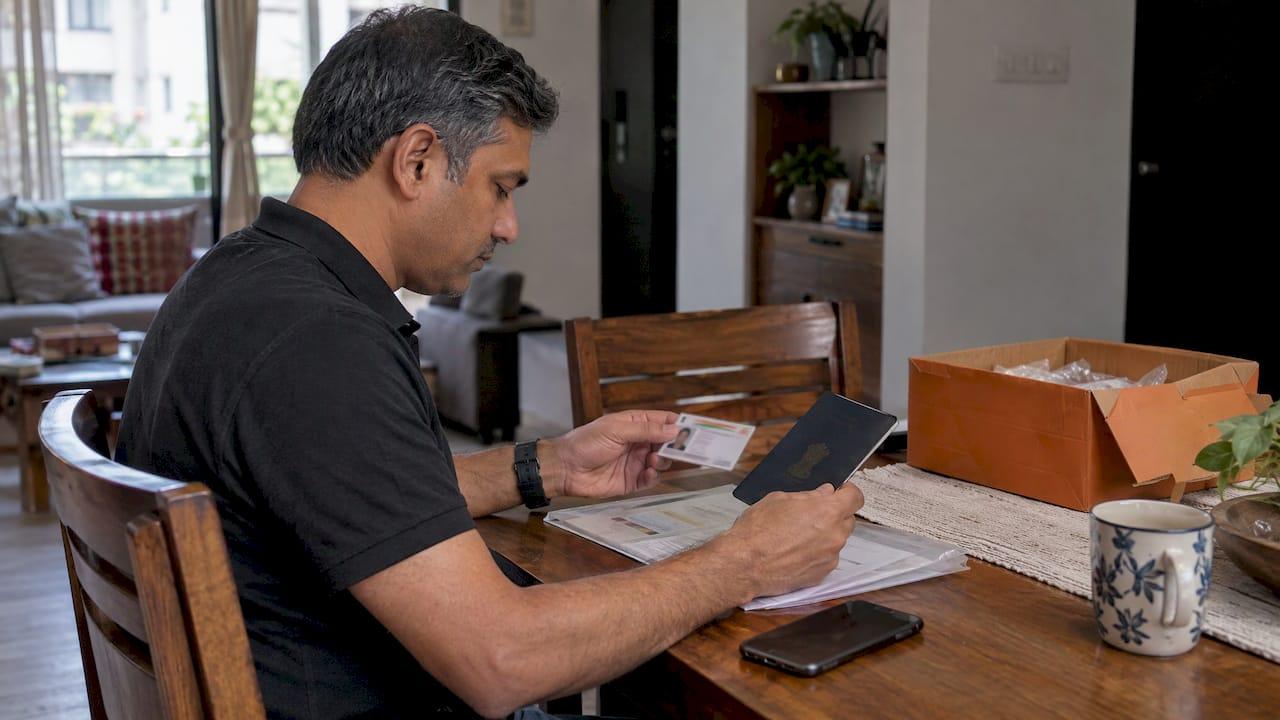
KYC (Know Your Customer) for customs is a check that the person receiving an international shipment is who they say they are. The best-known case is India: customs there will not start clearing a parcel until the recipient's government-recognized ID and address proof are on file. If you ship from Singapore, the practical answer is to confirm the recipient's KYC documents before you hand over the parcel, and to make sure the name and address on the shipment match those documents exactly. Do that, and most KYC delays never happen.
This guide explains what customs KYC is, which documents are accepted, how and when they are submitted, what happens when they are missing, and how the United States differs.
TL;DR
- India requires KYC from the recipient on courier imports regardless of value. Without it, clearance cannot begin.
- Individuals usually need one valid document that shows both identity and address: Aadhaar, passport, PAN or Voter ID.
- Businesses also need an Importer Exporter Code (IEC) for commercial imports, plus the individual or company documents customs asks for.
- The recipient's name and address on the shipment must match the KYC documents exactly.
- The United States has no comparable recipient KYC step for ordinary parcels. Importers need an importer number instead.
Table of Contents
- What KYC means in customs
- Why India is the main case
- Which KYC documents customs accepts
- The name and address must match
- How and when KYC is submitted
- What happens if KYC is missing or rejected
- A KYC checklist before you ship from Singapore
- What about the United States?
- Our perspective on customs KYC
- Ship with the paperwork done for you
- FAQ
- Sources
What KYC means in customs
Customs authorities want to know who is bringing goods into their country. Duty, tax and import rules attach to a named person or company, so an unidentified consignee is a risk. KYC is the paperwork that answers the question: a government-issued ID, proof of address and, for businesses, registration and tax records.
The consignee is the person or company receiving the goods. Customs KYC is almost always about the consignee, not the sender. That matters if you are sending from Singapore, because the documents you need come from someone else, often in another time zone. Getting them early is the single biggest time saver.
There is no single global KYC standard. Each country sets its own rules, and many countries ask for nothing beyond a name, address and a customs declaration. India is the destination where KYC is most visible and most often causes parcels to stall, which is why the top results for this topic focus on it. If you ship elsewhere, the general customs paperwork in our guide to what you need for a customs declaration in Singapore is the right starting point.
Why India is the main case
A retailer's published shipping policy says India Customs requires KYC documents for clearance and that import clearance cannot start unless the consignee uploads them. A shipping knowledge base for senders says the same: KYC is needed no matter the shipment value.
That catches many senders off guard. A gift worth a few dollars still needs the recipient's identity documents. If you send courier parcels to family, students or colleagues in India, plan for it every time. Our guide to sending courier to India covers the wider route, and this article covers the KYC piece in detail.
Which KYC documents customs accepts
For individuals in India
Chennai Customs' official FAQ, published in October 2025, sets out the rule for personal imports. Any one valid document is enough: Aadhaar, passport, PAN or Voter ID, as long as it shows both identity and address.
If the document does not show the current address, the courier records the delivery address when it hands over the parcel. This address allowance applies only to individuals importing documents, gifts, samples or low-value dutiable goods up to a maximum CIF value of Rs. 50,000. CIF means cost, insurance and freight: the goods' value plus the cost of shipping and insuring them to India.
For foreign nationals living in India, a retailer's policy lists a passport plus a Visa or PIO card as accepted documents. PIO stands for Person of Indian Origin.
| Recipient | Typical accepted documents |
|---|---|
| Indian citizen (individual) | Aadhaar, passport, PAN card or Voter ID showing identity and address |
| Foreign national living in India | Passport plus Visa or PIO card |
| Individual with an ID lacking the current address | The courier records the delivery address at handover, for personal imports up to Rs. 50,000 CIF |
| Business importing commercially | IEC plus the individual or company documents customs requests |
Always confirm the current list with the recipient's carrier portal, because accepted documents and thresholds are set by Indian authorities and can change.
For businesses in India
Commercial imports need more. The same Chennai Customs FAQ states that a valid Importer Exporter Code (IEC) is mandatory for commercial imports and exports, in addition to the individual KYC documents. The IEC is a registration number issued by India's trade authority, the DGFT.
First-time importers face a deeper check. A Jawahar Customs public notice from 2017 asked first-time importers or their customs brokers to submit a copy of the IEC certificate plus one Category-I and one Category-II document. Category I covers identity and registration records, such as the Aadhaar or passport of the proprietor or partners and the firm's registration papers. Category II covers financial proof, such as a filed income tax or GST return or a bank certificate confirming the remittance account. The notice describes a verification process that includes physical address checks in at least 10% of cases. It is an older notice from one customs location, so treat it as a picture of how thorough business KYC can be, and ask your Indian buyer what their port currently expects.

If you sell to Indian businesses, ask for their IEC and registration documents at order confirmation, not after the parcel is in transit.
The name and address must match
The most common KYC failure is not a missing document. It is a mismatch. A retailer's India shipping policy states that the consignee name and shipping address must exactly match the KYC documents.
In practice, check these before booking:
- The name on the shipment is spelled as it appears on the ID, with no nicknames or reordered names.
- The address on the shipment is the one on the document, or the recipient is an individual eligible for the address allowance above.
- A business shipment uses the company name and the company's documents. A shipping knowledge base suggests that if business KYC documents are unavailable, the parcel can go to the recipient's private address with the company field left blank. That only suits goods the individual is entitled to import personally.
- The phone number and email are ones the recipient actively uses, since the carrier contacts them to collect documents.
How and when KYC is submitted
In most cases the recipient, not the sender, uploads the documents. One retailer's policy describes the flow: the carrier sends the consignee an SMS with a link to a KYC web portal, where they upload their documents and a customs form. The consignee has 7 days, excluding Sundays, after the carrier receives the shipment to submit. If the documents are rejected and not corrected, the order is canceled and returned.
The timing is the trap. The clock starts when the carrier has the parcel, which can be before the recipient knows to expect a message. A recipient who ignores an unfamiliar SMS can let the window lapse.
Tell your recipient in advance:
- A text message with a KYC link will arrive, usually soon after the parcel is handed to the carrier.
- Have a clear scan or photo of the accepted document ready, front and back where needed.
- Upload promptly, and check the name and address against the shipment details.
- Watch for a rejection notice and reply with a corrected document straight away.
The process and links differ by carrier, so the recipient should follow the instructions in the message they receive rather than a generic template.
What happens if KYC is missing or rejected
Without KYC, the parcel waits in a customs queue. A shipping knowledge base reports that incomplete KYC in the carrier portal leads to customs holds and storage charges. One retailer's KYC FAQ says orders may be returned if KYC is not received within 7 business days, and that if documents are rejected, the consignee must upload corrected documents within 5 days or the order will be canceled. It adds that refunds may be withheld or delayed once a shipment is disposed of.
For a sender, that translates into three costs: transit days lost, storage charges that someone must pay, and a return trip you also pay for. On time-sensitive cargo such as a document for a visa or a contract, the delay can matter more than the money.
If you run a business that ships to many recipients, chasing missing KYC by hand gets tedious. Teams that track many open shipments sometimes use AI automation for logistics to sort email, flag open items and collect documents, so a missing recipient document does not sit unnoticed.
Duty is the other reason parcels get refused
KYC problems often arrive together with a duty surprise. Chennai Customs' FAQ notes that gifts attract 53.60% duty in India, a common reason consignees refuse delivery. Tell the recipient what duty to expect before the parcel ships. Our article on when gifts face customs duty explains how thresholds work, and the piece on the brokerage fee on a courier shipment explains the handling charge that can appear on top.
Value limits and customs brokers
For shipments from Singapore to India, value changes who can handle clearance. A shipping knowledge base states that for shipments under $1,359 USD the express carrier can complete clearance directly on the recipient's behalf, while above that amount the recipient must appoint a customs broker. The practical effect is that high-value consignments need one more party and more paperwork. Plan that extra time in before you promise a delivery date.
A KYC checklist before you ship from Singapore
Use this order each time you send to a KYC country.
- Ask the recipient which document they will use. Choose one that shows identity and address, and confirm it is valid and not expired.
- Copy the name and address from that document into your booking, character for character.
- Decide whether the shipment is personal or commercial. Commercial goods need an IEC and business records. Personal items need individual KYC only.
- Write an honest, specific goods description and value. Vague descriptions invite questions that stall clearance. Our guide to the shipping documentation process walks through each document.
- Warn the recipient about the KYC text message and the 7-day window.
- Track the shipment and contact the recipient the moment a customs hold appears.
SMEs shipping regularly can build these steps into their routine, along with the records listed in essential international shipping documentation for Singapore SMEs.
What about the United States?
If your parcel is going to the US, you are unlikely to meet a recipient KYC upload like India's. U.S. Customs and Border Protection (CBP) says it does not require an importer license, but entry forms need an importer number. That number is an IRS business registration number, a Social Security number if the business is not IRS-registered or the importer has no business, or a CBP-assigned number requested with Form 5106.
A tax guide to Form 5106 explains that US importers enter an EIN (businesses) or SSN (individuals and sole proprietors) in field 1B, and those with no US tax ID can request a CBP-assigned number in field 1E. A CBP number is not issued if an EIN or SSN is already provided.
So for the US, the question to ask a business recipient is: "What is your importer number?" For ordinary personal parcels, accurate names, addresses and a clear declaration cover most needs.
Our perspective on customs KYC
Most KYC trouble we can prevent starts before the parcel leaves Singapore. A sender who knows the rule, the right document and the matching-name requirement avoids almost all of it.
That is why we built Simply Parcel around the paperwork as much as the pickup. Our platform generates shipping labels and customs documentation automatically, so the declaration you send is complete and consistent. We also give guidance on customs requirements and restricted goods, so you know what to prepare before booking, not after a hold appears.
You compare priority, connect-plus and economy options in one place, book online, and we collect the parcel from your door at no charge. Real-time tracking then shows you when a shipment moves or stops, so you can contact your recipient quickly if a customs step needs their attention. We have no monthly volume commitment, which suits both a student sending one box and an SME shipping every week.
Good KYC is mostly good preparation. We make the preparation simpler.
SP
Ship with the paperwork done for you
Once your recipient's KYC documents are ready, booking is the easy part. Simply Parcel lets you compare Priority, Connect Plus and Economy shipping from Singapore, book a pickup online and get your labels and customs documents generated for you. Pickup at your doorstep is free, and you can follow the shipment with real-time tracking.

See your options and get a quote on our shipment quote page, or view the Priority, Connect Plus and Economy services. If you want to understand the delivery side too, our guide to ID checks on delivery explains what recipients may be asked to show at their door.
FAQ
Is KYC required for customs clearance?
It depends on the destination. India requires it for courier imports, and clearance cannot begin without it. Many other countries only need a standard customs declaration and the recipient's name and address. Check the destination's rules before you book.
What KYC documents are required for customs in India?
For individuals, one valid document showing identity and address is generally enough: Aadhaar, passport, PAN or Voter ID, per Chennai Customs' FAQ. Commercial imports also need an IEC. Foreign residents in India typically use a passport plus a Visa or PIO card.
Who submits the KYC documents, the sender or the recipient?
Usually the recipient. The carrier contacts them, often by SMS with a portal link, and they upload the documents within a limited window. As the sender, your job is to make sure they are ready and that the details on the shipment match.
Is KYC mandatory in the USA for customs?
There is no general recipient KYC upload for ordinary parcels. Importers do need an importer number such as an EIN, an SSN or a CBP-assigned number, as CBP explains. Business importers should have that number ready before shipping.
Sources
- Shipping to India, Reachdesk Knowledge Base
- FAQ: Import of Gifts and Personal Imports, Chennai Customs
- Public Notice on first-time importers and exporters, Jawahar Customs
- India shipping policy (Singapore site), iHerb
- India shipping policy, iHerb
- Know Your Customer (KYC) FAQ, iHerb Customer Self Service
- Tips for New Importers and Exporters, U.S. Customs and Border Protection
- How to Fill Out Form 5106, TaxShark
- AI automation for logistics and transport, Marvix Digital