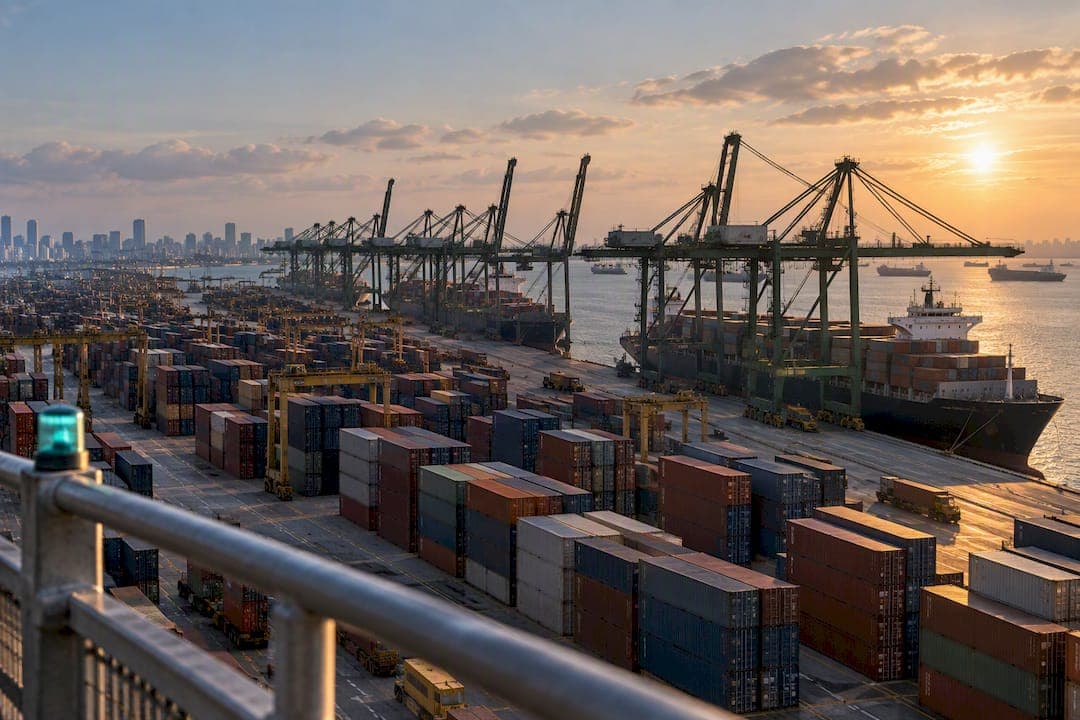
Most delayed international deliveries trace back to one of four things: port congestion, a customs hold, weather or a carrier capacity squeeze, or a paperwork error at origin. Before you do anything else, check the tracking number and the destination postal operator's service-alert page, confirm your commercial invoice and customs data are complete, and give the shipment the operator's advised wait time. Bodies like the Universal Postal Union and the EU's ICS2 publish exactly this kind of status information, and the platform's tracking tools pull from the same data.
TL;DR:
- Checking both origin and destination service alerts provides a clearer picture of systemic disruptions versus local issues, influencing who to contact and when.
- Port congestion has removed approximately 2.3 million TEU capacity, leading to blank sailings and tighter space, which prolongs shipping times for unaffected shipments.
- Customs holds often result from incomplete or mismatched paperwork and can occur independently of carrier delays, requiring proactive document verification.
- Weather and geopolitical disruptions, such as typhoons and conflict-related route closures, can add weeks to transit times, especially at Chinese ports in 2026.
- Shipping delays are now more predictable, so booking earlier, ensuring paperwork accuracy, and communicating proactively with customers mitigate most risks.
Table of Contents
- How Do You Read an International Service Alert?
- What's Actually Causing International Shipping Delays Right Now?
- How Do You Check Where a Delayed Package Actually Is?
- How Long Should You Wait Before Filing a Late-Delivery Enquiry?
- How Can You Reduce the Risk of a Delayed Shipment?
- What Simplyparcel Actually Does When a Shipment Runs Late
- An Editor's Take on Shipping Risk Heading Into Late 2026
- Get Your Shipment Moving With Simplyparcel
- Sources
- FAQ
How Do You Read an International Service Alert?
A service-alert page is the fastest way to tell the difference between "this parcel is stuck in normal transit" and "this entire route is disrupted." Every major postal operator and most commercial carriers maintain one, and they tend to follow the same basic structure: a list of affected countries or regions, a stated reason, and a status tag.
Three status tags show up almost everywhere, and each means something different for your timeline:
- "Service suspended" means the operator has stopped accepting or forwarding items to that destination entirely, often due to conflict, a natural disaster, or a canceled air/sea route. Nothing you already sent will move until service resumes.
- "Possible delay" is the most common tag and the vaguest. It usually points to a capacity squeeze, a temporary customs backlog, or weather affecting one leg of the route, not a full stoppage.
- "Service resumed" confirms the disruption has cleared, but a backlog of held items typically still needs to clear the pipeline, so expect a few extra days even after this tag appears.
The reasons behind these tags vary more than most people expect. Armed conflict and civil unrest account for some suspensions. Natural disasters, especially typhoons and flooding, account for more. Airspace closures over conflict zones (the Red Sea corridor and the Strait of Hormuz have both triggered rerouting in recent years) can add days to air and ocean legs alike, even when no single link in the chain is technically "delayed." Carrier schedule changes, including canceled sailings, round out the list.
Checking a single alert page isn't quite enough. Origin and destination operators sometimes report status differently, since a package can clear outbound scanning in Singapore while the destination country's postal service is mid-suspension. Cross-checking both origin and destination pages, and looking at UPU bulletins when a country-level suspension is suspected, gives you a clearer picture than relying on one source. If your tracking shows no movement and neither operator lists a formal alert, the delay is more likely a local customs hold or a last-mile issue than a systemic one, which changes who you should contact and how urgently.
What's Actually Causing International Shipping Delays Right Now?
Delays rarely have one clean cause. They usually stack: a port running behind schedule, a customs system flagging incomplete data, and a carrier quietly blanking a sailing to protect its own timetable. Understanding which factor applies to your shipment tells you how long to expect it to take and who can actually do something about it.
1. Port congestion and blank sailings. Global port congestion has approached 4 million TEUs as peak-season demand and weather disruption stack up on major trade lanes. When berths back up, carriers sometimes cancel a scheduled port call entirely rather than wait in a queue, a practice known as a blank sailing. Sea-Intelligence reporting found that congestion and ship delays have effectively pulled about 2.3 million TEU of capacity off the market, which tightens space on the sailings that remain and pushes freight onto later, fuller vessels.
2. Customs holds tied to pre-arrival data systems. Systems like the EU's Import Control System 2 require detailed manifest and invoice data before a shipment arrives. When that data is incomplete, late, or mismatched, ICS2 and comparable systems elsewhere can hold a parcel at the border even if the carrier itself is running on time.
3. Severe weather and geopolitical disruption. Weather is the most visible cause and often the most severe. Four consecutive typhoons hit major Chinese ports in a single stretch of 2026, forcing terminal closures at Shanghai, Ningbo, and Yantian and producing berth delays of up to two weeks, with knock-on blank sailings that pushed rates and delays into the following months. Strikes and route closures around conflict zones add a similar kind of disruption, just with less predictable timing.
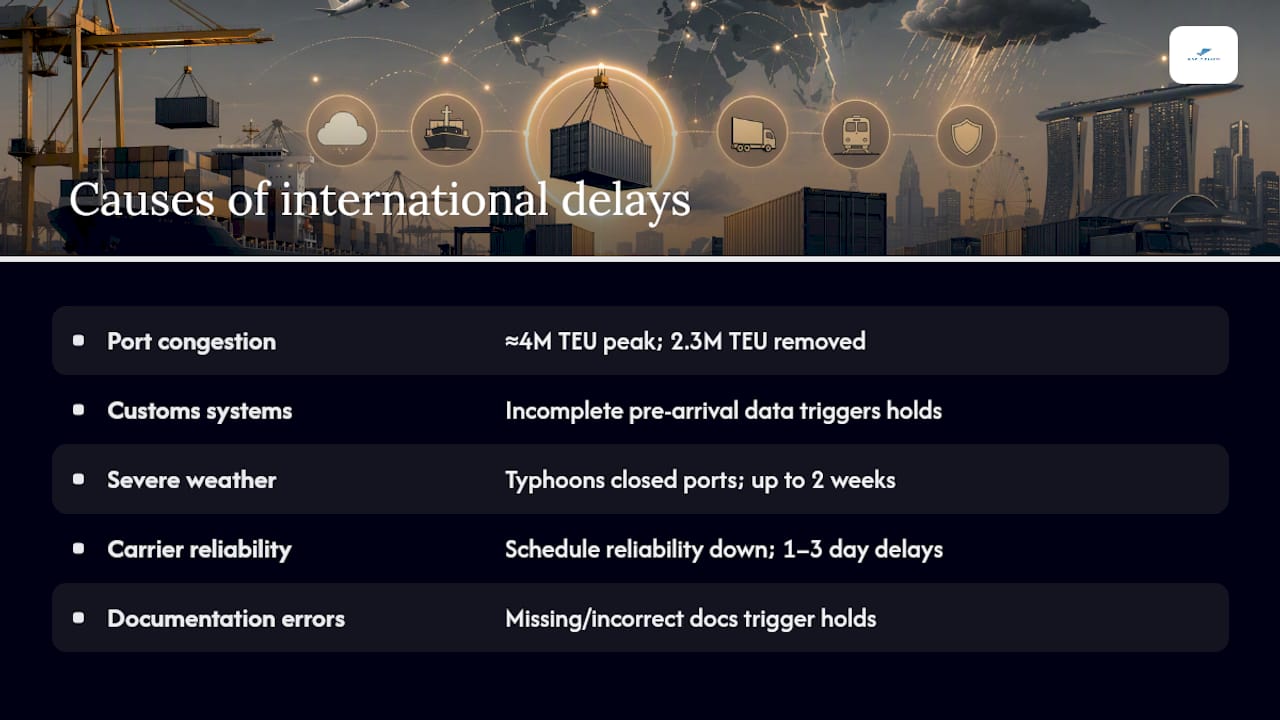
4. Carrier capacity and schedule reliability. WiseTech's ocean freight risk reporting found booking risk elevated into late 2026, with schedule reliability falling even as headline transit times stay close to normal. One to three day delays have become the single most common outcome rather than the exception, which is a quieter but more constant drag on delivery estimates than a single dramatic event.
5. Sender documentation errors. Missing HS codes, an incomplete commercial invoice, or a mismatched declared value are ordinary paperwork mistakes that trigger the same customs hold as a systemic disruption, just for one shipment instead of a whole trade lane.
Port congestion has quietly become a capacity problem, not just a delay problem. Removing 2.3 million TEU from effective circulation doesn't just slow individual vessels, it tightens space across the entire booking market, which is part of why even unaffected shipments are seeing longer waits.
Congestion has a second-order effect worth knowing about: cargo sometimes gets rerouted through secondary transshipment hubs when a primary port is backed up. Your shipment's nominal vessel might never have been affected, and it can still arrive late because it was quietly shifted onto a different route to avoid a jam somewhere else in the network.
How Do You Check Where a Delayed Package Actually Is?
Tracking scans tell a story, but only if you know how to read the vocabulary. Each status update marks a checkpoint in a chain that runs from your local depot to the receiver's mailbox, and the exact wording usually tells you which link is currently holding things up.
A few common statuses and what they typically mean:
- "Processed at outbound depot" means the parcel has left origin scanning but hasn't yet reached international handoff. A delay here usually points to a local pickup or sorting backlog.
- "Held for clearance" or "With border agency" means it's sitting in customs, most often due to incomplete paperwork or a random inspection.
- "In transit, international" with no update for several days often means it's on a vessel or aircraft that's behind schedule, not lost.
- "Arrived at destination country" but no forward movement usually points to a last-mile sorting delay rather than anything upstream.
Who to contact depends entirely on where the scan is stuck. A delay at outbound depot is a sender or origin-carrier problem. A "held for clearance" scan means customs, not the carrier, controls the timeline, and contacting the carrier will only get you a referral back to customs anyway. A stalled scan after arrival in the destination country is usually a job for the destination postal operator, not the origin carrier.
Three tools do most of the diagnostic work: the origin and destination operator's service-alert pages, UPU tracking for cross-border visibility between postal networks, and the booking platform's own tracking dashboard, which on Simplyparcel consolidates carrier updates in one place so you're not toggling between five different tracking pages.
Pro Tip: When you contact support, lead with your tracking number, the exact scan location and timestamp, and a screenshot of the tracking page. Vague messages like "my package is late" get generic replies; specific reference numbers get specific answers.
How Long Should You Wait Before Filing a Late-Delivery Enquiry?
Filing too early wastes everyone's time, since most carriers won't act on an enquiry until a minimum window has passed. Filing too late means losing time you could have spent escalating. Postal operators generally scale their recommended wait times to the service level you paid for, and it pays to know the rough bands before you reach for the enquiry form.
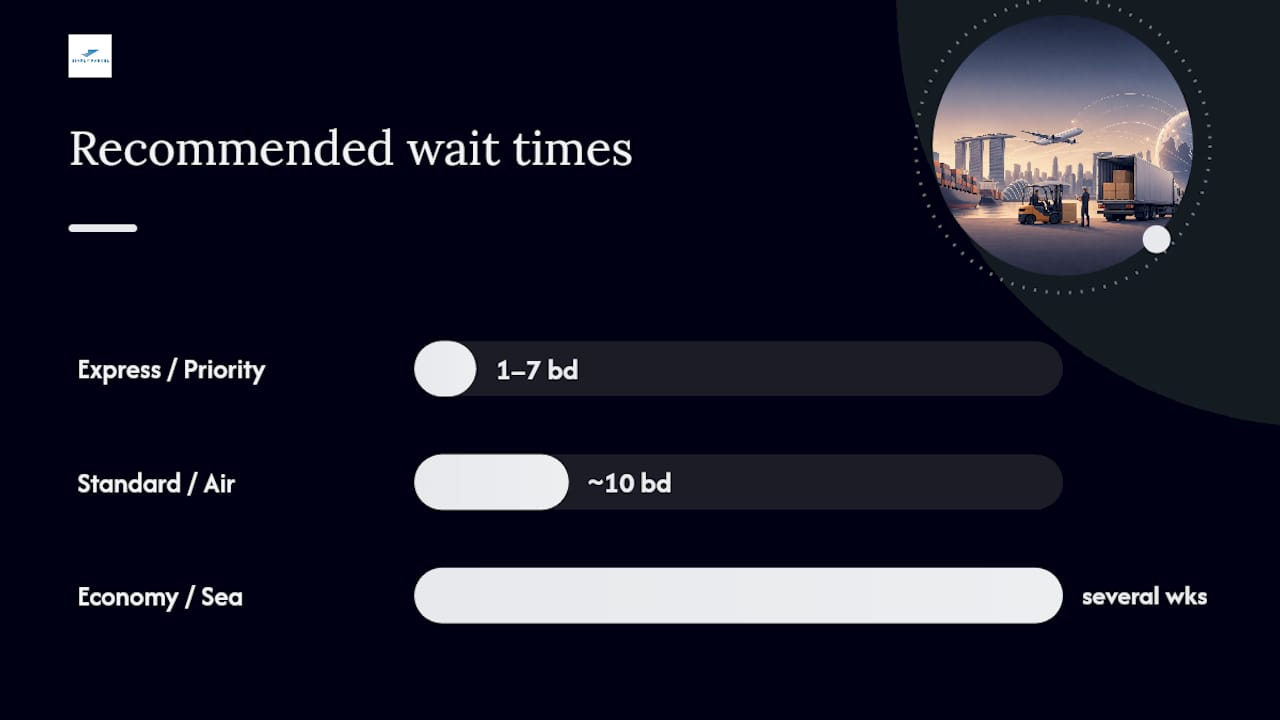
- Express or priority services: wait 1 to 7 business days past the expected delivery date before raising an enquiry. These services carry the tightest tracking and the fastest response times, so a longer silence is more meaningful.
- Standard or air services: allow around 10 business days past the estimated window. Air freight has more handoff points than express, so brief gaps in tracking are normal.
- Economy or sea services: allow several weeks, sometimes a couple of months, before filing a formal claim. Sea freight has the longest and most variable transit times, and it's the service most exposed to the port congestion and blank-sailing issues covered above. During a known disruption, such as a typhoon closure or an active service alert, add extra buffer on top of these windows before assuming something has gone wrong.
Once you decide it's time to file, having the right documents ready speeds everything up. Keep your tracking number, proof of posting, a copy of the commercial invoice, photos of the parcel and its contents if available, the receiver's contact details, and any customs notice you've received in one place before you start.
To submit an enquiry: log the issue through the original booking platform or the origin carrier first, since they typically own the case file even when the delay sits with a foreign customs authority. Attach every document listed above at the outset rather than waiting to be asked. If you get no meaningful update within the timeframe the operator quotes you, escalate to a supervisor or the customer relations channel specifically, and reference your original case number every time so the history doesn't get lost.
How Can You Reduce the Risk of a Delayed Shipment?
None of the causes covered so far are fully within a shipper's control, but a surprising amount of delay risk is. The senders who consistently avoid the worst of it aren't lucky, they're just doing three or four unglamorous things before the parcel ever leaves their hands.
Book smarter, not just faster
Moving your booking window earlier absorbs a lot of schedule risk before it becomes your problem. With booking risk elevated and on-time performance running below normal through much of 2026, a same-week deadline leaves almost no room to absorb even a routine one-to-three day slip. Where the shipment allows it, confirming the vessel or flight hasn't been blanked before you commit cargo to it saves you from discovering the cancellation after the fact. And where time genuinely matters, moving from an economy tier to a faster service isn't just about speed, it's about buying yourself a wider recovery window if something upstream goes wrong.
Get the paperwork right the first time
Customs holds caused by bad paperwork are the most preventable delay on this entire list, and also the easiest to overlook when you're moving fast. Pre-filing customs data ahead of arrival, rather than letting it arrive with the shipment, is exactly what systems like ICS2 are built around, and incomplete pre-arrival data is one of the most common reasons a parcel gets flagged for manual review. Double-check that HS codes match the actual contents, that declared values are accurate, and that your commercial invoice is itemized rather than vague. When a hold does happen, the most effective response is proactive: have the sender or importer submit the missing data immediately and be ready to bring in a customs broker if the hold drags on, rather than waiting passively for it to resolve on its own.
A few habits worth building into every shipment:
- Confirm HS codes against the actual product, not a rough category guess.
- Attach a fully itemized commercial invoice, not a one-line description.
- Declare accurate values; underdeclaring is a common trigger for inspection.
- Keep a digital copy of every customs document on hand before you're asked for it.
Build in operational slack
For businesses shipping regularly, a few structural changes reduce how much any single delay can hurt. Splitting a large order into two smaller consignments on different sailings or flights means one held shipment doesn't take your entire order down with it. Staggering shipment timing across a week rather than sending everything on the same day spreads your exposure to any single disruption. Adding insurance or extra protection coverage on higher-value shipments doesn't prevent a delay, but it changes what happens if the delay turns into a loss. And keeping a modest inventory buffer for fast-moving goods means a two-week port backlog doesn't immediately become a stockout.
Pro Tip: If you regularly ship time-sensitive goods, build your promised delivery dates around the slower end of the carrier's stated transit window, not the optimistic end. Customers forgive a shipment that arrives on the date you promised; they don't forgive one that's late against a date you invented.
Communicate before customers have to ask
The businesses that handle delays best aren't the ones that avoid them entirely, they're the ones that tell customers about them first. Setting realistic delivery windows at checkout, rather than promising the fastest possible outcome, avoids most complaints before they start. Automated tracking updates that flag a status change, rather than making a customer refresh a page repeatedly, do the same work with far less effort on your end. When you already know a lane is congested, saying so upfront costs you nothing and buys a lot of patience later.
The related guide on avoiding shipping delays walks through eight of these tactics in more depth if you want a fuller checklist to work from. For businesses managing customs risk on regulated or restricted categories, a compliance-focused resource like this U.S. shipping law checklist for restricted goods is a useful model for how detailed a documentation checklist needs to be to actually prevent a hold.
What Simplyparcel Actually Does When a Shipment Runs Late
A lot of the diagnostic steps in this guide assume you have a single place to check tracking, documentation, and carrier status instead of juggling five browser tabs. Many platforms aim to close this gap for shipments moving out of Singapore.
Some platforms offer features such as:
- Multi-carrier booking, allowing comparison of options against real transit windows.
- Auto-generated shipping labels and customs documentation to reduce paperwork mistakes.
- Real-time tracking consolidating carrier scan data into one dashboard.
- Free doorstep pickup, removing manual steps where shipments may be delayed before entering the carrier network.
For readers who want to go deeper on choosing the right service level for a time-sensitive shipment, the guide to picking a courier for international shipping from Singapore breaks down how priority, connect-plus, and economy tiers actually compare on speed and reliability. The full international shipping guide is a solid next stop for anyone still deciding which service tier fits a given shipment.
An Editor's Take on Shipping Risk Heading Into Late 2026
Schedule risk in 2026 isn't a temporary blip, it's closer to the new baseline. Between elevated booking risk, the capacity absorbed by port congestion, and typhoon-driven closures in China, the margin for error on any international shipment has gotten thinner even when nothing looks obviously wrong. The practical response isn't panic, it's discipline: book earlier than feels necessary, get customs data right the first time, and tell customers about delays before they have to ask. Shippers who treat those three habits as routine, rather than as damage control, are the ones least affected when the next disruption hits. If you need a hand applying any of that to a real shipment, contacting a logistics provider or shipping platform is a reasonable place to start.
— Simply
Get Your Shipment Moving With Simplyparcel
Delays are often about visibility as much as speed, and that's where Simplyparcel earns its place in this guide. Instead of juggling separate carrier accounts, customs paperwork, and tracking pages, you get one platform that compares multi-carrier rates, auto-generates labels and customs documentation, and gives you real-time tracking on every shipment, backed by free doorstep pickup so nothing sits waiting on your end. Whether you need a fast Priority option, a balanced Connect Plus tier, or a budget-conscious Economy service, The platform lets you weigh transit time against cost before you commit, without any monthly volume requirement holding you back.
If a shipment is already running late, your first move should still be checking your tracking and the destination's service alerts. But for your next shipment, start by getting a live quote and comparing transit windows before you book, so the margin for delay is built in from the start rather than discovered after the fact.
Sources
- Congestion and ship delays take 2.3m teu capacity off the market - The Loadstar
- Global port congestion approaches 4 million TEUs as peak season extends - World Ports
- Import Control System 2 (ICS2) - European Commission
- China typhoons push delays to October, rates near COVID - China Logistics Daily
FAQ
Why Is My International Package Delayed?
The most common causes are port congestion, a customs hold triggered by incomplete paperwork, severe weather, or a carrier capacity squeeze from blank sailings. Checking your tracking status against the destination operator's service-alert page usually tells you which one applies to your shipment.
How Long Can a Delivery Be Delayed?
It depends on the service level and the cause. A weather event like the 2026 typhoon closures in China added berth delays of up to two weeks on top of normal transit, while routine congestion or a customs hold more often adds a few days to a couple of weeks.
Can You Get Compensation for Delayed Shipping?
Compensation depends on the carrier's terms and the service level purchased, and it's rarely automatic for standard delays. Filing a claim generally requires your tracking number, proof of posting, the commercial invoice, and photos, submitted after the operator's recommended wait time has passed.
Why Is All Shipping Delayed Right Now?
Global port congestion has approached 4 million TEUs, and congestion-related ship delays have pulled roughly 2.3 million TEU of capacity off the market, tightening space across nearly every major trade lane at once. Add in periodic weather closures and elevated booking risk, and even unaffected shipments end up waiting behind the backlog.