
Customs value and insured value answer two completely different questions, and they almost never need to be the same number. Customs value is the regulatory figure a customs authority uses to calculate duties and taxes, based on the transaction price plus required adjustments. Insured value (or declared value) is the commercial figure that determines what you can recover if a shipment is lost or damaged. The only time insurance costs legally enter the customs calculation is under certain Incoterms like CIF, where insurance is part of the sale itself.
TL;DR:
- Customs value is primarily based on the transaction price, with specific adjustments like packing, royalties, and freight if Incoterms such as CIF are used, but it remains separate from insurance costs.
- Declared value caps the carrier’s liability in case of loss or damage, but it often does not cover full replacement costs without insurance, which operates under a different contract with distinct terms.
- Under CIF or CIP terms, insurance costs are included in the customs value calculation, increasing the taxable base, while under FOB or EXW, costs are usually outside the dutiable amount.
- Common mistakes include mistaking declared value for insurance coverage, under-declaring customs value to reduce duties, and lumping freight and insurance costs on invoices, which can lead to penalties and underinsurance.
- Proper documentation, including itemized invoices and accurate declarations aligned with Incoterms, significantly reduces the risk of disputes and unexpected costs at customs clearance.
Table of Contents
- Customs Value vs Insured Value: A Quick Comparison
- How Customs Value Is Calculated
- What Declared Value and Insured Value Actually Mean
- When Insurance Costs Belong in Customs Value
- Common Mistakes That Cost Shippers Money
- A Checklist for Declaring Values and Buying Cover
- The Real Tradeoff Behind These Numbers
- Get Your Paperwork and Protection Sorted With Simplyparcel
- Sources
- FAQ
Customs Value vs Insured Value: A Quick Comparison
Before you touch a commercial invoice, it helps to see how these three figures split up on paper. Each one lives in a different document, gets checked by a different party, and answers a different question.
- Customs value: used to calculate duties and taxes; verified by customs authorities; recorded on the commercial invoice and customs declaration.
- Declared value: sets the carrier's maximum liability if your parcel is lost or damaged in transit; set by you, checked against carrier terms; recorded in the shipping booking or airway bill.
- Insured value: determines your payout under a cargo insurance policy; assessed by the insurer against replacement or repair cost; recorded on the insurance certificate.
Three numbers, three documents, three audiences. Confusing any two of them is where most shipping disputes start.
How Customs Value Is Calculated
Customs authorities almost always start with the transaction value, the price actually paid or payable for the goods when sold for export. This is method one of a six-method hierarchy set out by the WTO Agreement on Customs Valuation, used when transaction value can't be applied or verified. The methods, in order, run from transaction value down to computed and "fallback" valuation, and customs officers are required to work through them in sequence rather than jumping straight to a convenient figure.
Getting from invoice price to final customs value usually involves a few adjustments:
- Add packing costs if the buyer paid for them separately.
- Add assists such as tooling, molds, or materials the buyer supplied to the manufacturer free of charge.
- Add royalties or license fees tied to the goods as a condition of sale.
- Add selling commissions paid by the buyer.
- Add freight and insurance to the place of import, but only when the Incoterm used (like CIF) actually includes those costs in the sale.
Singapore Customs can and does reassess a declared value if the paperwork doesn't support it. If your invoice looks incomplete or your freight and insurance costs seem stripped out where the Incoterm says they shouldn't be, expect a request for supporting documents, and possibly a formal reassessment with duty back charges.
What Declared Value and Insured Value Actually Mean
"Declared value" and "insurance" get used almost interchangeably by shippers, and that mix up causes more claim disappointment than almost anything else in cross-border logistics. They are not the same mechanism.
- Declared value raises the carrier's maximum liability for a shipment, but most carriers still require you to prove negligence on their part before paying out. Our guide on declared value and when to insure breaks down exactly where this liability cap comes from.
- Cargo insurance operates under a separate contract with its own terms, exclusions, and deductibles, and it typically pays based on proven loss rather than fault. That's a meaningful difference: an insurer doesn't need you to prove the carrier was careless, only that the loss happened and falls within the policy.
- Claims timelines and evidence requirements differ too. Carrier claims often move faster but recover less; insurance claims can take longer but usually recover closer to full replacement cost.
The difference between declared value and shipping insurance matters most at the moment something goes wrong, which is exactly the wrong time to discover you assumed the wrong protection.
When Insurance Costs Belong in Customs Value
Incoterms decide who pays for freight and insurance, and that decision directly changes what customs taxes you on. Under CIF (Cost, Insurance, Freight) or CIP (Carriage and Insurance Paid To), the seller is contractually responsible for insurance up to the named destination, which means that insurance cost becomes part of the price paid for the goods, and customs treats it as dutiable.
Here's the arithmetic customs actually applies under CIF:
- Start with the invoice price of the goods.
- Add freight to the port or place of import.
- Add insurance to that same point.
- The total is your CIF customs value, the base duties and taxes get calculated against.
Under FOB (Free On Board) or EXW (Ex Works), the buyer usually arranges and pays for freight and insurance separately, so those costs sit outside the transaction value and outside the dutiable base, at least in principle. Customs can still add them back in if the shipment's actual terms suggest otherwise, which is why the Incoterm printed on your invoice needs to match what actually happened commercially. Our guide to shipping terminology walks through how each Incoterm shifts cost and risk, which is worth reading before you pick one out of habit.
Common Mistakes That Cost Shippers Money
Most disputes trace back to one of two errors, and both are avoidable with better paperwork habits.
- Treating declared value as insurance. A shipper declares a high carrier value, assumes they're covered, and discovers after a loss that the carrier's liability cap and negligence requirement leave them recovering a fraction of what they expected.
- Under-declaring customs value to save on duty. This invites reassessment, back duty, interest, and in repeated cases, penalties for undervaluation, an outcome far more expensive than the tax saved.
- Lumping goods, freight, and insurance into one invoice line. This makes it harder for customs or an insurer to see what was actually paid for what, inviting scrutiny that itemized invoices avoid.
Pro Tip: Break freight and insurance into their own invoice line items every time, even when a supplier hands you a bundled quote. It takes thirty extra seconds and removes most of the guesswork customs officers face when checking your declared amounts.
Cargo insurance, even when comprehensive, typically won't cover customs fines or penalties tied to bad documentation. Compliance and coverage are two separate jobs, and you need both done right.
A Checklist for Declaring Values and Buying Cover
Getting this right on your first shipment saves you from arguing with a carrier or a customs officer on your fifth.
- List the true transaction price on your commercial invoice, itemizing freight and insurance separately if your Incoterm includes them.
- Set your carrier's declared value field based on that carrier's actual liability terms, not on wishful thinking. Our shipment value declaration guide explains what belongs in that field versus your invoice.
- Calculate insured value using replacement cost, including freight and duties if you want full protection rather than partial cover, and buy additional coverage for anything above standard carrier limits.
- Keep every document, the invoice, insurance certificate, bill of lading, and any proof of repair or replacement, in one file per shipment.
Pro Tip: If a shipment's value exceeds what your carrier's standard liability would ever realistically cover, buy dedicated cargo insurance rather than inflating the declared value field. It's usually cheaper than it sounds and pays out on very different terms.
The Real Tradeoff Behind These Numbers
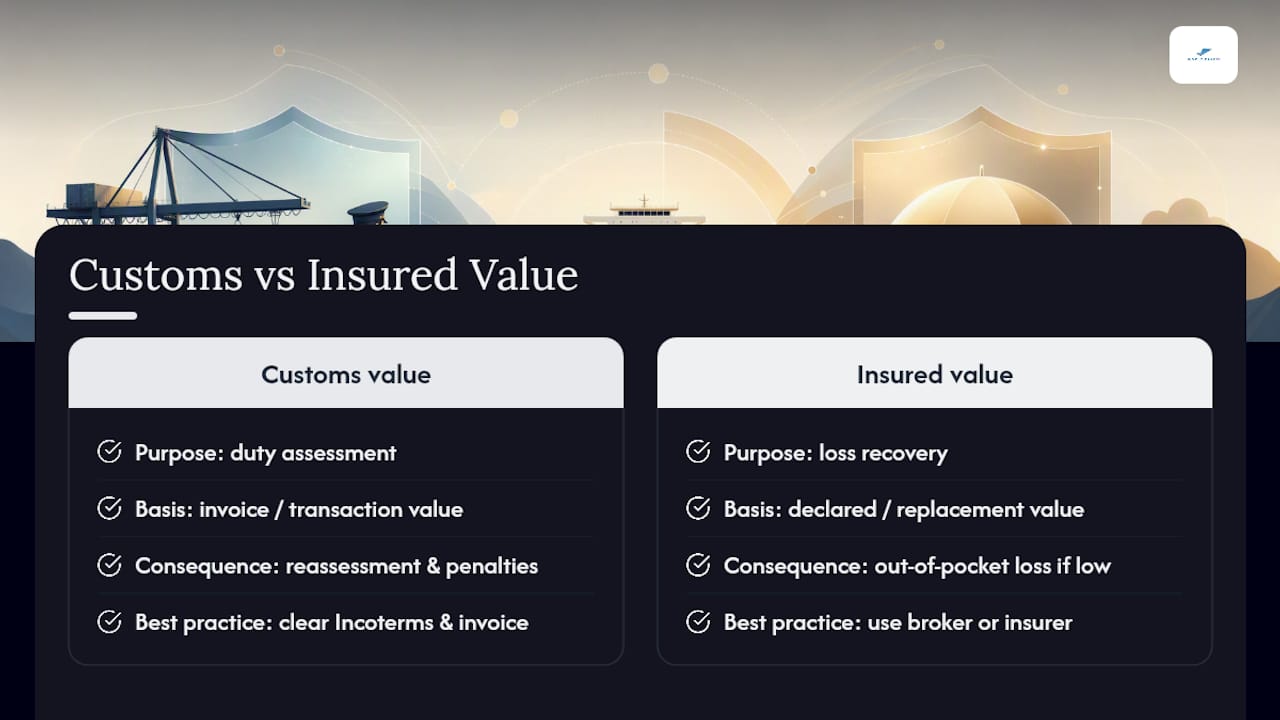
Every importer wants a lower customs value and a higher insured value, and that instinct is understandable but backwards in practice. Push customs value too low and you're exposed to reassessment and penalties. Skimp on insured value and you're the one absorbing the loss when a pallet gets crushed. The two numbers protect you against opposite risks, and treating either as negotiable usually backfires.
Clear Incoterms and itemized invoices remove most of the friction that turns a routine shipment into a dispute. For anything high-value, fragile, or commercially complex, a licensed customs broker or cargo insurer can catch mistakes a general shipping guide never will.
— Simply
Get Your Paperwork and Protection Sorted With Simplyparcel
Sorting out customs value from insured value on your own paperwork takes real attention, and one mismatched Incoterm or missing invoice line can cost you more than the shipment itself. The platform simplifies shipping by generating shipping labels and customs documentation, comparing carrier options across various speeds, and offering optional additional protection beyond the carrier's standard liability cap. That combination means fewer surprises at clearance and a clearer path to a real payout if something goes wrong in transit. If you're preparing a shipment now, get an instant shipping quote and see how the paperwork and coverage options line up before you book.
Sources
- Establishing customs value and methods — Singapore Customs
- Customs valuation — WTO technical information
- What's the difference between customs value and shipping value? — Ship24
FAQ
What is the difference between customs value and declared value?
Customs value is the figure customs authorities use to calculate duties and taxes, based on the transaction price plus required adjustments. Declared value is a separate figure you set with your carrier that caps their liability if your shipment is lost or damaged, and it has no bearing on the taxes you owe.
How is customs value calculated?
Customs value starts with the transaction value, the price actually paid for the goods, then adds required items like packing, assists, royalties, and commissions. Freight and insurance get added only when the Incoterm used, such as CIF, makes the seller responsible for those costs as part of the sale.
What is meant by customs value?
Customs value is the amount a country's customs authority uses as the base for assessing import duties and taxes on a shipment. Singapore Customs and most other authorities base it primarily on the transaction value method, falling back to alternative methods only when that price can't be verified.
What is the difference between declared value and insurance?
Declared value raises what a carrier is liable to pay you, but usually only after you prove they were negligent, and the payout is capped by their tariff terms. Cargo insurance is a separate contract that typically pays based on proven loss under the policy's own terms, often recovering closer to full replacement cost. Reading more on declared value and when it falls short is worth doing before you ship anything valuable.
Does a higher insured value increase the customs duty I pay?
No. Insured value and customs value are calculated independently in almost every case, and raising your insurance coverage does not change your dutiable amount. The only exception is under Incoterms like CIF, where the insurance cost itself is contractually part of the sale price and gets folded into the customs value calculation.