
Freight forwarding is the professional service of organizing and managing the transportation of goods from origin to destination on behalf of shippers, across one or more international borders. A freight forwarder acts as an intermediary between you and a network of carriers, customs authorities, and logistics providers. Rather than owning ships, planes, or trucks, forwarders coordinate multiple parties to move your cargo efficiently. Platforms like Freightos and GoFreight have helped make freight forwarding more transparent, while customs brokers often work alongside forwarders to handle regulatory compliance at each border crossing.
What is freight forwarding and what does a forwarder actually do?
Freight forwarding is best understood as an operational management layer sitting between you and the global transport network. You hand off a shipment, and the forwarder handles everything from booking cargo space to arranging final delivery. According to the full scope of services forwarders provide, this includes transportation coordination, documentation, rate negotiation, consolidation, insurance, warehousing, freight tracking, and last-mile delivery. That breadth is what makes freight forwarding genuinely useful for businesses that lack in-house logistics teams.
The core responsibilities of a freight forwarder include:
- Booking cargo space with carriers across ocean, air, road, and rail modes, selecting the right option based on your timeline and budget
- Preparing shipping documentation, including bills of lading, commercial invoices, packing lists, and certificates of origin
- Managing export and import customs clearance, filing the correct paperwork and coordinating with customs authorities at both ends
- Negotiating freight rates and consolidating smaller shipments into full container loads to reduce per-unit costs
- Providing cargo insurance to protect against loss or damage during transit
- Offering warehousing and freight tracking so you know where your goods are at every stage
- Acting as a single point of contact across multiple carriers, agents, and government bodies
That last point matters more than most shippers realize. Without a forwarder, you would need to manage separate relationships with an ocean carrier, a trucking company, a customs broker, and a warehouse operator. A forwarder collapses all of that into one accountable party.
Pro Tip: Ask any forwarder you evaluate to walk you through a recent shipment from booking to delivery. Their answer will reveal how well they communicate, how many partners they manage, and whether they proactively flag problems or wait for you to ask.

How does the freight forwarding process work step by step?
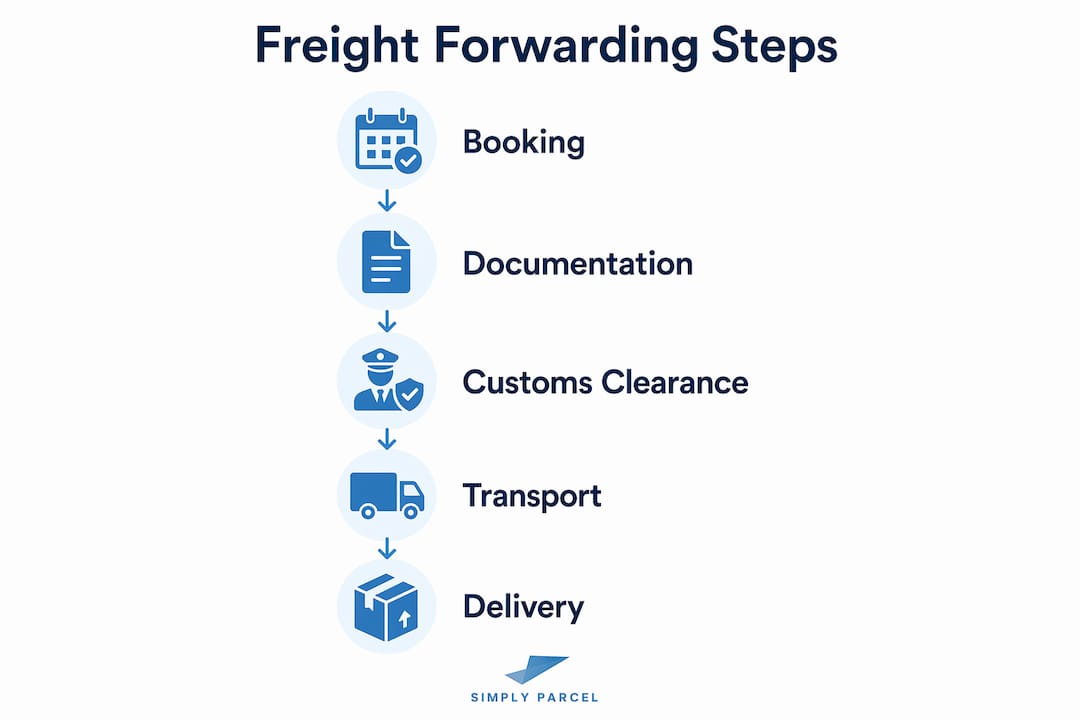
The freight forwarding process follows a defined sequence of six stages, each with its own documentation requirements and timing constraints. Missing a step or submitting incorrect paperwork at any stage can delay your entire shipment.
-
Origin handling. Your goods are collected from the factory, warehouse, or supplier and transported to the export gateway, typically a port or airport. The forwarder arranges inland transport and confirms the cargo is correctly packed and labeled.
-
Export customs clearance. Before cargo loads onto the international carrier, the forwarder files export declarations and submits supporting documents to the relevant customs authority. Timing at this stage is critical. Delays here can cause the shipment to miss its vessel or flight.
-
Main international transport leg. The forwarder books space on the chosen carrier, whether ocean freight, air freight, or a combination. For smaller shipments, the forwarder may consolidate your cargo with other shippers' goods into a single container, reducing your cost.
-
Import customs clearance. On arrival at the destination country, the forwarder or a local agent files import declarations, pays applicable duties and taxes, and confirms regulatory compliance. This stage often involves coordination with a licensed customs broker.
-
Destination handling. Once customs releases the cargo, it moves from the port or airport to a local warehouse or directly to the consignee. The forwarder manages this final inland leg and confirms delivery.
-
Coordination and communication throughout. A good forwarder provides proactive shipment updates at each stage, not just when something goes wrong. Real-time tracking and clear communication are what separate reliable forwarders from average ones.
Pro Tip: Always confirm the cutoff time for export customs filing before booking your cargo. Missing the cutoff by even a few hours can push your shipment to the next available vessel or flight, adding days to your transit time.
How is freight forwarding different from customs brokers and freight brokers?
These three roles are frequently confused, and the confusion can create real problems when something goes wrong with a shipment. Each role has a distinct scope of responsibility.
| Role | Primary function | Owns transport assets? | Handles customs filing? | Assumes cargo liability? |
|---|---|---|---|---|
| Freight forwarder | Coordinates full shipment logistics | No | Sometimes | Partially, per contract |
| Customs broker | Files customs entries and clearance | No | Yes, licensed | No |
| Freight broker | Connects shippers with carriers | No | No | Generally no |
| Carrier | Physically moves cargo | Yes | No | Yes, during transit |
Customs brokers are licensed agents who specialize in filing customs entries and navigating import regulations. They do not arrange transport. Freight brokers match shippers with carriers but typically do not take on responsibility for the cargo itself. Freight forwarders sit above both, coordinating the full logistics chain and often subcontracting customs brokerage when needed.
One legal distinction that many shippers overlook involves the Importer of Record. The Importer of Record holds legal responsibility for customs compliance at the destination country. A freight forwarder coordinates the shipment but does not automatically assume that legal role. You need to confirm in writing who holds Importer of Record status before your cargo ships, because coordination does not transfer liability automatically. Commercial terms like DDP (Delivered Duty Paid) do not guarantee the forwarder is recognized as the legal Importer of Record, which can create compliance gaps at customs.
Some freight forwarders offer customs brokerage as an additional service, which simplifies the process for you. But always verify their licensing and whether they are acting as your customs broker or simply referring the work to a third party.
What are the benefits of using freight forwarding services?
The benefits of freight forwarding are most visible when shipments cross multiple borders, involve more than one transport mode, or require strict regulatory compliance. For Singapore-based businesses shipping internationally, the value compounds quickly.
- Simplified logistics management. A forwarder functions like a travel agent for freight, managing complex cross-border processes so you do not have to coordinate with each carrier and agent separately.
- Customs compliance and fewer delays. Freight forwarding expertise reduces shipping delays by ensuring correct documentation and regulatory compliance at every border. A single incorrect field on a customs form can hold your cargo for days.
- Competitive freight rates. Forwarders negotiate volume discounts with carriers that individual shippers cannot access. They also consolidate smaller shipments, which lowers the cost per unit for businesses that do not fill a full container.
- Real-time shipment visibility. Forwarders provide cargo tracking and warehousing options that give you visibility throughout the journey, reducing uncertainty and helping you plan inventory more accurately.
- Route and mode optimization. A forwarder with strong carrier relationships can recommend the most cost-effective combination of air, ocean, and road transport for your specific shipment. For guidance on this, freight mode optimization strategies show how selecting the right transport mix directly affects cost and delivery time.
- Scalable support for growth. Whether you are an individual sending a single pallet or an SME managing regular export volumes, freight forwarding services scale to your needs without requiring you to build an in-house logistics team.
Common applications include import and export businesses, e-commerce sellers shipping cross-border, manufacturers sourcing raw materials internationally, and SMEs entering new markets. For a deeper look at how international shipping benefits Singapore SMEs specifically, the overlap with freight forwarding is direct and practical.
Key takeaways
Freight forwarding is the single most effective way for businesses and individuals to manage complex international shipments without building in-house logistics expertise.
| Point | Details |
|---|---|
| Core definition | Freight forwarding coordinates transport, documentation, and customs across the full shipping journey. |
| Six-stage process | Every shipment moves through origin handling, export clearance, transport, import clearance, and final delivery. |
| Legal clarity matters | Confirm who holds Importer of Record status before shipping to avoid customs liability gaps. |
| Role distinctions | Freight forwarders, customs brokers, and freight brokers each have separate and non-overlapping responsibilities. |
| Business value | Forwarders reduce costs, improve compliance, and provide tracking visibility that individual shippers cannot replicate alone. |
What I have learned from working in international shipping
After working closely with Singapore-based shippers across every volume tier, one pattern stands out clearly. Most shipping problems are not caused by carriers or customs authorities. They are caused by unclear role assignments before the shipment begins.
Shippers often assume their freight forwarder is also their customs broker, their Importer of Record, and their insurance provider. In reality, each of those is a separate function, and each may be handled by a different party. The forwarder may subcontract customs work to a broker you have never spoken to. The Importer of Record may default to you, the buyer, even if you expected the seller to handle it. These gaps only surface when something goes wrong, and by then, your cargo is sitting in a bonded warehouse accruing storage fees.
The practical fix is straightforward. Before any shipment moves, get a written breakdown of who is responsible for each function: customs filing, import liability, cargo insurance, and last-mile delivery. A forwarder who resists providing that clarity is a forwarder worth avoiding.
The other thing I have seen undervalued is tracking transparency. Real-time shipment visibility is not a luxury feature. It is how you catch problems early enough to act on them. A forwarder who sends you a booking confirmation and then goes quiet until delivery is not giving you operational control. You want updates at each stage, not just a final notification.
Choose a forwarder based on their network depth in your specific trade lanes, their willingness to explain every fee upfront, and their communication standards during transit. Those three factors predict shipment success more reliably than price alone.
— Simply
Ship smarter with Simplyparcel
Understanding freight forwarding is the first step. Executing it efficiently is where Simplyparcel helps. Simplyparcel is a Singapore-based shipping platform that lets you compare and book international shipping across multiple courier partners in one place, with instant quotes, automatic label generation, and real-time tracking built in. Whether you are sending a single parcel or managing regular export volumes, Simplyparcel gives you competitive rates, free pickup, and clear transit timelines without the complexity of managing multiple logistics providers. For businesses that want the benefits of freight forwarding coordination without the overhead, Simplyparcel is built for exactly that. Start with an instant quote and see how straightforward international freight shipping can be when the right tools are in place.
FAQ
What is freight forwarding in simple terms?
Freight forwarding is the service of organizing and managing the shipment of goods from one country to another on behalf of a shipper. The forwarder handles carrier bookings, customs paperwork, and delivery coordination so you do not have to manage each step yourself.
How does a freight forwarder differ from a shipping carrier?
A freight forwarder coordinates the logistics of your shipment but does not own ships, planes, or trucks. Carriers physically move the cargo. Forwarders book space with carriers and manage everything around the transport itself.
Do I need a freight forwarder for international shipping?
You do not legally require one, but freight forwarding expertise significantly reduces the risk of customs delays and documentation errors. For multi-modal or multi-country shipments, using a forwarder is the most practical way to manage compliance and cost.
What documents does a freight forwarder handle?
Forwarders typically manage bills of lading, commercial invoices, packing lists, certificates of origin, and customs declarations. For a detailed breakdown of required paperwork, the guide to shipping documentation for Singapore SMEs covers each document and its purpose.
Who is responsible for customs compliance, the forwarder or the importer?
The Importer of Record holds legal responsibility for customs compliance at the destination country. A freight forwarder coordinates the shipment but does not automatically assume that legal role, so you must confirm this assignment in writing before your cargo ships.