
A shipping label is the single document that determines whether your package reaches its destination or gets lost in transit. Every compliant label must include the sender's full address, the recipient's full address, a carrier-specific barcode, a unique tracking number, and a designated service level. For international shipments, the shipping label requirements list expands to include customs data such as Harmonized System (HS) codes, a commercial invoice, and country of origin. Getting these details right is not optional. Carriers like USPS, UPS, and FedEx use automated sorting systems that reject or misroute packages with incomplete labels.
1. What goes on a shipping label: the core requirements list
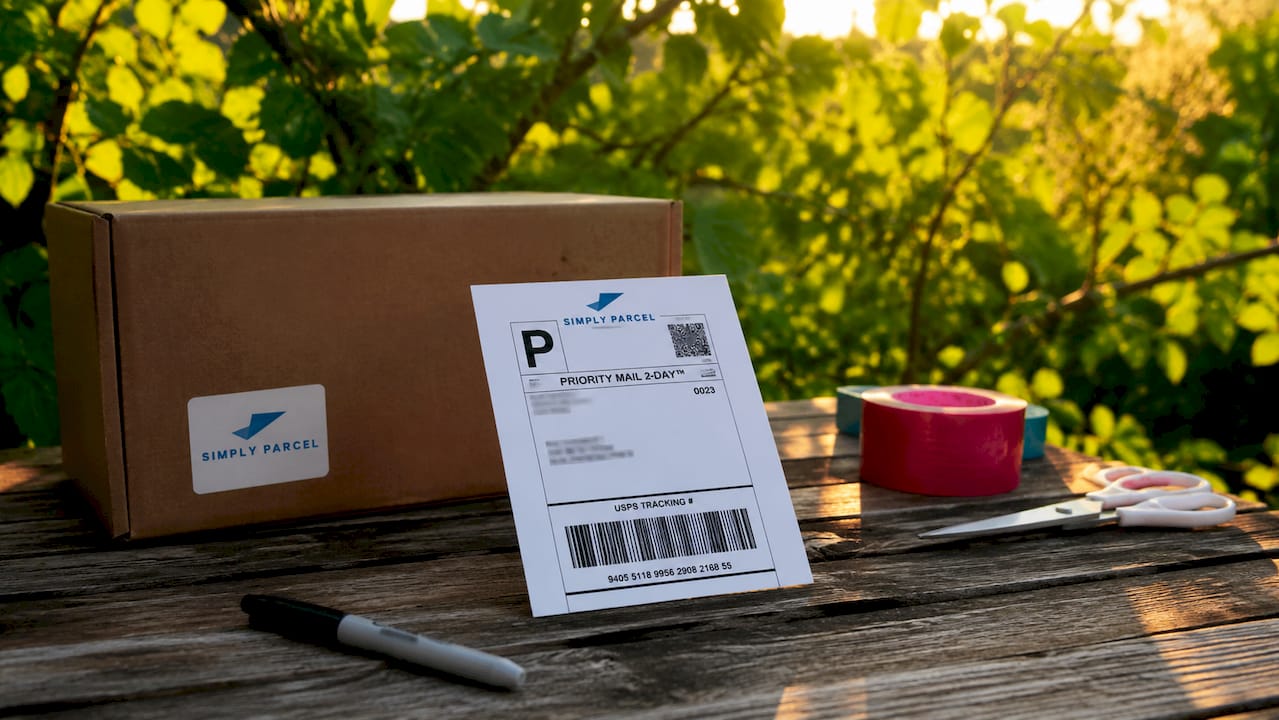
Every domestic shipping label shares the same foundational structure. The five required elements are a clear return address, a complete recipient address, a carrier barcode, a tracking number, and the service level indicator. Missing any one of these causes sorting failures or delivery delays. Think of these five elements as the minimum viable label, not the complete picture.
The service level indicator tells the carrier which network to route your package through. Ground, Priority Mail, and Express are examples of service classes that trigger different handling, speed, and cost tiers. Carriers print this information in a designated zone on the label so automated scanners can read it without human intervention.
2. Sender and recipient address formatting rules
Address formatting is where most labeling errors originate. Formatting the recipient address in all-uppercase letters without punctuation, except for the ZIP+4 hyphen, improves machine readability and reduces misdelivery risk. Automated optical character recognition (OCR) systems read uppercase text more accurately than mixed case. This is a USPS Publication 28 standard that most major carriers also follow.
Directional prefixes and suffixes matter more than most shippers realize. "123 N Main St" and "123 Main St" can refer to entirely different addresses in a city grid. Omitting the directional "N" is one of the most commonly skipped details that causes address confusion and failed delivery.
Font size is a hard requirement, not a suggestion. Use a minimum 10-point font for the recipient address and at least 8-point font for the return address, preferably in a sans-serif typeface like Arial or Helvetica. These fonts scan cleanly and hold up under thermal printing conditions.
- Full legal name or business name for both sender and recipient
- Complete street address including unit, suite, or apartment number
- City, state, and ZIP code on the recipient address line
- All uppercase letters with no punctuation except ZIP+4 hyphen
- Directional prefixes and suffixes (N, S, E, W, NE, SW) where applicable
Pro Tip: Size the recipient address at least three times larger than the return address. This size hierarchy helps both human handlers and automated systems identify the destination at a glance, cutting sorting errors.
3. Carrier-specific barcode and tracking number standards
Barcodes are the backbone of automated package sorting. USPS tracking numbers run 20–22 digits and begin with 94, 93, 92, or 95. UPS uses 18-character codes starting with "1Z." FedEx uses a numeric format. Each carrier's system validates these codes at every scan point, so a damaged or misprinted barcode stops tracking entirely.
The standard label size across all major carriers is 4x6 inches. This dimension fits thermal label printers and aligns with carrier scanner beds. Labels printed on standard 8.5x11 paper folded and taped to a box are technically acceptable for some carriers, but they carry a higher risk of damage and misread.
| Carrier | Tracking Format | Label Size |
|---|---|---|
| USPS | 20–22 digits, starts with 94/93/92/95 | 4x6 inches |
| UPS | 18 characters, starts with "1Z" | 4x6 inches |
| FedEx | Numeric format, carrier-assigned | 4x6 inches |
Service class must appear clearly on the label in a dedicated zone. Ground, Express, and Priority Mail each route through different carrier networks. Printing the service class in a legible font in the correct label zone prevents your package from being sorted into the wrong stream.
- Carrier barcode printed in the designated barcode zone
- Unique tracking number printed below the barcode in human-readable text
- Service class indicator in the correct label zone
- Postage or payment confirmation printed or marked clearly
- No tape, wrinkles, or folds over the barcode area
Pro Tip: Never place tape over a barcode. Even clear tape creates a glare layer that scanner beams cannot penetrate reliably. If a label is damaged, reprint it before dropping off the package.
4. International shipping label requirements and customs documentation
International shipments carry a longer shipping label requirements checklist than domestic ones. Failing to include customs data such as HS codes, a commercial invoice, and country of origin results in package holds or outright rejection at customs. These are not bureaucratic formalities. Customs authorities use this data to calculate duties, verify restricted goods, and clear shipments through border control.
The Harmonized System (HS) code is a 6 to 10-digit number that classifies every product traded internationally. A "blue ceramic coffee mug" has a specific HS code. Writing "household item" instead gives customs officers no basis for classification and triggers a manual review. For a deeper look at international parcel labeling, the rules vary by destination country, so checking country-specific requirements before you ship is always the right move.
The commercial invoice must accompany every international shipment. It lists the seller, buyer, item descriptions, quantities, declared values, and currency. Express carriers like FedEx and UPS require a recipient phone number for international deliveries. Including a phone number reduces logistical delivery delays because local couriers can contact recipients when access issues arise.
Required elements for international labels:
- Sender's full name, address, and phone number
- Recipient's full name, address, and phone number
- HS tariff code (6–10 digits) for each item in the shipment
- Detailed product description (material, use, and quantity)
- Declared value in the shipment currency
- Country of origin for each item
- Commercial invoice attached to the outside of the package
- Customs declaration form (CN22 or CN23 for postal shipments)
Vague descriptions like "Gift" or "Personal Item" are the single most common reason international packages get held at customs. Write "two cotton T-shirts, size M, valued at $30 each" instead. Precision clears packages faster and protects you from liability if the declared value is questioned. For more on why documentation matters for cross-border shipments, the consequences of skipping details range from delays to permanent seizure.
5. Common mistakes that cause shipping failures
Most delivery failures trace back to a small set of repeatable errors. Common labeling mistakes include missing unit numbers, vague customs descriptions, damaged barcodes, and expired labels. Each one triggers a different failure mode, from misdelivery to customs rejection to carrier refusal at drop-off.
Carrier address validation systems catch many typos, but they consistently miss missing apartment or unit numbers. Auto-validation tools do not flag a missing "#4B" because the street address itself is valid. A package addressed to "456 Oak Ave" instead of "456 Oak Ave #4B" gets delivered to the building, not the unit, and often bounces back.
Labels also expire. UPS and FedEx labels expire after 90 days from the issue date. Dropping off an expired label results in carrier rejection at the counter or a billing dispute later. Always check the label creation date if you printed it in advance.
- Missing unit, suite, or apartment numbers in the recipient address
- Omitting directional prefixes (N, S, E, W) in street names
- Placing tape or folding the label over the barcode zone
- Using vague customs descriptions like "Gift" or "Miscellaneous"
- Submitting expired labels past the 90-day carrier validity window
- Leaving out the recipient phone number on international shipments
Pro Tip: Before sealing your package, photograph the label. If a dispute arises about label condition or content, you have a timestamped record of exactly what was printed and how it looked.
For a full rundown of common shipping mistakes that affect delivery success, the list goes beyond labels and covers packaging, weight declarations, and carrier selection errors worth knowing about.
6. Label design, placement, and material best practices
Label placement affects scan success as much as label content does. Place the label on the largest flat surface of the package, away from edges, seams, and corners. A label that wraps around an edge gets partially obscured at every scan point. Flat placement keeps the barcode in a single plane that scanners read in one pass.
All-caps formatting is not just a USPS rule. It improves OCR accuracy across all carrier systems. Mixed-case addresses introduce character ambiguity that slows automated sorting. Using all caps on every address line is the single easiest formatting change that reduces misrouting.
For perishable shipments or packages exposed to moisture, moisture-resistant label material prevents smearing and keeps barcodes scannable through condensation and handling. Standard paper labels on a frozen food shipment will fail before the package reaches its first sort facility.
- Place the label on the largest, flattest surface of the box
- Use all caps for every address line
- Keep labels away from box edges, seams, and tape lines
- Use moisture-resistant label stock for perishable or refrigerated shipments
- Scale font size up for larger packages where label real estate allows
- Print labels rather than handwrite them for any shipment going through automated sorting
Pro Tip: Handwritten labels are acceptable for USPS retail counter drop-offs on simple domestic packages, but any shipment going through automated sorting benefits from a printed label. Thermal printers produce the clearest barcodes and the sharpest address text.
For a practical look at label templates and formats, seeing real examples side by side makes the formatting rules much easier to apply.
7. ZIP+4 codes and delivery point precision
ZIP+4 codes add four digits to the standard five-digit ZIP code and route packages deeper into carrier automation earlier in the sorting process. Using ZIP+4 and 11-digit Delivery Point Codes can reduce transit times by 1–2 days compared to five-digit ZIP codes alone. That reduction comes from fewer manual handling steps, not faster trucks.
The 11-digit Delivery Point Code goes one step further by encoding the specific delivery point within a ZIP+4 zone. Carriers use this to route packages directly to the correct carrier route, bypassing intermediate sort steps. Most shipping platforms generate this automatically when you enter a complete address. If yours does not, adding the ZIP+4 manually is a straightforward upgrade that costs nothing and saves time.
For a comprehensive look at labeling practices in 2026, the shift toward more granular address data reflects how carrier networks are investing in automation to handle higher parcel volumes.
Key takeaways
A complete shipping label requires accurate addresses, a valid carrier barcode, correct service class, and for international shipments, full customs data including HS codes and a commercial invoice.
| Point | Details |
|---|---|
| Address formatting | Use all caps, no punctuation except ZIP+4 hyphen, and include directionals. |
| Barcode integrity | Never place tape or folds over the barcode; reprint damaged labels before shipping. |
| International customs data | Include HS codes, declared value, country of origin, and a commercial invoice on every cross-border shipment. |
| Label expiration | UPS and FedEx labels expire after 90 days; check the issue date before drop-off. |
| Label placement | Affix labels to the largest flat surface, away from edges, seams, and tape lines. |
What I've learned from watching labels fail in the real world
The most expensive labeling mistakes are the quiet ones. A missing apartment number does not trigger an error message. The package ships, clears the sort facility, and then sits at a building entrance while the carrier attempts delivery to a unit that does not exist in their system. By the time the shipper notices, the package is already on its way back.
Carrier technology has gotten better at catching obvious errors, but it has not closed the gap on missing data. Automated address validation confirms that a street exists. It does not confirm that the unit number you left out is the one detail standing between delivery and a return-to-sender. Manual verification of every recipient address before printing is still the most reliable check.
The other pattern I see consistently is shippers treating customs declarations as a formality. Writing "personal items" on a commercial invoice is not just vague. It is a red flag that customs officers are trained to scrutinize. Precise declarations clear faster, cost less in inspection fees, and protect you legally if the shipment is questioned. The extra two minutes spent writing accurate descriptions is the best time investment in the entire shipping process.
Carrier requirements also change. USPS, UPS, and FedEx update their label specifications periodically, and a label format that worked in 2024 may not meet 2026 standards. Checking carrier guidelines at least once a year, or using a platform that updates automatically, keeps your labels compliant without requiring you to track every policy change manually.
— Simply
How Simplyparcel makes label compliance straightforward
Simplyparcel generates compliant shipping labels automatically when you book a shipment through the platform. You enter the sender and recipient details, select your carrier and service level, and the system produces a correctly formatted label with the right barcode, tracking number, and service class indicator. For international shipments, Simplyparcel also generates the required customs documentation, including the commercial invoice and customs declaration forms, so you do not have to create them separately.
The platform supports multiple carrier partners, offers real-time tracking, and provides instant quotes so you can compare rates before committing. Get a shipping quote directly on the Simplyparcel platform and have your label ready to print in minutes, with all the required fields pre-populated and validated.
FAQ
What must every shipping label include?
Every shipping label must include the sender's full address, the recipient's full address, a carrier-specific barcode, a unique tracking number, and the service level. International labels also require HS codes, declared value, country of origin, and a commercial invoice.
What size should a shipping label be?
The standard shipping label size is 4x6 inches. This dimension is compatible with thermal label printers and carrier scanner systems used by USPS, UPS, and FedEx.
How should I format the recipient address on a shipping label?
Format the recipient address in all-uppercase letters with no punctuation except the ZIP+4 hyphen. Include directional prefixes and suffixes, the full street address with unit number, city, state, and ZIP code.
Do shipping labels expire?
Yes. UPS and FedEx labels expire 90 days after the issue date. Submitting an expired label results in carrier rejection at drop-off or a billing dispute. Always verify the label creation date if you printed it in advance.
What customs information is required on an international shipping label?
International labels require a 6 to 10-digit HS tariff code, a detailed product description, declared value, country of origin, and an attached commercial invoice. Vague descriptions like "Gift" cause customs holds and should be avoided.