Rules of origin are the criteria customs authorities use to decide which country a product "comes from" for trade purposes. That answer is not always where it was shipped from. It is where the goods were made or last substantially transformed, and it decides whether your parcel or consignment pays full duty, reduced duty or none. If you ship from Singapore, getting origin right before you book keeps the commercial invoice, the customs declaration and any duty claim consistent, so the shipment is less likely to be held at the border.
TL;DR
- Rules of origin set a product's "economic nationality", meaning where it was made, not where it was posted from or the last country it passed through.
- There are two kinds: non-preferential rules (statistics, anti-dumping, origin marking) and preferential rules (lower or zero duty under a free trade agreement).
- Three tests recur: wholly obtained, change in tariff classification, and a minimum regional value content. Product-specific rules say which test applies to your HS code.
- To claim preference you usually need an origin statement or certificate, direct shipment and records kept for years. A wrong claim can mean back duties and penalties.
- Personal gifts and small parcels rarely need any of this. Commercial exports to free trade partners often do.
Table of Contents
- What rules of origin are, in plain terms
- Preferential vs. non-preferential rules
- The main tests for deciding origin
- Product-specific rules of origin
- How origin rules change what you pay
- The paperwork behind an origin claim
- What happens if origin is declared wrongly
- Origin rules keep moving
- When you do not need to worry
- Our perspective
- Book your shipment with the documents ready
- FAQ
- Sources
What rules of origin are, in plain terms
The World Trade Organization describes rules of origin as the criteria needed to determine the national source of a product. They matter because duties and restrictions often depend on that source. They are also needed because parts and raw materials now cross several borders before a finished product exists. A phone may use chips from one country, a screen from another and be assembled in a third. Someone has to decide which country the phone "belongs" to.
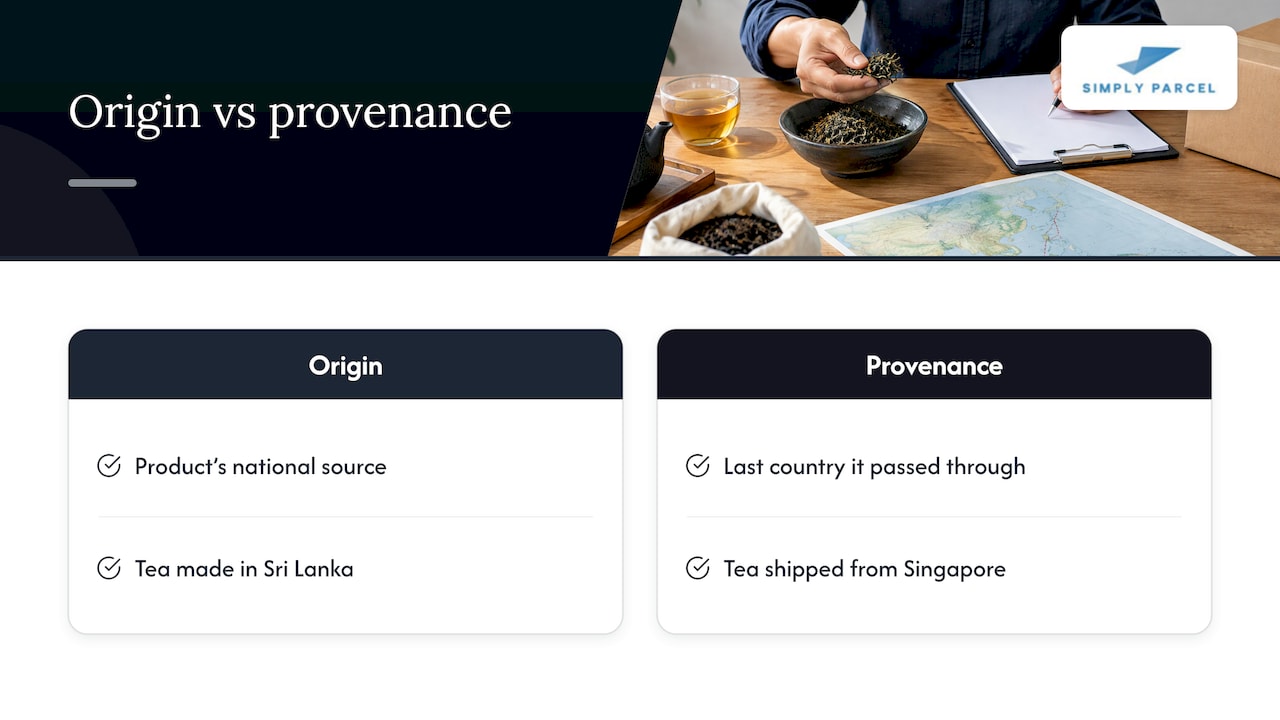
The World Customs Organization draws a useful line here. Origin is the nationality of the good. Provenance is the last country it passed through. A parcel of tea made in Sri Lanka and shipped to you from Singapore has Sri Lankan origin and Singapore provenance. Customs forms ask for origin, so "shipped from" is the wrong answer.
Why you should care as a sender
Origin shows up in three places in a typical export:
- The commercial invoice and customs declaration, where you state the country of origin of each item.
- The duty rate, where the importing country applies either the standard rate (most-favored-nation, or MFN) or a lower preferential rate.
- Compliance checks, where origin determines whether anti-dumping measures, quotas or marking requirements apply.
If you only send personal items such as clothes, books or gifts, you will mostly just state where each item was made. If you sell goods, export samples or dropship, origin can change what your buyer pays on arrival.
Preferential vs. non-preferential rules
According to the WCO's FAQ, non-preferential rules are used for measures such as statistics, anti-dumping, origin marking and government procurement, and they apply to all goods. Preferential rules are used to obtain preferential treatment at importation, and a trade agreement may exclude some goods from that treatment.
| Non-preferential origin | Preferential origin | |
|---|---|---|
| Purpose | Statistics, anti-dumping, marking, procurement | Reduced or zero duty under a trade agreement |
| Who benefits | Nobody directly; it is a classification | The importer, through lower duty |
| Scope | All goods | Only goods covered by the agreement |
| Proof | Country of origin on invoice and declaration; a certificate only when required | Origin statement or certificate under the agreement |
The WCO counts over 350 preferential trade arrangements worldwide. That is the main reason the details change so often between destinations.
Why the rules differ from one agreement to the next
The WTO notes that members agreed in 1994 to negotiate harmonized non-preferential rules, but those negotiations have not concluded. Preferential rules in regional agreements are not harmonized either. So a product can qualify under one agreement and fail under another. Always check the agreement that covers your specific route.
The main tests for deciding origin
The Congressional Research Service summarizes how a product earns preferential origin under a US free trade agreement. It must be one of the following:
- Wholly obtained: grown, harvested or fished entirely in the agreement region (think fresh fruit or fish).
- Made only from originating materials: produced in the region using only materials that themselves originate there.
- Made with outside parts but meeting product-specific rules: produced in the region with non-originating components, while satisfying the rule written for that product.
Many agreements also include a de minimis allowance. This lets a small share of non-originating material, for example 7 to 10 percent of the product's value, be ignored. Exact thresholds vary by agreement.
Substantial transformation
For non-preferential origin, US Customs and Border Protection generally gives origin to the country where the product was last "substantially transformed". That means a new product with a different name, character and use was created. Cutting fabric and stitching it into a jacket qualifies. Repackaging, relabeling or simple dilution usually does not.
Product-specific rules of origin
The third route above is where most commercial shipments land, and it is also where the search term "product specific rules of origin" comes from. Each agreement lists a rule for each product category, organized by Harmonized System (HS) code. The HS code is the international tariff classification number used on customs forms. If you are unsure of yours, our guide to getting the HS code right for exports walks through it.
The CRS report says US product-specific rules take three main forms:
- Change in tariff classification (tariff shift): the finished product must fall under a different HS code than its non-originating inputs.
- Regional value content (RVC): a minimum share of the product's value must come from the region. Agreements use build-up, build-down or net cost formulas to calculate it.
- Technical rules: a specific manufacturing or processing step is required, such as a chemical reaction.
Three levels of tariff shift
Australia's trade department explains in its CPTPP guide that change-in-classification rules work at three HS levels:
| Level | Digits | Example from the guide |
|---|---|---|
| Change in chapter | First 2 | Steel (chapter 72) to railway tracks (chapter 73) |
| Change in heading | First 4 | Gold (7108) to jewelry (7113) |
| Change in subheading | 6 | Fresh ginger (0910.11) to crushed ginger (0910.12) |
Some rules add exceptions. The guide cites ketchup (2103.20), whose rule excludes inputs from one specific heading.
A worked example
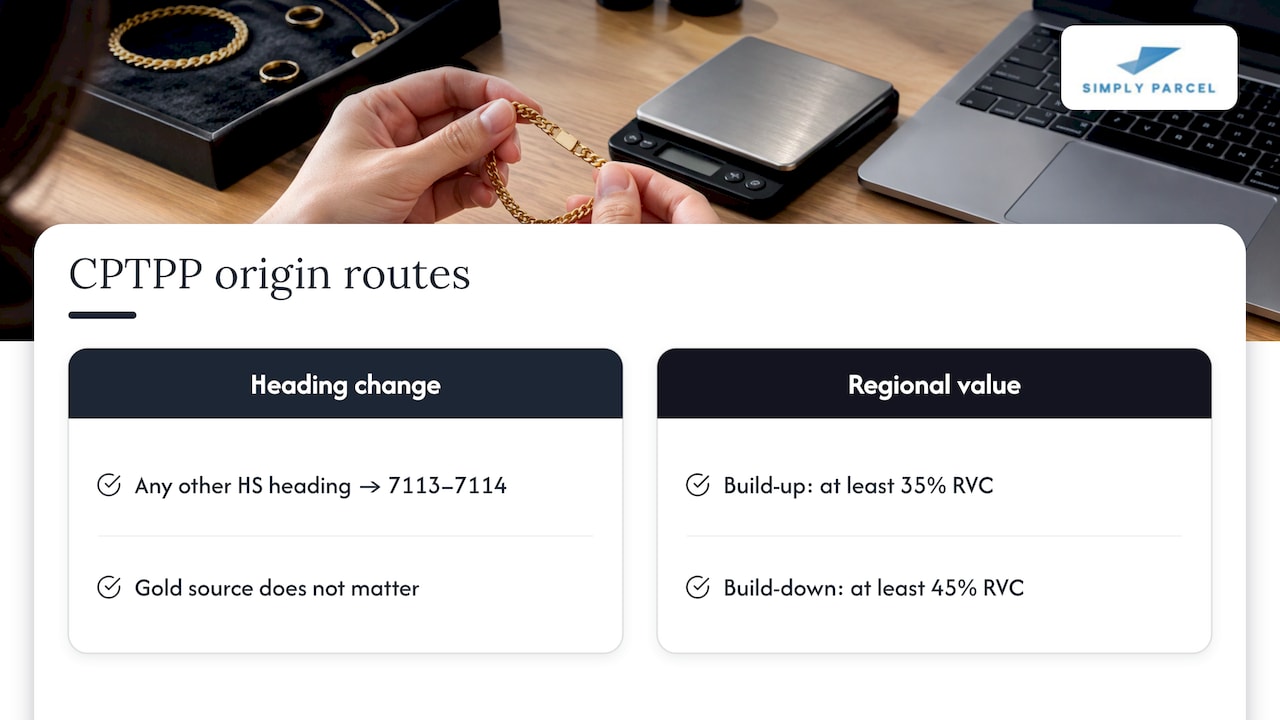
The same guide gives this case. Pure gold (HS 7108) from any country is processed in Australia into gold jewelry (HS 7113). The CPTPP rule for headings 7113 to 7114 allows a change from any other heading, so the jewelry qualifies as originating no matter where the gold came from. The rule also offers an alternative: no change is needed if the regional value content is at least 35 percent (build-up) or 45 percent (build-down).
The lesson for a small exporter: you do not need to make everything locally. You need to show that what you did to the inputs meets the rule for your product's code.
How to find the rule for your product
Per the same guide, product-specific rules sit in an annex of the agreement (Annex 3-D for CPTPP) and are searched by tariff code. Only the first six HS digits are needed, and a rule written at chapter or heading level applies to every subheading beneath it. The US trade.gov page on identifying and applying rules of origin lists where US agreements publish theirs. Note that some, such as those with Israel, Jordan, Bahrain, Morocco and Oman, use a 35 percent appraised value method instead of code-by-code rules.
How origin rules change what you pay
Goods that meet the rules receive the agreement's preferential duty rate. Non-compliant imports may pay the MFN rate or another applicable rate. Before doing any origin work, compare the two rates. As trade.gov points out, if the MFN rate is already zero, there is nothing to claim.
A simple example with invented numbers: a buyer imports a consignment worth 10,000 units of currency. The MFN rate is 7 percent and the agreement rate is zero. A valid origin claim saves 700. A failed claim means the buyer pays it, often plus any interest or penalties the importing country applies.
Singapore exporters and self-certification
Singapore is party to many agreements. Singapore Customs explains that for several of them it does not issue a preferential certificate of origin. Those agreements use self-certification, where the exporter, producer or importer makes an origin declaration on a commercial document such as the invoice, packing list or delivery note. Which route applies depends on the agreement and destination. Our guides on using free trade agreements and TradeNet and on the certificate of origin in Singapore cover the Singapore side in more detail.
The paperwork behind an origin claim
The requirements vary by agreement, but the pattern is consistent.
- Confirm the product is made or substantially transformed in the agreement territory. Trade.gov lists this as the first step in its five-step eligibility process.
- Compare the MFN and agreement duty rates. Skip the claim if the gap is zero.
- Apply one of the four tests: wholly obtained, exclusively originating materials, de minimis, or the product-specific rule.
- Certify the shipment. For small shipments the claim can usually be stated on the commercial invoice. Larger ones may need a statement on company letterhead or a specific form, according to trade.gov.
- Ship directly. Agreements typically require direct shipment, or only minimal processing if the goods are transshipped.
- Keep records. Under CPTPP, a certification of origin is valid for one year and records must be kept for at least five years.
The certification can be completed by the importer, exporter or producer under CPTPP, and must carry minimum data elements set by the agreement. Other agreements assign the responsibility differently, so read the customs chapter of the one you use.
Where it goes wrong
- Using the shipping country as the origin. The invoice says Singapore because the parcel left Singapore, but the goods were made elsewhere.
- Mismatched descriptions. The invoice, the HS code and the origin statement do not describe the same product.
- Missing proof at declaration. Some agreements require the importer to hold the certificate when the declaration is made.
- Indirect routing. Goods that pass through a third country with more than minimal handling can lose preference.
What happens if origin is declared wrongly
An honest mistake caught early is much cheaper than one found in an audit. The rules for correction differ by country, so these examples show the pattern.
- Canada: the Canada Border Services Agency says an importer must correct an incorrect origin declaration within 90 days of having reason to believe it is wrong. The obligation ends four years after the goods were accounted for, and missing the deadline may lead to administrative monetary penalties.
- North America (USMCA text): an importer who has reason to believe a certification is wrong must promptly correct and pay any duties owed, and is not penalized for the incorrect statement if it does so promptly. Exporters who find an error must notify everyone who received the certification.
- European Union: in the Lagura case, the EU Court of Justice held that when verification cannot confirm the origin on a certificate, the goods are of unknown origin and the preferential rate was wrongly granted. The burden of proof fell on the person liable for payment. In that case the German authority recovered the difference between a 3.5 percent and a 7 percent rate on shoes declared as from Macao instead of China.
If you are an exporter, the practical takeaway is to keep the supplier invoices, bills of materials and production records that support each origin statement. Your buyer's customs broker will ask for them if the claim is questioned.
Origin rules keep moving
Trade deals are renegotiated, and origin rules are often the last piece agreed. The Congressional Research Service reports that under the 21 August 2025 EU-US Joint Statement, the parties said they would negotiate rules of origin for the deal's benefits. The European Commission's implementing proposal provides that, until preferential rules are adopted, origin is determined under the EU's non-preferential rules. The CRS also notes that USMCA's automotive rules are the strictest among US agreements, with a 75 percent regional value content requirement.
For a sender, the point is simple: check the destination's official customs or trade site for the current rule before you ship commercial goods, and do not rely on last year's paperwork.
When you do not need to worry
If you are an international student mailing clothes home, or an expat sending a gift, you are not claiming a trade preference. You still state the origin of items on the customs form where asked, but there is no certificate to prepare. Value thresholds for duty-free gifts are a separate question, covered in our article on when gifts face customs duty. For a general view of what customs checks on any shipment, see the role of customs in shipping and what you need for a customs declaration in Singapore.
Our perspective
Most origin problems we see described by shippers start before the parcel is booked: the product description is vague, the HS code is a guess, and the country of origin is filled in as "Singapore" by default. The fix is a short routine: decide what the product is, find its code, identify where it was made, and write the same facts on every document.
That is why our platform generates shipping labels and customs documentation automatically from the details you enter once, and why we offer guidance on customs requirements and restricted goods. When the invoice, label and declaration come from the same booking, there are fewer places for a mismatch to creep in.
We also give you a choice of speeds, Priority, Connect Plus and Economy, with free pickup at your door and no monthly volume commitment. Whether you send one parcel or run an online store, you can book through one platform and follow the shipment with real-time tracking.
SP
Book your shipment with the documents ready
Once you know the origin of your goods and their HS code, the booking is the easy part. Simply Parcel lets you compare rates for Priority, Connect Plus and Economy shipping from Singapore, book a free pickup and have your shipping documentation generated automatically. You can start with a shipment quote or see the service options.

For business senders, our integration for e-commerce workflows and the absence of a monthly volume commitment mean you can ship as your order flow changes.
FAQ
What is the difference between country of origin and country of shipment?
Country of origin is where the goods were made or last substantially transformed. Country of shipment is where the parcel was sent from, and the WCO calls this provenance. A product made in Vietnam and posted from Singapore has Vietnamese origin. Customs declarations ask for origin.
Do I need a certificate of origin for every export?
No. The WCO says a certificate is needed only when necessary, for example when a trade policy measure or a preferential claim requires proof. Many agreements accept a statement on the commercial invoice for small shipments. Check your destination and agreement.
What are product-specific rules of origin?
They are rules written into a trade agreement for each product category, listed by HS code. They say what processing a product with non-originating inputs must undergo to qualify, such as a change in tariff classification or a minimum regional value content. You look the rule up using the first six digits of your product's HS code.
Can a free trade agreement lower the duty on my parcel automatically?
Not automatically. The goods must meet the agreement's origin rules, and the importer usually has to claim preference with the right documentation. If the standard duty rate is already zero, no claim is needed.
Sources
- WTO: Rules of origin
- World Customs Organization: Origin FAQ
- Congress.gov: Rules of Origin (CRS IF10754)
- Australian DFAT: CPTPP guide to preferential tariff treatment
- trade.gov: Identify and Apply Rules of Origin
- trade.gov: Is your product eligible for FTA duty-free or reduced duties
- Singapore Customs: Self Certification
- CBSA Memorandum D11-6-10: Reassessment Policy
- trade.gov: US customs procedures text (USMCA Chapter 5)
- EUR-Lex: Case C-438/11
- Congress.gov: EU-US Joint Statement (CRS IF13107)
- European Commission proposal COM(2025) 471