
Singapore Customs and three authorized organizations, the Singapore International Chamber of Commerce (SICC), the Singapore Chinese Chamber of Commerce & Industry (SCCCI), and the Singapore Manufacturing Federation (SMF), all issue Certificates of Origin for Singapore-made goods. For most manufacturers, the path runs through three steps: register your manufacturing premises or product line, submit a Manufacturing Cost Statement (MCS) for verification, then apply through TradeNet and collect your certificate. Keep every supporting document for a period required by regulations.
TL;DR:
- Most exporters should prepare their manufacturing registration and Manufacturing Cost Statement well before shipment to avoid delays and rejections.
- Only certain FTAs and destinations accept electronic Certificates of Origin, which can accelerate the application process and eliminate physical collection.
- Maintaining accurate and current documentation, such as matching product descriptions and valid MCSs, is crucial to prevent penalties and duty disputes.
- Linking the CO application correctly to the export permit in TradeNet and verifying all details beforehand saves days at the customs checkpoint.
- Coordinating shipment booking and paperwork in advance, and using services like Simplyparcel, ensures timely pickup and smooth export movement.
Table of Contents
- What Is a Certificate of Origin and Which Type Do You Need?
- Who Can Issue a CO in Singapore?
- How Do You Apply for an Ordinary or Preferential CO?
- What Documents and Timelines Should You Plan Around?
- What Compliance Risks Should Exporters Watch For?
- How Do TradeNet and eCO Submissions Actually Work?
- Why Preparing CO Paperwork Early Saves You at the Dock
- Get Your Shipment Moving Once Your CO Is Ready
- Sources
What Is a Certificate of Origin and Which Type Do You Need?
A Certificate of Origin (CO) is a formal document confirming where your goods were made. Customs authorities and buyers overseas rely on it to apply the correct duty rate and confirm your shipment meets trade rules.
Singapore issues two kinds. An Ordinary CO (non-preferential) simply confirms commercial origin, often required by a buyer's bank or import authority with no tariff benefit attached. A Preferential CO lets your buyer claim reduced or zero import duty under one of Singapore's free trade agreements, such as those covering ASEAN markets or the Singapore-Australia FTA.
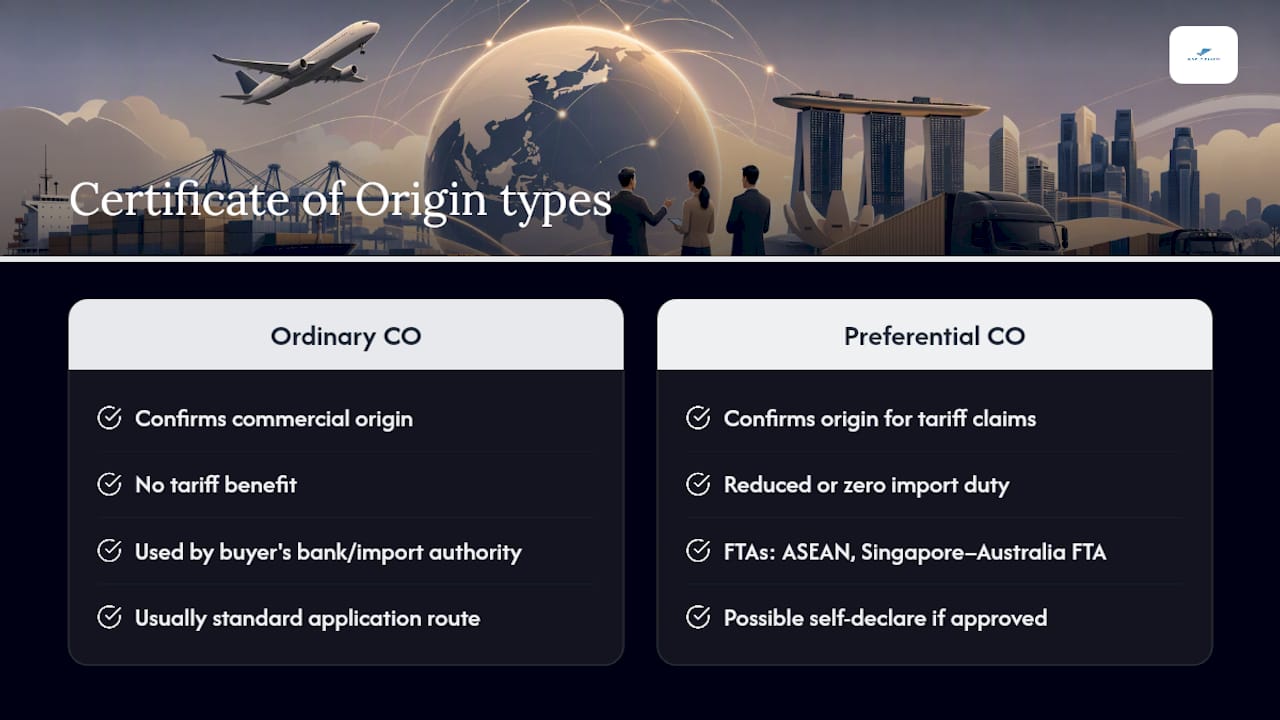
Some FTAs also allow approved or certified exporters to self-declare origin on commercial invoices instead of applying for a separate certificate each time. That option only applies once Singapore Customs has approved your business for that scheme, so most exporters still start with the standard application route.
Who Can Issue a CO in Singapore?
Singapore Customs handles certification directly for many Preferential COs, especially where an FTA names Customs as the sole authority. For Ordinary COs covering locally manufactured goods, SICC, SCCCI, and SMF are all authorized to issue on Customs' behalf, giving exporters more flexibility on turnaround and service channels.
Check the destination market's requirements before choosing an issuer. Some FTA schemes and importing countries only accept certification from Singapore Customs itself, not from an authorized organization. When in doubt, confirm against the Singapore Customs handbook or ask your intended issuer to verify eligibility for your specific product and market before you submit anything.
How Do You Apply for an Ordinary or Preferential CO?
The application sequence is the same whether you're pursuing an Ordinary CO (OCO) or Preferential CO (PCO), though document requirements differ slightly by FTA. Follow these steps in order.
- Register your manufacturing premises or product line. Submit details of your factory location and production process. This registration stays valid for two years, so mark the renewal date now.
- Prepare and submit your Manufacturing Cost Statement (MCS). This breaks down material costs, labor, and overhead to prove local value-add meets the origin threshold. Verification typically takes several working days once Customs receives a complete submission, and an approved MCS remains valid for a certain duration.
- Apply for the CO via TradeNet, linking your application to the relevant export permit. Certain destinations require a specific TradeNet message type, so confirm the correct format with your issuer or freight forwarder before submitting.
- Collect your certificate. Plan to collect within a reasonable timeframe following approval. If someone other than your own staff is picking it up, they'll need either a one-time Letter of Authorisation or a blanket appointment already on file with the issuer.
Keep a checklist handy for each application:
- Manufacturing premises registration (current, not expired)
- Approved MCS (within its one-year validity window)
- Draft commercial invoice matching the goods described
- Export permit number ready before lodging cargo
Pro Tip: MCS validity (one year) and manufacturing registration validity (two years) run on separate clocks. Set two distinct calendar reminders instead of one, since a lapsed MCS is one of the most common reasons a TradeNet CO application gets bounced back.
What Documents and Timelines Should You Plan Around?
Beyond the CO application itself, checkpoints require their own paperwork before your shipment clears. Have these ready:
- Approved Customs export permit, with the permit number on hand when lodging cargo
- Commercial invoice matching the CO's declared value and description
- Airway bill (AWB) or bill of lading (BL)
- Current manufacturer registration and approved MCS
Document requirements vary depending on whether cargo is containerized, conventional, or hand-carried, so confirm the exact set with your forwarder ahead of departure.
On timing: MCS verification runs roughly seven working days, manufacturer registration holds for two years, MCS itself for one year, and you should collect an approved CO within two weeks. If you're zero-rating the sale for GST purposes, IRAS requires evidence of export/charging-gst-(output-tax)/when-to-charge-0-gst-(zero-rate)/exporting-of-goods) alongside your invoice and shipping documents, so file these together rather than scattering them across systems.
What Compliance Risks Should Exporters Watch For?
Misdeclaring origin to secure preferential tariff treatment is a serious breach, not a paperwork technicality. Singapore Customs treats false origin declarations as grounds for penalties, and an overseas customs audit that finds inconsistent origin claims can unwind duty savings your buyer already claimed.
Recordkeeping is not optional. You must retain trade and export documents for at least five years, and an inability to produce them on request can invalidate a preferential origin claim after the fact.
Common traps that trip up exporters:
- An expired MCS or lapsed manufacturing registration used on a fresh application
- Origin wording on the CO that doesn't match the commercial invoice
- Incomplete or inconsistent product descriptions between the CO and the export permit
Pro Tip: Track expiry dates separately from any software or agent notification system you use. Mismatched MCS and registration windows are a leading cause of unexpected TradeNet rejections, and a simple spreadsheet with two columns catches it before Customs does.
How Do TradeNet and eCO Submissions Actually Work?
TradeNet is where your CO application gets formally linked to your export permit, and getting that link right the first time saves days. Before submitting, confirm your permit number, product HS code, and declared value all match across every document in the package.
- An electronic CO (eCO) may be available for certain FTAs and destinations, cutting out physical collection entirely.
- Where a hard copy is required, the collector needs either a Letter of Authorisation or standing appointment on file with the issuing body.
- If a freight forwarder is collecting on your behalf, confirm which document combination they'll present ahead of time rather than at the counter.
Working with a forwarder who understands your export documentation requirements in advance avoids last-minute scrambling when a shipment is already booked.
Why Preparing CO Paperwork Early Saves You at the Dock
Most CO delays we see trace back to timing, not paperwork errors. Exporters wait until a shipment is booked to start their MCS or registration renewal, and by then the seven-working-day verification window is competing with a courier pickup already scheduled.
Prepare your MCS and registration renewal before you need to ship, not after. When you book a courier pickup, attach your CO, export permit, invoice, and HS codes to the shipment record up front so nothing gets re-keyed or misplaced between systems. Centralizing that paperwork alongside your booking is one of the simplest ways to keep an FTA-driven shipment moving without a checkpoint holdup.
— Simply
Get Your Shipment Moving Once Your CO Is Ready
Once your Certificate of Origin is in hand, Simplyparcel handles what comes next: booking, label generation, and pickup coordination, so the paperwork you just secured doesn't sit idle while you chase a courier. If you're working against a tight FTA shipping window or juggling multiple courier options for a bulk export order, Simplyparcel lets you compare rates across priority, connect plus, and economy speeds and generate shipping documents automatically instead of re-entering the same invoice and HS code details across separate forwarder portals.
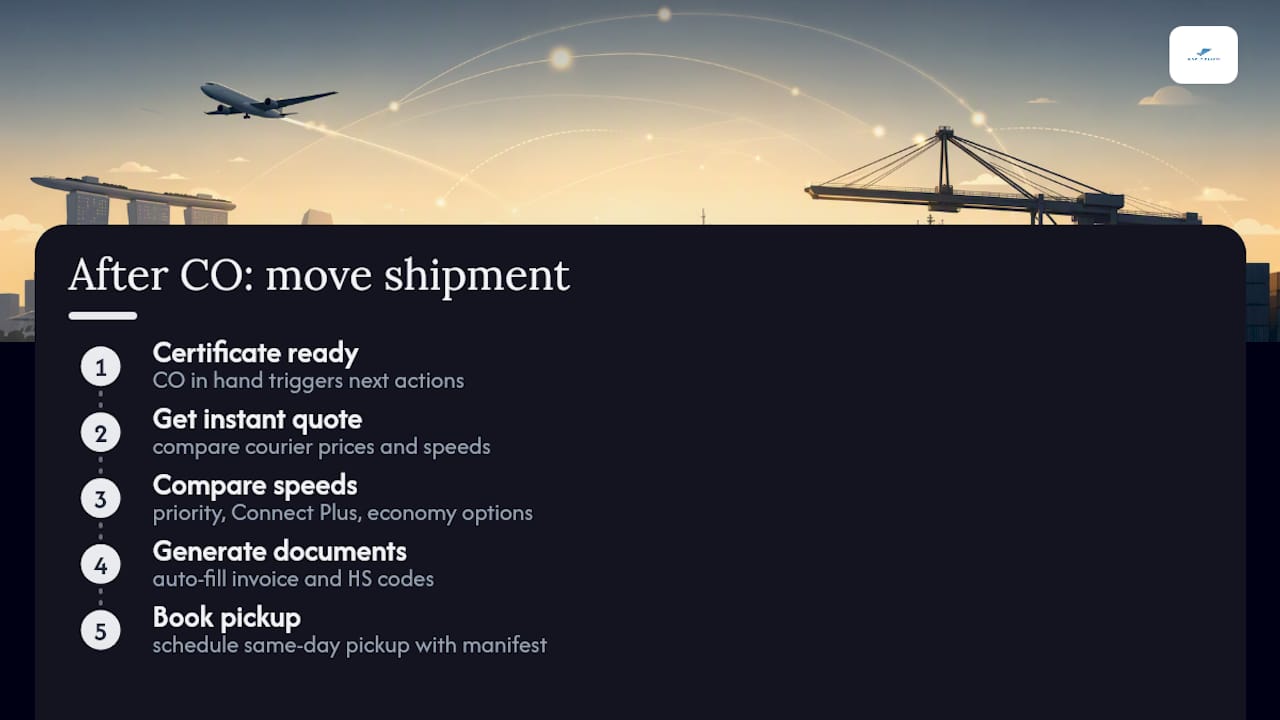
That matters most when you're consolidating several export orders under one manifest and need pickup scheduled the same day your CO clears. Get an instant shipping quote and book your pickup once your export documents are in order.