
A peak season surcharge (PSS) is a temporary carrier fee added on top of base freight rates during formally declared high demand windows. Ocean, air, and parcel carriers all use it, and it disappears once the window closes, which is what separates it from a permanent rate change.
The practical takeaway: never budget off the base rate alone.
- Treat PSS as its own line item, stacked with the base rate, fuel surcharges, and any general rate increase (GRI) in effect.
- Expect the timing and size to vary by mode, so check the lane before you commit volume.
- Build your all-in cost estimate before peak season starts, not after the invoice arrives.
Key Takeaways
Peak season surcharges are temporary, stackable fees that can push all-in freight costs 40% to 70% above base rate, and the shippers who model them in advance avoid budget surprises.
| Point | Details |
|---|---|
| PSS is temporary, not permanent | Unlike a GRI, it expires when the declared peak window closes. |
| Timing follows predictable patterns | Ocean announces May to July, air runs August to December, parcel spans October to mid-January. |
| Amounts vary widely by mode | Ocean can run $300 to $1,000 per TEU/FEU; parcel per-package fees vary by volume tier. |
| Model three scenarios, not one number | Build conservative, median, and worst-case estimates using base rate plus GRI plus PSS plus fuel. |
| Simplyparcel compares tiers instantly | Its platform lets you weigh economy, connect-plus, and priority options with transparent all-in quotes. |
Table of Contents
- What Is a Peak Season Surcharge, and How Does It Differ From a GRI?
- When Do Carriers Typically Announce Peak Season Surcharges?
- How Much Does a Peak Season Surcharge Typically Cost?
- How Do You Model PSS Into an All-In Shipping Budget?
- What Can You Do to Reduce Your Peak Season Surcharge Exposure?
- How Simply Parcel Helps You Estimate Peak Season Costs
- What Should Change in Your Peak Season Procurement Process?
- Get an All-In Quote Before Peak Season Hits
- Where to Verify Lane-Specific Peak Season Surcharge Notices
- Sources
What Is a Peak Season Surcharge, and How Does It Differ From a GRI?
A PSS is a temporary, declared surcharge carriers add during specific high-demand windows. A GRI is different: it resets the base rate itself, often staying in effect until the next adjustment. Equipment imbalance surcharges are different again, covering the cost of repositioning empty containers where exports and imports don't balance out. All three can show up on the same invoice, and PSS sits separately from the base rate in most carrier contracts, billed as its own line item.
Carriers apply PSS for a simple reason: capacity gets tight, handling costs climb, and seasonal demand outpaces available vessel or aircraft space. Rather than renegotiate every contract, they layer on a surcharge that expires when demand normalizes.
- PSS: temporary, tied to a declared window, expires on schedule.
- GRI: a base rate change, often longer lasting.
- Imbalance surcharge: covers repositioning costs, unrelated to seasonal demand.
Carriers typically scope PSS per lane, per equipment type (TEU or FEU for ocean), or per package for parcel shipments, so the same surcharge can hit two shippers very differently depending on what and where they ship.
When Do Carriers Typically Announce Peak Season Surcharges?
Timing follows a fairly predictable pattern across modes, though exact dates shift year to year and carrier to carrier.
- Ocean freight: Carriers usually announce trans-Pacific and Asia to Europe PSS between May and July, with the surcharge windows themselves running from July through October, sometimes stretching into November on the busiest lanes.
- Air freight: Asia-origin air cargo tends to see PSS windows from August through December, tracking the run-up to holiday retail demand and pre-Lunar New Year manufacturing pushes.
- Parcel shipping: Major parcel carriers apply peak surcharges from early October through mid-January, aligned almost exactly with holiday e-commerce volume.
If you ship on a Far East to Europe or Far East to Upper Gulf lane, watch for direct carrier notices. Hapag-Lloyd's own announcements show exactly how specific these notices get, right down to the per-container dollar figure and effective date.
How Much Does a Peak Season Surcharge Typically Cost?
Amounts vary widely by mode, lane, and how tight capacity gets that season, but you can work with useful ranges.
Typical PSS Ranges: Ocean carriers on busy trans-Pacific and Asia to Europe lanes commonly charge USD 300 to $1,000 per TEU or FEU during peak windows. Parcel carriers apply per-package surcharges that vary by volume tier, often landing between roughly $1.40 and $7 or more per package, plus additional fees for oversized or high-volume shippers. Air freight PSS is typically quoted per kilogram and moves with spot market tightness.
Here's a worked example for a single ocean FEU shipment during a tight peak window:
- Base ocean freight rate: $1,800
- Active GRI already layered in: $200
- Peak season surcharge: $700
- Fuel surcharge: $150
- All-in cost per FEU: $2,850
That's a 58% jump over the base rate alone, which matches broader guidance that all-in peak-week rates can run 40% to 70% above base on the most congested lanes. If you quoted a customer or built a budget off that $1,800 number, you'd be short by more than half.
How Do You Model PSS Into an All-In Shipping Budget?
Invoices label PSS differently depending on the carrier and mode, but the unit basis usually falls into one of three buckets: per TEU or FEU for ocean, per kilogram for air, and per package for parcel. Once you know which basis applies to your shipments, building a repeatable model gets straightforward.
- Pull your base rate for the lane and mode you're shipping.
- Add any active GRI currently in effect for that trade lane.
- Layer in the announced or estimated PSS for the relevant window.
- Add fuel and any equipment imbalance surcharges that apply.
- Run three scenarios: conservative (low end of PSS range), median (midpoint), and worst case (top of range plus an unannounced increase).
Building three scenarios rather than one number gives finance teams a defensible range instead of a guess, and it makes the inevitable "why did this shipment cost more than quoted" conversation much shorter. Our guide on how to calculate shipping costs walks through the full stepwise approach in more detail.
Pro Tip: Set a calendar reminder to check carrier rate announcement pages monthly starting in April for ocean lanes and August for parcel. Feeding those dates directly into your scenario model beats waiting for a surprise line item on next month's invoice.
What Can You Do to Reduce Your Peak Season Surcharge Exposure?
You have more leverage than most shippers assume, especially if you start planning months before the window opens.
On the operational side:
- Prebuild inventory ahead of the announced window so less volume needs to move during the highest-cost weeks.
- Book earlier than usual. Carriers often prioritize space allocation for shippers with confirmed early bookings.
- Consolidate smaller shipments into fewer, fuller containers or larger parcel batches to reduce per-unit surcharge exposure.
- Consider alternate ports or a different mode entirely if a specific lane's PSS is unusually steep that season, an approach our guide to avoiding shipping delays covers alongside timing tactics.
On the commercial side, negotiate PSS caps or waivers into your contract, commit to a guaranteed volume in exchange for surcharge protection, or push for a seasonal clause that locks your rate for the peak window in advance. Working through a courier aggregator or broker can also help, since they compare multiple carriers' peak pricing and can shift your volume toward whichever lane has the least capacity pressure that season. Seasonal driver and capacity shortages are a real driver behind these surcharges, as trucking industry hiring data shows.
Pro Tip: If your contract renews annually, negotiate the PSS cap clause during the renewal conversation, not mid-peak season when you have zero leverage and the carrier has all of it.
How Simply Parcel Helps You Estimate Peak Season Costs
Simplyparcel's platform is built to solve exactly the problem this article describes: not knowing your all-in cost until the invoice lands. Because it aggregates rates across multiple courier partners, you can compare options side by side before you book, rather than discovering the surcharge after the fact.
- Get an instant rate comparison across priority, connect-plus, and economy service tiers for the same shipment.
- See transparent quotes that reflect current carrier pricing, so you're not estimating blind during a volatile pricing window.
- Weigh a faster, pricier tier against a slower, cheaper one based on your actual deadline, not guesswork.
- Book online with automatic label and customs documentation generation, cutting handling delays that compound during peak congestion.
For shippers exporting from Singapore during a busy quarter, that kind of upfront visibility is the difference between a budget that holds and one that blows through its ceiling.
What Should Change in Your Peak Season Procurement Process?
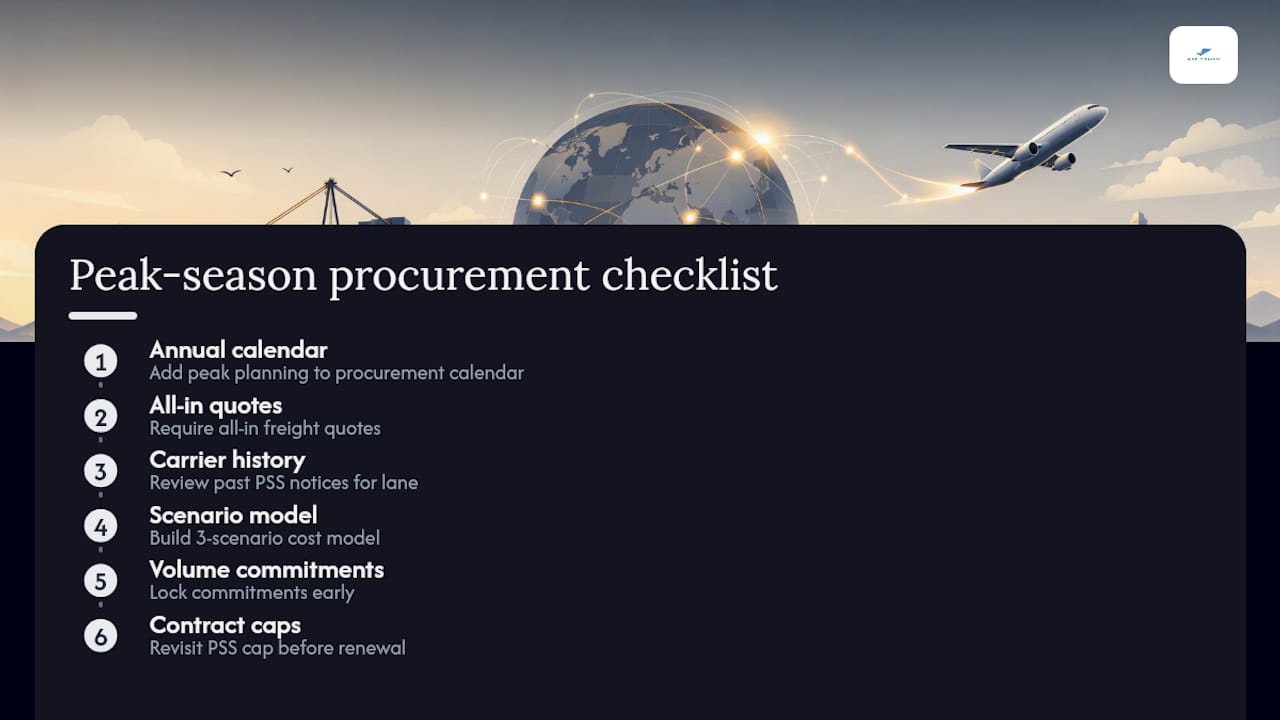
Most shippers treat peak season surcharges as an annual surprise. They shouldn't be. Build peak planning into your annual procurement calendar just as you would for a contract renewal, and insist every freight quote you receive is all-in, not base-rate-only.
A short checklist before each peak window: confirm your carrier's announcement history for that lane, build your three-scenario model, lock in any volume commitments early, and revisit your contract's PSS cap language before renewal season, not during it.
— Simply
Get an All-In Quote Before Peak Season Hits
There are other ways to estimate peak costs, spreadsheets built from scattered carrier PDFs, or calling three freight forwarders and waiting days for callbacks. Simplyparcel gets you there faster: one platform, multiple courier partners, instant side-by-side quotes that already reflect current pricing conditions rather than a stale base rate you'd have to adjust by hand.

That matters most exactly when it's hardest to plan, during the weeks when ocean, air, and parcel surcharges are all moving at once. Compare economy against priority and connect-plus tiers for your specific shipment, see the real cost difference upfront, and book the option that fits your deadline and your budget.
Head to the instant quote page to model your next shipment's all-in cost before the next surcharge notice lands in your inbox.
Where to Verify Lane-Specific Peak Season Surcharge Notices
For exact effective dates and amounts on your specific lane, go straight to the carrier. Maersk's Far East to Europe PSS notices and Hapag-Lloyd's announcement pages both publish lane-by-lane detail, and industry glossaries like Flexport's PSS definition are useful for quick internal reference when you need consistent wording across your team.
Sources
- Carrier Peak Season Surcharges 2026: FedEx, UPS and Ocean Line Rate Guide | GoFreight
- A Peak Season Surcharge (PSS) is coming into effect for shipments from the Far East to the Upper Gulf | Hapag-Lloyd