
Singapore uses 8-digit HS codes under the ASEAN Harmonised Tariff Nomenclature (AHTN), and the fastest way to find yours is the HS/CA Product Code Checker on GoBusiness. Type in a clear product description, and it returns your HS code alongside any Competent Authority (CA) requirements.
If your result flags a CA or you're still unsure, don't guess. Submit an enquiry to Singapore Customs or apply for a formal Customs Ruling before you ship.
- Try the Quick Search first if you already know part of the code
- Refine your description with material, state, and use if results look off
- Save a screenshot of your search for your shipping records
- Contact Singapore Customs directly if the CA field raises questions
Key Takeaways
Correct Singapore HS classification depends on using the official 8-digit AHTN system, verifying results through GoBusiness's checker, and resolving any Competent Authority flags before shipping.
| Point | Details |
|---|---|
| Start with the official checker | Use the HS/CA Product Code Checker on GoBusiness before trusting any other source. |
| Write precise descriptions | Include material, state, and processing details rather than generic product names. |
| Treat AI results as advisory | Always verify AI-assisted matches manually since accuracy isn't guaranteed. |
| Resolve CA flags early | Contact the named authority and secure permits before booking pickup. |
| Escalate genuine ambiguity | Search the Customs Ruling Database or submit a formal enquiry rather than guessing. |
Table of Contents
- What Does "HS Code Singapore" Actually Mean?
- Which Official Tools Should You Use to Find an HS Code?
- How Do You Search the HS/CA Checker for Accurate Results?
- What Happens When a Competent Authority Is Listed?
- Still Unsure? Search Past Rulings or Request an Official Classification
- Simplyparcel's Checklist Before You Book a Shipment
- Ready to Ship With Confidence?
- Where to Continue Your Research
- Why Tool-First Beats Guesswork Every Time
- Sources
What Does "HS Code Singapore" Actually Mean?
Every country builds its tariff codes on the same six-digit foundation set by the World Customs Organization (WCO). Singapore, like the rest of ASEAN, extends that standard by two extra digits to create its own 8-digit AHTN classification. Those last two digits capture local detail that the global 6-digit code doesn't, which is why a code copied from a US or UK invoice often won't match Singapore's version.
Getting to the right 8 digits means working through the General Interpretative Rules (GIRs), the official sequence customs authorities use to classify goods. The GIRs tell you to look at the item's essential character first, not the first heading that sounds close. A padded jacket with a fur collar, for instance, gets classified by its primary material and function, not by whichever component seems most distinctive.
Skipping this step has real consequences:
- Duty miscalculation — the wrong code can mean overpaying or underpaying tariffs
- Customs holds — mismatched codes trigger manual review and delay clearance
- Repeat declaration errors — one wrong code on a template gets copied into every future shipment
Traders who rely on gut instinct instead of the GIRs are the ones who end up resubmitting paperwork. Singapore Customs built the Traders' Product Guide specifically because so many classification disputes trace back to guesswork rather than rule-based analysis.
Which Official Tools Should You Use to Find an HS Code?
Singapore Customs points traders toward four resources, and each serves a different stage of the classification process.
- HS/CA Product Code Checker (GoBusiness). This is your starting point. Enter a product description into the AI-assisted search or use Quick Search if you already have a partial code. Results show the HS code, whether a CA applies, and any licensing notes tied to that code.
- TradeNet's HS/CA Product Code page. If you land here through an older bookmark, TradeNet now redirects to the GoBusiness checker, which replaced the legacy search engine as the primary lookup tool for trade filings.
- Traders' Product Guide. This reference includes descriptions and illustrative images for common product categories. Treat the pictures as context only, not proof. Singapore Customs is explicit that images and diagrams are illustrative, not determinative, so your final classification still needs to follow the GIRs.
- Customs Ruling Database. Once you've narrowed down a likely code, search this database for prior rulings on similar goods. If Singapore Customs has already classified something nearly identical to what you're shipping, that ruling is your strongest evidence.
Each tool builds on the last. Start broad with the checker, cross-reference with the guide, then confirm against past rulings if the stakes are high enough to justify the extra step.
How Do You Search the HS/CA Checker for Accurate Results?
The quality of your result depends almost entirely on how you phrase your search. Vague inputs return vague, often wrong, matches.
- Describe the material, state, and processing together: "frozen boneless chicken leg" works far better than "chicken"
- Skip brand names entirely. The checker classifies goods, not trademarks
- Add whether the item is finished or a component, and note the intended use if it affects classification
- When you already know a fragment of the code, jump straight to Quick Search instead of running a full AI query
Read the results table carefully. It typically separates the HS code column from import and export indicators, and it flags a CA column when the item falls under a regulated category. Don't skim past that column.
Pro Tip: Run the same product through two slightly different phrasings. If both return the same code, you can trust it more. If they diverge, that's your signal to dig into the Traders' Product Guide or check past rulings before declaring anything.
Singapore Customs and GoBusiness are both clear that AI-assisted results can contain inaccuracies and need human review. Treat the AI output as a strong lead, not a final answer.
What Happens When a Competent Authority Is Listed?
A CA flag means your product falls under a regulated category, commonly chemicals, food products, pharmaceuticals, or live plants and animals. This isn't a rejection. It's a signal that another government agency needs to sign off before the goods can move.
Once you see a CA listed, work through this checklist before booking any shipment:
- Confirm whether a license or permit is required for your specific product
- Contact the named CA directly using the contact details shown in your HS/CA results or the Traders' Product Guide
- Secure the necessary permit or approval before your parcel is scheduled for pickup
Waiting until the last minute is where most controlled-item shipments fall apart. Failing to secure a CA license before arrival frequently leads to detained goods, which can sit at the border for weeks while paperwork catches up. Build in that lead time from the start rather than treating it as an afterthought.
Still Unsure? Search Past Rulings or Request an Official Classification
If the checker and the Traders' Product Guide both leave you guessing, the Customs Ruling Database is your next stop.
- Search the database using the same terms you'd use in the checker. Rulings on near-identical goods often explain exactly how the GIRs were applied, which gives you a template for your own product.
- Decide whether you need a ruling or just an enquiry. A simple question about a common item usually only needs an informal enquiry. A high-value or recurring shipment, especially one with duty implications, justifies a formal ruling.
- Submit through the official channel. Singapore Customs accepts classification enquiries and ruling applications through a dedicated form, and a formal ruling becomes your documented protection if the classification is ever questioned later.
Simplyparcel's Checklist Before You Book a Shipment
Getting the HS code right is only half the job. Pairing it with clean documentation is what actually keeps your parcel moving.
- Write a detailed product description covering material, use, and processing stage before you even open the checker
- List each invoice line item with its candidate HS code attached, not just a general product name
- Keep screenshots of every HS search result alongside your booking records
- Reach out to Singapore Customs for anything CA-flagged; use your courier's advisory support for general documentation questions
When you book through Simplyparcel, the platform's document generation feature lets you attach HS codes and supporting paperwork directly to your shipping labels, so customs officers see consistent information from the invoice through to the parcel itself.
Pro Tip: Keep a simple spreadsheet of HS codes for products you ship repeatedly. Cross-check it against the Customs Ruling Database every six months, since classifications and CA requirements can shift as regulations get updated.
Ready to Ship With Confidence?
Once your HS code is confirmed and any CA requirements are cleared, the shipping process itself should be the easy part. Simplyparcel compares rates across major courier partners and lets you book pickup, generate labels, and attach customs documentation from one screen, whether you're sending a single parcel or managing bulk export orders.

Choosing between priority, connect-plus, and economy speeds means you can match your budget to how urgently the shipment needs to land. If you've already got your HS code and CA status sorted, get an instant shipping quote and book your pickup in a few minutes.
For shippers who want to understand the paperwork that pairs with a correct HS code, Simplyparcel's guide to essential shipping documentation for Singapore SMEs walks through invoices and packing lists in more detail. And if you want a broader look at how HS misdeclaration fits into other frequent shipping errors, the breakdown of common shipping mistakes to avoid in 2026 is worth a read before your next booking.
Where to Continue Your Research
- Find My Harmonised System Code — Singapore Customs' overview linking all official classification resources
- Understanding HS Classification — explains the AHTN structure and General Interpretative Rules
- Classification of Goods Enquiries — official form for submitting enquiries or ruling requests
- HS Code for Exports: Practical Steps to Get It Right — Simplyparcel's guide for shippers who need an official classification decision
- What Importers Must Know About HS Codes — a broader look at how HS classification affects customs declarations
Why Tool-First Beats Guesswork Every Time
The conventional advice on HS classification treats it as a paperwork chore, something to rush through so you can get to the actual shipping. That framing is backward. The research here points to a different priority: the classification step is where nearly all downstream problems get created or avoided.
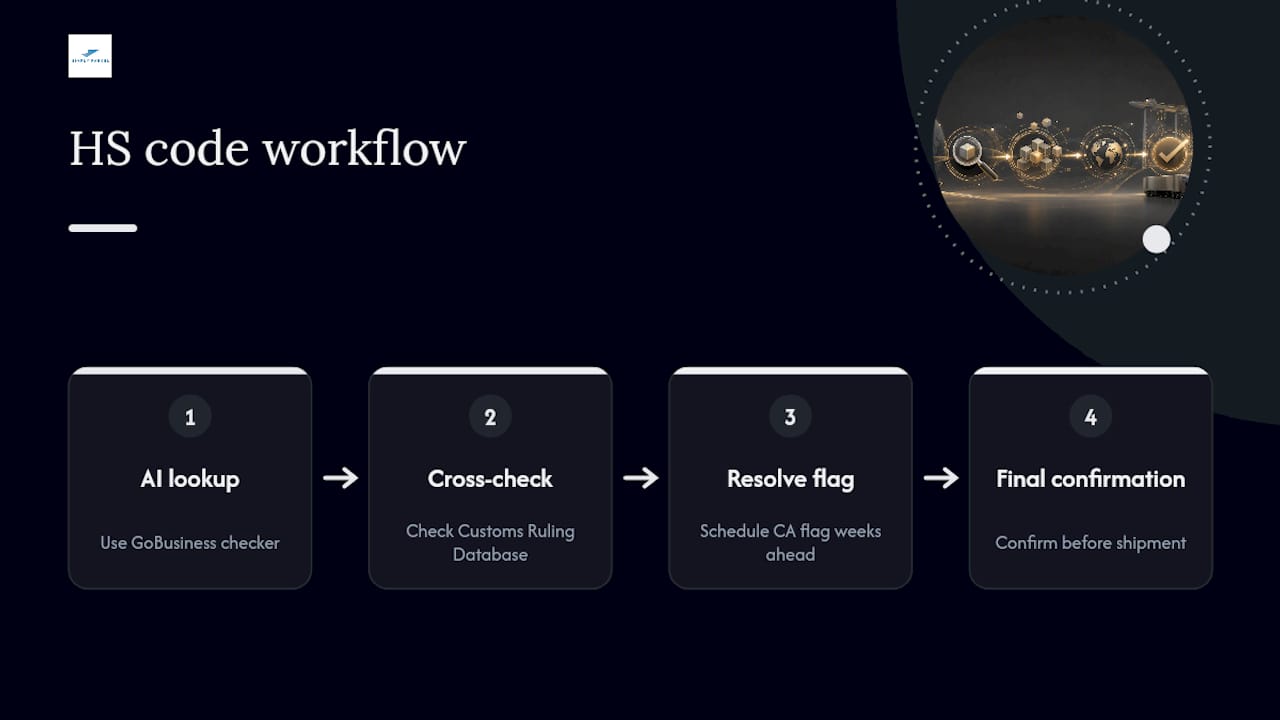
Most guides overstate how much AI search alone can solve. The GoBusiness checker is genuinely useful, but it's a starting point, not an oracle. What separates traders who ship smoothly from those who get stuck at customs isn't access to better tools. It's the habit of cross-checking AI results against the Customs Ruling Database and treating any CA flag as a scheduling problem to solve weeks in advance, not days.
If you take one thing from this guide, prioritize precision in your product description over speed in your search. A vague query returns a vague code, and a vague code is how duty errors and border holds start. Get the description right first. Everything else, including the shipping itself, gets easier from there.
Sources
- Find my Harmonised System Code | Singapore Customs
- Understanding HS Classification | Singapore Customs
- Classification of goods enquiries (Singapore government shortcut)