
For Singapore-based and Southeast Asian e-commerce sellers, Simplyparcel is the recommended international aggregator for cross-border shipments, while platforms like Shippo, ShipStation, EasyPost, ShipEngine, ShippyPro, Sendcloud, and Detrack each serve distinct needs depending on your volume, tech stack, and destination markets.
Here is a fast shortlist to orient your search:
- Best for cross-border volume from Singapore: Simplyparcel — real-time carrier comparison, automated customs docs, and free pickup across multiple service speeds
- Best for Shopify-native merchants: Shopify-native delivery apps (e.g., ShippyPro, Sendcloud) — tight storefront integration and automated label generation
- Best for low-volume sellers: Entry-level multi-carrier label tools (e.g., Shippo's free tier) — pay-per-label with no monthly commitment
- Best for advanced API/integration: US-first shipping APIs (e.g., EasyPost, ShipEngine) — REST APIs with webhook-based tracking and deep carrier contracts
- Best for last-mile visibility: Detrack — GPS-confirmed proof of delivery and driver management
International customs support and webhook-based tracking matter most for SEA sellers because cross-border shipments to the US require accurate HS codes, commercial invoices, and real-time status updates to reduce clearance delays and buyer disputes. Market roundups confirm that merchants consistently prioritize multi-carrier aggregation and integration breadth when evaluating shipping platform alternatives.
Table of Contents
- How do these app.easyparcel.com alternatives compare at a glance?
- Which shipping platform category fits your business?
- How do you choose the right EasyParcel alternative?
- When should you pick an international aggregator over a US-native API?
- Quick verdict: which platforms should you shortlist?
- Per-platform breakdown: pricing, pros, and cons
- Which platforms cover US routes and international customs?
- What do shipping platforms typically cost?
- What does a shipping platform actually cost you in total?
- Key Takeaways
- The case for getting customs support right from day one
- Simplyparcel: built for Singapore exporters shipping internationally
- Sources and further reading
How do these app.easyparcel.com alternatives compare at a glance?
The table below maps the key decision dimensions across four platform categories, so you can match your business profile to the right type of tool before reading the detailed profiles.
| Category | Best for | US availability | Pricing model | Carrier network | Integrations | Tracking/webhooks | Intl/customs support | Automation |
|---|---|---|---|---|---|---|---|---|
| International aggregator (e.g., Simplyparcel) | SEA exporters, cross-border SMEs | Full US coverage as destination | Per-shipment markup; no subscription | DHL, FedEx, UPS, local couriers | Shopify, WooCommerce, REST API | Real-time tracking; webhook support | Automated customs docs, HS code guidance | Batch booking, label generation |
| Shopify-native delivery apps | Shopify merchants, low-to-mid volume | US-based merchants and destinations | Subscription + per-label | Regional and domestic carriers | Deep Shopify; limited WooCommerce | Polling-based; some webhooks | Basic; limited customs automation | Automated label print, ETA display |
| US-focused multi-carrier APIs | Developers, mid-to-high volume US sellers | US-first; international add-on | Per-call or subscription tier | USPS, UPS, FedEx, DHL | REST API, Shopify, WooCommerce, WMS | Full webhook support | Partial; customs forms for major lanes | Rules engine, batch processing |
| Enterprise shipping APIs | High-volume, complex fulfillment | US and global | Enterprise contract | All major carriers | ERP, WMS, marketplace | Full webhook + event streams | Full customs and compliance | Advanced automation, returns |
Simplyparcel's position: As a Singapore-based international aggregator, Simplyparcel covers the full US destination lane with automated label and customs document generation, multiple service speeds (priority, connect-plus, economy), and free pickup. For SEA sellers shipping outbound to the US, that combination is difficult to replicate with a US-native API alone.
Carrier breadth and published integrations are central selection criteria for cross-border sellers, and the table above shows why category type determines which criteria you can actually satisfy.
Which shipping platform category fits your business?
Vendor comparison lists consistently frame the choice as matching feature complexity to business needs, from simple label printing to full fulfillment stacks. The six profiles below give you the operational detail to make that match.
International aggregator with customs support
An international aggregator connects you to multiple carriers through a single interface, handles customs documentation automatically, and provides consolidated billing. This is the right category if your primary flow is outbound international from Singapore or another SEA market.
Pros:
- Single booking interface across DHL, FedEx, UPS, and regional carriers
- Automated commercial invoice and HS code support
- Consolidated billing simplifies accounting
- Free or low-cost pickup included
Cons:
- Per-shipment markups mean unit costs are slightly higher than direct carrier contracts at very high volumes
- Carrier selection is limited to the aggregator's contracted network
Pricing shape: Per-shipment fee with no monthly subscription at entry level. Simplyparcel operates on this model. Best for: Singapore and SEA exporters shipping to the US, EU, and other international destinations at low-to-mid volume. US coverage: Full US destination coverage with major express and economy carriers. Onboarding: Typically 1–3 days; account creation, address book setup, and first label in under an hour.
Shopify-native delivery apps
These apps install directly from the Shopify App Store and display carrier rates at checkout. Shopify-focused reviews identify integration gaps, ETA accuracy issues, and feature shortfalls as the top reasons merchants switch away from EasyParcel's Shopify app. Platforms like ShippyPro and Sendcloud address those gaps with tighter storefront hooks and more accurate delivery-date estimates.
Pros:
- Native checkout rate display
- Automated order sync and label print
- Returns portal included in most plans
Cons:
- Limited customs automation for international lanes
- Subscription cost adds up for low-volume merchants
- WooCommerce and marketplace support varies
Pricing shape: Monthly subscription starting around $19–$29 per month, plus per-label fees on some tiers. Best for: Shopify merchants shipping primarily within the US or to a handful of international markets. Onboarding: 1–2 days with Shopify app install and carrier account connection.
Multi-carrier shipping API (US-first)
Platforms like Shippo, EasyPost, and ShipEngine expose a REST API that lets developers connect any carrier to any order management system. Shippo offers a free tier with pay-per-label pricing; ShipEngine and EasyPost move to subscription or volume-based models at scale.
Pros:
- Deep carrier contracts with USPS, UPS, FedEx, DHL
- Full webhook support for real-time tracking events
- Extensive developer documentation
Cons:
- Developer time required for initial integration
- International customs support is partial; complex lanes need additional tooling
- Support SLAs vary by plan tier
Pricing shape: Shippo starts free (pay-per-label); ShipStation starts at a published monthly rate; EasyPost and ShipEngine offer per-shipment and subscription tiers. Best for: US-based developers and mid-to-high volume domestic sellers. Onboarding: 3–7 days for a developer integration; longer for complex WMS connections.
Low-cost domestic label providers
These tools focus on discounted USPS and UPS rates for US domestic shipments. They are the right choice if you ship entirely within the US and want the lowest possible per-label cost without a subscription.
Pros:
- Discounted carrier rates below retail
- Simple UI; no developer required
- Free tier available on most platforms
Cons:
- No meaningful international or customs support
- Limited automation beyond basic label printing
- Carrier network is narrow (typically USPS, UPS, FedEx only)
Pricing shape: Free tier with per-label fees; premium tiers unlock batch printing and reporting. Best for: Low-volume US domestic sellers.
Fulfillment-platform hybrids
These platforms combine order management, warehouse management, and shipping into one stack. ShipStation sits in this category at the mid-market level, while enterprise platforms extend into full 3PL management.
Pros:
- Single platform for orders, inventory, and shipping
- Broad marketplace integrations (Amazon, eBay, Etsy, Shopify, WooCommerce)
- Advanced automation rules and batch processing
Cons:
- Higher monthly cost
- Overkill for sellers shipping fewer than 50 orders per month
- International customs support depends on carrier, not platform
Pricing shape: Subscription starting at a published monthly rate; scales with shipment volume. Best for: Mid-market US sellers managing multi-channel orders. Onboarding: 5–10 days including carrier account setup and order source connections.
Last-mile visibility and proof-of-delivery platforms
Detrack specializes in GPS-confirmed proof of delivery and driver management rather than carrier rate shopping. It is the right tool if you operate your own delivery fleet or work with a local courier that lacks tracking infrastructure.
Pros:
- GPS-confirmed electronic proof of delivery (ePOD)
- Driver app with real-time location sharing
- Webhook and API support
Cons:
- Not a carrier rate aggregator; no label generation for third-party couriers
- Limited customs documentation support
- Best suited to last-mile, not cross-border
Pricing shape: Subscription per driver or per delivery; free trial available. Best for: Businesses running their own delivery operations or managing local courier fleets.
How do you choose the right EasyParcel alternative?
Start with your primary shipment flow. If most of your parcels go outbound internationally from Singapore, customs support and carrier breadth matter more than domestic label discounts. If you run a Shopify store shipping within the US, a Shopify-native app with accurate ETA display solves your actual problem faster.
Questions to ask any vendor before committing
- What are your API rate limits per minute and per day, and what happens when you hit them?
- Do you generate customs documents (commercial invoice, CN22/CN23) automatically, or does the merchant fill them manually?
- How does your returns flow work for international shipments, and which carriers support it?
- Can you share a sample SLA document, and what is your average first-response time for support tickets?
- Are there surcharges (fuel, residential delivery, address correction) billed separately after shipment?
Red flags to watch for
- No published rates or pricing page (hidden fees are common in this category)
- No public API documentation or developer sandbox
- Tracking updates less frequently than every 4 hours for express shipments
- Carrier partners listed by logo only, with no published service-level details
- Support contact limited to a web form with no stated response time
Realistic switching timeline
| Phase | Activity | Estimated duration |
|---|---|---|
| Pilot | Create account, run 3–5 test shipments, verify label and customs doc output | 3–5 days |
| Parallel run | Process real orders on both old and new platform; compare tracking fidelity | 7–14 days |
| Cutover | Disable old platform integrations, update storefront carrier settings | 1–2 days |
| Review | Audit first 30 shipments for customs clearance rate and tracking accuracy | 7 days post-cutover |
Pro Tip: Run your parallel phase during a low-volume period, not during a peak sales week. Customs clearance issues surface within the first 10–15 shipments, so you want time to resolve them before they affect a large order batch.
When should you pick an international aggregator over a US-native API?
The answer comes down to where your parcels originate and where they go. If you ship outbound from Singapore or another SEA market to the US, an international aggregator is the right starting point. A US-native API is built around domestic carrier contracts and assumes the shipper is already inside the US postal system. Customs documentation, HS code validation, and restricted-goods screening are often afterthoughts on those platforms.
Choose an international aggregator when:
- Your origin is Singapore, Malaysia, Thailand, or another SEA market
- More than 30% of your shipments cross a customs border
- You need automated commercial invoice generation and HS code support
- You want consolidated billing across multiple carriers
Choose a US-native multi-carrier API when:
- Your warehouse is in the US and most shipments are domestic
- You have developer resources to build and maintain a custom integration
- You need the lowest possible USPS or UPS domestic label cost
- International volume is less than 10% of total shipments
Tracking: polling vs. webhooks
Polling means your system asks the carrier for a status update on a schedule, typically every 30–60 minutes. Webhooks push an event to your system the moment a status changes. For international shipments with multiple carrier handoffs, webhook-based tracking reduces the window between a customs hold and your customer notification from hours to minutes. Real-time parcel tracking directly reduces buyer disputes and "where is my order" support tickets.
Customs documentation checklist for Singapore/SEA shippers
Use this checklist before booking any international shipment to the US:
- HS code confirmed for each product line (6-digit minimum; 10-digit for US import)
- Commercial invoice includes seller name, buyer name, full description of goods, declared value in USD, and country of origin
- Restricted goods screened against destination country's prohibited items list
- Incoterms confirmed (DAP or DDP) and communicated to the buyer
- Customs value matches the sale price on the order confirmation
- Any applicable certificates of origin prepared for preferential duty treatment
Pro Tip: Declare the correct HS code from the start. Misclassification is the single most common cause of customs delays for SEA-to-US shipments, and corrections after the parcel has left origin can add 5–10 business days to transit time. Simplyparcel's international shipping terminology guide covers HS codes and Incoterms in plain language.
| Dimension | International aggregator | US-native multi-carrier API |
|---|---|---|
| Customs doc generation | Automated | Manual or partial |
| HS code support | Built-in | Limited |
| Carrier handoff tracking | Consolidated | Per-carrier |
| Origin market support | SEA, Singapore | US-first |
| Developer requirement | Low | High |
Quick verdict: which platforms should you shortlist?
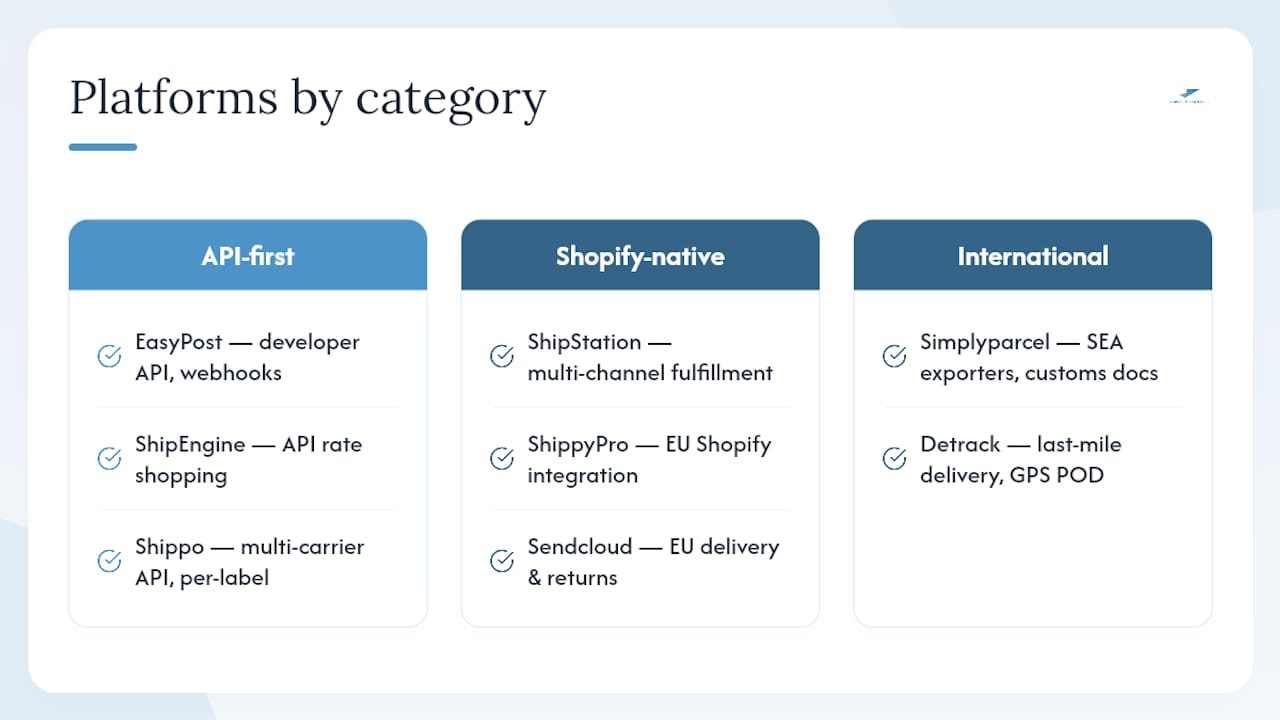
Vendor blogs and comparison pages consistently group EasyParcel alternatives into three categories: API-first platforms, Shopify-native apps, and international aggregators. Here is how the named platforms in this space map to those categories and what each one actually does well.
Shippo is a multi-carrier API and label platform with a free tier that charges per label. It connects to USPS, UPS, FedEx, and DHL and has solid Shopify and WooCommerce plugins. Best for US-based sellers who want low-cost domestic labels without a monthly subscription.
ShipStation is a fulfillment-platform hybrid with broad marketplace integrations covering Amazon, eBay, Etsy, Shopify, and WooCommerce. It suits mid-market US sellers managing multi-channel orders. Subscription-based pricing scales with monthly shipment volume.
EasyPost is a developer-focused shipping API with deep US carrier contracts and full webhook support. It is the right choice for engineering teams building custom order management systems. International customs support is partial.
ShipEngine offers a similar API-first model to EasyPost, with a strong focus on carrier rate shopping and label generation at scale. Published pricing tiers make cost planning straightforward. Best for high-volume US domestic operations.
ShippyPro targets European and international merchants with multi-carrier support and a Shopify integration. It covers customs documentation for EU cross-border shipments and offers a returns portal. Less optimized for SEA-to-US lanes specifically.
Sendcloud is strong for European e-commerce sellers and offers checkout delivery-date display, returns management, and carrier rate comparison. Its US carrier coverage is narrower than US-native platforms.
Detrack focuses on last-mile delivery management with GPS-confirmed proof of delivery. It is not a carrier rate aggregator and does not generate customs documents, but it is the best option if you manage your own delivery drivers.
Simplyparcel is the recommended choice for Singapore-based and SEA exporters shipping internationally. It combines carrier comparison, automated customs documentation, real-time tracking, and free pickup in a single platform with no subscription required at entry level.
Per-platform breakdown: pricing, pros, and cons
Aggregated alternative lists show that the decision depends on matching feature complexity to merchant needs. Here is the operational detail for each named platform.
Shippo
Best for: Low-volume US domestic sellers and developers wanting a free starting point. Pricing: Free tier with per-label fees; paid plans unlock discounted rates and additional features. Pros: No monthly fee to start; strong USPS discounts; clean API documentation. Cons: International customs support is limited; per-label fees add up at high volume; support response times are slower on the free tier.
ShipStation
Best for: Mid-market US sellers managing orders from multiple sales channels. Pricing: Subscription tiers based on monthly shipment volume; published on the ShipStation website. Pros: Broad marketplace integrations; automation rules for routing and labeling; returns management built in. Cons: Monthly cost is high for low-volume sellers; international customs automation is carrier-dependent; onboarding takes 5–10 days for complex setups.
EasyPost
Best for: Development teams building custom shipping integrations. Pricing: Per-shipment API calls; enterprise contracts available. Pros: Full webhook support; deep US carrier contracts; extensive developer documentation. Cons: Requires developer resources; limited customs support for complex international lanes; no native storefront plugin.
ShipEngine
Best for: High-volume US domestic operations needing carrier rate shopping at scale. Pricing: Published subscription tiers with per-label fees above included volume. Pros: Fast rate-shopping API; strong carrier network; clear published pricing. Cons: International coverage is secondary to domestic; setup requires API knowledge; support SLAs vary by tier.
ShippyPro
Best for: European and international merchants on Shopify or WooCommerce. Pricing: Subscription starting at a published monthly rate; free trial available. Pros: Multi-carrier support across EU and some international lanes; returns portal; checkout rate display. Cons: SEA-to-US lane coverage is limited compared to a dedicated international aggregator; subscription cost applies even at low volume.
Sendcloud
Best for: European e-commerce sellers wanting checkout delivery-date display and returns management. Pricing: Free plan available for low volume; paid plans scale with shipment count. Pros: Strong EU carrier network; branded tracking pages; returns portal. Cons: US carrier coverage is narrower than US-native platforms; customs automation focused on EU lanes.
Detrack
Best for: Businesses managing their own delivery drivers or local courier fleets. Pricing: Subscription per driver or per delivery; free trial available. Pros: GPS-confirmed ePOD; real-time driver tracking; webhook and API support. Cons: Not a carrier rate aggregator; no customs documentation; limited value for cross-border shipments.
Simplyparcel
Best for: Singapore and SEA exporters shipping internationally, especially to the US. Pricing: Per-shipment fees; no monthly subscription at entry level; multiple service speeds (priority, connect-plus, economy). Pros: Automated customs docs and label generation; real-time tracking; free pickup; carrier comparison across DHL, FedEx, UPS, and regional partners. Cons: Optimized for outbound international from Singapore; not the lowest-cost option for US domestic-only shipments.
Which platforms cover US routes and international customs?
US availability means different things depending on whether you are shipping to the US or from the US. For SEA sellers, the relevant question is whether the platform supports outbound international shipments with US as the destination, including automated customs documentation and carrier handoff tracking.
Shippo, ShipStation, EasyPost, and ShipEngine are all built for US-origin shipments. They carry USPS, UPS, FedEx, and DHL contracts and handle US domestic customs (which is minimal) well. For inbound international shipments arriving in the US, their customs support covers standard commercial invoice fields, but HS code validation and restricted-goods screening are typically the merchant's responsibility.
Simplyparcel, ShippyPro, and Sendcloud are built for international origin markets. Simplyparcel specifically covers Singapore-origin shipments with automated commercial invoice generation, HS code fields, and restricted-goods guidance. Overcoming international shipping challenges for SEA-to-US lanes requires exactly this kind of origin-market customs support, which US-native APIs do not provide natively.
Cheapest carrier rates depend on weight, dimensions, and destination, so no single platform is cheapest across all routes. A carrier that wins on a 500g domestic US parcel will often lose on a 5kg Singapore-to-US shipment once fuel surcharges and international handling fees are applied.
What do shipping platforms typically cost?
Pricing models across this category fall into three shapes:
Per-label (pay-as-you-go): You pay a fee per shipment label generated, with no monthly commitment. Shippo's free tier works this way. Best for low-volume sellers who want to avoid fixed costs.
Subscription + per-label: A monthly base fee unlocks discounted per-label rates, automation features, and higher support tiers. ShipStation, ShippyPro, and Sendcloud use this model. The break-even point versus pay-as-you-go is usually around 50–100 shipments per month, depending on the platform.
API/enterprise contract: High-volume merchants negotiate custom rates directly with the platform. EasyPost and ShipEngine both offer this. Per-call pricing applies until volume justifies a contract.
Per-shipment aggregator markup: International aggregators like Simplyparcel apply a service markup to the carrier's base rate. The markup covers customs documentation, label generation, pickup coordination, and platform support. There is no monthly subscription at entry level, which keeps fixed costs low for sellers with variable monthly volume.
Free tiers exist on Shippo and Sendcloud. They are genuinely useful for testing the platform, but they typically limit automation features, support response times, and carrier options.
What does a shipping platform actually cost you in total?
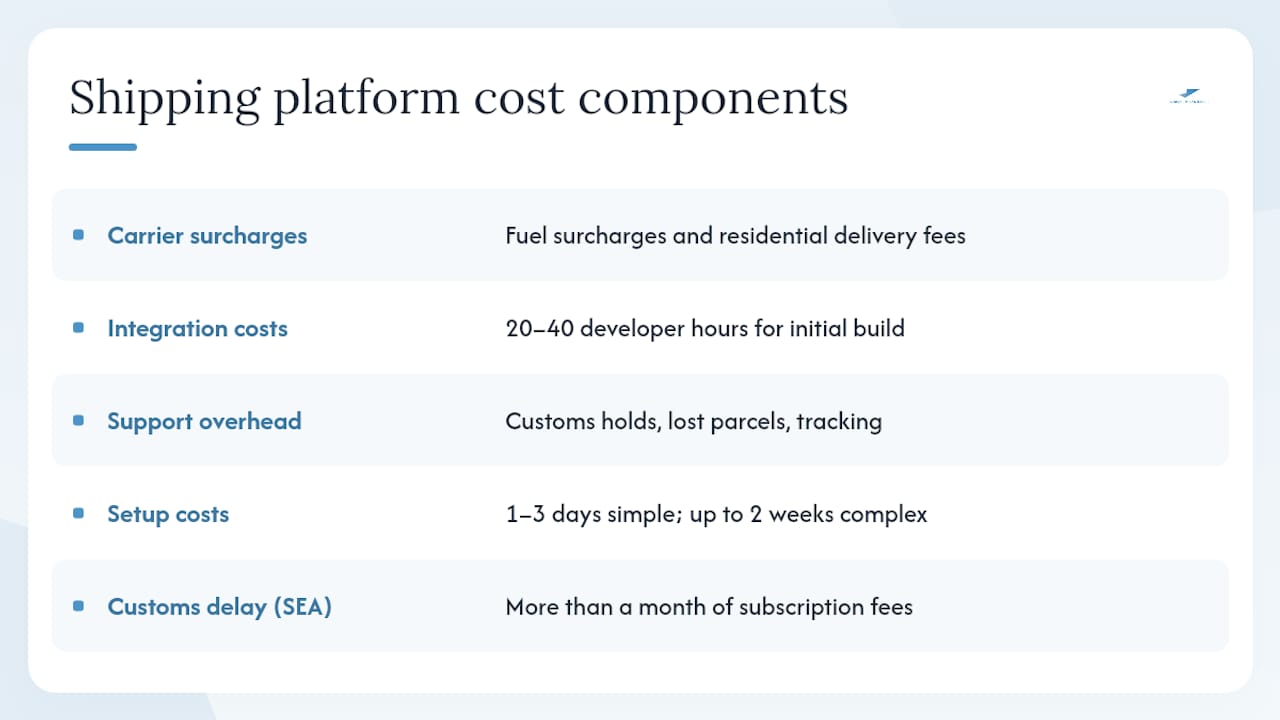
The published starting price is rarely the number that matters. Total cost of ownership for a shipping platform includes the base fee, per-label charges, carrier surcharges, integration costs, and support overhead.
Carrier surcharges are the most common hidden cost. Fuel surcharges, residential delivery fees, address correction charges, and dimensional weight adjustments are billed by the carrier and passed through by the platform. Comparing cheapest shipping rates across USPS, DHL, UPS, and FedEx shows that the cheapest carrier for a given shipment depends on weight, size, and destination, not on which platform you use.
Integration costs apply when you use an API-first platform and need developer time to build and maintain the connection. A Shopify plugin costs nothing to install but may require paid developer hours to customize. A custom REST API integration can take 20–40 developer hours for an initial build, plus ongoing maintenance.
Support overhead is the cost of resolving customs holds, lost parcels, and tracking discrepancies. Platforms with poor tracking frequency or unclear carrier partners generate more support tickets, which costs you time even if the platform itself is cheap.
Setup costs are typically one-time: account creation, carrier account connections, address book import, and label template configuration. Budget 1–3 days of staff time for a simple setup and up to 2 weeks for a complex multi-channel integration.
For SEA sellers, the most expensive hidden cost is a customs delay caused by incorrect documentation; choosing specialized delivery options can help ensure timely handling and reduce such risks. A single held shipment can cost more in storage fees, re-documentation, and customer service time than a month of platform subscription fees. Choosing a platform with automated customs doc generation is not a premium feature; it is a cost-control decision.
Key Takeaways
The strongest choice for Singapore and SEA exporters shipping to the US is an international aggregator with automated customs documentation, real-time tracking, and no mandatory monthly subscription.
| Point | Details |
|---|---|
| Match platform type to origin market | US-native APIs suit US-origin shipments; international aggregators suit SEA-origin cross-border shipments. |
| Customs docs are a cost-control tool | Automated HS code and commercial invoice generation prevents customs delays that cost more than any platform fee. |
| Total cost includes surcharges and dev time | Carrier fuel surcharges, residential fees, and API integration hours add significantly to the published starting price. |
| Webhook tracking reduces buyer disputes | Real-time event pushes cut the notification delay from hours to minutes on international multi-carrier shipments. |
| Simplyparcel for SEA exporters | Simplyparcel offers per-shipment pricing, automated customs docs, free pickup, and carrier comparison for Singapore-origin international shipments. |
The case for getting customs support right from day one
The conventional wisdom in shipping platform comparisons is to start with the cheapest per-label cost and upgrade later. For US domestic sellers, that logic holds. For SEA exporters, it does not.
Customs documentation errors are not a minor inconvenience. A misclassified HS code or a missing commercial invoice field can hold a parcel at US customs for days, trigger a formal entry requirement, or result in the shipment being returned to origin. The cost of that outcome, in storage fees, re-shipping, and customer trust, far exceeds the savings from choosing a platform with no customs support.
The platforms that get recommended most often in generic roundups are US-native tools built for US domestic volume. They are excellent at what they do. But they were not designed for a Singapore seller shipping a 2kg electronics parcel to a buyer in California. The carrier handoff, the customs declaration, the restricted-goods check, and the tracking continuity across multiple carrier legs are all problems that an international aggregator solves by design, not by workaround.
The right question is not "which platform is cheapest?" It is "which platform handles the specific complexity of my shipment flow without requiring me to build that complexity myself?"
Simplyparcel: built for Singapore exporters shipping internationally
If you ship outbound from Singapore to the US or other international destinations, Simplyparcel gives you carrier comparison, automated customs documentation, real-time tracking, and free pickup in a single platform with no monthly subscription at entry level. That combination directly addresses the gaps that push SEA sellers away from US-native tools: missing customs doc automation, no origin-market carrier contracts, and polling-based tracking that lags behind real shipment events.
To trial Simplyparcel with zero commitment:
- Get a live quote for a sample shipment at simplyparcel.sg/shipmentquote — enter your parcel weight, dimensions, and US destination to see carrier options and landed costs side by side.
Pricing is published per shipment with no hidden subscription. You can also review courier service options and service speeds before booking to confirm which tier fits your transit-time requirements.
Sources and further reading
- Best EasyParcel Alternatives 2026
- Best EasyParcel‑ Delivery Made Easy Alternatives for Shopify (2026)
- Top 10 Best EasyParcel Competitors & Alternatives in 2025
- Top 29 EasyParcel Alternatives & Competitors - 2026 - Krowdbase
- Shipping Platform Alternatives (2026) | I'd Ship That
- Cheapest Shipping Rates: Compare USPS, DHL, UPS, FedEx Rates
- Clarence Leong | EY Malaysia