
Dropshipping is often sold as the ultimate hands-off business: no warehouse, no inventory, no stress. But if you are wondering what is drop shipping in Singapore and whether it is as simple as it sounds, the honest answer is no. Dropshipping is a retail fulfillment model where you sell products without holding stock, and a third-party supplier ships directly to your customer. You still manage marketing, customer service, supplier relationships, tax compliance, and delivery expectations. That is a real business, not a passive income stream. This guide walks you through exactly how it works, what it costs, and how to run it properly in Singapore.
Table of Contents
- How dropshipping works in Singapore
- Navigating GST and tax rules for dropshipping in Singapore
- Profit margins and cost considerations in dropshipping
- Managing supplier relationships and delivery expectations
- Setting up your dropshipping store and legal compliance
- Why dropshipping success in Singapore demands active supply chain management
- Explore Simply Parcel for your dropshipping logistics needs
- Frequently asked questions
Key Takeaways
| Point | Details |
|---|---|
| Dropshipping basics | Dropshipping lets you sell products without holding inventory by forwarding orders to suppliers who ship directly. |
| GST compliance | Singapore's GST rules apply to dropshipping sales and require proper registration and documentation. |
| Profit trade-offs | Dropshipping offers low upfront costs but generally yields lower profit margins than stocking inventory. |
| Supply chain management | Active management of supplier reliability and shipping expectations is critical for success. |
| Partner with logistics experts | Working with trusted courier services improves delivery speed and customer satisfaction. |
How dropshipping works in Singapore
The basic dropshipping workflow is straightforward. A customer places an order on your online store and pays you at your retail price. You then forward that order to your supplier, who holds the stock and handles packaging. The supplier ships directly to your customer. You keep the difference between what the customer paid and what the supplier charged you.
Here is the step-by-step flow:
- Customer places an order on your store and pays the full retail price.
- You receive payment and forward the order details to your supplier.
- Your supplier processes the order, packs the item, and ships it directly to your customer.
- You pay the supplier the wholesale price and pocket the margin.
- You handle all customer communication including tracking updates, queries, and complaints.
The standard dropshipping workflow means your supplier controls the physical product at every stage. This is what makes managing supplier reliability so critical.
A few things specific to Singapore are worth noting:
- Supplier location matters. Suppliers based in China, the US, or elsewhere mean longer transit times, which affects how you set delivery expectations.
- Cross-border fulfillment is common. Most Singapore dropshippers source from overseas suppliers, so understanding international shipping options is essential from day one.
- Your customer only sees your brand. You are the seller of record. If something goes wrong, the customer contacts you, not the supplier.
Understanding this flow is the foundation. Everything else, from pricing to compliance, builds on knowing exactly where your role begins and ends.

Navigating GST and tax rules for dropshipping in Singapore
This is where many new dropshippers in Singapore get tripped up. GST (Goods and Services Tax) applies to your online business the same way it applies to any retail store. The channel you sell through does not change your obligations.
Key points to understand:
- GST rules for e-commerce in Singapore apply equally whether you sell online or offline. Your dropshipping setup does not create any special exemption.
- You must register for GST if your taxable turnover exceeds S$1 million in a 12-month period. Once registered, you charge GST on local supplies.
- Imported low-value goods (valued at S$400 or below) from GST-registered overseas suppliers are subject to GST at point of purchase, not at the point of importation. This is a detail many dropshippers miss.
- If your overseas supplier is not GST-registered and the shipment value is S$400 or below, GST treatment may differ. You need to verify this with your supplier and check IRAS guidance directly.
- Proper documentation is not optional. Keep records of invoices, supplier agreements, and transaction logs to support any GST filings or audits.
Pro Tip: Do not assume low shipment values mean you have no GST obligations. The rules around imported low-value goods changed in 2023, and IRAS actively monitors e-commerce compliance. Getting international shipping documentation right from the start protects you from compliance issues later.
Working with a tax advisor who understands e-commerce is a worthwhile investment, especially when you are scaling past the GST registration threshold.
Profit margins and cost considerations in dropshipping
One of the biggest misconceptions about dropshipping is that low startup costs equal high profitability. The reality is more nuanced. Here is a direct comparison between traditional retail and dropshipping to help you understand the trade-offs:
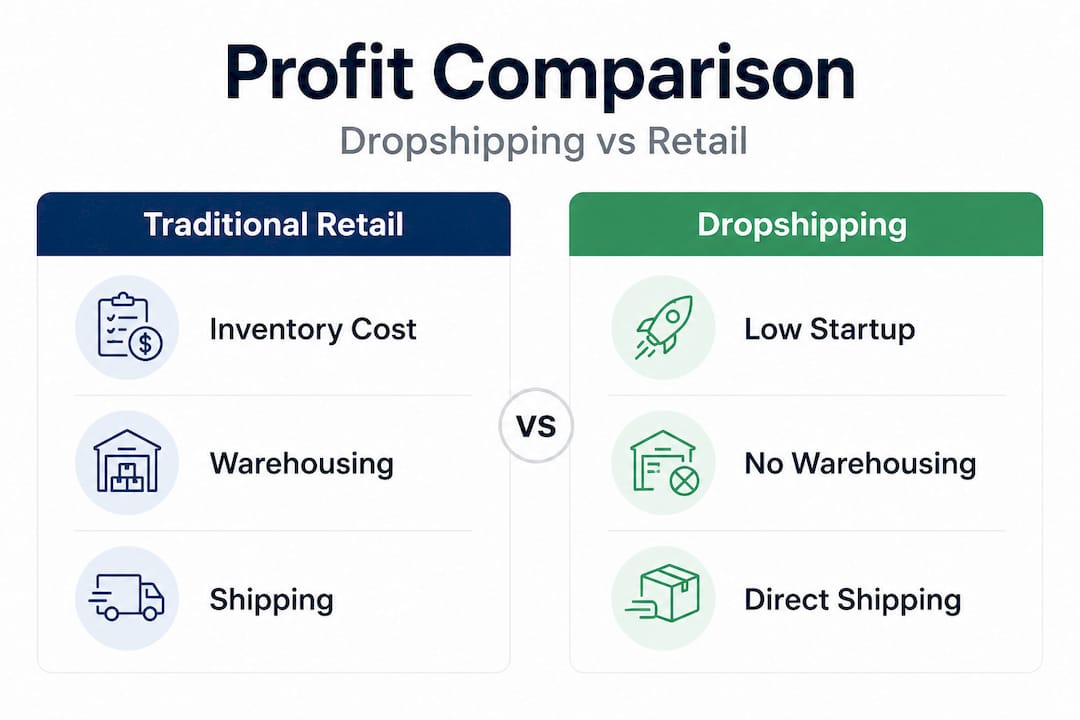
| Factor | Traditional retail | Dropshipping |
|---|---|---|
| Upfront inventory cost | High | Low to none |
| Warehousing required | Yes | No |
| Profit margin per unit | Higher | Lower |
| Control over fulfillment | Full | Limited |
| Risk of unsold stock | High | Low |
| Scalability | Slower | Faster |
Dropshipping typically yields lower profit margins because supplier wholesale prices already include storage and fulfillment costs. You are paying for convenience.
Here is where costs add up for Singapore dropshippers:
- Platform fees. Shopify, WooCommerce, or other platforms charge monthly subscriptions plus transaction fees.
- Marketing spend. You need traffic to generate sales. Paid ads on Meta or Google are common, and costs can erode margins quickly.
- Customer service time. Handling complaints, tracking queries, and returns takes real hours.
- Shipping fees. Even when the supplier handles fulfillment, you may absorb shipping costs or need to factor them into your pricing.
- Returns and refunds. These come out of your pocket first, even if you later recover from the supplier.
Pro Tip: Before committing to any product category, calculate your break-even margin after platform fees, ad spend, and expected return rates. Many dropshippers discover their margins are too thin only after launching. Use shipping cost-saving strategies to keep logistics expenses manageable as your order volume grows.
Managing supplier relationships and delivery expectations
Your suppliers are the backbone of your dropshipping business in Singapore. You may never touch the product, but your supplier controls fulfillment timing, and that directly affects your store's reputation.
Supplier delays and stockouts are among the most common causes of poor reviews and chargebacks for new dropshippers. Preventing them requires deliberate supplier vetting before you list a single product.
Here is how to evaluate a supplier before partnering:
- Order a test product. Measure the actual shipping time from order to delivery. Do not rely on the supplier's advertised timelines.
- Review their return and refund policy. Know the exact process before a customer asks you to handle one.
- Check their inventory update frequency. Suppliers who do not sync stock data in real time can cause you to sell items that are out of stock.
- Ask about backup stock locations. Some suppliers have warehouses in multiple countries, which can significantly cut shipping time.
- Test their customer communication. If they are slow to respond to you during vetting, they will be slow when problems arise.
Additional practices that protect your store:
- Set delivery expectations conservatively. Promising 5-day delivery when your supplier ships from overseas in 10 to 14 days is a fast way to lose customer trust.
- Build in buffer time. Customs clearance, public holidays, and courier delays are all real variables in cross-border shipping.
- Use multiple suppliers. Relying on one supplier for a core product is a single point of failure. Having a backup reduces stockout risk significantly.
- Communicate proactively with customers. If you know there is a delay, inform the customer before they contact you.
Understanding how to overcome international shipping challenges is a practical skill every dropshipper in Singapore needs, not an optional extra.
Setting up your dropshipping store and legal compliance
Once you understand the financial and operational realities, setting up your store is the practical next step. Here is a clear sequence to follow:
- Choose your e-commerce platform. Platforms like Shopify support dropshipping store setup with supplier integrations and order automation tools built in.
- Register your business. In Singapore, register with ACRA (Accounting and Corporate Regulatory Authority) as a sole proprietor or private limited company.
- Select your product niche and suppliers. Research demand, check supplier reliability, and confirm pricing leaves you a workable margin.
- Integrate supplier automation. Use apps that automatically forward orders to your supplier when a customer checks out. This removes manual errors.
- Set up payment gateways. Stripe, PayPal, and local options like PayNow are all commonly used by Singapore-based stores.
- Plan your shipping options. Decide early whether you will offer fast delivery options or economy shipping, and price accordingly.
Key compliance considerations to keep in mind:
- You are the seller of record. Product descriptions, pricing claims, and warranties are your legal responsibility, even if you never touched the product.
- Consumer protection laws apply. The Consumer Protection (Fair Trading) Act in Singapore gives buyers the right to fair dealings. Misleading product listings can expose you to legal risk.
- Check import restrictions. Some categories such as health supplements, electronics, and food products require additional permits before you can sell them in Singapore.
- Keep financial records. Even before you hit the GST threshold, organized bookkeeping makes tax filing and future audits far simpler.
Why dropshipping success in Singapore demands active supply chain management
Here is the perspective that most guides skip: dropshipping is not a business model that rewards passivity. It rewards people who treat it like an integrated supply chain role.
Many new dropshippers get hurt by promising fast delivery without actually confirming warehouse locations, dispatch windows, or courier transit times. They copy supplier descriptions without verifying accuracy. They assume GST is someone else's problem because they do not hold the stock. These are expensive assumptions.
The truth is that the best dropshippers we observe in the Singapore market operate more like supply chain managers than passive store owners. They know exactly where their suppliers' warehouses are located. They track average dispatch times across different order volumes. They build direct relationships with logistics providers so they can resolve shipping exceptions quickly. They check shipping challenge scenarios proactively, not after a customer complaint has already landed.
GST compliance is another area where diligence matters more than most realize. The rules around low-value imported goods are relatively new and not widely understood. Assuming a low order value exempts you from all obligations is a mistake. Working through each supply scenario with a tax professional is not overcautious, it is good business practice.
The entrepreneurs who build sustainable dropshipping businesses in Singapore are the ones who invest in relationships: with reliable suppliers, with logistics partners, and with customers through honest communication. The model removes inventory risk. It does not remove the need for operational discipline.
Explore Simply Parcel for your dropshipping logistics needs
Running a dropshipping business in Singapore means your logistics partner matters as much as your supplier. Simply Parcel is a Singapore-based shipping platform built for exactly this kind of e-commerce operation. You can compare courier options, book pickups, and manage cross-border shipments from one place, without needing to call multiple couriers or negotiate rates individually. Get an instant shipping quote for your parcels to understand your fulfillment costs before you finalize your pricing strategy. Whether you need priority delivery or a cost-effective economy option, Simply Parcel gives you clear transit timelines and competitive rates so you can make promises to your customers that you can actually keep. Start with an international shipping quote and see how it fits into your dropshipping cost model.
Frequently asked questions
Is dropshipping legal in Singapore?
Yes, dropshipping is legal in Singapore, but you must comply with local business registration rules, consumer protection laws, and GST obligations relevant to your revenue level.
Do I need to register for GST if I do dropshipping?
If your annual taxable turnover exceeds S$1 million, you must register for GST. Singapore GST rules apply equally to online and offline sales, so your dropshipping channel does not create any exemption.
How do I manage returns in dropshipping?
You must coordinate returns with your supplier's specific policy, which you should review before any partnership begins. Managing supplier return terms proactively and communicating them clearly to customers prevents most disputes before they escalate.
What are common pitfalls new dropshippers in Singapore face?
The most damaging pitfalls are underestimating GST complexity, promising delivery timelines that suppliers cannot meet, and depending on a single supplier with no backup plan for stockouts.
Can I use multiple suppliers for my dropshipping business?
Yes, and it is strongly recommended. Using multiple suppliers reduces your exposure to stockouts and shipping delays, which directly protects your store's reputation and customer satisfaction scores.