
Choose a money-back express service when delivery certainty matters most. For most urgent personal shipments within the U.S., Priority Mail Express delivers within a short window with a money-back guarantee for eligible late deliveries. For international priority shipments, a rate-shopping aggregator like Simplyparcel simplifies lane checks, customs paperwork, and carrier selection in one booking.
Quick picks by scenario:
- Urgent replacement item (same-day order, next-day need): Premium express with a money-back guarantee. The cost of a missed delivery exceeds the shipping premium.
- Last-minute gift with a firm deadline: Priority express with signature confirmation. Proof of delivery protects you if the parcel goes missing.
- Time-sensitive documents: Flat-rate express envelope. Dense, small, and predictable in cost.
- International priority shipment: Use an aggregator to rate-shop carriers, generate customs forms, and book pickup in one step.
The thread connecting all four: apply the "cost of failure" test. If a late or missing parcel costs you more than the express upgrade, pay for the guarantee.
Table of Contents
- What priority shipping actually means for you
- When paying for priority shipping is worth it
- How priority services differ and what actually matters
- How to choose the right option in five steps
- When to use an aggregator for international priority shipments
- Typical timelines and relative costs to expect
- Pre-booking checklist: confirm these before you pay
- Key Takeaways
- Why aggregators are the smarter call for most international priority bookings
- Simplyparcel makes international priority shipping straightforward
- Useful sources
What priority shipping actually means for you
"Priority" and "express" are not just marketing words for faster transit. They describe a bundle of service commitments that standard ground shipping does not include.
A priority or express service typically covers:
- Transit window: 1–3 days for Priority Mail Express; 2–3 days for Priority Mail.
- Money-back or on-time guarantee: Premium express products often refund postage on eligible late deliveries. Standard priority options, like USPS Priority Mail, generally do not carry that guarantee.
- Tracking granularity: Scan-by-scan updates from acceptance through delivery, not just a final confirmation.
- Included basic insurance: USPS Priority Mail includes up to $100 in coverage; express products often match or exceed that.
- Pickup and dropoff options: Scheduled pickups, retail counter dropoff, and in some cases Sunday or holiday delivery for an added fee.
The practical gap between priority and ground shows up most clearly on weekends. Standard ground often pauses; priority express can move through Saturday and, on eligible lanes, Sunday. That distinction matters when your deadline is Monday morning.
Cost of failure, defined simply: What does it cost you if this parcel arrives late or not at all? If that number exceeds the express upgrade fee, the upgrade pays for itself.
When paying for priority shipping is worth it
The decision rule is straightforward: choose priority when the cost of a late or missing parcel exceeds the shipping premium. Shipping analysts confirm the primary differentiator is service commitment, not transit hours alone.
Here are five scenarios where the upgrade is clearly justified:
- Urgent replacement item. A broken appliance part or a medication refill that cannot wait three to five days. Express with a guarantee is the right call.
- Last-minute gift with a hard deadline. A birthday or anniversary where arriving two days late is the same as not arriving at all.
- Time-sensitive legal or financial documents. Missing a filing deadline has real financial consequences. Flat-rate express envelopes cover this at a predictable cost.
- Perishable or temperature-sensitive items. Faster transit reduces exposure time. Pair with appropriate packaging.
- High-value personal items. When declared value or insurance coverage is a factor, express handling reduces the window for loss or damage.
Borderline cases are simpler than they seem. If the item is replaceable, the deadline is flexible, and the recipient will not be inconvenienced by a two-day variance, standard priority (2–3 days, tracking included) is usually sufficient. Save the express premium for situations where the consequence of failure is real.
How priority services differ and what actually matters
The biggest practical differences between priority offerings are not transit hours. They are guarantees, pickup cutoffs, tracking detail, and weekend or holiday coverage.
Checklist of dimensions to compare before you book:
- Speed window: Overnight (eligible ZIP lanes only), 1–3 day, or 2–3 day.
- Guarantee and refund policy: Does a late delivery trigger a postage refund? USPS Priority Mail Express carries a money-back guarantee for eligible late deliveries; USPS Priority Mail does not.
- Tracking granularity and alerts: Scan-level updates versus end-point confirmation only. Some regional premium carriers provide real-time scanning across their delivery networks for stronger last-mile visibility.
- Price relative to ground: Express typically costs several times more than ground for the same parcel weight and distance.
- Pickup and dropoff options and cutoff times: A 5:00 PM retail cutoff versus a 7:00 PM commercial pickup window can determine whether your parcel ships today or tomorrow.
- Insurance and declared value handling: Know the included coverage ceiling and the process for filing a claim before you need it.
Two services can share a "2–3 day" transit window and differ entirely on guarantee and handling. One refunds postage on a late delivery; the other does not. That gap is what you are paying for with a premium product.
Pro Tip: Check lane-level eligibility before you buy. Next-day delivery on Priority Mail Express is available only for eligible origin-destination ZIP-code pairs; 2-day is more common. Sunday and holiday delivery also require verification by ZIP.

Note that white-glove and premium freight services exist for high-value or specialized shipments, but they target different needs than standard consumer parcel priority. For most personal packages, the express parcel tier is the right level.
How to choose the right option in five steps
Use this checklist at the moment of booking: assign a failure cost, check lane eligibility, compare guarantees, select protection, and confirm tracking before you pay.
Step 1: Assign a failure cost. What does a late or missing delivery actually cost you? If the answer is "significant inconvenience or financial loss," you need a guaranteed service.
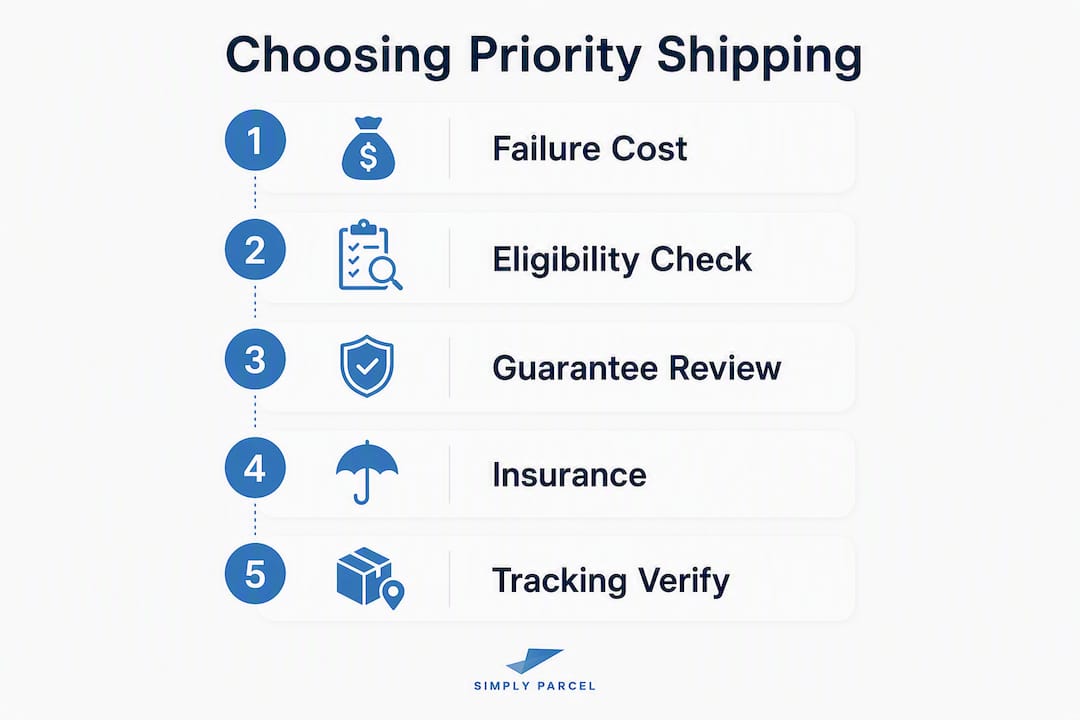
Step 2: Check lane eligibility and cutoff times. Not every ZIP-code pair qualifies for next-day express. Verify eligibility on the carrier's site before selecting the service. Also confirm the pickup or dropoff cutoff for same-day acceptance.
Step 3: Compare guarantee and refund rules. Does the service refund postage on a late delivery? Is signature confirmation included or optional? Proof of delivery matters if you need to file a claim.
Step 4: Select insurance or declared-value protection. If the item is worth more than the included coverage ceiling, add declared-value protection. Note the carrier's claim filing window; guarantees are conditional and exclude events like severe weather, natural disasters, or incorrect addresses.
Step 5: Confirm tracking and package prep. Double-check the recipient's full address and phone number. Accurate information prevents avoidable delays that void your guarantee eligibility.
Red flags to watch for: no stated refund policy, vague or unstated cutoff times, tracking that only confirms final delivery, and no clear claims process.
When to use an aggregator for international priority shipments
For international priority shipments, an aggregator is usually the simpler and more cost-effective route. Use one when you need fast international transit plus easier lane checks, pre-populated customs documents, and automatic rate comparison across multiple carriers.
The aggregator workflow is straightforward: enter shipment details, compare live rates across carriers, select your priority lane, generate a shipping label and customs forms automatically, book a pickup, and track the shipment through a single dashboard.
Pros of using an aggregator:
- Commercial pricing that is typically lower than retail walk-in rates.
- Simplified customs paperwork, often pre-populated from your shipment details.
- Broader carrier coverage, including priority and express international lanes.
- Consolidated tracking across carriers in one place.
Cons to keep in mind:
- Platform fees or service markups apply on top of carrier rates.
- You may have limited control over which named carrier handles the final mile.
- Claims handling goes through the aggregator's process, which can add a step versus filing directly with the carrier.
When comparing aggregator platforms, look for automatic customs form generation, live rate-shopping across multiple carriers, clear claims guidance, and support for international postage requirements by destination corridor.
Typical timelines and relative costs to expect
Expect a few days for premium express lanes domestically, a slightly longer window for standard priority, and several business days for express international corridors, though specific routes vary.
| Service class | Typical delivery window | Relative cost cue |
|---|---|---|
| Overnight / next-day express | typically next day on eligible ZIP lanes | Highest; multiple times ground rate |
| Premium express (domestic) | typically 1–3 days | High; retail starts around $33 for flat-rate express envelopes |
| Standard priority (domestic) | typically 2–3 days | Moderate; no money-back guarantee |
| Express international | typically several business days depending on corridor | High; varies significantly by destination |
Commercial online rates are consistently lower than retail walk-in prices for the same service. If you are booking through an aggregator or a carrier's online portal, you will generally pay less than at the counter.
Quick timeline reference:
- Overnight: eligible ZIP-code lanes only; verify before booking.
- 1–3 day: typical for Priority Mail Express on major domestic corridors.
- 2–3 day: Priority Mail; tracking included, no guarantee.
- 3–5 business days: typical for express international; customs clearance adds variability.
Pre-booking checklist: confirm these before you pay
Verify every item below before you complete your booking to avoid delays and claim denials.
- Recipient's full address, including apartment or suite number, and a working phone number.
- Proper packaging: dimensions and weight accurately declared; fragile items padded.
- Delivery guarantee and signature option selected (or consciously declined).
- Insurance or declared-value protection added if the item exceeds the included coverage ceiling.
- Pickup or dropoff cutoff time confirmed for same-day acceptance.
- Customs paperwork completed for international shipments: accurate item description, declared value in the correct currency, and HS code where required.
Pro Tip: Keep your tracking number in a safe place immediately after booking, and photograph the packed parcel at dropoff. Both are required if you need to file a claim, and money-back guarantees require filing within the carrier's specified claim window.
Key Takeaways
Choose a money-back express service when the cost of a late delivery exceeds the shipping premium; use an aggregator like Simplyparcel for international priority bookings to simplify rate comparison and customs paperwork.
| Point | Details |
|---|---|
| Cost of failure rule | Choose express with a guarantee when a late parcel costs more than the shipping upgrade. |
| Speed vs. guarantee | Priority Mail generally delivers in 2–3 days without a money-back guarantee; Priority Mail Express delivers in 1–3 days and includes a refund commitment for eligible late deliveries. |
| Lane eligibility check | Next-day express is available only on eligible ZIP-code pairs; always verify before booking. |
| Pre-book essentials | Confirm full address, cutoff time, insurance, and customs docs before you pay to protect your guarantee. |
| Simplyparcel for international | Use Simplyparcel to rate-shop carriers, auto-generate customs forms, and book priority international pickups in one step. |
Why aggregators are the smarter call for most international priority bookings
Simplyparcel's view is direct: for international priority shipments, a rate-shopping aggregator reduces two of the biggest risks consumers face: choosing the wrong lane and getting customs paperwork wrong.
Carrier websites show you one carrier's rates. An aggregator shows you several, side by side, with transit windows and pricing visible before you commit. That comparison step alone prevents the most common mistake: paying express rates for a service that does not actually reach the destination on a priority timeline.
The customs paperwork piece is equally underestimated. A missing or inaccurate customs declaration can hold a priority shipment in clearance longer than the transit itself. Pre-populated forms reduce that risk significantly.
The honest caveat: aggregators add a layer between you and the carrier, and claims handling can take an extra step. For high-value shipments where you want direct carrier accountability, weigh that tradeoff carefully. But for most consumers sending personal parcels internationally on a priority timeline, the aggregator workflow is faster, simpler, and often cheaper than booking direct.
Simplyparcel makes international priority shipping straightforward
When you need a priority international shipment handled without the back-and-forth of checking multiple carrier sites, Simplyparcel offers a faster path. The platform lets you compare live rates across major courier partners, book a pickup, and generate shipping labels and customs documentation automatically, all from a single booking flow.
Commercial rates on the platform are typically lower than retail walk-in pricing for the same express service. For time-sensitive corridors, the priority and express lanes are clearly labeled with transit windows so you know what you are committing to before you pay.
Availability varies by destination corridor. For urgent or high-value international shipments, Simplyparcel's customer support team can help confirm lane eligibility and timing before you book. Get an instant quote to compare priority options for your specific route, or visit Simplyparcel to review service coverage and support options.
Useful sources
For live rates, guarantee terms, and lane eligibility, go directly to official and authoritative sources:
- USPS product pages: Check current Priority Mail and Priority Mail Express rates, guarantee terms, and ZIP-code lane eligibility at usps.com.
- Carrier guarantee pages: Each major carrier publishes its money-back guarantee conditions and claim filing instructions. Read these before booking, not after a delay.
- Simplyparcel rate comparison: Use the instant quote tool for live international priority rates across multiple carriers.
- Logistics industry guides: For deeper comparisons of express service classes and handling standards, carrier-neutral logistics publications provide useful context alongside official carrier pages.
Always prefer the carrier's own policy page for final guarantee and claim details. Use aggregator booking pages for comparative pricing and customs guidance.