
You can ship lithium batteries internationally, but only if you correctly identify the UN number, follow the matching Packing Instruction, and supply the paperwork carriers now demand. Get any of that wrong and the shipment gets refused at check-in. The rules sit inside the IATA battery guidance, the ICAO Technical Instructions, the IMDG Code for ocean freight, and UN 38.3 test criteria, and 2026 tightened several of them further.
TL;DR:
- Shipping lithium batteries requires accurate UN number identification, correct packing instructions, and proper documentation to avoid shipment refusal.
- Classify batteries by chemistry and configuration, ensuring the correct UN number, watt-hour rating, and test summaries are on hand.
- Proper packaging involves non-metallic inner packaging, terminal protection, compartmentalization, and a rigid outer box that withstands drops.
- Labels, markings, and declarations must meet specific size, placement, and content standards, especially for cargo aircraft only or high-quantity shipments.
- For high-risk, bulk, or EV batteries, consulting a dangerous goods specialist reduces the risk of delays, refusals, or unsafe shipping practices.
Table of Contents
- Your Pre-Booking Checklist for Lithium Battery Shipping
- How Do You Classify a Lithium Battery for Shipping?
- What Are the Packaging Rules for Lithium Battery Shipments?
- What Labels and Documents Does Lithium Battery Shipping Require?
- Air, Sea, or Ground: Which Mode Handles Batteries Differently?
- Shipping Damaged, Defective, or End-of-Life Batteries
- Why Do Carriers Reject Lithium Battery Shipments?
- Simply Parcel's Take: When to DIY and When to Call in a Specialist
- Ready to Book a Compliant Battery Shipment?
- Sources
Your Pre-Booking Checklist for Lithium Battery Shipping
Before you box anything, run through this sequence. Skipping a step here is exactly how shipments end up stuck at a carrier's dangerous goods desk for a week.
- Identify the UN number first. Check whether you're shipping UN 3480 (lithium-ion batteries alone), UN 3481 (lithium-ion batteries packed with or contained in equipment), UN 3090 (lithium metal alone), or UN 3091 (lithium metal with equipment). This single decision determines which Packing Instruction applies.
- Confirm you have a UN 38.3 test summary. Manufacturers must test cells and batteries against the UN Manual of Tests and Criteria, and carriers increasingly ask to see the summary document, not just a claim that testing happened.
- Check the mode and carrier rules. Air, sea, and ground carriers apply different thresholds, and not every carrier accepts standalone battery shipments at all.
- Verify state of charge. Many lithium-ion cells now need to ship at 30% state of charge or below under IATA's 2026 packing instructions.
- Pack with non-metallic inner packaging, keep terminals fully covered, and use a rigid outer box sized to prevent movement.
- Label, mark, and prepare your Dangerous Goods Declaration where the packing instruction requires one.
Pro Tip: Take a photo of your UN 38.3 test summary and shipment paperwork before you seal the box. If a carrier questions the declaration mid-transit, you'll need to produce it fast, and a sealed box won't help you retrieve a document you forgot to keep a copy of.
How Do You Classify a Lithium Battery for Shipping?
Classification decides everything downstream, from which box you use to which label goes on it. Get this step wrong and the rest of your prep is built on a false foundation.
Start with chemistry. Lithium metal batteries and lithium-ion batteries are regulated differently because they fail differently. Lithium-ion cells are rechargeable and carry a watt-hour (Wh) rating; lithium metal cells are typically non-rechargeable and are measured by lithium content in grams. Mixing these up on paperwork is one of the more common mis-declarations carriers catch.
Next, determine configuration:
- UN 3480 — lithium-ion batteries shipped by themselves, not attached to or packed with any device.
- UN 3481 — lithium-ion batteries packed with equipment (in a separate compartment of the same box) or contained inside equipment (installed in a laptop, tool, or power bank).
- UN 3090 — lithium metal batteries shipped alone.
- UN 3091 — lithium metal batteries packed with or contained in equipment.
- UN 3551 — a newer entry covering lithium-ion batteries installed in cargo transport units or similar large equipment configurations, reflecting the growing volume of battery-integrated freight moving through global supply chains.
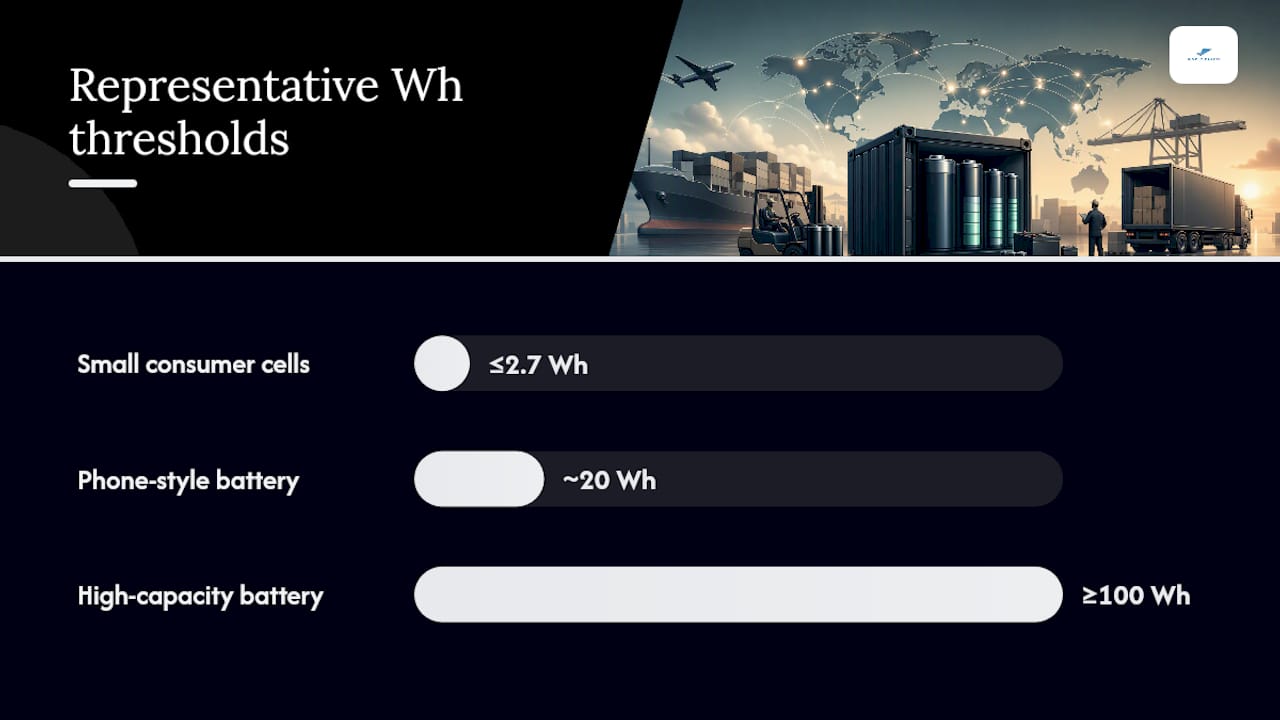
Watt-hour thresholds change which Packing Instruction applies within each UN number. A phone battery under 20 Wh faces lighter requirements than an e-bike battery pushing past 100 Wh. Small consumer cells under 2.7 Wh (the kind found in hearing aids or watches) can sometimes move under relaxed provisions, while anything approaching or exceeding 100 Wh per battery typically triggers stricter packing sections, additional marking, and in some cases operator approval before it flies at all.
Here's where it gets practical. If you're shipping replacement laptop batteries on their own, you're looking at UN 3480 and one of the Packing Instructions in the PI 965 series. If those same batteries are already installed in the laptop, you shift to UN 3481 and PI 967 or PI 970, depending on quantity and whether the shipment goes by air cargo. Power bank shipping almost always falls under UN 3480, since a power bank is functionally a standalone lithium-ion battery in a plastic shell, regardless of how consumer-facing the packaging looks.
The manufacturer's UN 38.3 test summary should specify the exact classification, Wh rating, and applicable UN number. If you're a reseller or exporter without direct access to the manufacturer, request this document before you commit to a shipping date. Retailers who bought stock in bulk sometimes discover, only when a carrier asks, that nobody in the supply chain kept the test summary on file.
What Are the Packaging Rules for Lithium Battery Shipments?
Packaging is where good intentions meet physical reality. A battery that's correctly classified but poorly packed will still get flagged, and it's often the single biggest reason carrier acceptance gets denied.
- Use non-metallic inner packaging. Metal containers can conduct a short circuit if a terminal makes contact with the casing. Rigid plastic trays, cardboard dividers, or molded inserts keep batteries separated and terminals isolated.
- Fully enclose or tape over terminals. Exposed terminals are the most common cause of in-transit short circuits. Terminal caps, individual poly bags, or non-conductive tape all work, as long as contact points can't touch another battery, a metal surface, or loose foil.
- Separate individual batteries or cells. Batteries packed loose against each other can shift during transit and create pressure points or contact between terminals. Cushioned dividers or individual compartments solve this.
- Choose a strong, rigid outer box sized correctly. Oversized boxes let contents shift; undersized boxes crush under stacking weight. The box should hold its shape under normal handling stress.
- Cushion to prevent internal movement. Packing material should fill gaps completely, not just pad the top. A battery that can slide two inches inside its box during transit hasn't been packed to standard.
Packaging must be able to withstand a 1.2-meter drop without damage that exposes contents or allows short circuits, a performance benchmark that shows up across carrier guidance and regulator checklists even though it isn't always spelled out box by box. For most consumer battery shipments, using a sturdy double-wall corrugated box with adequate internal cushioning meets this in practice, though higher-quantity or higher-Wh shipments may require UN-specification packaging that's been independently tested and certified to that standard.
State of charge changes what you need to do here too. Reducing a lithium-ion battery to 30% state of charge or below, now required for many air shipments under IATA's 2026 update, lowers the energy available if a short circuit does occur, which is exactly why regulators pushed for it.
By the numbers: Batteries offered for air transport at a reduced state of charge are generally considered to have a lower thermal runaway risk than fully charged cells, which is the safety rationale IATA cites for the reduced threshold now built into multiple Packing Instructions.
Practically, this means charging devices to roughly 30% before shipping rather than sending them fully charged, then documenting that state of charge on your paperwork where the Packing Instruction requires it. A reliable packaging supplier can help source the corrugated stock and inner cushioning that meets these performance expectations consistently, especially if you're shipping batteries as a regular part of your business rather than a one-off.
If you're unsure whether your current packing setup would survive carrier inspection, our guide to packaging best practices walks through material choices in more detail.
What Labels and Documents Does Lithium Battery Shipping Require?
Correct packaging means nothing to a carrier's dangerous goods agent if the outside of the box doesn't tell them what's inside. Labeling and documentation are how you communicate compliance at a glance.
The lithium battery mark is a diamond-shaped label showing a battery symbol with the UN number printed inside it, along with a telephone number for additional information where required. This mark applies to most UN 3480, 3481, 3090, and 3091 shipments, though the exact size and content required can shift slightly depending on quantity and whether the shipment qualifies for a relaxed provision.
Cargo Aircraft Only (CAO) labeling becomes mandatory when a shipment exceeds the quantity or Wh thresholds allowed on passenger aircraft. This typically applies to bulk battery shipments and certain lithium metal battery configurations that regulators consider too risky for passenger cabins or holds. A Class 9 placard applies at the pallet or container level once you exceed certain quantity thresholds, distinct from the individual package lithium battery mark.
Your documentation set should include:
- Dangerous Goods Declaration (DGD) where the Packing Instruction requires one, listing the UN number, proper shipping name, quantity, and packing instruction reference.
- UN 38.3 test summary reference, either attached or available on request, confirming the battery passed required testing.
- Watt-hour rating or lithium content, stated accurately, since this figure determines which packing section and label requirements apply.
- State of charge confirmation, where the shipment falls under a reduced SoC packing instruction.
- Shipper and consignee details consistent across the label, the declaration, and the commercial invoice.
Print labels on durable adhesive stock, not standard paper that smudges or peels in humid transit conditions, and place them where they won't get covered by a courier's own tracking label. A label that's technically correct but physically illegible by the time it reaches a sorting facility creates the same problem as no label at all. Our breakdown of label requirements covers placement and sizing specifics if you want a visual reference before printing your first batch.
Air, Sea, or Ground: Which Mode Handles Batteries Differently?
Transport mode changes almost everything about how a lithium battery shipment gets treated, and assuming ocean rules mirror air rules (or vice versa) is a fast way to get a shipment bounced.
By air, the IATA DGR and ICAO Technical Instructions govern everything. Some lithium metal battery configurations are prohibited on passenger aircraft entirely and must move Cargo Aircraft Only. Many lithium-ion shipments now require the 30% state of charge cap that took effect across multiple packing instructions in the 2025–2026 cycle. Special Provisions A201 and A331 carve out specific exceptions and conditions, mostly for small cell quantities or particular equipment types, and State approvals under provisions like A334 exist for edge cases but require formal coordination with the State of Origin and State of the Operator, something casual shippers rarely need to pursue.
By sea, the IMDG Code sets the baseline, and Special Provision 188 (SP188) offers an exemption pathway for certain lower-risk configurations that would otherwise face fuller dangerous goods requirements. Container shipments carry their own risks, since a fire inside a sealed steel box behaves very differently than one in open air. CINS guidance recommends notifying the vessel operator ahead of loading, avoiding co-loading battery containers with other dangerous goods, and favoring on-deck stowage over below-deck placement for higher-risk consignments.
By ground, national road and rail regulations apply, often mirroring IMDG or IATA thresholds but with local variations you need to confirm with the carrier directly. Door-to-door shipments that combine truck, port, and ocean legs need every provider in that chain, truckers, terminal operators, and the ocean carrier, aware of the dangerous goods nature of the freight and equipped to handle it at each handoff.
A few situations call for a specialist:
- Shipments involving EV battery modules, e-bike batteries, or anything with a high Wh rating.
- Any consignment needing a State approval or operator-specific exception.
- Bulk shipments crossing multiple transport modes in a single journey.
- Cases where you can't get a straight answer from a carrier about acceptance.
For any of these, a dangerous goods specialist forwarder is worth the added cost, since the liability for getting it wrong falls on the shipper, not the carrier who simply declined the load.
Shipping Damaged, Defective, or End-of-Life Batteries
Batteries that are damaged, defective, or headed for disposal fall under a stricter regime than healthy cells, and treating them the same way you'd treat a new battery is a serious compliance gap.
Special Provision 376 (SP376) governs how to identify and classify batteries that are damaged or defective in a way that could produce dangerous evacuation of gas, fire, or a short circuit. If a battery has a swollen casing, visible corrosion, a crack, or any sign it was involved in an incident, it likely falls under this provision rather than standard packing rules.
- Damaged or defective batteries generally require packaging designed to contain a fire and prevent gas buildup, often involving specialized inner packaging beyond what a healthy battery needs.
- Segregation from other dangerous goods and general cargo is typically mandatory, and on-deck stowage is often preferred for sea shipments in this category, similar to the caution CINS guidance recommends for higher-risk battery containers generally.
- Never ship a damaged battery in standard consumer packaging expecting it to pass as a normal shipment. Carriers train staff to catch this, and doing so anyway can void insurance coverage entirely.
Special Provision 377 (SP377) and Packing Instruction 909 (P909) apply to batteries being shipped specifically for disposal or recycling. These require their own transport statement on the shipping documents, distinct wording that identifies the shipment's purpose, and often specific package marking beyond the standard lithium battery mark. If you're a business clearing out old device inventory or partnering with an e-waste recycler, confirm which provision applies before you box anything, since disposal shipments get scrutinized differently than commercial sales shipments.
Why Do Carriers Reject Lithium Battery Shipments?
Most rejections trace back to a handful of repeat offenders, and IATA's own guidance points to mis-declaration and improper packaging, not outright prohibition, as the leading causes.
- Wrong UN number or packing instruction. Declaring a battery-with-equipment shipment as UN 3480 instead of UN 3481, or vice versa, is a common paperwork error that carriers catch immediately.
- Missing UN 38.3 test summaries. No documentation means no proof the battery was tested, and most carriers won't accept that gap.
- Incorrect Wh or lithium content reporting. A battery mislabeled below its actual watt-hour rating can push a shipment into the wrong packing section entirely.
- Insufficient short-circuit protection. Exposed terminals or metal-on-metal contact inside the box are visible red flags during carrier inspection.
- Missing required labels. Absent Cargo Aircraft Only marking, when the shipment's quantity or configuration requires it, is one of the fastest ways to get a shipment held.
- Not confirming carrier acceptance in advance. Some carriers simply don't accept standalone battery shipments on certain routes, and finding that out at drop-off wastes a trip.
Pro Tip: Call or message your carrier's dangerous goods desk before you book, not after you pack. A five-minute question about their current acceptance policy can save you a rejected shipment and a repacking job later in the week.
Simply Parcel's Take: When to DIY and When to Call in a Specialist
Not every battery shipment needs a dangerous goods specialist standing over your shoulder, and pretending otherwise oversells the complexity for the average sender. If you're shipping a handful of consumer power banks or laptop batteries with clear manufacturer documentation, correct packaging, and accurate labeling, doing it yourself is entirely reasonable. The rules aren't secret; they're just detailed, and once you've classified the battery correctly the rest is procedural.
Where we'd push back on the DIY instinct is bulk shipments, high watt-hour batteries, and anything involving e-bike or EV battery modules. These carry higher stakes if something goes wrong in transit, and the paperwork burden (state approvals, stricter packing instructions, carrier-specific exceptions) grows fast enough that a specialist forwarder often pays for itself in avoided delays alone.
What we've built Simply Parcel around is closing the gap in between: senders who understand their obligations but don't want to manually cross-reference three regulatory documents every time they ship. Carrier filtering that surfaces which partners actually accept battery shipments on your route, documentation support, and booking assistance exist precisely because classification is the easy part and carrier-matching is where most people get stuck.
Before you book anything, have your UN number, Wh rating, and test summary ready. That single piece of prep determines almost everything else.
— Simply
Ready to Book a Compliant Battery Shipment?
If you've made it this far, you already know classification and packaging are the hard part, not the booking. Simply Parcel is built to handle what comes after: once you know your UN number, Wh rating, and state of charge, our platform filters for carriers that actually accept battery shipments on your specific route instead of leaving you to call around and get told no at the counter.
Head to our instant quote page with your UN number, battery weight, and destination ready, and you'll see which of our courier partners can carry the shipment and what it costs before you commit to anything. Have your UN 38.3 test summary and Dangerous Goods Declaration prepared if your Packing Instruction requires one. If your shipment involves bulk quantities, high-Wh batteries, or anything outside standard consumer electronics, reach out to our support team directly. We'll flag any documentation gaps before a carrier does.
Sources
The rules covered here draw on a small set of documents that any regular shipper should bookmark. The IATA lithium battery guidance and the companion 2026 update document are the primary references for air classification, Packing Instructions, and the 30% state of charge requirement. The ICAO Technical Instructions sit underneath IATA's DGR as the underlying regulatory framework that IATA member airlines apply in practice.
For ocean freight, the CINS container shipping guidelines explain SP188 exemptions and the stowage and segregation practices that reduce risk in containerized transport. The UN Manual of Tests and Criteria (UN 38.3) sets the testing standard every lithium cell and battery must pass before it can legally ship, and manufacturers should provide a summary of that testing on request.
For a broader industry view of how forwarders handle these shipments in practice, the Dimerco primer on shipping lithium-ion batteries covers documentation expectations and when specialist handling makes sense. Together, these sources back every packing, labeling, and documentation rule in this guide.
- IATA battery guidance (content assets PDF)
- Shipping Lithium Ion Batteries Internationally: A Primer — Dimerco