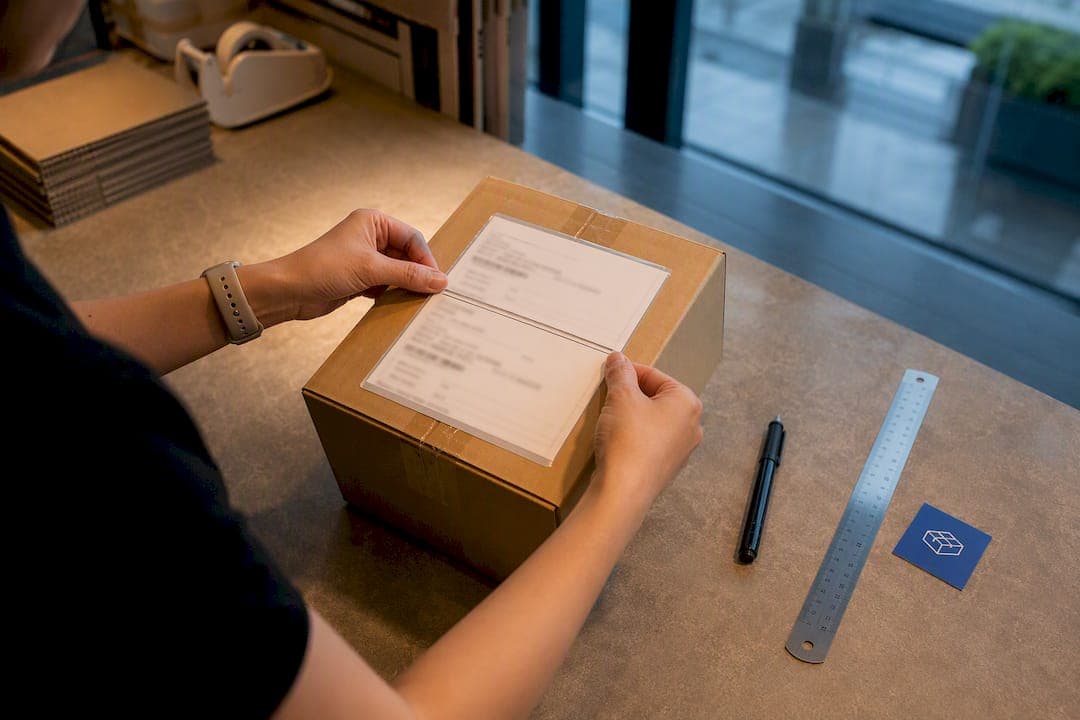
Japanese addresses run largest to smallest, opening with the seven-digit postal code (〒 NNN-NNNN), followed by prefecture, city, neighborhood, and the chōme-banchi-gō numbers written as hyphenated digits (like 4-2-8). For international mail, flip to romaji, keep those same hyphenated numbers intact, and place "JAPAN" as the final line, ideally with the Japanese script included as a backup line whenever a form allows it.
TL;DR:
- Shipping within Japan requires using the largest-to-smallest order, with the postal code, prefecture, city, neighborhood, and detailed block numbers.
- For international shipping, addresses must be reversed to smallest-to-largest order in romaji, with the full Japanese script as backup if possible.
- The seven-digit postal code is essential for routing, and chōme-banchi-gō numbers must remain in their original hyphenated form to prevent delivery errors.
- Omitting building names, reversing number sequences, or missing unit details are common mistakes that cause delays and should be double-checked.
- Standardized formatting, including script choice, hyphenation, and postal code placement, improves accuracy and delivery speed across different Japanese regions.
Table of Contents
- Understanding the Japanese Address Format for Domestic Mail
- Writing Japanese Addresses in Romaji for International Shipping
- Postal Codes and the Chōme-Banchi-Gō Numbering System
- Rural Addresses, Kyoto, Sapporo, and Other Regional Exceptions
- Common Mistakes That Delay Delivery
- Copy-Ready Japanese Address Templates and Examples
- Practical Notes for Faster Booking and Fewer Delivery Errors
- Author Perspective: Pick One Format Per Destination Type
- Let a Courier Handle the Formatting for You
- Sources
- FAQ
Understanding the Japanese Address Format for Domestic Mail
Japanese addresses read like a zoom lens. You start wide, at the postal code and prefecture, and end narrow, at the recipient's name. That's the opposite of how Americans write addresses, and it trips up a lot of first-time senders.
The seven-digit postal code comes first, formatted as NNN-NNNN and usually marked with the 〒 symbol. Japan Post uses this code to route mail to a specific delivery zone before a human ever reads the rest of the line, so getting it right matters more than getting the building name perfect.
After the postal code, the structure breaks down like this:
- Prefecture, marked with a suffix such as ‑to (Tokyo), ‑fu (Osaka, Kyoto), ‑dō (Hokkaido), or ‑ken (everywhere else)
- City or ward, marked ‑shi for cities or ‑ku for wards within major cities like Osaka or Yokohama
- Neighborhood, marked ‑machi/chō or, in less urban areas, ‑son/mura for villages
- Chōme, banchi, and gō, the block, sub-block, and building numbers
- Building name and unit number, when applicable
- Recipient name, written last
Japanese addresses are commonly printed vertically on envelopes, top to bottom, right to left, which is standard for formal or handwritten mail. Shipping labels and most digital forms use the horizontal version instead, since it's faster to type and easier for scanning software to read.
Writing Japanese Addresses in Romaji for International Shipping
International shipping flips the entire order. Where domestic mail goes largest to smallest, romaji addresses for international mail go smallest to largest, following Western convention so postal workers outside Japan can process them without confusion.
- Start with the recipient's name, followed by the building name and unit number if there is one.
- Write the chōme-banchi-gō string exactly as the numbers appear domestically (e.g., 4-2-8), never reversed. This keeps the digit groups intact so Japan Post can still match the address on the receiving end.
- Add the neighborhood, city or ward, and prefecture, each written in romaji.
- Place the postal code either right before the prefecture or on its own line above the city
- Finish with "JAPAN" in capital letters as the very last line. This tells customs and international sorting facilities exactly which country the parcel belongs to.
A phone number belongs directly under the recipient's name, written with the country code (+81) for international forms and without it for domestic ones. Customs forms often ask for this separately from the address block, so keep it consistent in both places.
One transliteration decision matters more than most senders realize: when a form allows a second line, add the full Japanese-script address underneath the romaji version. Japan Post's own delivery staff frequently work faster from kanji, even on parcels that arrived from overseas, so the romaji gets it through customs while the kanji gets it to the door.
Postal Codes and the Chōme-Banchi-Gō Numbering System
The seven-digit postal code format (NNN-NNNN) exists to narrow a delivery down to a small cluster of blocks before anyone reads the street details. Leading with it on any form, digital or handwritten, cuts down on manual sorting.
Below the postal code, three numeric layers do the real work:
- Chōme: a numbered district within a neighborhood, roughly the size of a few American city blocks
- Banchi: a specific block within that chōme
- Gō: the individual building or lot number within that block
Housing and logistics guides widely recommend collapsing these into a hyphenated string for anything typed rather than handwritten, so "1-8-15" reads as chōme 1, banchi 8, gō 15. Add a unit number after another hyphen (1-8-15-801) for apartments.
Statistic Callout: Multiple logistics and e-commerce platforms in Japan trigger an automatic city and prefecture fill the moment a correct seven-digit postal code is entered, which is why postal-code-first entry saves so much back-and-forth on online forms.
Character width matters too. Many Japanese web forms expect half-width numerals (standard ASCII digits) rather than full-width Japanese numerals, and typing the wrong width can cause a form to reject the entry entirely.
Rural Addresses, Kyoto, Sapporo, and Other Regional Exceptions
Not every address in Japan follows the tidy chōme-banchi-gō pattern, and knowing the exceptions saves you from a returned parcel.
- Jūkyo hyōji vs. chiban: Most urban areas use jūkyo hyōji, the residential indication system established under the 1962 Act on Indication of Residential Address. Some rural and older districts still rely on the earlier chiban land-registry numbers, which don't run sequentially by geography. Japan's Digital Agency notes that both systems coexist today, which explains why a block's numbers sometimes seem to jump around.
- Kyoto's street-based addresses: Locals often describe a location by the nearest intersection and a direction (north, south, east, west of it) rather than by chōme-banchi-gō alone. Including both the formal postal address and the street-based description helps when shipping to older Kyoto neighborhoods.
- Sapporo's grid system: Sapporo uses a quadrant-based numbering system built around a central point, with addresses reading something like "Kita 3, Nishi 5" (North 3, West 5) instead of a standard chōme.
- PO boxes and large facilities: Include the organization name, floor, and box number clearly, since large office buildings and campuses often route mail internally after it clears the main postal code.
Common Mistakes That Delay Delivery
Most delivery delays trace back to a handful of repeat offenders, and every one of them is avoidable with a quick check before you print a label.
- Omitting the building name. In dense urban blocks, several buildings can share the same banchi-gō number, and leaving out the building name is one of the most common causes of failed delivery.
- Reversing the number order. Chōme-banchi-gō should always read in that order. Swapping it turns a correct address into a nonexistent one.
- Skipping the postal code. Without it, sorting facilities have to route the parcel manually, adding days to transit.
- Relying on romaji alone for domestic delivery. Local carriers move faster with kanji, even when the romaji is technically correct.
- Missing unit numbers on apartments. A missing unit number on a mid-rise apartment building is functionally the same as a missing building name.
Before printing any label, run through this fast check: postal code present, chōme-banchi-gō correctly ordered, building name included, unit number included, and script matched to the destination (kanji for domestic, romaji plus JAPAN for international).
Pro Tip: If you're not sure your address is correctly formatted, search the postal code on Japan Post's own lookup tool. If the city and ward it returns don't match what you have written, something upstream is wrong, and it's worth fixing before the label ever gets printed.
Copy-Ready Japanese Address Templates and Examples
Here are four formats you can adapt directly, depending on the address and where it's headed.
Tokyo single-family home (Japanese script, domestic): 〒150-0002 東京都渋谷区渋谷1-2-3 山田太郎様
Tokyo apartment with unit (bilingual): 〒150-0002 東京都渋谷区渋谷1-2-3 渋谷ハイツ 401 Yamada Taro Shibuya Heights 401, 1-2-3 Shibuya, Shibuya-ku, Tokyo 150-0002, JAPAN
International romaji label: Taro Yamada 1-2-3 Shibuya, Shibuya-ku Tokyo 150-0002 JAPAN
Rural address using chiban-style numbering: 〒321-0983 栃木県宇都宮市桑島町245 佐藤花子様
For single-line web forms, use a minimal template: postal code, then the full string joined by hyphens, such as "150-0002, 1-2-3 Shibuya, Shibuya-ku, Tokyo." Use the bilingual version whenever a courier form has room for two address lines, since it covers both the sorting facility and the delivery driver.
Practical Notes for Faster Booking and Fewer Delivery Errors
When a booking form gives you the option, enter both kanji and romaji. It closes the gap between what customs needs and what the local delivery driver actually reads on arrival.
- Type chōme-banchi-gō as one hyphenated string, using half-width numerals so the form doesn't reject the entry.
- Add a local phone number and the building name in the same field, not a separate note, so nothing gets dropped during handling.
- Confirm your shipment's tracking details once the label generates, so you can catch a formatting issue before the parcel leaves the pickup point.
Author Perspective: Pick One Format Per Destination Type
Use Japanese-script, largest-to-smallest order for anything staying inside Japan. Switch to romaji with JAPAN last for anything crossing a border, and attach kanji as backup whenever the form allows it. Standardize this across your team so every courier receives the same address shape, every time.
— Simply
Let a Courier Handle the Formatting for You
Formatting a Japanese address correctly takes attention to detail, hyphen order, script choice, postal code placement, and not every business wants to manage that on every single shipment. That's where a platform like Simplyparcel becomes useful: it lets you compare courier options, auto-generate shipping labels, and prepare customs documentation without retyping the same address string across five different forms.
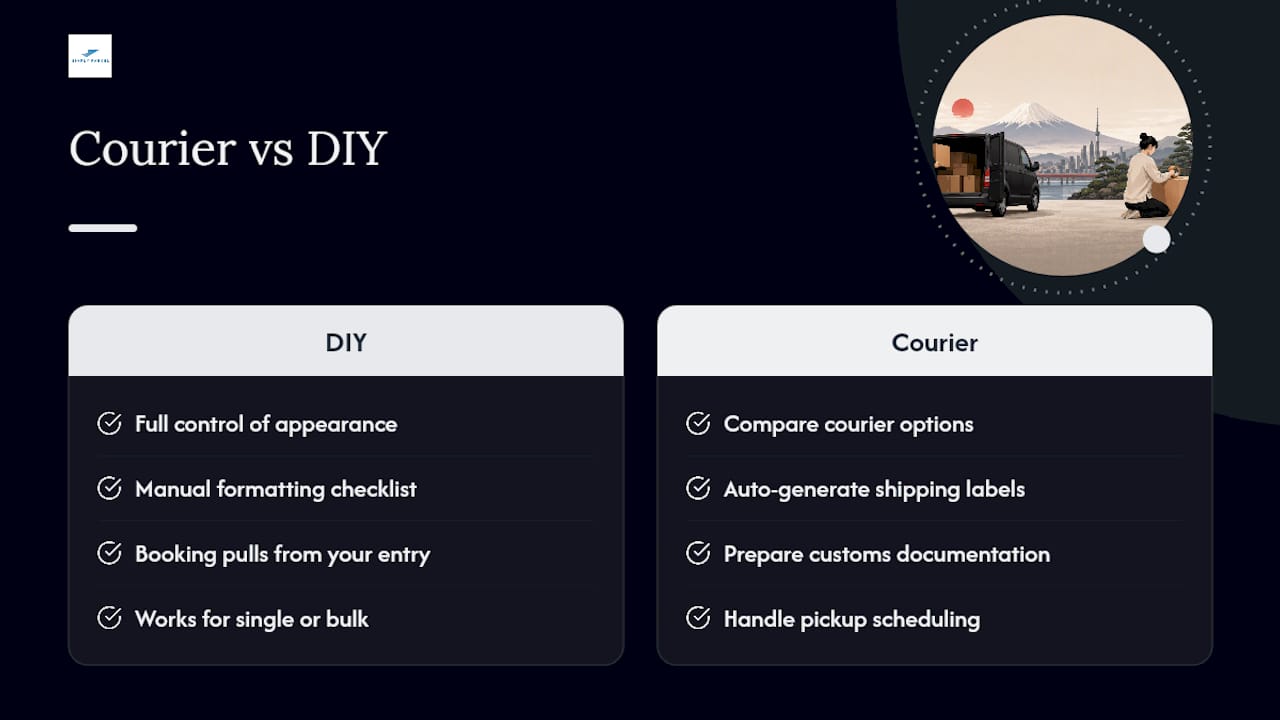
You still choose how the address looks. The booking flow pulls from what you enter and builds a label around it, whether you're sending a single parcel or coordinating bulk freight. If you'd rather skip the manual formatting checklist altogether, get a shipment quote and let the platform handle the label generation, pickup scheduling, and paperwork from there. This is entirely optional. Everything in this guide still applies if you prefer to format and print your own labels.
Sources
- Japanese addressing system
- Japan — Addressing specification (UPU)
- Japanese Address Format: How to Read and Write Addresses in Japan | Housing Japan
FAQ
Do You Address a Japanese Person by First or Last Name?
Japanese convention lists the family name first, followed by the given name, and the honorific "様" (sama) after the full name on formal mail and shipping labels. On romaji labels for international shipping, it's common to reverse this to given-name-first for clarity, since that matches Western reading order.
What Does 1-Chome Mean in Japan?
Chōme refers to a numbered subdivision within a neighborhood, similar to a specific block cluster in an American city. "1-chome" simply means district number one within that neighborhood, and it's followed by the banchi and gō numbers that pinpoint the exact building.
How Do I Convert a Japanese Address to English?
Convert the address by reversing the element order from largest-to-smallest to smallest-to-largest, transliterating each part into romaji, and keeping the chōme-banchi-gō numbers in their original hyphenated sequence (such as 4-2-8) rather than rearranging them. Add "JAPAN" as the final line for international mail.
Can You Give Me an Example Address in Tokyo, Japan?
A sample Tokyo address reads: 〒150-0002, Tokyo-to, Shibuya-ku, Shibuya 1-2-3, followed by the building name and recipient. In romaji for an international label, it becomes: 1-2-3 Shibuya, Shibuya-ku, Tokyo 150-0002, JAPAN.