
"In transit" means your shipment has left the sender's hands and is somewhere in the carrier's network, between pickup and final delivery. It has usually not reached a local delivery vehicle yet. If your tracking page shows this status, here's what to check next:
- Look at the last scan timestamp, not just the word "in transit" itself
- Check whether the status has moved to "out for delivery" (that's the real signal your parcel is close)
- Compare the current date against the estimated delivery window on your booking confirmation
If the last scan is recent and inside the expected window, your shipment is behaving normally. If it's been quiet for days past the estimate, keep reading, because the next sections tell you exactly when to worry and what to do about it.
Key Takeaways
"In transit" describes a shipment's stage between pickup and delivery, and most delays within that window are routine rather than signs of a lost package.
| Point | Details |
|---|---|
| Definition matters | "In transit" means accepted by the carrier but not yet delivered, often not yet on a local vehicle. |
| Delays are usually routine | Scheduled departures, transshipment, and customs reviews commonly extend this status without anything going wrong. |
| Timelines vary by service | Express air often takes 1 to 5 days; ocean freight and economy services can take weeks. |
| Escalate with evidence | Gather your AWB number, invoice, and tracking screenshots before contacting the carrier or filing a claim. |
| Check scans, not just status | Compare the last scan timestamp against your estimated window before assuming a problem. |
Table of Contents
- What "In Transit" Actually Covers in the Shipping Process
- Why Some Shipments Stay "In Transit" Longer Than Expected
- How Long "In Transit" Usually Lasts by Shipping Speed
- What to Do If Your Package Is Stuck "In Transit"
- How Tracking Scans and Aggregator Platforms Show "In Transit"
- Where the Standard Advice on "In Transit" Falls Short
- Sources
What "In Transit" Actually Covers in the Shipping Process
"In transit" is a wide net. Industry guidance from iContainers confirms it covers the entire span between carrier acceptance and final delivery, not one specific moment of physical movement. That's why your parcel can sit still for hours and still legitimately show this status.
A typical journey moves through several stages:
- Pickup accepted — the courier scans the parcel into its system at collection.
- Origin hub sort — the package is sorted by destination and consolidated with other shipments.
- Transport leg — it travels by air, road, or sea toward a regional or international gateway.
- Transshipment — for cross-border parcels, it may change carriers, vehicles, or facilities mid-route.
- Destination gateway arrival — the parcel lands in the receiving country's network.
- Customs and bonded storage — international shipments often clear import checks before release, a step Singapore Customs outlines in its import declaration guidance.
- Final-mile handoff — the parcel is assigned to a local courier for delivery.
Scans between these steps aren't always continuous. Handovers between carriers, different time zones, and inconsistent scanning practices at smaller depots all create gaps. A missing scan for a day or two rarely means something has gone wrong.
Why Some Shipments Stay "In Transit" Longer Than Expected
Most delays inside the "in transit" window are routine, not red flags. Vessels and flights run on fixed schedules, so a parcel can sit at a port or airport for a day or more simply waiting for the next scheduled departure. Transshipment adds another layer: rerouting through a secondary hub for consolidation can add a day or two without anything being wrong.
Customs is the most common cause of an unexpectedly long "in transit" window, and it's often an official process rather than a problem, as explained in detail in this guide on customs clearance when moving internationally. Missing documentation, incomplete invoices, or a routine inspection can all extend clearance time.
Other causes worth ruling out:
- Severe weather grounding flights or slowing road transport
- Peak-season capacity shortages at sorting hubs
- Labor strikes or operational disruptions at ports and airports
Pro Tip: Give an express shipment 2 to 3 extra business days past its estimate before contacting support. For economy or ocean freight, wait at least a week past the quoted window before escalating; those services build in more buffer by design.
How Long "In Transit" Usually Lasts by Shipping Speed
Timelines vary sharply by service level, and knowing the normal range for your shipping method helps you tell a routine wait from an actual problem.
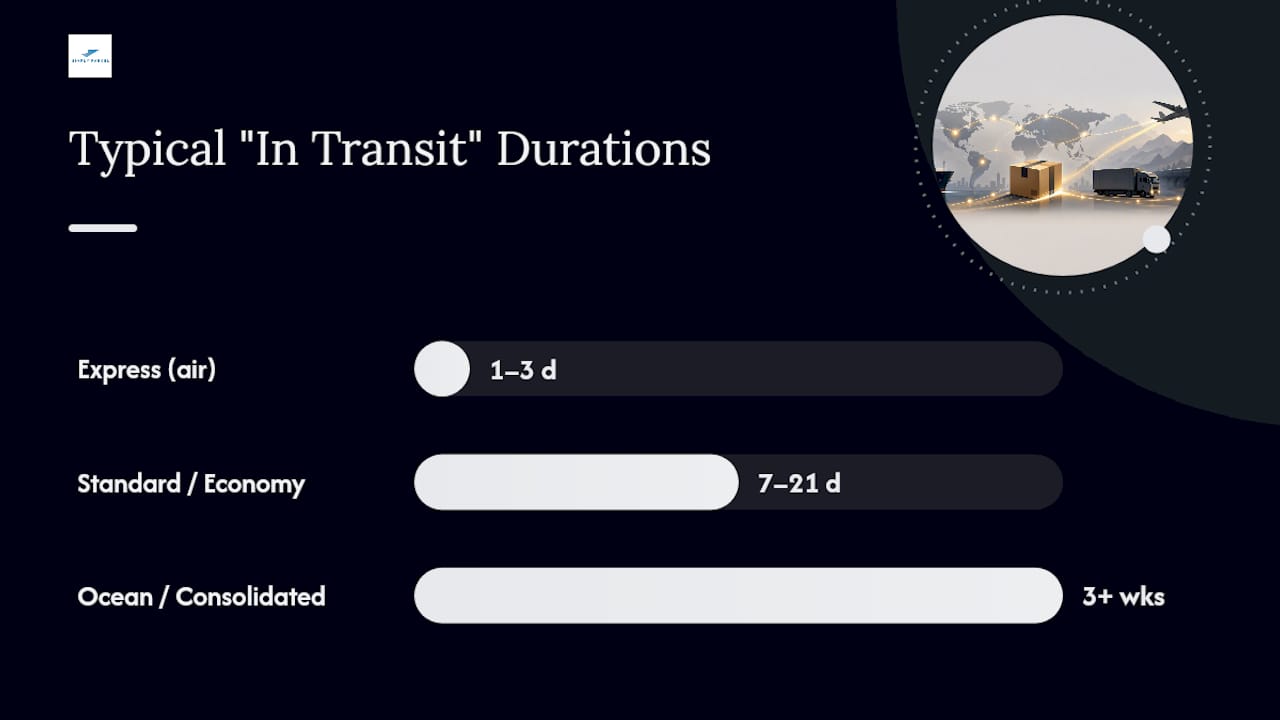
- Express courier (air): Usually a few business days for international shipments; domestic deliveries often arrive the next day.
- Standard or economy service: Several business days to multiple weeks depending on origin, destination, and mode of transport.
- Ocean freight and consolidated shipments: Transit windows often span multiple weeks due to port dwell times and scheduled departures, as iContainers notes for freight consolidation.
Customs clearance sits outside all of these estimates. There's no fixed guarantee on how long an inspection or document review takes, which is why "in transit" spans such a broad range of real-world outcomes. Being in this status doesn't promise on-time delivery. It only tells you the shipment's current stage, not whether it will land on schedule.
If you're comparing services for an upcoming shipment, checking the priority, connect-plus, and economy options side by side gives you a clearer sense of which timeline fits your urgency and budget.
What to Do If Your Package Is Stuck "In Transit"
Follow these steps in order before assuming the worst:
- Verify your tracking details. Confirm the AWB or tracking number matches your booking confirmation and that the delivery address is correct.
- Check the last scan timestamp. Compare it against the estimated delivery window; a gap of a day or two is often normal, especially across international legs.
- Contact the carrier directly. Provide your AWB number and ask for the most recent scan location, the reason for any delay, and a revised estimate.
- Reach out to the sender or platform. If the carrier's response is slow or vague, contact whoever booked the shipment, such as Simply Parcel, for a status check across their tracking system.
- Open a claim if needed. If the shipment is significantly overdue or appears lost, gather your invoice, AWB copy, and screenshots of the tracking history before filing an insurance or loss claim, since Cambridge Dictionary notes that goods damaged or lost in transit typically fall under standard insurance coverage.
Keeping a simple log of dates, times, and who you spoke with speeds up any claim significantly.
How Tracking Scans and Aggregator Platforms Show "In Transit"
Not all scans mean the same thing. A hub scan confirms your parcel arrived at a sorting facility. A gate scan marks it moving through a checkpoint, often at a border or airport. A load scan means it's now on a truck, plane, or vessel headed to the next stop. Each one tells you where the parcel is, not necessarily how fast it's moving.
Aggregator platforms sometimes show different timing than a single carrier's own portal, since they consolidate scan data from multiple sources, a pattern The Parcel Tracker explains in its rundown of tracking behavior. That can mean a slight lag compared to checking the carrier directly.
Real-time tracking combined with direct integration across major courier partners gives you one place to check status instead of juggling several carrier logins, which matters most when a shipment crosses borders and changes hands more than once.
Simply Parcel builds its tracking and multi-carrier integration around this exact problem, giving individual shippers and small businesses a single view instead of five separate ones.
Where the Standard Advice on "In Transit" Falls Short
Most explainers stop at defining the term and never tell you when a wait actually crosses into a problem. That's the gap worth closing. A three-day quiet stretch on an economy shipment from another continent isn't news. The same three days on an express courier package that quoted next-day delivery is worth a call.

The instinct to panic the moment a status stalls is understandable but usually wrong. Customs review, scheduled transport windows, and transshipment account for the overwhelming majority of "stuck" complaints, not lost parcels. What actually helps isn't refreshing the tracking page every hour. It's knowing your service level's normal range, checking the last scan timestamp against it, and having your AWB number and documentation ready before you contact anyone.
If there's one habit worth building, it's this: treat the tracking page as a timeline, not a verdict. A single missing scan means very little on its own.
— Simply