
Delivery speed options are defined as the set of shipping service tiers that determine how quickly a parcel moves from sender to recipient, at what cost, and with what level of handling priority. These tiers range from economy and standard shipping to expedited, express, and same-day services. Each tier carries a different transit window, price point, and operational treatment by carriers. Understanding these differences helps you match your shipment to your actual budget and urgency, whether you are sending a personal gift abroad or fulfilling a business order internationally.
What are the main delivery speed options and their transit windows?
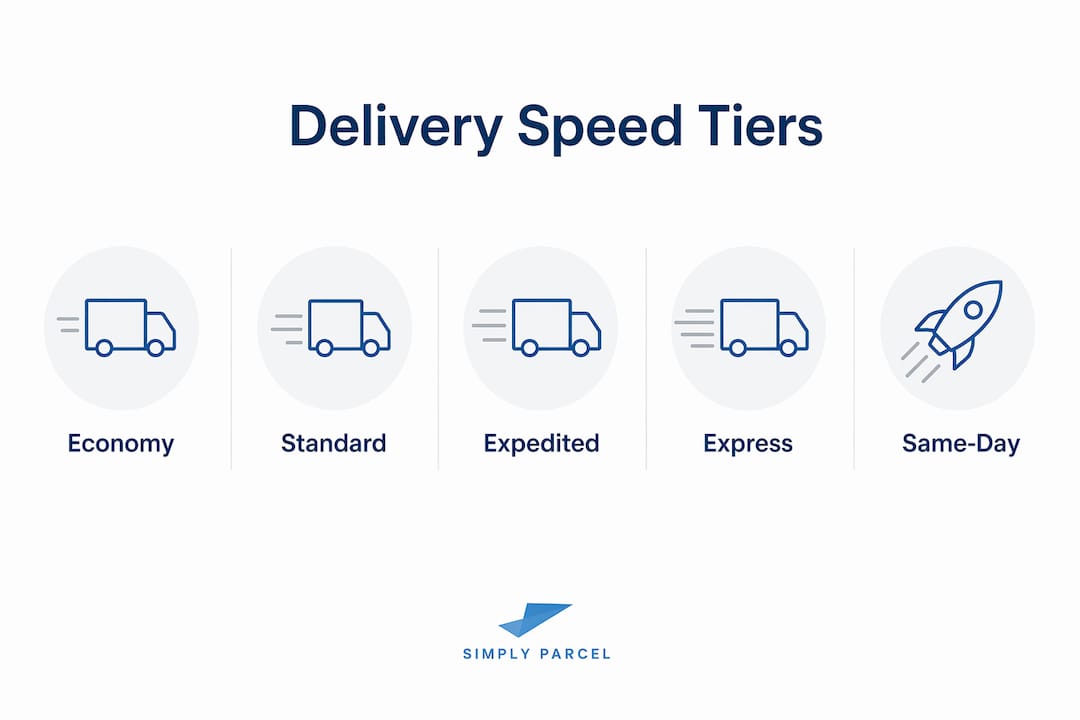
Delivery speed tiers are the industry's standard way to categorize shipping services by transit time and cost. Most carriers and aggregators organize their services into five core tiers: economy, standard, expedited, express, and same-day. Each tier serves a distinct need, and choosing the wrong one costs you either money or time.
| Tier | Typical Transit Window | Best For |
|---|---|---|
| Economy | 3–10 business days | Non-urgent, budget-sensitive shipments |
| Standard | 3–7 business days | Everyday parcels with no hard deadline |
| Expedited | 1–3 business days | Time-sensitive but not emergency shipments |
| Express | 1–2 business days | Urgent deliveries needing fast, reliable arrival |
| Same-day | Same calendar day | Local, metro-area urgent needs |
Economy shipping involves transit times of 3–10 business days and limited tracking visibility, making it suited for non-urgent or budget-conscious orders. The tradeoff is real: you pay less, but you accept less certainty about exactly when your parcel arrives.
Standard shipping sits one step above economy. It typically delivers within a week and includes basic tracking. For most routine international shipments without a hard deadline, standard is the practical default.
Expedited shipping delivers within 1–3 business days and receives priority handling at every stage, including sorting and routing. That priority status is what separates it from standard, not just the speed promise on paper.
Express shipping is often used interchangeably with expedited, but in practice it refers to the fastest network-based service a carrier offers, typically 1–2 business days. Same-day delivery is the fastest tier of all, but same-day coverage is limited to dense metro areas and carries the steepest price. It is most valuable for urgent local needs, not cross-border shipments.
How do carriers handle different delivery speed tiers?
The difference between tiers is not just a label. Carriers physically treat expedited and express shipments differently from economy parcels at every point in the network.
Here is how that operational difference plays out:
- Priority sorting: Expedited and express parcels move to the front of sorting queues at distribution hubs, reducing dwell time.
- Optimized routing: Faster tiers use fewer network touchpoints. Fewer stops mean fewer chances for delay.
- Cutoff times: Order and courier cutoff times are critical for meeting delivery promises. A late submission can shift your delivery window by a full business day, even on an expedited service.
- Tracking granularity: Faster services generate more scan events. Economy shipments may show only origin and destination scans, while expedited parcels update at each facility.
- Dedicated capacity: Some carriers reserve truck or air space specifically for priority tiers, so those parcels do not compete with economy freight for space.
For international shipments, these distinctions matter even more. A parcel crossing borders passes through customs clearance, which adds a variable that domestic shipments do not face. Expedited services often include proactive customs documentation support, which reduces clearance delays. Economy services typically do not.
Pro Tip: Always check the carrier's cutoff time for your origin location before booking an expedited service. Missing the cutoff by even 30 minutes can push your delivery to the next business day, eliminating the speed advantage you paid for.
How to choose the right delivery speed for your shipment
Choosing the right tier comes down to two questions: how soon does it need to arrive, and what is the cost you can justify? The answers to both shape every other decision.
Follow this framework when evaluating your options:
-
Define your hard deadline. If the parcel must arrive by a specific date, work backward from that date using the carrier's transit window. Add one buffer day for international customs clearance.
-
Assess your budget ceiling. Expedited shipping offers the best balance of speed and cost for most shippers, delivering within 1–3 days with a manageable surcharge and better tracking than economy. If your deadline allows 5 or more days, economy is the rational choice.
-
Check destination coverage. Remote destinations reduce the speed advantage of any tier. Destination remoteness and order time can diminish expedited speed advantages over standard methods. Verify the carrier's coverage map before committing to a faster tier.
-
Factor in shipment value. High-value parcels benefit from the enhanced tracking and handling that come with expedited and express tiers. The added cost is a form of risk management, not just a speed purchase.
-
Avoid over-buying speed. Selecting same-day or express for a parcel with a flexible deadline wastes budget. That money is better applied to packaging, insurance, or the next shipment.
Pro Tip: For international business shipments, expedited is the practical sweet spot for most routes. It is fast enough to satisfy most customers, affordable enough to protect your margins, and reliable enough to build a consistent delivery reputation. Read more about express shipping for urgent deliveries to see when upgrading to express is worth the extra cost.
What are the newest ultra-fast delivery options available?
Beyond the standard five tiers, a new category of ultra-rapid fulfillment services has emerged for local and hyperlocal delivery. These services operate on a fundamentally different model from traditional carrier networks.
Priority ETA services can deliver within 45 minutes to 5 hours from order creation, relying on hyperlocal fulfillment centers or "dark stores" located close to delivery addresses. A dark store is a warehouse that functions like a retail location but serves only online orders, with no public access. This proximity eliminates most of the transit time that standard networks require.
| Service Type | Delivery Window | Coverage | Best Use Case |
|---|---|---|---|
| Priority ETA | 45 minutes to 5 hours | Dense urban areas only | Urgent local orders |
| Same-day | Same calendar day | Major metro areas | Local urgent needs |
| Next-day express | Next business day | Broad national coverage | Time-sensitive parcels |
| Expedited | 1–3 business days | Wide, including international | Business and personal shipments |
These ultra-fast options come with clear limitations for international shippers:
- Coverage does not extend across borders. Priority ETA and same-day services are domestic, metro-area products.
- Cost per shipment is significantly higher than any standard network tier.
- Scheduled delivery time slots, where you pick a two-hour window, offer a middle ground between speed and cost for local deliveries.
For businesses shipping internationally, the role of shipping speed in international logistics is shaped more by expedited and express network tiers than by hyperlocal fulfillment. Ultra-fast options are powerful tools for domestic last-mile delivery, but they do not replace a well-chosen international shipping tier.
Key Takeaways
Expedited shipping is the most practical tier for most international shipments, balancing transit speed, cost, tracking quality, and carrier reliability better than any other single option.
| Point | Details |
|---|---|
| Five core tiers exist | Economy, standard, expedited, express, and same-day each serve a distinct urgency and budget need. |
| Cutoff times determine outcomes | Missing a carrier's cutoff shifts your delivery window by a full day, even on priority services. |
| Expedited is the sweet spot | Expedited shipping delivers in 1–3 days with priority handling and better tracking than economy. |
| Remote destinations reduce speed gains | Destination remoteness can close the gap between expedited and standard transit times. |
| Ultra-fast options are local only | Priority ETA and same-day services do not apply to international or cross-border shipments. |
My honest take on picking the right shipping tier
Shippers consistently make one of two mistakes: they default to economy to save money, or they default to express because it feels safer. Neither approach is actually rational.
Economy shipping is the right choice when your timeline is genuinely flexible and the parcel has low value. The moment you add time sensitivity or value to the equation, the cost savings from economy shrink fast. A delayed economy parcel that requires a replacement shipment costs far more than the expedited rate you avoided.
Express and same-day services are oversold for international use. Expedited shipping bypasses standard network sequences but is not as fast as hotshot or dedicated rush services used for critical deadlines. For most international business shipments, expedited hits the right balance without the premium cost of full express.
The detail most shippers miss is the cutoff time. You can book the fastest tier available and still receive a standard-speed result if you submit after the carrier's daily cutoff. Always confirm the cutoff for your pickup location before you book. That single habit eliminates a large share of delivery surprises.
Tracking also matters more than shippers realize. Faster tiers generate more scan events, which means you can intervene earlier if something goes wrong. That visibility has real value, especially for business shipments where a customer is waiting.
— Simply
Simplyparcel makes choosing your delivery speed straightforward
Simplyparcel offers three delivery speed tiers, priority, connect-plus, and economy, designed to match different urgency levels and budgets for international shipments from Singapore. You can get an instant quote and compare transit times and prices across carrier partners in one place, without contacting each carrier separately. Simplyparcel generates shipping labels and documentation automatically, so you spend less time on paperwork and more time on your actual work. Free pickup is included, and real-time tracking keeps you informed at every stage of the shipment. For a full view of international shipping options and pricing, the platform gives you everything you need to make a confident, informed choice.
FAQ
What are the main types of delivery speed tiers?
The five main tiers are economy, standard, expedited, express, and same-day. Each differs in transit time, cost, handling priority, and tracking detail.
How does expedited shipping differ from standard shipping?
Expedited shipping delivers within 1–3 business days and receives priority sorting and routing at carrier facilities. Standard shipping typically takes 3–7 business days with no priority handling.
Is same-day delivery available for international shipments?
Same-day delivery is limited to dense metro areas and does not apply to international or cross-border shipments. Expedited or express tiers are the fastest practical options for international shipping.
How do cutoff times affect my delivery speed choice?
Missing a carrier's cutoff time shifts your delivery window by a full business day, even on expedited or express services. Always confirm the cutoff for your pickup location before booking.
When does economy shipping make sense?
Economy shipping makes sense when your parcel has no hard deadline and low value, and you can accept 3–10 business days in transit with limited tracking updates.