Most exports leaving Singapore require a Customs export permit, and the only common exception is a narrow air small-value exemption. Before you book a single shipment, your first move is to register for a UEN and activate a Customs Account on TradeNet, then run your item through the HS/CA Product Code Checker to confirm whether it's controlled.
TL;DR:
- Most exports require a Customs export permit regardless of shipment size, except for certain low-value air exports from non-licensed premises.
- Selecting the correct TradeNet permit code is crucial to prevent shipment delays, with codes like OUT–DRT for direct export and OUT–APS for bonded or free trade zone goods.
- All shipments must pass through the HS/CA Product Code Checker before booking, especially for controlled or prohibited items like chemicals or strategic technology.
- Accurate declaration of HS codes, values, and permit details is essential to avoid penalties, delays, or legal consequences.
- Strategic goods and sensitive commodities require early planning and possibly extra lead time, especially when involving CA approvals or export permits.
Table of Contents
- Do You Need a Customs Export Permit?
- Which TradeNet Permit Code Fits Your Shipment?
- How Do You Apply for an Export Permit?
- How Do You Check If Goods Are Controlled or Prohibited?
- What Documents Do You Need at Cargo Clearance?
- What Happens If You Get a Declaration Wrong?
- Your One-Page Export Permit Checklist
- A Practical Take on Permit Complexity
- Let Simplyparcel Handle the Paperwork While You Handle the Sale
- Sources
Do You Need a Customs Export Permit?
You need a Customs export permit if your goods fall into any of the common trigger categories below. Singapore Customs applies these rules regardless of shipment size in most cases, so checking early saves you a rejected booking later.
- Locally manufactured or GST-paid goods leaving Singapore
- Goods withdrawn from a Free Trade Zone (FTZ) for export
- Dutiable goods, such as liquor, tobacco, or petroleum products
- Goods removed from licensed premises, including bonded warehouses
There's one notable exception: some low-value air exports fall outside the standard permit requirement. That exemption doesn't extend to goods coming from licensed premises. A GST-paid item sitting in a bonded warehouse still needs a permit before it flies out, regardless of its value. Standard practice is to submit your permit before the goods leave Singapore, and strategic goods carry their own separate notice timelines, which we cover further down.
Which TradeNet Permit Code Fits Your Shipment?
TradeNet assigns a specific code to every export scenario, and picking the wrong one is one of the fastest ways to get a shipment held at the checkpoint. Singapore Customs lists these codes on its types of export permits page, and matching your shipment to the right one up front avoids resubmission delays.
- OUT–DRT covers a straightforward direct export, the most common code for a business shipping finished goods overseas.
- OUT–APS applies when goods move from an approved premises or scheme, such as a zero-GST warehouse or an FTZ.
- TIS variants (Temporary Import Scheme codes) apply to goods leaving Singapore temporarily, like equipment sent out for repair or items exhibited at an overseas trade show before returning.
| Shipment scenario | Likely TradeNet code |
|---|---|
| Finished goods sold and shipped abroad | OUT–DRT |
| Cargo released from a bonded warehouse | OUT–APS |
| Machinery sent overseas for repair, expected back | TIS variant |
| Goods exhibited abroad, then re-imported | TIS variant |
How Do You Apply for an Export Permit?
Getting a permit approved comes down to sequencing three things correctly: your registration, your submission channel, and your timing.
- Register your UEN. If you don't already have one through ACRA or another issuing agency, you'll need it before Customs will let you transact anything.
- Activate your Customs Account on TradeNet. This is the account that lets you or your agent lodge permit applications, and Singapore Customs treats it as a prerequisite for every export transaction.
- Choose your submission route. You can appoint a Declaring Agent, register as one yourself, or lodge directly through an approved TradeNet front-end or the government front-end application, as GoBusiness outlines in its step-by-step export workflow.
- Budget for fees. Expect a statutory permit charge plus a separate messaging fee for each declaration, paid through your TradeNet front-end at submission.
Pro Tip: If TradeNet goes down unexpectedly, Singapore Customs allows clearance under a Letter of Undertaking, but you must still submit the formal permit within three working days after the system is restored. Don't treat the LOU as a substitute for the real permit.
Submit standard permits before your goods leave Singapore. Strategic goods and certain sensitive commodities carry their own advance notice windows, so build that lead time into your shipping schedule rather than assuming a same-day turnaround.
How Do You Check If Goods Are Controlled or Prohibited?
Run every shipment through the HS/CA Product Code Checker before you book anything. Getting the HS code wrong doesn't just risk a fine, it can hold your shipment at the checkpoint while you sort out the correct classification.
- Controlled categories include items like chemicals, certain electronics, and strategic technology goods, each needing sign-off from a specific Competent Authority (CA).
- Some items are outright prohibited from export, rhinoceros horn being one concrete example Singapore Customs flags directly.
- If your classifier returns a controlled result, contact the relevant CA early. Approvals and certificates take real lead time, and they rarely happen overnight.
If you're exporting food products, the Singapore Food Agency (SFA) is the CA you'll need to loop in for many controlled food categories.
What Documents Do You Need at Cargo Clearance?
Whatever mode you're shipping through, checkpoint officers expect a consistent core document set, plus a few mode-specific extras.
- Your approved Customs export permit with the correct code and matching shipment details
- Commercial invoice and either a Bill of Lading (BL) or Air Waybill (AWB), depending on transport mode
- A packing list that matches what's declared on the permit
Containerized cargo at land checkpoints typically needs one permit per container or vehicle, and partial clearances follow their own presentment rules. If you're carrying goods out personally through Changi, the Hand-Carried Export Scheme has its own lodgement process worth checking before you pack your bags. Keep copies of everything: Customs can request supporting documents after departure for audit purposes.
What Happens If You Get a Declaration Wrong?
Incorrect or late declarations carry real consequences, from financial penalties to shipment delays and, in serious cases, prosecution for false statements. The most common triggers are a mismatched HS code, an inaccurate FOB value or country of origin, or exporting from licensed premises without lodging a permit first. Since "no tax" on a zero-rated export doesn't mean "no oversight," Customs still expects accurate paperwork every time.
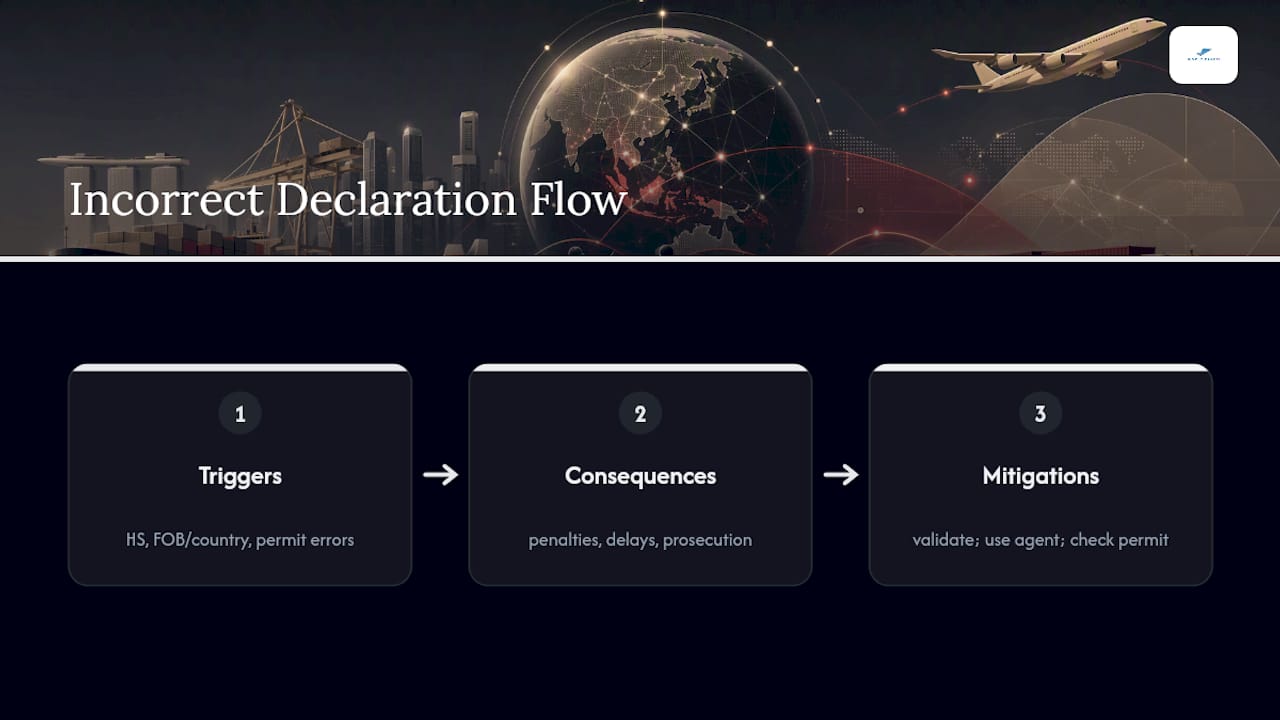
Run a validation check on your HS code and declared values before submission, use an experienced Declaring Agent if you're unsure of the process, and double-check that your permit code matches the actual shipment before it leaves the warehouse.
Your One-Page Export Permit Checklist
Use this as a quick pass before any shipment leaves Singapore.
- Register your UEN and activate your TradeNet Customs Account.
- Run the HS/CA Product Code Checker and secure any Competent Authority approvals needed.
- Prepare your commercial invoice, BL/AWB, and packing list.
- Appoint or register a Declaring Agent if you're not submitting yourself.
- Confirm you've selected the correct TradeNet permit code.
- Submit before export, with extra lead time for strategic goods.
- Present your permit number and documents at the checkpoint or courier handover.
- Retain all documents for post-departure audit requests.
| Stage | Key task |
|---|---|
| Pre-export | UEN, Customs Account, HS/CA check, documents ready |
| At lodgement | Correct permit code, valid permit, documents on hand |
| Post-export | Retain records, follow up on any LOU submissions |
A Practical Take on Permit Complexity
The permit system itself isn't the obstacle most exporters run into. It's the assumption that "small shipment" means "simple paperwork." A single mislabeled HS code on a modest parcel can trigger the same hold as a container load, because Singapore Customs doesn't scale its scrutiny to shipment value. What actually separates a smooth export from a stuck one is preparation done in the right order: UEN and Customs Account first, HS code check second, permit code selection third. Skip that sequence and you're troubleshooting at the checkpoint instead of at your desk.
Businesses that export strategic or controlled goods regularly should also look at Strategic Trade Scheme registration, since it centralizes controls and can shorten repeated permit lead times once your internal processes are established. It's not a shortcut around compliance, it's a way to stop repeating the same CA conversation every quarter.
— Simply
Let Simplyparcel Handle the Paperwork While You Handle the Sale
Simplyparcel exists for the part of exporting that has nothing to do with your product and everything to do with getting it there. Once your export permit is sorted, Simplyparcel automatically generates shipping labels and the customs documentation your courier needs, so you're not re-entering the same invoice and packing list details across three different systems. You can compare priority, connect-plus, and economy options side by side, book a free pickup, and track the shipment in real time from one dashboard.
That said, Simplyparcel doesn't replace the parts of the process that legally require you: HS code classification, Competent Authority approvals, or a Declaring Agent for complex TradeNet submissions still need your attention or a qualified agent's. Once your permit is in hand, get a shipment quote and book your courier in minutes.
Sources
- Obtain Customs Export Permit | Singapore Customs
- Types of Export Permits | Singapore Customs
- Guide to Import, Export and Transhipment | GoBusiness