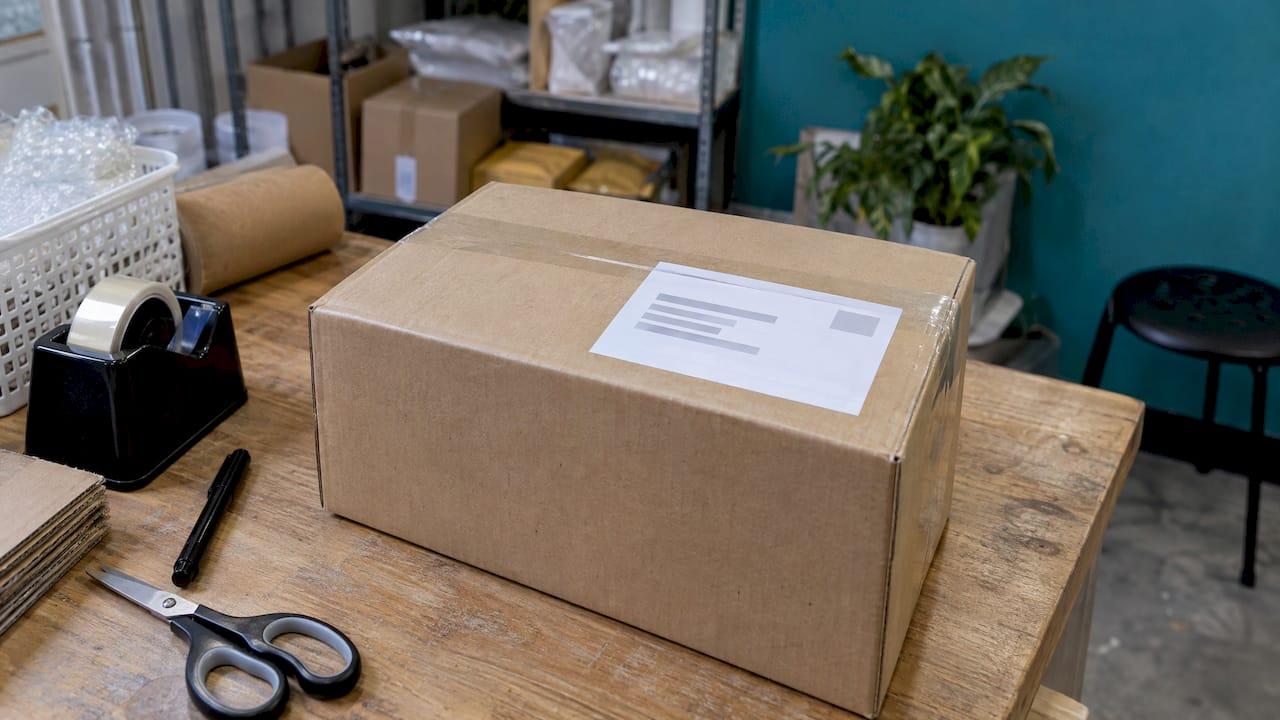
An Australian address has three to four lines. Put the recipient first, then the street address, then the suburb, state or territory abbreviation and four-digit postcode in capitals. For parcels sent from abroad, add AUSTRALIA in capitals on the last line. Get that order right and a parcel from Singapore is far less likely to be held up at sorting. We built our booking flow around this kind of detail, so below you will find the format, the rules behind it, worked examples and the mistakes that most often cause delays.
TL;DR
- Write the address in 3 to 4 lines: name, street address, then SUBURB STATE POSTCODE, then AUSTRALIA when sending from overseas.
- The last line holds the locality in capitals, the state or territory abbreviation in capitals and a four-digit postcode, with no punctuation.
- Units go in front of the street number with a slash, as in 5/45 OCEAN AVENUE. A level is written with the word LEVEL, never a slash.
- The suburb is the place name on the address, not necessarily the city. Do not add "Sydney" or "Melbourne" unless it is the locality.
- Print parcel labels in black on white, with no commas or punctuation, and keep your own sender address visibly smaller than the delivery address.
Table of Contents
- The standard Australian address layout
- Line by line: what goes where
- Suburb, not city: the mistake international senders make
- Apartments, units and levels
- How to format an Australian postcode
- Writing the address on a parcel from Singapore
- Label printing rules that stop delays
- Your return address
- Common mistakes and how to fix them
- Book your parcel to Australia with the address done for you
- Our perspective: the address is the first thing that can go wrong
- FAQ
- Sources
The standard Australian address layout
Australia Post's addressing guidelines set out a simple structure of three to four lines:
- Line 1: the recipient's name. If you need both a business name and a person's name, the business name comes first and the recipient's name next.
- Line 2: the street number and name, or a PO Box or Locked Bag number.
- Line 3: the locality (suburb), the state or territory and the postcode, all in capital letters.
- Line 4 (international mail only): the country name in capitals.
Here is a complete example for a parcel sent from Singapore:
MS JANE SMITH
5/45 OCEAN AVENUE
SURRY HILLS NSW 2010
AUSTRALIA
The last two lines matter most. Australia Post explains that its sorting technology reads addresses electronically, and the last line of the address is the one machines read directly. If the bottom line is wrong or hard to read, nothing else on the label can rescue the routing.
Line by line: what goes where
Recipient name
Write the full name of the person or business. If a parcel is addressed to a person at a company, put the business name on the first line and the person on the second, which pushes the street address to line 3. That is the one case where the layout runs to a fifth line, so keep each line short.
Street address
The house number comes before the street name, and the street type is usually abbreviated or written out in full (ST, RD, AVENUE). The Australian Style Manual shows the pattern in its own example: 11 Banks Av, then the locality on the line below. For a PO Box or Locked Bag, write the box type and number on this line in place of a street. Keep the number and street on one line, and avoid adding delivery notes on the same line.
Suburb, state and postcode
The last address line must contain the locality name in upper case, the state or territory abbreviation in upper case and the postcode, with no punctuation or underlining. The Style Manual example reads WAGGA WAGGA NSW 2650, and the abbreviations it uses are the standard set: NSW, VIC, QLD, SA, WA, TAS, NT and ACT, as listed on its Australian place names page.
Leave one to two character spaces between the locality, state and postcode, as Australia Post's Correct Addressing guide advises for hand addressing. Do not put a comma after the suburb.
Country line
For items going abroad, the UPU Addressing and Postcode Manual says the destination country name must always be on the last line, in full. For Australia that is simply AUSTRALIA. The postcode stays on the suburb line, before the country line.
Suburb, not city: the mistake international senders make
In Australia the locality is the place name used for delivery, and it is often a suburb rather than the big city nearby. A Sydney address can read SURRY HILLS NSW 2010 without the word Sydney appearing anywhere. If you add "Sydney" as an extra line or inside the suburb line, you can push the address away from the format sorting systems expect.
The practical rule: copy the suburb exactly as the recipient gives it to you. If the recipient writes only "Sydney" and a street, ask them for the suburb and postcode, or look up the postcode on Australia Post's own lookup. Some suburbs share a postcode. For example, postcode 2000 is a valid delivery-area postcode covering SYDNEY, NSW, along with BARANGAROO, DAWES POINT, HAYMARKET, MILLERS POINT, PARLIAMENT HOUSE, SYDNEY SOUTH and THE ROCKS. So 2000 alone does not tell you which of those places is meant. The locality on the line must be the recipient's.

Apartments, units and levels
Unit numbers are where most formatting questions come from. Australia Post's addressing standards allow a slash to separate a flat, unit or apartment number from the street number, as in 2/17 Jones St. The slash is not used to separate a floor or level number.
| What the recipient gives you | How to write line 2 |
|---|---|
| Unit 5, 45 Ocean Avenue | 5/45 OCEAN AVENUE |
| Apartment 12, 8 King Street | 12/8 KING STREET |
| Level 7, 17 Jones Street | LEVEL 7 17 JONES ST |
| Level 3, Unit 4, 20 Park Road | UNIT 4 LEVEL 3 20 PARK RD, kept on one line if it fits in 40 characters |
The last row combines the two rules above, so check that the recipient agrees with how you have written it before you print the label. Never write 7/17 Jones St to mean level 7, because the system will read 7 as a unit number.
How to format an Australian postcode
Australian postcodes have four digits. The UPU's Australia addressing document states that the postcode sits to the right of the state abbreviation. So the order on the last line is always locality, state, postcode:
MELBOURNE VIC 3000
A few points that save trouble:
- Leading zeros matter. Some Australian postcodes begin with 0, for example in the Northern Territory. If you type the postcode into a spreadsheet, make sure the zero is not dropped.
- Postcodes belong to localities, not whole cities. A large city has many postcodes.
- Is 2000 a real postcode? Yes. It is the postcode for the Sydney central business district, as shown on Australia Post's lookup for 2000.
- Pre-printed boxes. If you use an envelope with four pre-printed postcode squares, Australia Post still asks that the postcode appear in the address on the same line as the suburb and state, so machines can read it.
Writing the address on a parcel from Singapore
When the parcel leaves Singapore, two extra rules apply. First, the country goes on the last line, in full and in capitals. Second, spell out anything that could be confused. The Style Manual notes that for overseas mail all names in the address should be spelled out in full, because "SA" could mean South Australia or South Africa. In practice, the state abbreviation stays as the standard abbreviation, but the country line removes any doubt, so never skip it.
A full label for a business recipient looks like this:
HARBOUR TRADING PTY LTD
ATTN ALEX NGUYEN
LEVEL 7 17 JONES ST
ULTIMO NSW 2007
AUSTRALIA
Also add the recipient's phone number in the shipment details when you book. Couriers often need it for delivery, though it does not go on the address block itself.
Label printing rules that stop delays
A correct address can still be rejected by a sorting machine if it is printed badly. Australia Post's Parcel and Freight Preparation Guide sets these requirements for parcel labels:
- Black ink on a white label.
- No bold, underline or italics.
- Suburb and state capitalised, with the postcode on the last line.
- No commas or punctuation.
- The "Deliver to" address in Arial 12pt, and the sender address in Arial 10pt, visibly smaller.
The same guide explains that addresses in the standard format let sorting machines validate Australian addresses and generate a barcode that carries routing information to the individual address, not just the postcode. It also warns that labels not matching the standard may not be easily read by machines, which could delay delivery.
The UPU document adds technical limits: a maximum of 40 characters per line, characters between 1.8 and 7 mm high, and the last two lines in upper case. It also notes Australia Post prefers fixed-width fonts such as Courier 12, and that punctuation should be avoided except in the name line because it can interfere with optical character recognition.
If you write by hand, Australia Post advises using a blue or black pen, capital letters, no punctuation and no highly stylised characters.
Placement matters too. The same guide puts the address zone at least 40 mm from the top edge of an envelope and at least 15 mm from the bottom edge. For a parcel, stick the label flat on the largest face, with no folds across the address. Our guides on how to attach a shipping label so it scans and the shipping label requirements list walk through placement and what else belongs on the label.
If your parcel contains lithium batteries, the label question goes beyond the address. Read up on battery shipping label marks to see which mark your package needs before you print.
Your return address
The sender's details are part of a correct label. On an envelope, Australia Post's Addressing an envelope guide says to write the return address neatly at the top of the seal flap: your name, street address, then suburb and state or territory in capitals, and the postcode. The Correct Addressing document also allows the top left-hand corner or the back of the envelope. Australia Post's PreSort Letters guide prefers the top left-hand corner, no more than 40 mm from the top edge.
For a parcel leaving Singapore, your return address is your Singapore address, written in the same clean style as the delivery address and smaller. If you want the equivalent rules for another market, see our guide to the four-line U.S. address format or the Japanese address format templates.
Common mistakes and how to fix them
| Mistake | Why it causes trouble | Fix |
|---|---|---|
| Adding a comma after the suburb | Punctuation can interfere with machine reading | Write SURRY HILLS NSW 2010 with no commas |
| Using the city instead of the suburb | The locality is the delivery place, and many addresses never mention the city | Copy the recipient's suburb exactly |
| Writing a level with a slash (7/17 Jones St) | The slash means a unit, not a level | Write LEVEL 7 17 JONES ST |
| Placing the postcode on its own line | The last line is the one machines read | Keep suburb, state and postcode together |
| Leaving off the country | Overseas items need the destination country on the last line | Add AUSTRALIA in capitals |
| Small, light or decorative fonts | Hard for scanners to read | Black on white, plain font, 12pt |
Book your parcel to Australia with the address done for you
Once you have the address right, the rest is booking. On Simply Parcel you can compare shipping options from Singapore, book online and have the parcel collected from your doorstep at no charge. The platform generates your shipping label and customs documentation automatically, and you can follow the shipment with real-time tracking. You choose between Priority, Connect Plus and Economy shipping depending on how urgent the parcel is and what you want to spend.

To see the options for your parcel, get a shipping quote or view the Priority, Connect Plus and Economy services. If you sell online, our guide to creating a shipping label online shows how labels and customs paperwork fit together.
Our perspective: the address is the first thing that can go wrong
Most delays on international parcels start before the courier ever touches the box. A suburb typed in the wrong place, a unit number turned into a level, a missing country line: each one is small, and each one is easy to avoid when the address is checked at the start.
That is why we put the address, the label and the customs paperwork in one booking flow. You enter the details once, and the platform generates the shipping label and documentation for you, so you are not retyping the address into separate forms. Pickup is free at your door, and tracking lets you see where the parcel is after it leaves.
Our advice for anyone sending to Australia is simple. Ask the recipient to send their address exactly as it appears on their own mail. Copy the suburb, the state and the four-digit postcode as written. Then book through one platform that compares the courier options for you, so speed and budget are your only decisions.
SP
FAQ
What is the correct Australian address format?
Use three to four lines: the recipient's name, the street address, then the suburb, state or territory abbreviation and postcode in capitals. For mail from overseas, add AUSTRALIA in capitals on the last line. Do not use commas or other punctuation in the address.
Is 2000 a postcode in Australia?
Yes. Australia Post lists 2000 as a valid delivery-area postcode covering SYDNEY, NSW and nearby localities such as THE ROCKS and HAYMARKET. Write it after the state, as in SYDNEY NSW 2000.
How do I write an apartment number in an Australian address?
Put the unit or apartment number before the street number and separate them with a slash, for example 5/45 OCEAN AVENUE. Australia Post does not allow the slash for a floor or level, so write LEVEL 7 17 JONES ST in that case.
How do I address a postcard to Australia?
Use the same layout as a letter or parcel: name, street address, then SUBURB STATE POSTCODE, and AUSTRALIA on the last line. Keep the writing clear, use a blue or black pen and avoid punctuation, as Australia Post advises for hand addressing.
Where does the return address go?
On an envelope, write it at the top of the seal flap or in the top left-hand corner. On a parcel label, show your sender address in a visibly smaller size than the delivery address.
Sources
- Addressing guidelines, Australia Post
- Appendix 1: Correct Addressing Standards, Australia Post
- Correct Addressing, Australia Post
- Parcel and Freight Preparation Guide, Australia Post
- Australia Post addressing standards (1999)
- Addressing an envelope, Australia Post
- PreSort Letters service guide, Australia Post
- Postcode 2000, Australia Post
- Australia addressing unit, Universal Postal Union
- Addressing and Postcode Manual, Universal Postal Union
- Australian place names, Style Manual