
For most Singapore-to-U.S. shippers, Simplyparcel is the recommended pick: it gives you instant multi-carrier quotes, free pickup scheduling, and end-to-end tracking from a single Singapore-based platform. If you need parcel-keeper.com.my alternatives that actually cover international routes to the United States, the practical shortlist breaks down into five solution types: multi-carrier booking platforms (like Simplyparcel), national express carriers, postal/economy services, hybrid economy services, and regional carriers. Your choice among them comes down to four factors: pricing flexibility, U.S. coverage, tracking visibility, and customs handling. Get an instant quote to see live rates before reading further.
Table of Contents
- How do the top alternatives compare for Singapore → U.S. shipments?
- How do you choose the right option for your parcel?
- Why a multi-carrier strategy saves you money on U.S. shipments
- Why Simplyparcel is the recommended pick for most Singapore shippers
- How to reproduce this comparison yourself
- Key Takeaways
- What logistics teams actually look for when picking a carrier
- Simplyparcel: compare and book your Singapore → U.S. shipment in minutes
- Useful sources and further reading
How do the top alternatives compare for Singapore → U.S. shipments?
The table below maps each solution type against the criteria that matter most for international parcels. No single type wins on every dimension.
| Solution type | Best for | Pricing model | Transit to U.S. | Singapore pickup/drop-off | Tracking | Customs support | Insurance/claims | Integrations | Support |
|---|---|---|---|---|---|---|---|---|---|
| Multi-carrier booking platform | Mixed weights, e-commerce sellers | Aggregated rates; surcharges itemized | 3–10 business days (varies by carrier selected) | Free pickup or drop-off points via partner network | Aggregated dashboard across carriers | Document generation included | Platform-level cover; claims via platform | API, CSV, Shopify | Local SG support |
| National express carrier | Time-sensitive, high-value B2B | Published retail + account discounts; fuel surcharge separate | 2–5 business days | Scheduled pickup or service centers | Detailed scan events | Full customs brokerage available | Declared-value cover; direct claims | ERP/API | global |
| Postal/economy service | Lightweight parcels, non-urgent | Lowest base rate; limited surcharges | 7 business days | Post office drop-off | Basic milestones only | Sender-completed forms | Limited; long claims windows | Minimal | Standard hours |
| Hybrid economy service | Non-time-sensitive, cost-sensitive | Mid-range; final-mile surcharges vary | 8 business days | Drop-off at partner hubs | Partial; handoff gaps possible | Basic | Moderate; claims SLA varies | Some API | Business hours |
| Regional carrier | Intra-Asia or short-haul only | Zone-based; surcharges on remote areas | Not direct to U.S. | Good SG coverage | Good regionally | Limited for U.S. customs | Basic | Varies | Regional hours |
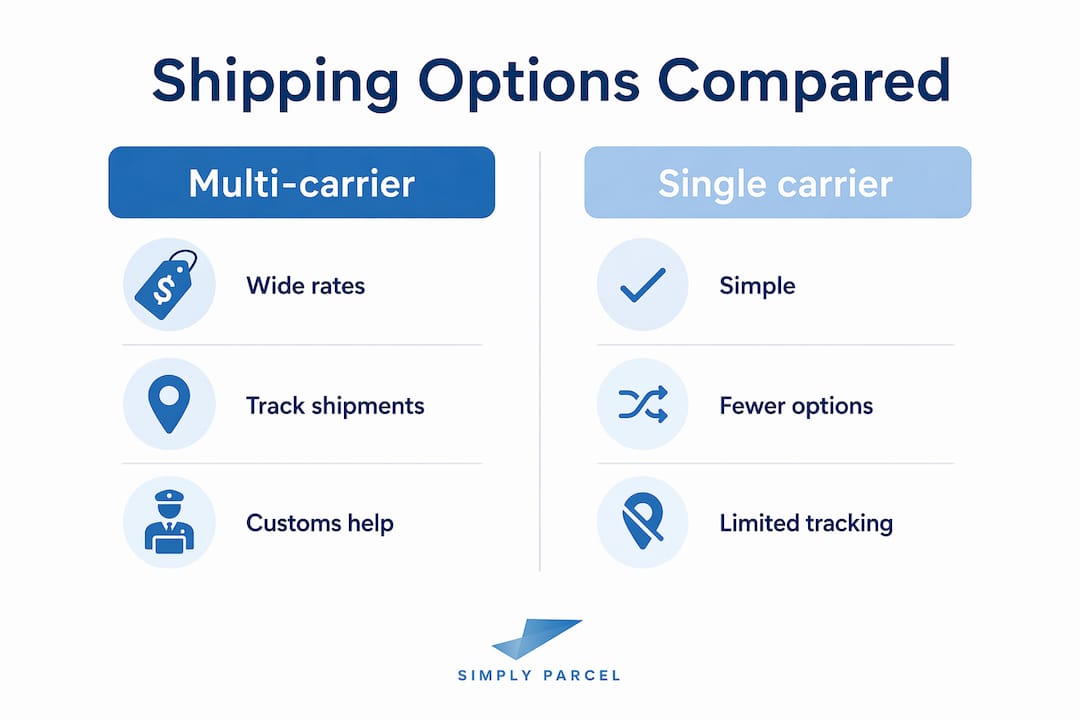
Pros and cons in brief: Multi-carrier platforms give you the widest rate comparison but require you to manage documentation carefully. National express carriers offer speed and reliability at a premium. Postal/economy options are the cheapest for light parcels but sacrifice predictability. Hybrid economy services lower cost by mixing private line-haul with postal final mile, which works well for non-urgent shipments. Regional carriers are strong within Asia but are not a direct route to the U.S.
Typical cost and transit ranges for Singapore → U.S.
| Parcel weight | Economy (postal) | Hybrid economy | Express (national carrier) |
|---|---|---|---|
| 0.5 kg | Lower base rate | Mid-range | Higher base rate |
| 2 kg | Low | Mid | High |
| 10 kg | Moderate | Mid-high | Premium |
| 25 kg | Negotiated | Negotiated | Account rate |
Exact figures vary by carrier, account status, and destination ZIP zone. Request a full landed-cost breakdown for each weight tier before committing.
Pro Tip: Ask every provider to quote the same parcel weight, dimensions, and destination ZIP code. Without identical inputs, you cannot compare rates fairly.
How do you choose the right option for your parcel?
Start with one decision rule: pick the solution type that matches your dominant constraint. Speed-first? Go express. Cost-first on light parcels? Postal or hybrid economy. Reliability across mixed weights? A multi-carrier platform.
Ten questions to ask when getting quotes:
- What is the total landed cost, including fuel surcharge, residential surcharge, and remote-area fee?
- What are the exact pickup windows available in Singapore?
- Are customs brokerage fees included, or billed separately on delivery?
- What is the declared-value insurance limit, and what does it exclude?
- What is the claims resolution SLA (days to settlement)?
- Can you provide sample transit times to a metro ZIP (e.g., 10001), a suburban ZIP, and a remote ZIP?
- Is cubic/dimensional weight pricing applied, and at what divisor?
- At what volume threshold do account discounts activate?
- What integration options exist (API, CSV, Shopify plugin)?
- Is tracking event data available at every carrier handoff, including final-mile?
Red flags to watch for: no published surcharge schedule; tracking that shows only two or three scan events for an international shipment; claims windows longer than 30 days; no customs documentation support for U.S. entry.
When requesting sample quotes, use these exact inputs: parcel dimensions (L × W × H in cm), gross weight in kg, declared value in SGD, origin postal code in Singapore, and destination U.S. ZIP code. This makes every quote comparable on a per-parcel landed-cost basis.

Pro Tip: Request a historic transit-time sample for your specific Singapore postal code to your target U.S. ZIP. Averages hide outliers; a 90th-percentile transit time tells you what your worst-case customer experience looks like.
Why a multi-carrier strategy saves you money on U.S. shipments
Relying on a single provider is the most common and most expensive mistake Singapore shippers make. Rate structures shifted in 2026, and no single carrier is cheapest across every weight band and U.S. destination. Rate variability by weight and lane means the "cheapest" option for a light parcel to New York is often a different carrier than the best option for a heavier parcel to rural Montana.
A practical playbook has four steps: define your service targets (maximum acceptable transit time and minimum tracking events), score your shortlisted carriers by cost and on-time rate for your actual weight profile, assign routing rules by weight and destination type, then automate selection via a platform API or CSV upload rules. This is not complex to set up; most multi-carrier platforms handle the routing logic once you input your rules.
Here is how the routing logic works in practice. For a 0.5 kg personal parcel going to a metro U.S. ZIP with no urgency, a postal/economy route is usually the right call: the base rate is low, and the recipient is not waiting on a deadline. For a 10 kg e-commerce order going to a suburban ZIP with a 5-day delivery promise, a national express carrier or a hybrid economy service with a tracked handoff is the better fit, because the cost difference over postal is justified by the reliability and tracking density.
Retailers who layer regional carriers and postal-economy options under a national carrier contract report shipping spend reductions of 8–12% when the routing is managed by a shipping platform.
Tracking data is not just for customer notifications. Modern tracking platforms score carrier performance by on-time rate and cost per kilometer, giving you the data to flag underperforming lanes and re-route future parcels before problems compound. Tools like Trackora provide API access, Shopify integration, and carrier performance dashboards that make this analysis routine rather than manual. Learn more about multi-carrier shipping mechanics before you set up your routing rules.
Pro Tip: Run a quarterly transit-time audit by lane. Pull your tracking data, calculate the 90th-percentile delivery time per carrier per destination zone, and replace any lane where actual performance consistently exceeds your stated SLA.
Why Simplyparcel is the recommended pick for most Singapore shippers
Simplyparcel is a Singapore-based shipping aggregator that gives you instant quotes from multiple carriers, free pickup scheduling, customs documentation support, and a single tracking dashboard, all from one platform. For individual consumers and small e-commerce sellers, that combination removes the need to manage separate accounts with each carrier.
Core features:
- Instant quote engine comparing multiple carriers simultaneously
- Free pickup scheduling from your Singapore address
- Automatic generation of shipping labels and customs documentation
- Aggregated tracking dashboard covering all booked shipments
- Insurance options with claims handled through the platform
- CSV and shopping-cart integrations for e-commerce sellers
- Local Singapore customer support
Simplyparcel serves three main use cases: individual consumers sending personal parcels abroad, small e-commerce sellers with mixed weight profiles who need rate flexibility, and businesses that want single-pane booking across multiple carriers without managing individual carrier contracts. You can review the platform's partner carriers and service levels on the about page.
Simplyparcel's platform covers priority, connect-plus, and economy service levels, so you can match the shipping speed to the parcel's urgency and budget without switching platforms.
At booking time, you enter parcel dimensions, weight, declared value, and destination ZIP. The platform returns itemized quotes, you select a service level, and pickup is scheduled. The documentation checklist is generated automatically, which reduces the risk of customs delays at U.S. entry.
How to reproduce this comparison yourself
The comparison above used four representative parcel weights (0.5 lb, 2 lb, 10 lb, and 25 lb) and three U.S. destination types: metro (ZIP 10001), suburban (ZIP 60601), and remote (ZIP 59801). Each quote was requested at economy, standard, and express service levels.
Steps to reproduce:
- Gather your parcel's gross weight (kg), dimensions (cm), declared value (SGD), and HS code if applicable.
- Request quotes from at least three providers using identical inputs.
- Ask each provider to itemize: base rate, fuel surcharge, residential/remote surcharge, customs brokerage fee, insurance premium, and expected transit window.
- Convert all quotes to total landed cost per parcel.
- Normalize by dividing total landed cost by parcel weight (SGD/kg) to compare across weight tiers.
Sample quote request template:
| Field | Your input |
|---|---|
| Origin postal code | Your SG postal code |
| Destination ZIP | Target U.S. ZIP |
| Gross weight | e.g., 2 kg |
| Dimensions (L × W × H) | e.g., 30 cm |
| Declared value | e.g., SGD |
| Service level requested | Economy / Standard / Express |
| Breakdown requested | Base rate, fuel surcharge, residential surcharge, remote surcharge, customs fee, insurance, transit window |
Carrier cost-performance varies by weight band: lightweight parcels often favor postal-economy, while heavier B2B shipments tend to favor negotiated national express accounts. Account discounts and dimensional weight pricing can flip the cost equation entirely, which is why automated rate shopping via a platform is standard practice for mid-market shippers.
Pro Tip: Always request commercial pricing, not retail pricing. The gap between the two can be significant for heavier parcels, and most platforms pass negotiated rates directly to you.
Key Takeaways
Simplyparcel is the most practical starting point for Singapore shippers sending parcels to the U.S., combining multi-carrier rate comparison, free pickup, and customs documentation in one platform.
| Point | Details |
|---|---|
| Multi-carrier strategy saves money | Layering carriers by weight and lane can reduce total shipping spend by 8–12%. |
| Always compare total landed cost | Request base rate, fuel surcharge, residential fee, customs fee, and insurance as separate line items. |
| Tracking is a routing tool | Use carrier on-time data to flag underperforming lanes and adjust routing before problems repeat. |
| Red flags to avoid | No published surcharges, sparse tracking events, and claims windows over 30 days are signs to look elsewhere. |
| Simplyparcel for easy comparison | Get an instant quote to compare carriers, schedule pickup, and generate customs documents in one booking. |
What logistics teams actually look for when picking a carrier
From an operational standpoint, the carrier selection decision is rarely about finding the single best option. It is about building a routing matrix that holds up under real conditions: volume spikes, customs holds, and the occasional lost parcel. Cost matters, but transit reliability and claims resolution speed matter just as much, because a delayed or lost parcel costs more in customer service time than the shipping fee itself.
Logistics teams run three routine checks that most individual shippers skip: a quarterly transit-time audit by lane (pulling 90th-percentile delivery times, not averages), a claims-resolution test (submitting a small test claim to measure actual settlement time against the stated SLA), and an invoice audit (comparing billed surcharges against the quoted schedule). These checks catch the hidden costs that make a "cheap" carrier expensive in practice. Using tracking analytics for smarter shipping is what separates teams that control their shipping costs from those who just accept the invoice.
One practical example: routing all sub-1 kg parcels through a postal-economy channel while keeping express slots for time-sensitive orders reduced per-parcel cost on the light-weight lane without touching the service level for priority shipments. The savings on the light lane funded the express premium on the urgent lane.
Simplyparcel: compare and book your Singapore → U.S. shipment in minutes
Simplyparcel gives Singapore shippers something no single carrier can: a side-by-side rate comparison across multiple carriers, with free pickup, automatic customs documents, and a single tracking dashboard, all in one booking flow. You enter your parcel details once, see itemized quotes by service level, and schedule pickup without calling anyone.
- Compare multiple carriers at once with a single set of parcel inputs
- Free pickup from your Singapore address, no minimum volume required
- Customs documentation generated automatically at booking
- Single invoice covering all carriers and shipments
- Local Singapore support available when you need it
Get your instant shipping quote now, or visit simplyparcel.sg to see service levels, transit timelines, and partner carriers before you book.
Useful sources and further reading
Use these sources to validate the claims in this article and run your own carrier checks.
- Simply Parcel about page: Platform capabilities, partner carriers, and service levels for Singapore-based shippers.
- 2026 shipping carrier comparison for U.S. retailers: Documents 2026 rate changes, multi-carrier strategy rationale, and the 8–12% spend-reduction finding for layered carrier approaches.
- UPS vs USPS vs FedEx: 2026 costs and performance data: Weight-band cost comparisons and account-discount analysis; use this when normalizing quotes by weight tier.
- Trackora carrier performance platform: Carrier on-time scoring, route history, and API integrations (Shopify, SAP, Salesforce) for automating multi-carrier routing decisions.
- 17TRACK Package Tracker: Consumer-facing multi-carrier tracker supporting thousands of carriers; useful for monitoring international shipments where the final-mile provider changes by country.
- Parcels App universal tracker: Auto-detects carriers from tracking numbers and consolidates events across handoffs, helpful for international routes with multiple carrier legs.
When contacting any carrier or platform, use the sample quote template from the methodology section above. Identical inputs are the only way to make rate comparisons reliable.