
ISPM 15 compliance means your wood packaging is debarked, treated with an approved method, and carries a legible ISPM 15 mark showing the country code, facility number, and treatment code. Heat treatment (56°C at the core for 30 continuous minutes) is the most widely used method. Skip any of these three elements and customs authorities can hold, treat, re-export, or destroy your shipment on arrival.
TL;DR:
- Confirm that the wood packaging is debarked, heat-treated at 56°C for 30 minutes, and bears a clear, legible ISPM 15 mark with correct components.
- Ensure the packaging materials are made from processed wood or fall under exemptions like thin wood, shown to eliminate pests during manufacturing.
- Verify treatment records, facility authorization, and proper storage practices before acceptance to prevent delays at border inspections.
- Watch for red flags such as missing marks, incorrect codes, visible bark exceeding tolerance, or presence of live pests, as these can lead to shipment rejections or destruction.
- Building simple sourcing habits—requesting facility IDs, treatment proof, and proper storage details—can prevent costly delays, especially on first shipments or high-value cargo.
Table of Contents
- What ISPM 15 Wood Packaging Rules Are and Why They Exist
- Which Wood Packaging Is Covered, and What's Exempt
- Approved Treatments and What the Technical Schedules Require
- How to Read the ISPM 15 Mark Correctly
- Facility Approval and the NPPO's Role in Wood Packaging Compliance
- Inspection Red Flags and What Happens When Wood Packaging Fails
- A Practical Checklist for Sourcing and Verifying Compliant Wood Packaging
- Why ISPM 15 Compliance Is a Lead-Time Problem, Not Just a Paperwork Problem
- Sources
What ISPM 15 Wood Packaging Rules Are and Why They Exist
ISPM 15 stands for International Standards for Phytosanitary Measures Publication No. 15, issued by the International Plant Protection Convention under the United Nations Food and Agriculture Organization. It governs the wood packaging material, or WPM, that moves goods across borders: pallets, crates, boxes, drums, dunnage, and load boards.
The problem it solves is older than modern shipping itself. Raw, untreated wood carries bark beetles, wood-boring nematodes, and fungal spores that can survive an ocean crossing and establish themselves in a new country with no natural predators. The emerald ash borer and the pinewood nematode are two organisms that phytosanitary officials point to repeatedly when explaining why this standard exists. Once a pest species escapes into a forest ecosystem thousands of miles from where it evolved, eradication becomes expensive, slow, and often impossible.
Wood packaging is the perfect vehicle for this kind of accidental pest transport because it travels constantly, sits in ports and warehouses for weeks at a time, and often gets reused, repaired, or repurposed without much scrutiny. A single pallet might cross a dozen borders in its working life. ISPM 15 targets that pathway directly rather than trying to inspect every log or every finished good.
Here's what falls under the standard's scope in practice:
- Pallets used to consolidate and move cartons or crates
- Wooden crates and boxes built to hold machinery, produce, or retail goods
- Dunnage, the loose wood used to brace or wedge cargo inside containers
- Cable reels and spools made from solid wood
- Load boards and pallet collars that support stacked freight
If your shipment includes any of these made from raw softwood or hardwood, ISPM 15 wood packaging rules apply the moment that cargo crosses an international border. The standard doesn't regulate the goods inside the crate. It regulates the crate itself, treating wood packaging as a biosecurity risk independent of what it's carrying.
Which Wood Packaging Is Covered, and What's Exempt
Not every wooden item needs a stamp. The standard draws a fairly clean line based on how the wood was processed and how thick it is, and knowing that line saves exporters unnecessary treatment costs.
Processed wood products are exempt because manufacturing them already kills the pests that ISPM 15 targets. Plywood, oriented strand board, particleboard, and similar engineered materials go through heat, pressure, and adhesive bonding during production, which the explanatory document for ISPM 15 recognizes as achieving the same pest-elimination outcome as a dedicated treatment.
Beyond processed panels, several other categories sit outside the standard's reach:
- Wood 6mm thick or thinner, since pests generally can't establish themselves in material that thin
- Wooden barrels used for wine or spirits, when the manufacturing process involved heating
- Sawdust, wood shavings, and wood wool, because the milling process destroys the pathway pests use to survive
- Veneer sheets, for the same reasons that apply to plywood
Mixed-material shipping units create a common point of confusion. A crate built mostly from plywood but reinforced with solid wood corner blocks needs the solid wood components treated and marked, even though the plywood panels themselves are exempt. Treatment providers typically stamp only the components that require it, not the whole unit, so don't assume a single mark on a mixed-material crate covers everything inside it.
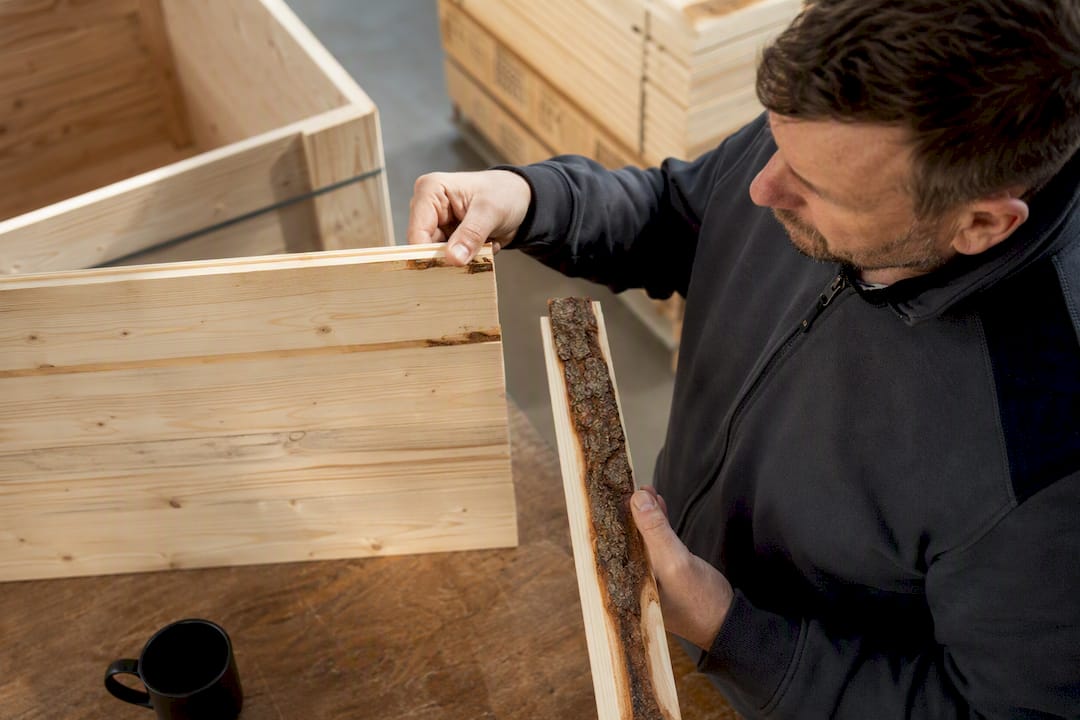
Bark tolerance is the other detail exporters routinely get wrong. ISPM 15 permits small amounts of bark to remain on treated wood under two conditions: individual bark pieces must be narrower than 3 centimeters, and any single piece wider than that is only acceptable if it covers less than 50 square centimeters total. A few small bark fragments on a pallet stringer are fine. A strip of bark running the length of a crate panel is not, regardless of what treatment was applied underneath it.
Approved Treatments and What the Technical Schedules Require
Four treatment methods satisfy ISPM 15, and each has a specific technical schedule set out in Annex 1 of the standard. Picking the wrong one for your wood dimensions or your export lane can invalidate an otherwise correctly stamped shipment.
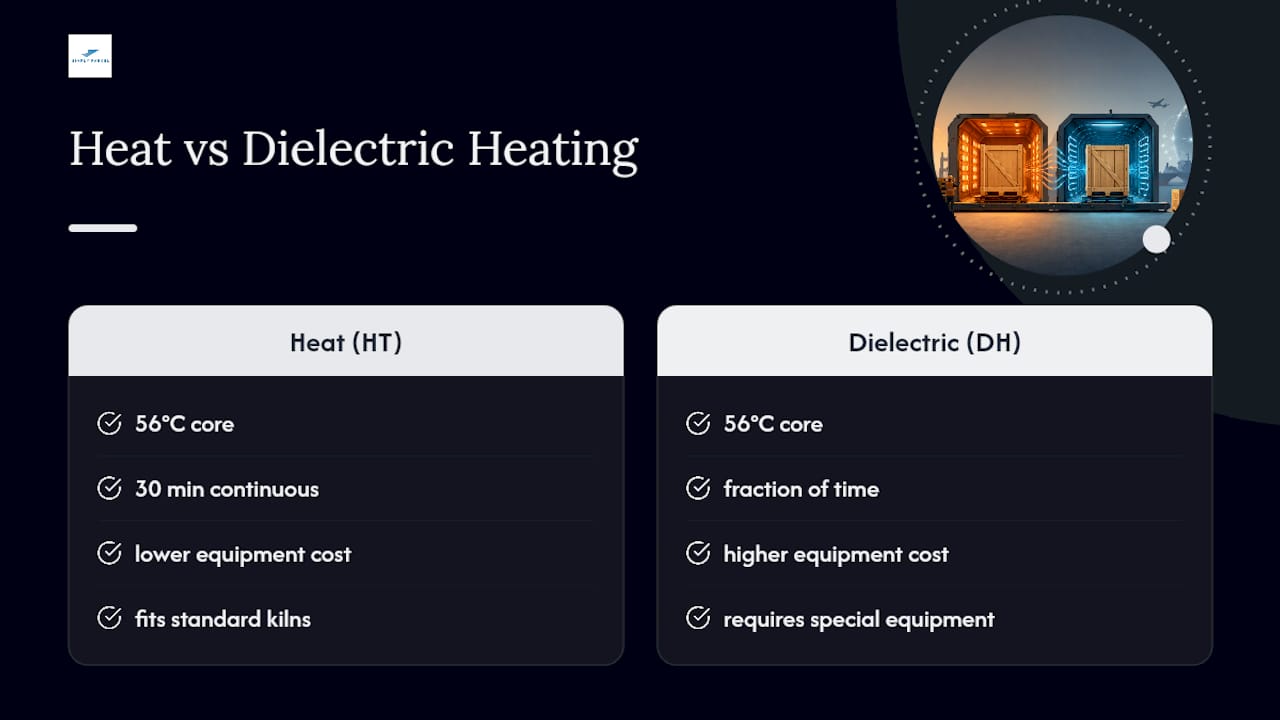
Heat treatment (HT) is the industry default, and for good reason. The wood's core temperature must reach a minimum of 56°C and hold there for 30 continuous minutes. This kills insects and larvae throughout the wood, not just on the surface, and it leaves no chemical residue behind. Heat treatment tends to be the go-to option because it's effective, doesn't raise the environmental concerns fumigation does, and fits into most facilities' existing kiln infrastructure.
Dielectric heating (DH) uses microwave or radio-frequency energy to heat wood from the inside out, reaching the same 56°C core temperature but typically in a fraction of the time a conventional kiln needs. It's less common than standard HT mainly because the equipment costs more, but it's gaining ground at high-volume facilities that need faster turnaround.
Methyl bromide fumigation (MB) works by exposing wood to a gaseous fumigant under sealed conditions for a set concentration-time schedule. It's fast, but it comes with real limitations. Methyl bromide has documented size and dimension constraints, meaning oversized timber may not fumigate evenly enough to meet the standard's requirements, and its environmental profile as an ozone-depleting substance has pushed a growing number of countries to restrict or phase it out entirely.
Sulphuryl fluoride fumigation (SF) is a more recent addition to the approved list, used as an alternative to methyl bromide where regulatory or environmental concerns rule MB out.
Treatment schedule at a glance Heat treatment requires the wood's core to sustain 56°C for at least 30 continuous minutes, verified with temperature probes placed at the wood's thickest point, not just the surface, according to Annex 1 and 2 of ISPM 15.
The detail exporters underestimate most: treatment kills the pests present in the wood at the moment of processing. It does nothing to prevent new infestation afterward. Wood treated and stamped in January can pick up new pests in March if it's stored outdoors, stacked against untreated timber, or left in a damp yard for weeks. That's why facilities are expected to keep monitoring logs and treatment records tied to each batch, and why serious exporters ask for those records rather than trusting the stamp alone.
How to Read the ISPM 15 Mark Correctly
The mark is a paperless certification. Border officials rely on it to confirm treatment without needing a separate phytosanitary certificate for every pallet in a container, which is precisely why a sloppy or fraudulent stamp causes so much trouble at inspection.
A compliant mark has four required components, and Annex 2 of the standard specifies the exact layout:
- The IPPC logo, a stylized symbol unique to this standard and instantly recognizable to inspectors worldwide
- A two-letter ISO country code identifying where the treatment took place
- A unique facility or producer number, assigned by the national authority that authorized that specific treatment provider
- A treatment code, one of HT, DH, MB, or SF, showing which method was applied
These four elements have to appear together, in a bordered box, applied directly to the wood in a location visible from at least two sides of the packaging unit. Ink stamps, branding irons, and adhesive labels are all acceptable application methods, provided the mark stays legible for the life of the packaging.
Most rejections at inspection trace back to a handful of avoidable mistakes: a stamp applied over rough or wet wood that smears into an unreadable blur, a mark missing the treatment code entirely, a facility number that doesn't match any registered provider, or a country code that doesn't correspond to where the treatment claims to have happened. Counterfeit stamps, whether intentional or copied from an old crate without authorization, are a frequent cause of holds, and inspectors have gotten better at spotting the inconsistent fonts and spacing that mark them.
Pro Tip: Photograph every stamp on every shipment before it leaves your facility, not after a customs officer flags it. A clear, dated photo showing the full mark on each unit gives you something concrete to hand a broker if a shipment gets questioned later, and it costs you thirty seconds per pallet.
The mark generally replaces the need for a separate phytosanitary certificate specific to the wood packaging itself. That said, some countries request supplementary documentation for high-risk cargo or first-time suppliers, so it's worth confirming current requirements for your specific destination before you ship.
Facility Approval and the NPPO's Role in Wood Packaging Compliance
Only facilities authorized by their country's National Plant Protection Organization, or NPPO, can legally apply the ISPM 15 mark. This authorization isn't automatic. It follows an audit process where the NPPO or a body it designates confirms the facility has the right equipment, the trained staff, and the internal controls to treat wood correctly and stamp it honestly.
Here's roughly how that oversight works in practice:
- The facility applies for authorization with its national plant protection authority, providing evidence of treatment equipment and staff training.
- The NPPO audits the facility, checking that heat treatment chambers reach and hold the required temperatures, that monitoring equipment is calibrated, and that recordkeeping systems track each treated batch.
- Approved facilities get added to a national register, and the NPPO issues them a unique facility identification number for use in the ISPM 15 mark.
- Ongoing compliance gets checked periodically, since authorization isn't a one-time credential. Facilities that fail to segregate treated from untreated wood, or that stamp material they haven't actually treated, risk losing their authorization.
Approved facilities are expected to physically separate treated stock from untreated stock on the yard floor, since mixing the two defeats the entire purpose of the treatment. They're also expected to keep batch-level records tying each treated shipment to a specific chamber run, temperature log, and date, so that a facility number stamped on a crate in Rotterdam can be traced back to an actual documented treatment cycle if anyone ever questions it.
If you're sourcing packaging from a new supplier, ask for three things before you commit: their facility identification number, a copy of recent authorization or audit confirmation from their NPPO, and treatment records for the specific batch supplying your order. You can cross-check a supplier's home country authority through the IPPC's list of national plant protection organizations if you want to verify the authorizing body actually exists and is active.
Inspection Red Flags and What Happens When Wood Packaging Fails
Customs and biosecurity inspectors are trained to spot a fairly consistent set of problems, and knowing them in advance lets you catch issues before a shipment ever reaches a border checkpoint.
The most common red flags include:
- A missing or illegible ISPM 15 mark, or one with an incomplete set of the four required components
- Visible bark exceeding the tolerance limits, particularly wide strips rather than small fragments
- Live insects, larvae, or exit holes visible on the wood surface
- Wet, moldy, or clearly untreated timber mixed into an otherwise compliant load
- Mismatched documentation, where the mark's country or facility code doesn't align with the paperwork accompanying the shipment
When an inspector flags a shipment, national authorities such as APHIS in the United States generally have three courses of action available: order on-arrival treatment of the wood packaging, require re-export of the noncompliant material back to its country of origin, or mandate destruction if treatment or return isn't feasible. In the US, these determinations often arrive as an Emergency Action Notification, which typically urges the importer to arrange one of those remedies promptly before the shipment incurs storage fees or further penalties.
If your shipment gets flagged, move fast. Pull together every treatment record and facility document you have for that batch, contact your customs broker or freight forwarder immediately, and notify the consignee so they understand the delay isn't on your end of the paperwork. A quick, organized response can sometimes downgrade an inspection from a destruction order to a same-day on-site treatment, which is a very different cost outcome.
A Practical Checklist for Sourcing and Verifying Compliant Wood Packaging
Compliance problems almost always trace back to a shortcut taken weeks before the shipment ever reached a port. Building a few verification habits into your sourcing process catches most of them early.
Before you accept a wood packaging order from any supplier, run through this sequence:
- Request the facility's authorization number and confirm it against their NPPO's published register rather than taking the supplier's word for it.
- Ask for clear photographs of the actual stamp on the batch you're receiving, not a generic sample image from the supplier's catalog.
- Get treatment records for that specific batch, including the date and the treatment method used, and check the code matches what's stamped on the wood.
- Confirm the supplier segregates treated and untreated stock in their yard, since cross-contamination after treatment is a real and common failure point.
- Add a compliance clause to your purchase contract, stating explicitly that all wood packaging must meet ISPM 15 requirements and that the supplier bears responsibility for remediation costs if it doesn't.
Storage matters just as much as sourcing. Treated wood sitting outdoors in humid conditions, or stacked directly against untreated pallets, can pick up new pests despite a perfectly valid stamp. Keep treated packaging dry, elevated off bare ground, and physically separated from anything unmarked. This importer's checklist on avoiding packaging delays covers additional handling steps worth building into your warehouse procedures.
Reuse is generally fine as long as the original mark stays legible and the wood hasn't been repaired with untreated timber. The moment you patch a damaged pallet with a new, unstamped board, that unit needs re-treatment and re-marking before it ships again. An old stamp on a crate that's been rebuilt with fresh, untreated wood is no longer telling the truth about what's actually inside that packaging.
Pro Tip: Build a simple supplier scorecard tracking facility ID, last verified audit date, and any past shipment holds. A supplier with two flagged shipments in the past year is a bigger risk than their quote suggests, even if their price is the lowest you've seen. For more on the paperwork that typically travels alongside compliant shipments, this guide to essential international shipping documentation is worth bookmarking.
Why ISPM 15 Compliance Is a Lead-Time Problem, Not Just a Paperwork Problem
Every delayed shipment we've seen tied to wood packaging traces back to the same root cause: someone assumed a stamp was there when nobody had actually checked. That assumption is the expensive part, not the regulation itself.
Compliance affects your shipment timeline well before the container reaches port. A supplier who can't produce a facility ID or a recent treatment record on request is telling you, indirectly, that verification is going to happen at the border instead of at the loading dock, and border verification is always slower and more expensive. Build the check into your booking process instead of your contingency plan.
The three habits that prevent most delays cost almost nothing: ask suppliers for their facility ID before confirming an order, request a photo of the actual stamp on the batch you're receiving, and confirm how the packaging was stored before it reached you. None of that requires legal expertise. It requires asking the question before the shipment leaves the warehouse.
Where it does make sense to bring in outside expertise is high-value cargo, first-time trade lanes, or any shipment where a hold would create serious downstream cost. A customs broker or a direct line to your destination country's NPPO earns its fee quickly the first time it prevents a container from sitting in a bonded warehouse for two weeks. If you're weighing shipping speed against packaging risk on your next booking, our shipping quote tool lets you compare priority, connect-plus, and economy options while you sort out the compliance details on your end.
— Simply
Sources
- Regulation of wood packaging material in international trade
- Import ISPM 15-Compliant Wood Packaging Material into the United States